
Starting a landscaping business can cost between $7,400 and $50,000, depending on the services you offer and the equipment you already own. A residential maintenance company requires less investment than a business installing patios or retaining walls. Your initial expenses will include equipment, business registration, insurance, and enough working capital to cover operating costs.
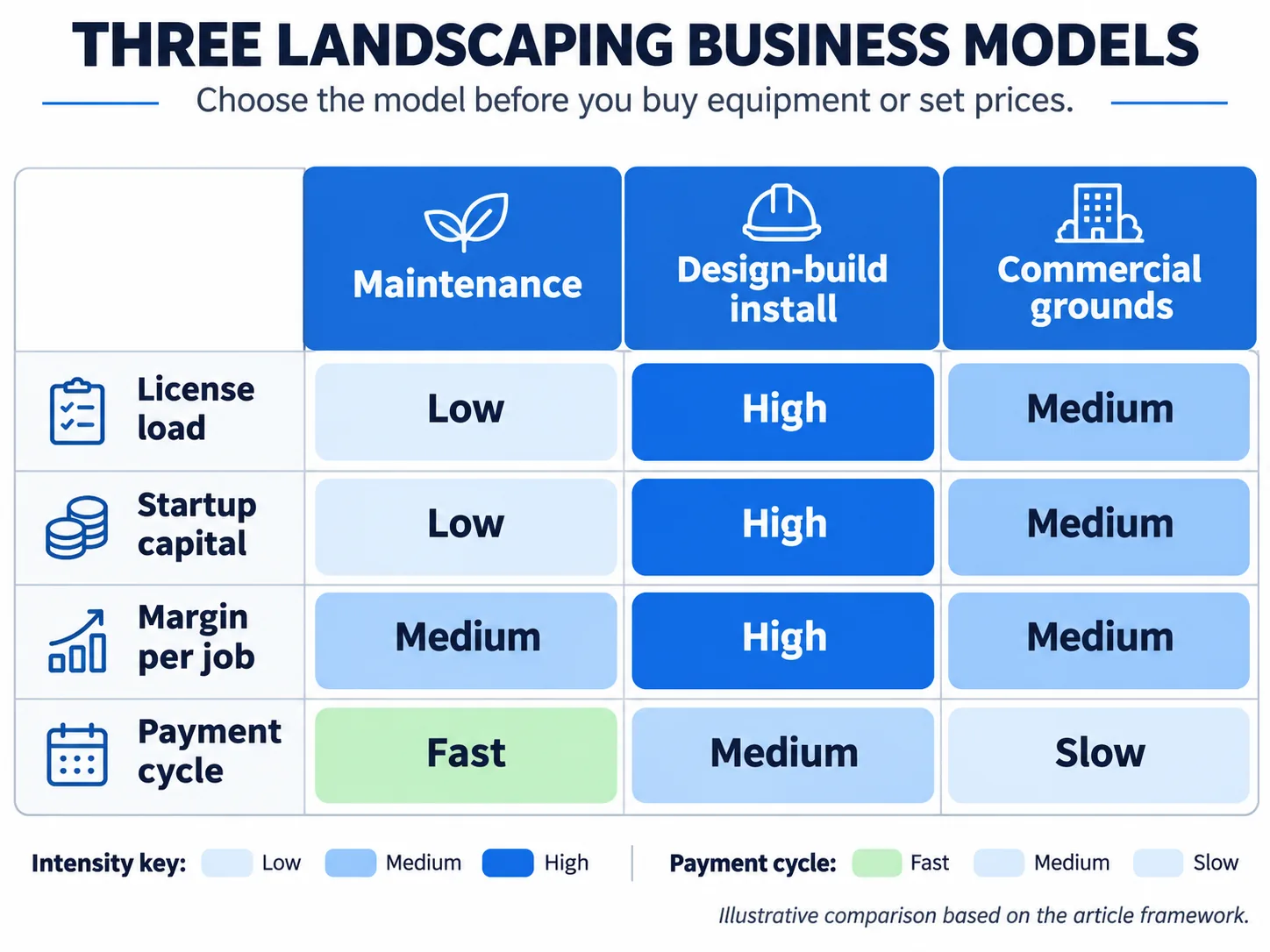
Before purchasing equipment, decide whether you want to focus on routine maintenance, landscaping installation, or commercial contracts. Each business model has different licensing requirements, operating expenses, and payment schedules. Maintenance provides recurring income, while installation projects generally have higher contract values but require more detailed estimates and greater upfront spending.
According to the Bureau of Labor Statistics, about one in five grounds maintenance workers are self-employed. Experience performing landscaping work helps, but running a company also requires accurate pricing and financial management. If your business will focus mainly on mowing, read RankBeaver's guide to starting a lawn care business.
On this page
- Decide what type of landscaping business to start
- Research landscaping demand in your area
- Calculate your landscaping business startup costs
- Register your landscaping business and obtain the required licenses
- Get landscaping business insurance
- Learn how to price landscaping jobs
- Create written landscaping quotes and contracts
- Find your first ten landscaping customers
- Manage scheduling, customer payments, and seasonal expenses
- Avoid common landscaping startup mistakes
- Getting started with your landscaping business
- Landscaping startup planning worksheet
1. Decide what type of landscaping business to start
Landscaping businesses generally fall into three categories: residential maintenance, landscape installation, and commercial property maintenance. Your choice determines which equipment you'll need, what licenses may apply, and how customers will pay. Starting with services you already know how to perform can reduce expenses while you establish your first customer accounts.
Residential landscaping and maintenance
Residential maintenance includes mowing, edging, pruning, mulching, and seasonal yard cleanups. Customers typically pay for regular visits, providing a predictable source of monthly income. These services usually require less equipment than installation work, and routine maintenance may be exempt from contractor licensing in some states.
Travel time can become a substantial expense as your customer base grows. A crew maintaining several properties within one neighborhood can complete more visits than a crew driving between distant locations. Keeping customers close together helps reduce fuel expenses and the number of paid hours spent traveling.
Landscape design and installation
Installation businesses build patios, retaining walls, irrigation systems, and other outdoor features. They may also handle planting, landscape lighting, grading, and drainage improvements. These projects generally have higher contract values, but they require more expensive equipment and additional working capital to cover materials and labor before customers make their final payments.
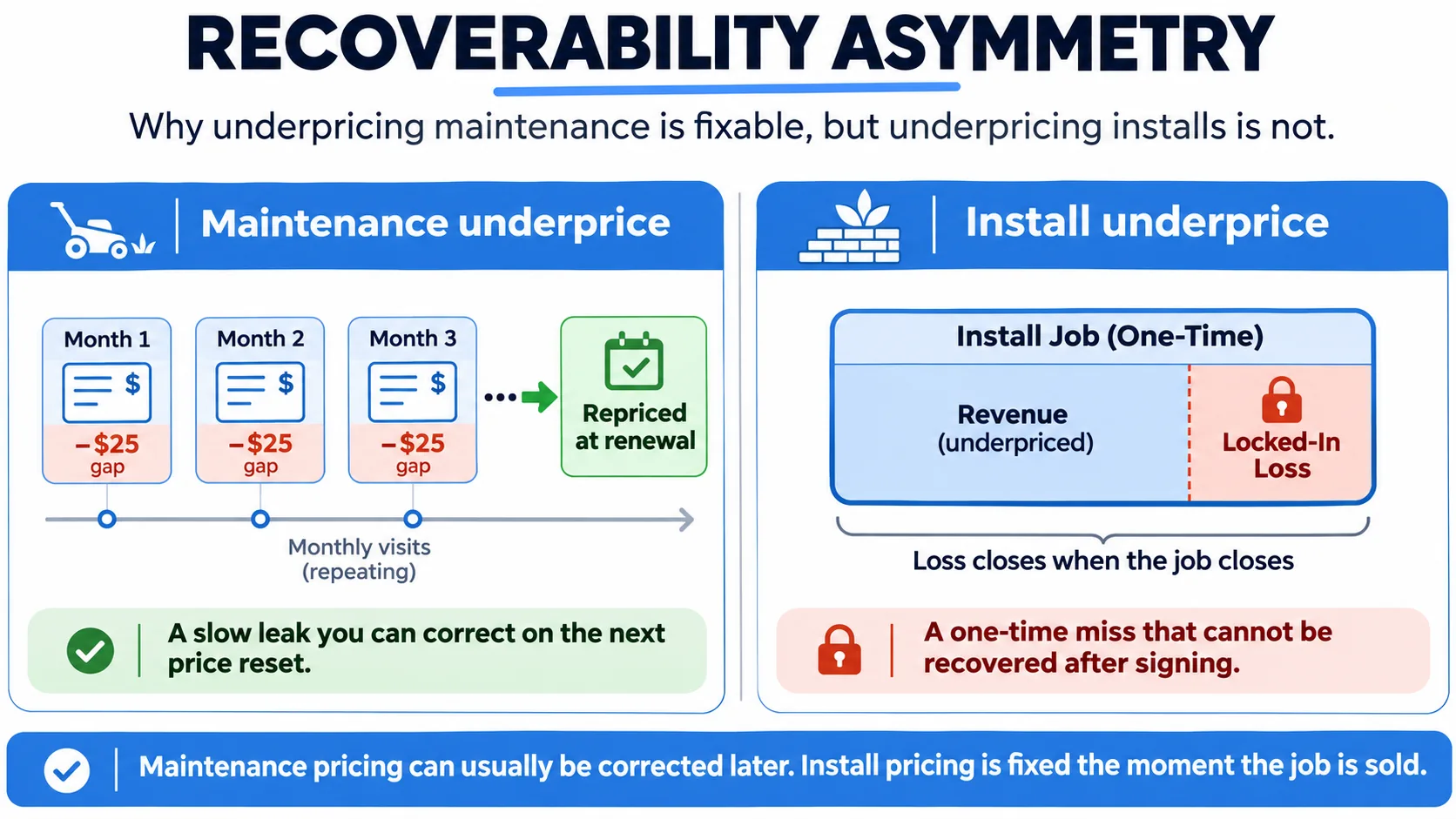
Installation work also requires accurate estimates because each project has different labor and material requirements. For example, underpricing a $40,000 patio project by 30% could create a substantial loss. Once the contract is signed, the contractor may have limited options for recovering unexpected costs that fall within the agreed scope.
Commercial landscaping
Commercial landscaping companies maintain office properties, homeowners association (HOA) communities, and properties managed by professional management firms. These contracts can provide steady revenue and may cover multiple locations under one agreement. However, contractors often compete against established companies and may need higher insurance limits to qualify for certain projects.
Commercial customers may take 30 to 60 days to pay their invoices. During that period, your company still needs to cover payroll, transportation, and equipment expenses. Make sure your working capital can support the payment terms before accepting contracts that require substantial spending between invoices.
2. Research landscaping demand in your area
Start by identifying five to eight landscaping companies serving the neighborhoods where you want to operate. Search Google for specific services followed by your city, such as "landscaping contractors in Austin" or "patio installation near me." Review the services those companies offer, the areas they cover, and any prices published on their websites.
Look for services that appear to have fewer competing providers. For example, a neighborhood may have several businesses offering routine mowing but fewer companies specializing in paver patio installations. This could be worth investigating further, although you'll still need to confirm that enough customers are interested in the service.
Check local landscaping competitors on Google
Google's local search results can change depending on where someone searches. A landscaping company appearing near the top of Google Maps in one neighborhood may have much lower visibility several miles away. Checking results from multiple locations gives you a clearer picture of the companies customers are likely to encounter.
RankBeaver's Local Search Result Checker lets you check whether a business appears for a particular search in a selected location. The Local Rank Grid displays rankings across multiple points within a service area, while the Benchmark tool helps compare businesses competing in the same market.
These tools can help you identify neighborhoods where competing businesses have stronger or weaker search visibility. Combine those findings with what you learn from competitor websites and service menus. This information can guide your initial service area and help you decide which landscaping services to promote.
3. Calculate your landscaping business startup costs
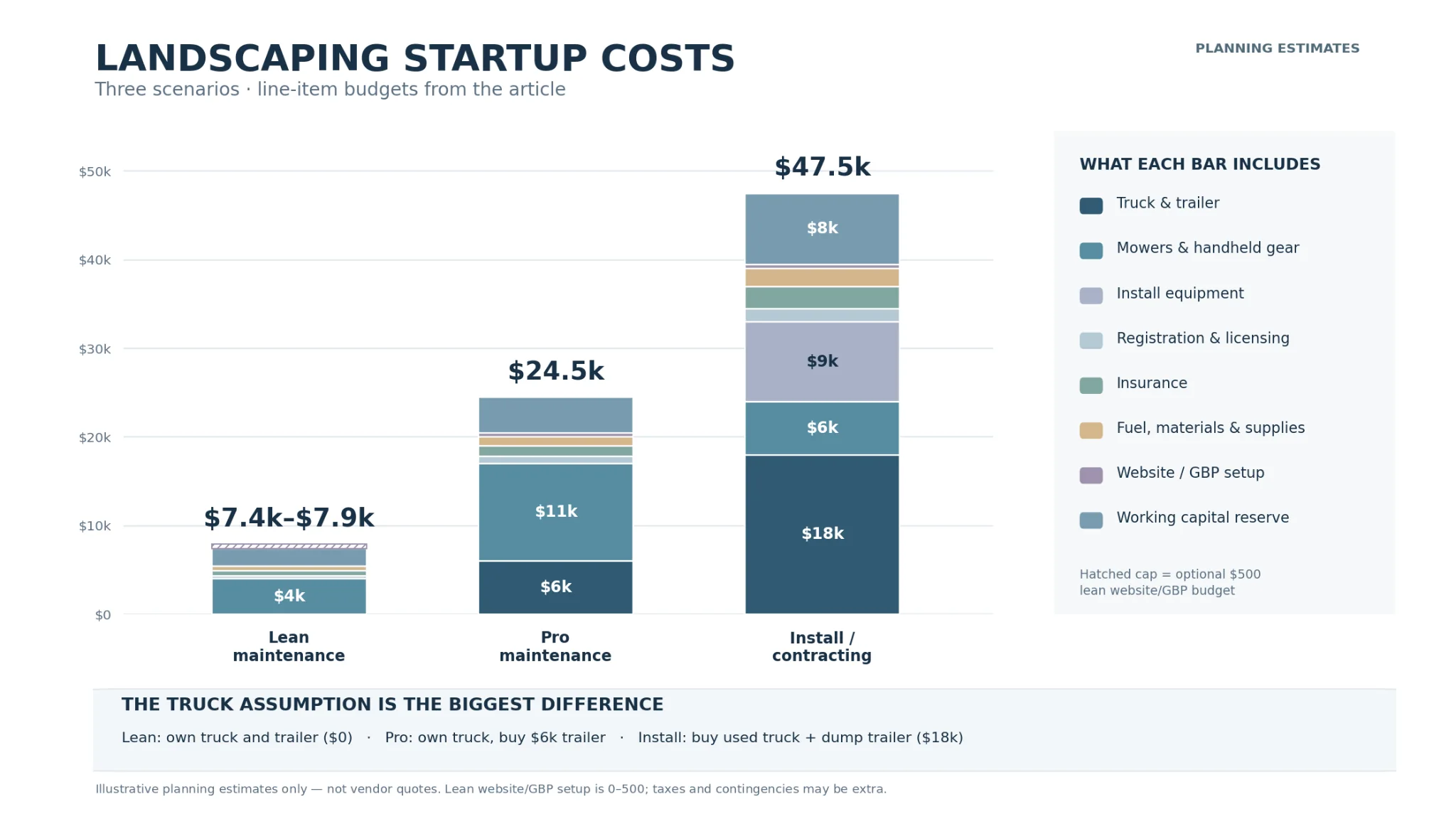
Starting a small residential maintenance business may cost approximately $7,400 if you already own a truck and trailer. A better-equipped maintenance operation could require around $24,500, while an installation company purchasing transportation and construction equipment may need approximately $47,500. These figures are planning estimates based on different equipment and operating requirements.
Your actual costs will depend on equipment prices, existing tools, registration fees, and insurance premiums in your state. Someone who already owns a mower, truck, and trailer can avoid several major purchases. A contractor starting without equipment will need a larger budget before accepting their first jobs.
Landscaping business startup cost breakdown
| Expense | Lean maintenance setup | Professional maintenance setup | Installation business |
|---|---|---|---|
| Truck and trailer | $0 (already owned) | $6,000 (used trailer, own truck) | $18,000 (used truck and dump trailer) |
| Mowers and handheld equipment | $4,000 | $11,000 | $6,000 |
| Installation equipment, including compactor and saws | $0 | $0 | $9,000 |
| Business registration and licensing | $300 | $800 | $1,500 |
| First insurance payment | $600 | $1,200 | $2,500 |
| Fuel, materials, and supplies | $500 | $1,000 | $2,000 |
| Website and Google Business Profile setup | $0–$500 | $500 | $500 |
| Working capital reserve | $2,000 | $4,000 | $8,000 |
| Estimated startup cost | $7,400–$7,900 | $24,500 | $47,500 |
Include a working capital reserve in your startup budget. This money covers expenses such as fuel, payroll, and materials before customers pay their invoices. Installation businesses especially need available cash because material purchases may be due before the first substantial customer payment arrives.
Free resource: Use the Landscaping Startup Planning Worksheet to record a startup budget, check license requirements by service, and track outreach to your first 30 prospects. It is at the end of this guide; no signup is required.
Should you buy, rent, or finance landscaping equipment?
Buy equipment that you'll use regularly enough to justify the purchase. A mower needed for daily maintenance work will usually be worth owning, while a plate compactor used only six times a year may be cheaper to rent. Consider storage costs, maintenance, and repairs when comparing ownership with rental expenses.
Financing can make sense when equipment will generate enough regular income to cover its monthly payment. Calculate how frequently you'll use the machine and how much billable work it will support. Avoid financing equipment simply because you expect the business to grow in the future.
4. Register your landscaping business and obtain the required licenses
Business registration and landscaping contractor licensing are separate requirements. You may be able to register a business and offer routine mowing services without obtaining a landscaping contractor's license. However, hardscaping, irrigation installation, and pesticide application can require additional licenses or certifications depending on your state.
Start by choosing a legal structure, registering the business, and arranging the accounts needed to manage its finances. Then review the licensing requirements for every service you intend to advertise. State licensing agencies provide the applicable rules, including project-value thresholds and experience requirements.
Choose a business structure
A sole proprietorship is generally the simplest business structure to establish. A limited liability company (LLC) provides separation between personal assets and certain business liabilities, although the protection has limits. Forming an LLC can cost approximately $50 to $500, depending on the state where you register.
The business structure you choose can also affect how your company is taxed. Review the Small Business Administration's business planning guidance before making a decision. An accountant can help you understand which structure is appropriate for your expected income and operating arrangements.
Apply for an Employer Identification Number
An Employer Identification Number (EIN) is a federal tax identification number issued by the IRS. Businesses use it for activities such as hiring employees, opening bank accounts, and handling federal tax reporting. Some sole proprietors may not need one immediately, depending on how their business operates.
You can apply for an EIN directly through the IRS website without paying an application fee. Avoid third-party websites that charge simply to submit the same application. Once registered, keep the number with your other business documents for banking and tax purposes.
Open a business bank account
Use a separate bank account for landscaping income and operating expenses. Customer payments should go into the business account, while equipment purchases, insurance, employee wages, and material expenses should be paid from it. Keeping these transactions separate makes bookkeeping easier and helps you calculate the company's actual earnings.
You'll also need to check state and local tax registration requirements. If you intend to store landscaping materials or park commercial equipment at home, review your local zoning rules. Some areas restrict business-related storage or the parking of certain commercial vehicles on residential property.
Understand landscaping contractor licensing requirements
Licensing rules depend on the type of landscaping work and the state where it takes place. Routine maintenance is often treated differently from construction activities such as grading and hardscape installation. Irrigation and pesticide services may be regulated by separate agencies, even when they are offered by the same landscaping company.
| Landscaping service | Typical licensing requirements | State example |
|---|---|---|
| Mowing and routine maintenance | Often outside contractor licensing | California generally exempts gardeners performing regular paid landscape maintenance from C-27 licensing |
| Hardscaping, grading, drainage, and installation | State contractor or specialty license, sometimes based on project value | California's C-27 threshold is $1,000 in combined labor and materials; North Carolina generally requires landscape contractor licensing at $30,000 or more per job site within 12 consecutive months |
| Irrigation installation and repair | May require a separate irrigation license | Texas requires a landscape irrigator's license, including to advertise irrigation services |
| Commercial pesticide or herbicide application | State pesticide certification and possibly business licensing | California requires a Maintenance Gardener Pest Control Business license for qualifying applications, including incidental use of certain over-the-counter products |
| Excavation and digging | Underground utility locate requirements | Contact 811 before digging for activities such as planting trees or installing fences |
#For North Carolina landscape projects, G.S. 89D-13 sets the $30,000 exemption for work on one job site within any consecutive 12-month period. General contracting is a separate license category; confirm the scope of the work with the appropriate board.
California landscaping license requirements
California generally requires a C-27 Landscaping Contractor license for landscaping construction projects costing $1,000 or more in combined labor and materials. The small-project exemption does not apply when the work requires a permit or when workers are employed to complete it. A project below $1,000 may therefore still require a contractor's license.
The California Contractors State License Board provides licensing information and application requirements. Some older agency materials may still refer to the previous $500 threshold, so confirm the current rules before accepting projects. California also generally requires four years of journey-level or supervisory experience to qualify for the C-27 examination.
Irrigation and pesticide licensing
Some states regulate irrigation services separately from general landscaping work. In Texas, the Texas Commission on Environmental Quality regulates landscape irrigators and requires applicable license information on advertising, vehicles, and contracts. Contractors must meet the relevant requirements before advertising or performing regulated irrigation services.
Pesticide rules can also apply to products available for ordinary consumer purchase. Commercial application may require certification or business licensing even when the products are not classified as restricted-use pesticides. Check with your state's pesticide regulatory agency before adding chemical weed control or similar treatments to your service menu.
If your business focuses on mowing and routine property maintenance, RankBeaver's lawn care business license guide provides additional information. For construction projects, consult your state's contractor licensing authority directly. Local permit requirements may also apply, particularly when the work involves structural installations or excavation.
5. Get landscaping business insurance
Landscaping insurance helps cover certain financial losses involving accidents, damaged property, stolen equipment, and employee injuries. The coverage you need will depend on your services, vehicles, and workforce. A company performing routine mowing may have different insurance requirements from a contractor installing retaining walls or operating heavy machinery.
General liability insurance
General liability insurance helps cover claims involving injury to other people or accidental damage to their property. For example, a mower could throw a stone through a customer's window, or installation equipment could damage an existing structure. Select coverage limits based on the type and value of the work your company performs.
Commercial auto insurance
Landscaping trucks and trailers may require commercial auto insurance when used for business activities. Personal vehicle policies can exclude certain commercial uses or provide insufficient coverage for work-related accidents. Explain how you use the vehicle, including equipment transportation and trailer towing, when requesting a quote from your insurer.
Tools and equipment insurance
Tools and equipment insurance, sometimes called inland marine coverage, can protect against covered theft or damage. This coverage is particularly relevant for companies transporting expensive compactors, saws, and installation machinery between job sites. Check the policy's limits and exclusions to understand which equipment and circumstances are covered.
Workers' compensation insurance
Workers' compensation generally covers qualifying work-related injuries and illnesses affecting employees. State requirements vary according to the workforce and the activities being performed. The BLS identifies grounds maintenance as an occupation with a high fatal-injury rate, and that risk can contribute to higher workers' compensation insurance costs.
Get insurance quotes based on your actual landscaping services, employee payroll, and vehicles. Premiums can vary considerably between states and business models. Revisit your coverage when you begin offering additional services or purchasing equipment that changes the company's exposure to financial losses.
6. Learn how to price landscaping jobs
Accurate pricing starts with calculating what a landscaping job will cost your business. Include employee wages, payroll expenses, equipment use, travel time, materials, disposal charges, and overhead. Once you've calculated the total, set a selling price that provides enough profit to justify accepting the work.
Maurice Dowell, founder of landscaping company DOWCO Enterprises, described an experience that makes the financial risk clear in an interview with Green Industry Pros:
“We were growing and making very little money. The business was running us.”
Lowering your estimate simply to secure a contract can leave too little profit to cover unexpected expenses. This is especially risky with installation work because the agreed price may remain fixed throughout the project. Review your costs before offering discounts or changing a quote to compete with another contractor.
Include travel and preparation time in labor costs
Employees are paid for work beyond the time spent on a customer's property. Crews may need to load equipment, drive between locations, purchase materials, or transport waste to a disposal facility. These activities increase total labor costs, even when the customer only sees the crew working at the property.
For example, two employees spending 45 minutes on site and another 20 minutes driving use approximately 2.2 paid person-hours altogether. Your estimate should account for that entire period, including payroll-related costs. Ignoring travel and preparation time can cause routine maintenance jobs to earn less than expected.
Understand profit margin and markup
Markup measures the amount added to a job's cost, while profit margin measures profit as a percentage of the final selling price. These calculations produce different results even when you use the same percentage. Confusing them can cause your actual profit margin to fall below the amount you intended to earn.
Suppose a landscaping visit costs $150. Adding a 25% markup produces a selling price of $187.50, leaving $37.50 in profit. That profit equals a 20% margin because it represents 20% of the selling price, rather than 25%.
To calculate a selling price based on a target profit margin, use the following formula:
Selling price = Total cost ÷ (1 − Target profit margin)
For a $150 job with a desired 25% margin, divide $150 by 0.75. The result is $200, which provides $50 in profit. Applying this calculation consistently can prevent small pricing errors from reducing profit across many completed jobs.
| Method | Price | Result |
|---|---|---|
| 25% markup on $150 cost | $187.50 | 20% actual margin |
| 25% target margin on $150 cost | $200.00 | $12.50 higher price |
Example: Pricing a residential landscaping maintenance visit
Consider a two-person crew completing a routine maintenance visit. The employees spend approximately 45 minutes working and another 20 minutes driving between locations. At a loaded labor rate of $35 per person-hour, the total labor cost is approximately $77, before adding equipment expenses and overhead.
| Expense | Amount |
|---|---|
| Labor: approximately 2.2 paid person-hours at $35 | $77 |
| Fuel, equipment wear, and disposal | $15 |
| Business overhead allocation | $18 |
| Total job cost | $110 |
| Selling price at a 25% profit margin | About $147 |
These figures are hypothetical and should be adjusted using your actual expenses. At the estimated selling price of $147, the visit produces approximately $37 in profit before any unaccounted costs. Travel distance, property size, and the services included will affect what you need to charge.
Example: Pricing a 320-square-foot paver patio
Installation projects require more detailed estimates because several expenses can change between jobs. Consider a hypothetical 320-square-foot patio requiring three workers for three eight-hour days. The estimate includes materials, equipment rentals, disposal fees, overhead, and a contingency allowance for possible delays or rework.
| Expense | Amount |
|---|---|
| Pavers, base material, sand, and edging | $3,200 |
| Three workers for three eight-hour days: 72 person-hours at $40 | $2,880 |
| Plate compactor and mini excavator rental | $600 |
| Disposal and dump fees | $400 |
| Business overhead | $900 |
| Contingency allowance for weather and rework | $600 |
| Total estimated cost | $8,580 |
| Selling price at a 20% profit margin | $10,725 |
The estimated selling price provides a planned profit of $2,145. If the project requires 20 additional labor hours at $40 per hour, labor costs rise by $800. Unless an approved change order allows additional charges, that extra cost reduces the contractor's expected profit.
Keep records of estimated and actual expenses for every project. Compare the labor hours, material quantities, and equipment costs after completing each job. Reviewing your first ten projects can help you identify recurring estimating errors and set more accurate prices for future work.
7. Create written landscaping quotes and contracts
Use written agreements before starting maintenance or installation work. A contract should explain which services are included, what the customer will pay, and when payment is due. Clear terms also help establish how additional work or delays will be handled if the project changes after work begins.
What to include in maintenance agreements
A maintenance agreement should identify the work being performed, visit frequency, monthly charges, and services that cost extra. It should also explain how either party can cancel the arrangement. For example, a mowing agreement may include edging but charge separately for mulch installation or seasonal yard cleanups.
What to include in installation contracts
Installation contracts need detailed descriptions of the work and materials being supplied. Include the project schedule, payment milestones, and any services excluded from the agreed price. The contract should also explain how weather delays and customer-requested changes will affect the work schedule or final charges.
Check state limits on landscaping deposits
Some states restrict how much contractors can collect before beginning residential improvement projects. California's home improvement contract rules generally limit down payments to $1,000 or 10% of the contract price, whichever is less. A narrow statutory exception applies to contractors with an approved blanket performance and payment bond.
For the $10,725 patio example, the maximum initial deposit under that California rule would be $1,000. The contractor may need to purchase materials before receiving further payments. Confirm the requirements in your state and arrange legally permitted progress payments so your company has enough cash to complete the project.
Use change orders for additional landscaping work
Customers sometimes request additional work after an installation project has started. They might want a larger patio, more planting, or drainage improvements that weren't included in the original estimate. Prepare a written change order explaining the added work, its price, and any changes to the completion schedule.
Have the customer approve the change order before performing the additional work. Keep a simple form available at the job site so requests can be documented quickly. This creates a record of what the customer authorized and reduces the chance of disputes over extra charges.
8. Find your first ten landscaping customers
Start by creating a Google Business Profile and contacting people familiar with your landscaping work. Former coworkers, neighbors, local suppliers, and property managers can help you find potential customers. Paid advertising can wait until you understand which services are profitable and how much you can afford to spend acquiring customers.
Create and complete your Google Business Profile
A Google Business Profile is free and helps eligible businesses appear in local Google Search and Maps results. Customers can use it to find your services, contact information, operating hours, and project photos. Completing the profile gives potential customers more information when comparing landscaping companies in their area.
| Profile field | What to include |
|---|---|
| Business name | Your actual business name without additional location keywords |
| Primary category | "Landscaper" for installation or "Lawn care service" for maintenance |
| Additional categories | Relevant services such as "Landscape designer," "Paving contractor," or "Snow removal service" |
| Service area | Towns and ZIP codes you genuinely serve, generally within roughly two hours of your location |
| Business address | Hide the address if customers do not visit your business location |
| Services | Individual landscaping services with descriptions and prices or ranges where appropriate |
| Photos | At least three genuine project photos at launch, followed by additional completed work |
| Business hours | The hours when customers can contact your business |
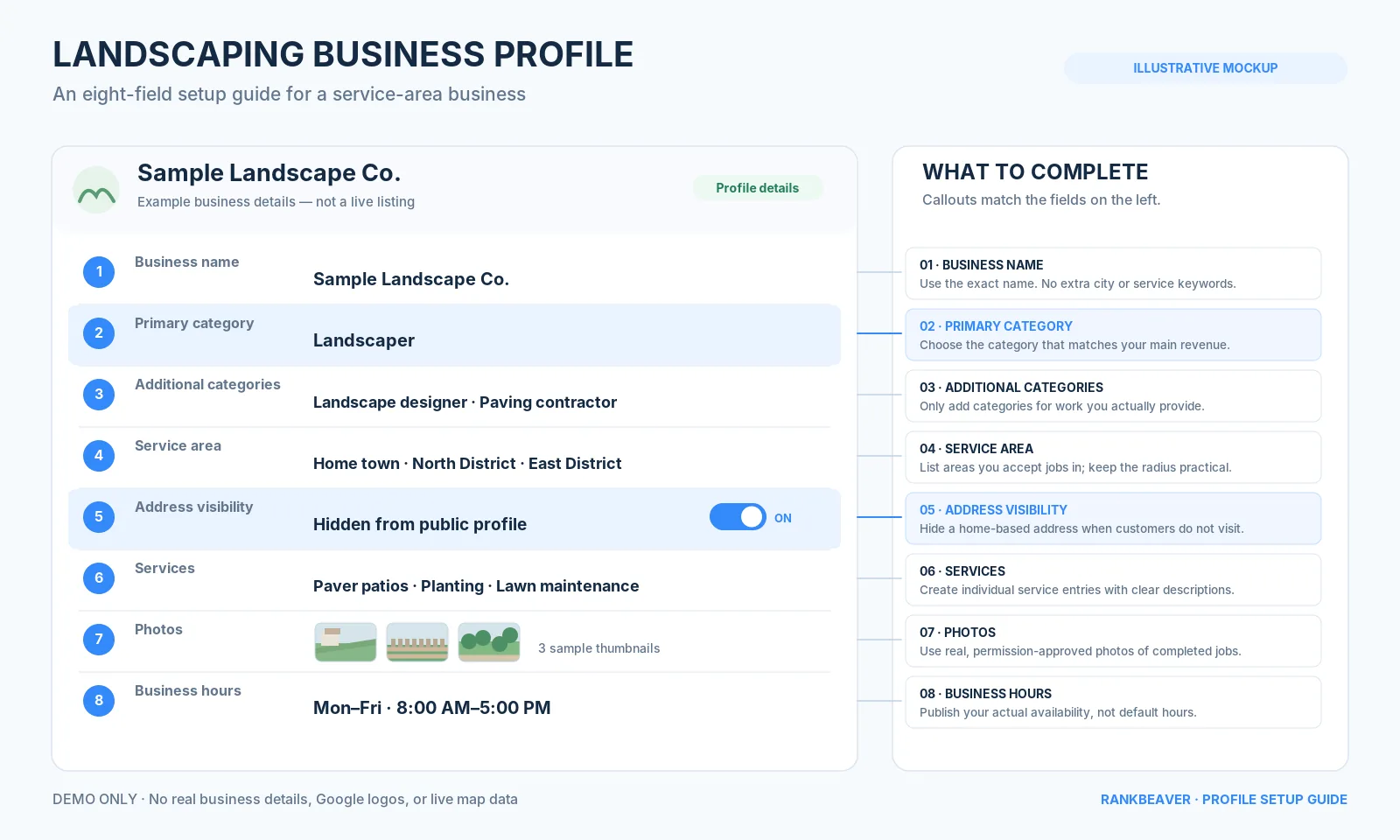
Google has specific rules for companies that visit customers instead of serving them at a physical business location. Service-area businesses without a customer-facing location should generally hide their address. PO boxes and virtual offices do not qualify as acceptable business locations under Google's guidelines.
Review Google's Business Profile guidelines before completing your listing. Incorrect business information can cause problems with verification or profile eligibility. Keep your services, location information, and operating hours accurate whenever your business makes changes.
Add project photos and keep your profile updated
Take photos of completed landscaping projects and upload them to your profile with the customer's permission. Before-and-after images can help potential customers understand what your company does. Start with at least three genuine photos, then continue adding examples as you complete more work.
You can also publish a weekly update featuring three project photos. Check your profile regularly for customer questions and reviews, and aim to respond within a day. Preparing a simple weekly post may take about 15 minutes, while customer replies may require additional time.
Ask customers for Google reviews
Request a review after completing a job, preferably while you're still speaking with the customer. Give them a direct link so they can leave feedback without searching for your business. Keep the request simple and allow customers to describe their experience in their own words.
You could say:
"If you're happy with how the yard turned out, would you leave us a quick Google review? I can text you the link."
Send the link before leaving the property if the customer agrees. Reviews should reflect genuine customer experiences and should not be exchanged for discounts or other incentives. Continue requesting honest feedback as you complete more projects and build your customer base.
Contact people who already know your work
Tell former coworkers, suppliers, neighbors, and other contacts that you've started a landscaping business. Explain exactly which services you offer and where you're available to work. Someone familiar with your previous landscaping projects may be willing to recommend you when they hear about a customer needing similar work.
Consider competitive introductory pricing while establishing your first customer accounts, provided the jobs remain financially worthwhile. Ask customers for permission to photograph completed projects for your website or business profile. These early examples can help potential customers evaluate your work before requesting an estimate.
Build relationships with property managers and suppliers
Property managers often need contractors for recurring maintenance across several properties. Contact local management firms to ask whether they're accepting bids and what qualifications contractors must meet. One management relationship could eventually provide several maintenance accounts, depending on the properties the firm manages.
Local nurseries and landscaping suppliers can also be useful referral contacts. A nursery that sells plants but doesn't provide installation may encounter customers who need someone to complete the work. Explain your services and share examples of completed projects so suppliers know what kinds of customers they can refer.
For additional customer acquisition ideas, read RankBeaver's landscaping marketing guide. It covers marketing channels that can help businesses reach property owners searching for landscaping services. Start with the channels you can manage consistently before adding paid advertising or more complicated campaigns.
9. Manage scheduling, customer payments, and seasonal expenses
As your landscaping business grows, track the time your crews spend traveling and how quickly customers pay. Both affect the amount of cash available for operating expenses. You'll also need to prepare for seasonal changes in demand, particularly in areas where outdoor maintenance slows during colder months.
Keep landscaping routes close together
Travel time reduces the number of properties a maintenance crew can visit in a day. A crew serving 12 properties in two nearby neighborhoods may complete more work than one driving across the county between appointments. Shorter routes can reduce fuel expenses and paid time that cannot be billed directly.
When accepting new customers, consider their location along with the contract value. A distant property may require a higher price to cover additional travel expenses. Build a manageable service area before expanding into neighborhoods that require longer journeys between jobs.
Track invoices and payment schedules
Installation contractors often pay for materials and labor before receiving the customer's final payment. Commercial contracts may also involve payment terms of 30 to 60 days. Keep track of unpaid invoices and upcoming expenses so you know whether the company has enough cash to meet its obligations.
For installation projects, define legally permitted payment milestones in the contract and send invoices when those milestones are reached. For maintenance customers, maintain accurate service records and invoice according to the agreed schedule. Follow up on overdue payments instead of allowing outstanding balances to accumulate.
Develop crew leaders before expanding
Hiring more workers can increase your company's capacity, but each crew needs someone capable of managing the work. The landscaping industry operates at roughly one supervisor for every six or seven workers. A dependable crew leader must understand job requirements and be able to coordinate employees without constant owner supervision.
Developing an experienced crew leader may take several years. Before taking on more projects than you can personally oversee, consider who will manage the additional work. Expanding too quickly without reliable supervision can create scheduling problems and make it harder to maintain consistent job quality.
Prepare for slower winter months
Landscaping demand decreases during winter in many parts of the United States. Routine lawn maintenance may slow or stop, while weather conditions can delay outdoor installation projects. Plan for these changes by setting aside money during busy months to cover expenses when fewer jobs are available.
Federal employment data shows how much landscaping depends on seasonal labor. In fiscal year 2025, landscaping accounted for 89,013 certified positions in the H-2B temporary worker program, making it the program's largest occupation. That figure exceeded the program's standard annual cap of 66,000 visas, although certified positions and issued visas are different measures.
Decide how much of each payment you'll transfer into a separate seasonal reserve. Keep that money available for insurance, equipment payments, and other operating costs during slower periods. Saving throughout the busy season provides more flexibility than waiting until winter to address a drop in income.
Use software when administrative work becomes difficult to manage
A small landscaping business may be able to manage quotes, appointments, and invoices manually. As the number of customers grows, these tasks can take more time and become harder to coordinate. Software may be worth considering when manual scheduling or billing starts consuming hours that could otherwise be spent on paid work.
RankBeaver has comparisons of lawn care scheduling software and lawn care billing software. Many of these tools can also support landscaping companies. Compare their features against your actual scheduling and invoicing requirements before paying for a subscription.
10. Avoid common landscaping startup mistakes
Financial problems often begin with decisions made before a landscaping job starts. Underestimating labor, accepting unlicensed work, or buying equipment too early can create expenses that are difficult to recover. Review these risks when planning your initial services and deciding how much money to invest.
| Common mistake | What can happen | How to avoid it |
|---|---|---|
| Underpricing jobs to win customers | Installation work may produce little profit or lose money | Calculate all expenses before setting your selling price |
| Confusing markup with margin | Actual profit falls below your target | Divide total cost by one minus your desired margin |
| Offering services without the required license | Fines, penalties, or stop-work orders | Verify licensing requirements for each service |
| Starting installation work without sufficient working capital | The company may run out of cash before finishing | Maintain reserves and use legally permitted milestone payments |
| Purchasing equipment before it's needed | Financing and maintenance expenses continue while equipment sits idle | Rent until regular use justifies ownership |
| Treating business revenue as personal income | Insufficient money remains for expenses or taxes | Maintain separate accounts and reserve money for tax obligations |
BLS data across the economy indicates that approximately 78% of new businesses survive their first year, while about 57% remain operating after five years. These figures cover multiple industries and should not be treated as landscaping-specific survival rates. Keeping accurate records and reviewing completed-job profitability can help you identify financial problems early.
Frequently asked questions
Q.1 How much does it cost to start a landscaping business?
Starting a landscaping business may cost approximately $7,400 to $50,000. A small maintenance company with an existing truck and trailer can start near the lower end, while an installation business purchasing transportation and construction equipment may need around $47,500. Licensing, insurance, equipment prices, and working capital will affect your final budget.
Q.2 Can you start a landscaping business without experience?
You can start a basic landscaping maintenance company without extensive professional experience in many states, provided you meet applicable business requirements. Installation work may require documented professional experience before you qualify for a contractor's license. California, for example, generally requires four years of journey-level or supervisory experience to qualify for the C-27 examination.
Q.3 Do I need a license to start a landscaping business?
Routine mowing and landscape maintenance may be exempt from contractor licensing in some states. Hardscaping, irrigation installation, and commercial pesticide applications can require separate licenses or certifications. Check the requirements for your specific services with the relevant state licensing agencies, since regulations and project-value thresholds vary.
Q.4 Can I start a landscaping business with one mower and a truck?
Yes, a dependable mower, truck, trailer, and basic handheld tools can be enough to start a residential maintenance business. You'll still need to meet applicable registration, insurance, and licensing requirements. Installation work generally requires additional equipment and may involve contractor licensing once the project meets the applicable requirements.
Q.5 How many landscaping customers do I need to break even?
Divide your monthly fixed expenses by the average amount each customer contributes after direct service costs. For example, if fixed costs total $2,000 per month and each recurring maintenance customer contributes $120, you'll need approximately 17 customers to break even. Travel expenses and changes in service costs can affect that number.
Q.6 Should I start with maintenance or landscaping installation?
Maintenance usually requires less equipment and provides recurring income through scheduled customer visits. Installation can generate larger contracts, but projects require more working capital and detailed estimates. Start with services you can perform using your existing skills and equipment, then consider expanding once you have reliable customers and accurate cost records.
Q.7 How do I get my first landscaping customer?
Create a Google Business Profile and tell people in your network which landscaping services you're offering. Contact former coworkers, local suppliers, neighbors, and property managers who may know potential customers. After completing your first jobs, photograph the work with permission and ask customers to leave honest Google reviews.
Getting started with your landscaping business
Before accepting your first project, confirm that you're licensed for the work and have enough money to cover its expected costs. Record your labor hours and material expenses as jobs are completed so future estimates become more accurate. Keep business finances separate and maintain a reserve for expenses between customer payments.
Once you're ready to accept customers, complete your Google Business Profile and check how your company appears in local search. RankBeaver's Local Search Result Checker can help you examine your visibility for landscaping searches in the areas you serve.
Landscaping startup planning worksheet
Record real quotes, fees, and customer conversations before spending money. All blank fields are for the operator to complete; the three budgets in the article are illustrations, not supplier quotes.
1. Cost plan and working capital
| Item | Expected cost | Actual quote / source |
|---|---|---|
| Truck / trailer | ||
| Mowers and handheld equipment | ||
| Installation / rental equipment | ||
| Business registration and licenses | ||
| Insurance deposit / first premium | ||
| Fuel, supplies and materials | ||
| Website and photography | ||
| Payroll and taxes | ||
| Working capital reserve | ||
| Other costs | ||
| TOTAL |
2. Service-specific license and risk check
| Planned service | Regulator to contact | License / permit needed? | Insurer confirmed coverage? |
|---|---|---|---|
| Mowing and routine maintenance | |||
| Paver patios and retaining walls | |||
| Irrigation installation or repair | |||
| Chemical weed control | |||
| Excavation / grading |
3. First-customer outreach tracker
| Prospect / referral | Service and area | Contact date | Estimate sent | Outcome / follow-up |
|---|---|---|---|---|
Weekly review: Record inquiries, qualified leads, estimates sent, jobs booked, cash collected, and upcoming bills. Use completed-job costs to revise estimates, and ask the licensing authority before offering regulated services.