Starting a lawn care business is one of the few trades you can legally begin this weekend in most of the country. The licensing question is real, but it is smaller than the competition makes it sound, and the part that matters is not the part most guides lead with.
This guide is written for the operator going out on their own, from pre-launch through the first year. If you are already running and your question is how customers find you once you are legal, the last section is written for you.
Steps at a glance
- Lawn care vs. landscaping: the line that decides your licenses
- The licenses almost every lawn care business needs
- The pesticide applicator license: the one that actually bites
- Contractor and specialty licenses, if you cross into landscaping
- Insurance, which is usually a license precondition
- Your licensing checklist, in order
- You are licensed. Now make sure customers can find you.
Lawn care vs. landscaping: the line that decides your licenses
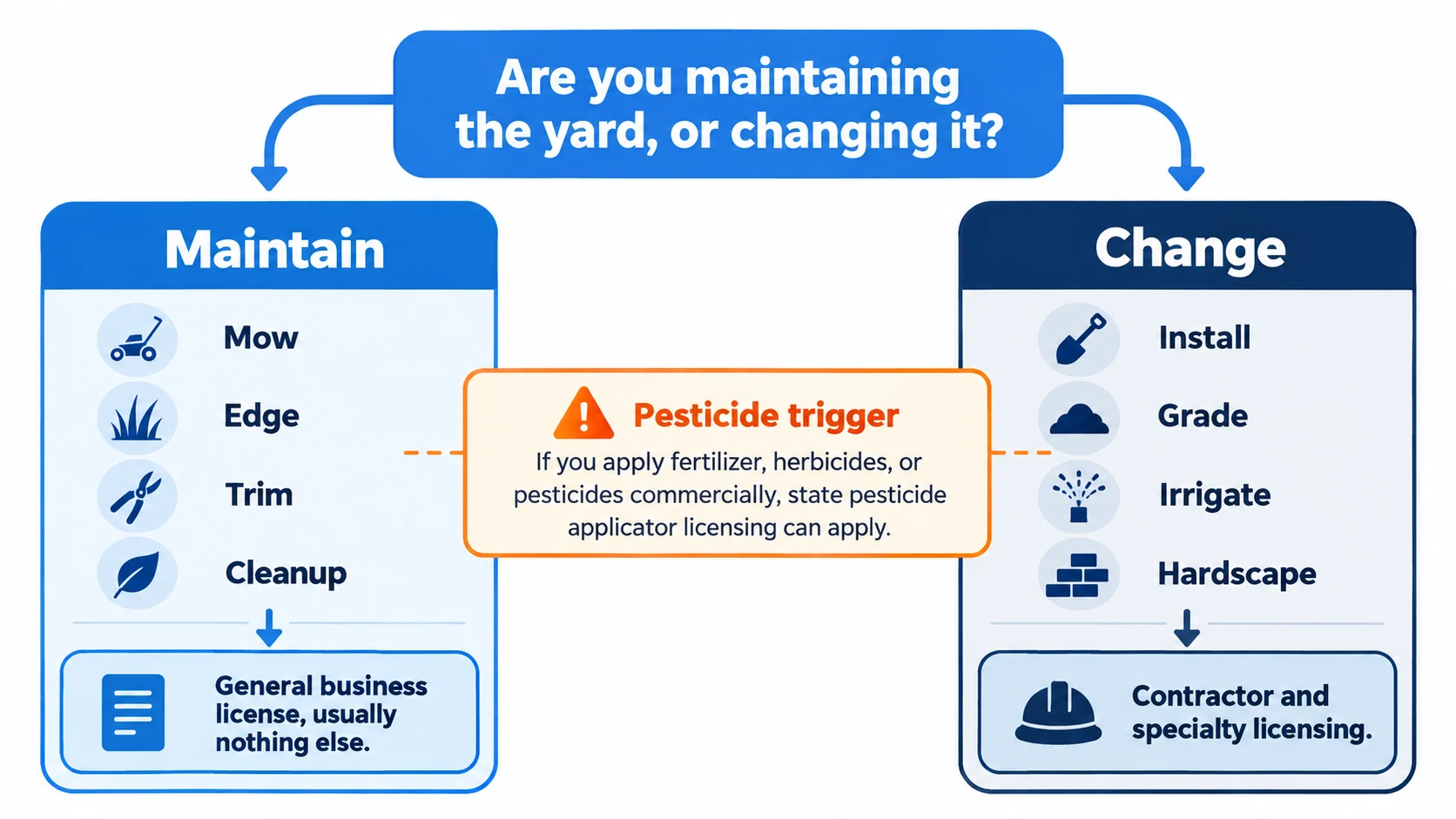
The single thing that determines which licenses you need is whether you maintain what is already there or build something new. Most guides blur lawn care and landscaping together and then half-correct themselves later. The distinction is not cosmetic. In many states it is written into the law, and it is the difference between a weekend business license and a multi-year contractor credential.
Maintenance is lightly regulated. Installation is not. Mowing, edging, trimming, leaf removal, aeration, and overseeding are maintenance. They rarely trigger anything beyond a general business license. Designing a yard, installing irrigation, building a retaining wall, grading land, or laying a patio changes the property itself, and that work sits inside contractor licensing in a large share of states.
A simple test before you quote a job: am I maintaining this yard, or am I changing it? Your answer usually points straight at the right requirement.
| What you do | Usual license picture |
|---|---|
| Mow, edge, trim, blow, seasonal cleanup | General business license. Usually nothing else. |
| Apply fertilizer only | General business license. A few states also require a license for fertilizer. |
| Apply any pesticide, herbicide, or fungicide for pay | Commercial pesticide applicator license, in most states |
| Install irrigation or sprinklers | Often a separate irrigation or backflow license |
| Prune or remove large trees | Sometimes an arborist credential plus higher insurance |
| Build patios, walls, grade, or design-install | State contractor license, once you cross a dollar threshold |
The rest of this guide follows that table from top to bottom: the things nearly every operator needs, then the one most operators actually trip over, then the contractor rules that only apply if you move into install work.
The licenses almost every lawn care business needs
Even in the states with the lightest rules, three pieces of paper come up again and again. None of them is a "lawn care license," because that is not usually a thing. They are the ordinary legal setup for operating any small service business.
A general business license comes first. Your city or county issues it, not the state, and most areas want it before you can legally advertise, sign a contract, or accept payment. The application is usually short and the fee is usually small, often in the range of $50 to $100 a year, though some places charge less and a few charge more. This is the one license almost no operator can skip.
An EIN, if you hire anyone or form an entity. The IRS issues an Employer Identification Number for free. You need one if you take on employees, and if you set up as anything other than a sole proprietorship. A sole operator with no employees can often use their Social Security number instead, but an EIN keeps your business and personal records separate and costs nothing to get.
A sales-tax permit, where your state taxes the service. This is the item operators miss most often. Some states tax lawn care as a service, some tax only the materials you resell like mulch or sod, and some do not tax it at all. Texas, for instance, taxes a range of these services; your neighbor state may not. You cannot reason it out from what another state does. Check your own state's department of revenue, and register before your first invoice so your pricing is right from the start.
Pro tip: To find the office that issues your business license, search your city or town name plus "business license" in Google. The result is almost always your city hall or county clerk, and a five-minute phone call will tell you the exact form and fee.
The pesticide applicator license: the one that actually bites
This is the license the competition waves at and never explains, and it is the one most likely to catch a new operator off guard. The rule is simpler than it looks, and the structure is worth understanding before you decide what services to offer.
Fertilizer alone usually needs no license. Any pesticide for pay usually does. The moment you apply a weed killer, insecticide, or fungicide on a client's property for money, most states require a commercial pesticide applicator license, and that holds even if the product is something a homeowner could buy off a shelf. The common belief that the license is only for "restricted-use" chemicals is wrong in most states. General-use products applied for hire are enough to require it.
There is no national pesticide license. The EPA sets a floor for restricted-use products only, and leaves the rest to the states, so every rule below varies and you have to check your own.
The license does not have to be in your name. This is the part almost no guide mentions and it changes the math for a lot of people. A company needs at least one licensed applicator, but the states that use this structure let that be an employee. In Illinois, for example, the structure splits two ways:
- A commercial applicator is the person who buys, stores, handles, and supervises pesticide use for hire. The company must have at least one. The categories on that person's license set where the whole company can legally apply.
- A commercial operator applies pesticides on site under that applicator's supervision, and only within the applicator's categories.
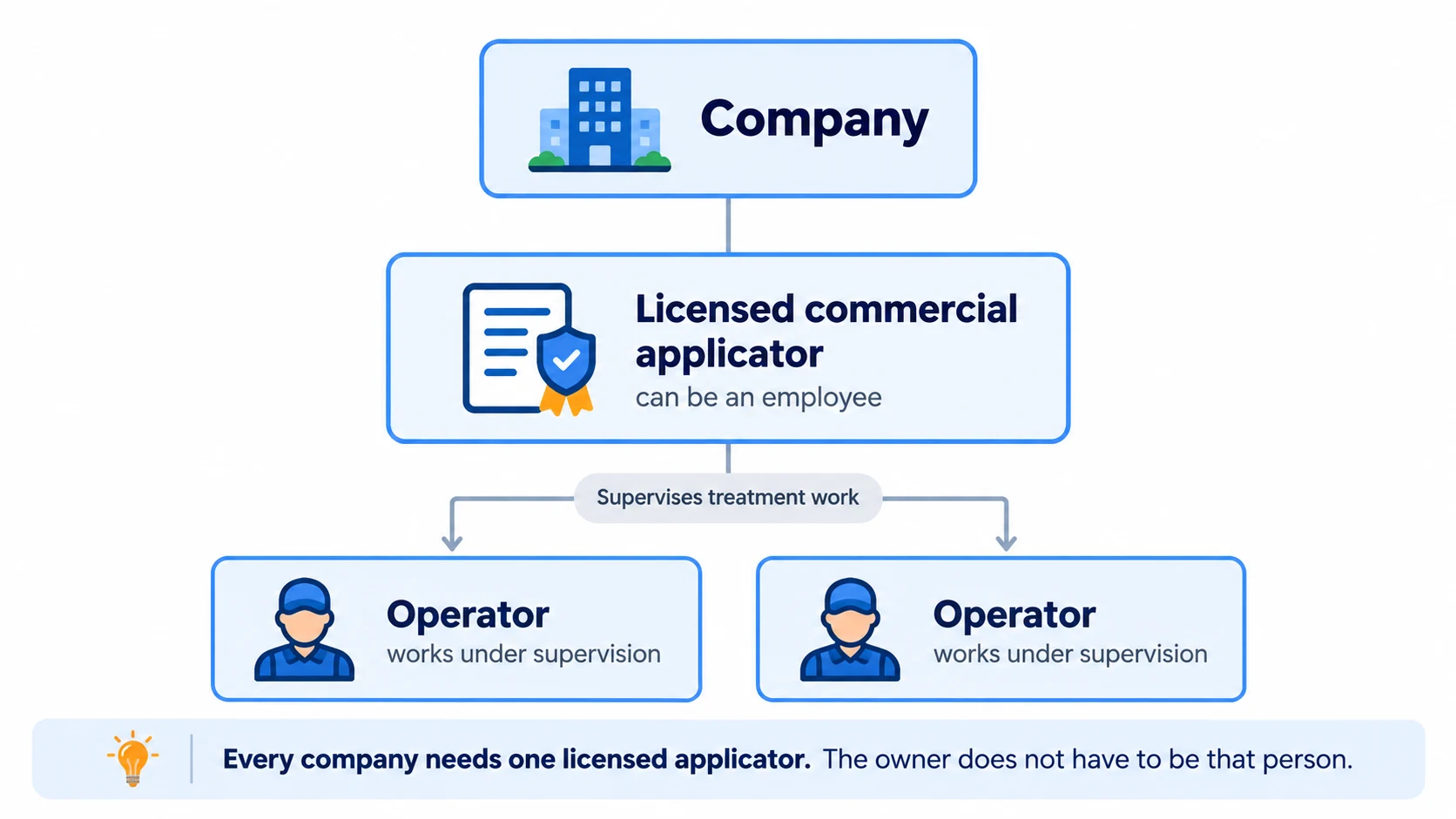
So if you do not want to sit the exam, or you do not pass it, you can hire or designate a qualified applicator and build the company around them. The owner and the license holder do not have to be the same person.
The exam is a time gate, not a money gate. Where the license costs you is the studying and the waiting, not the fee. Illinois runs it as a General Standards exam that every licensee takes, plus a category exam for the kind of work you do, commonly Turfgrass and Ornamentals for residential lawn care. The exams are closed-book, around 70% to pass, and offered online and in person. One point worth burning into memory, stated plainly by the Illinois Pesticide Safety Education Program: passing the exam does not let you spray. You have to wait for the state to issue the actual license first.
Pro tip: To find your own state's rule, search your state name plus "commercial pesticide applicator license." That lands you on your state department of agriculture, which is the only authority that matters here. Skip the fifty-state blog posts; every one of them is published by a vendor and none is official.
Contractor and specialty licenses, if you cross into landscaping
If you stay in maintenance, you can usually skip this section. If you start installing, it becomes the most important thing you read, because install work is where licensing gets expensive and the penalties for skipping it get real.
A state contractor license kicks in once a job crosses a dollar threshold, and the threshold is all over the map. This is the number operators get wrong most often, partly because it changes and the guides do not keep up. A few current examples show how wide the range is:
| State | What triggers a contractor license for landscape install |
|---|---|
| California | Jobs over $1,000 require a C-27 Landscaping Contractor license. The threshold rose from $500 to $1,000 on January 1, 2025 under AB 2622. |
| North Carolina | A landscape contractor license is required at $30,000 per job site over a rolling 12 months. |
| Arizona | A license is required above $1,000, with a narrow carve-out for minor work only. |
| Florida | No statewide landscape contractor license for basic install, though counties set their own certificates. |
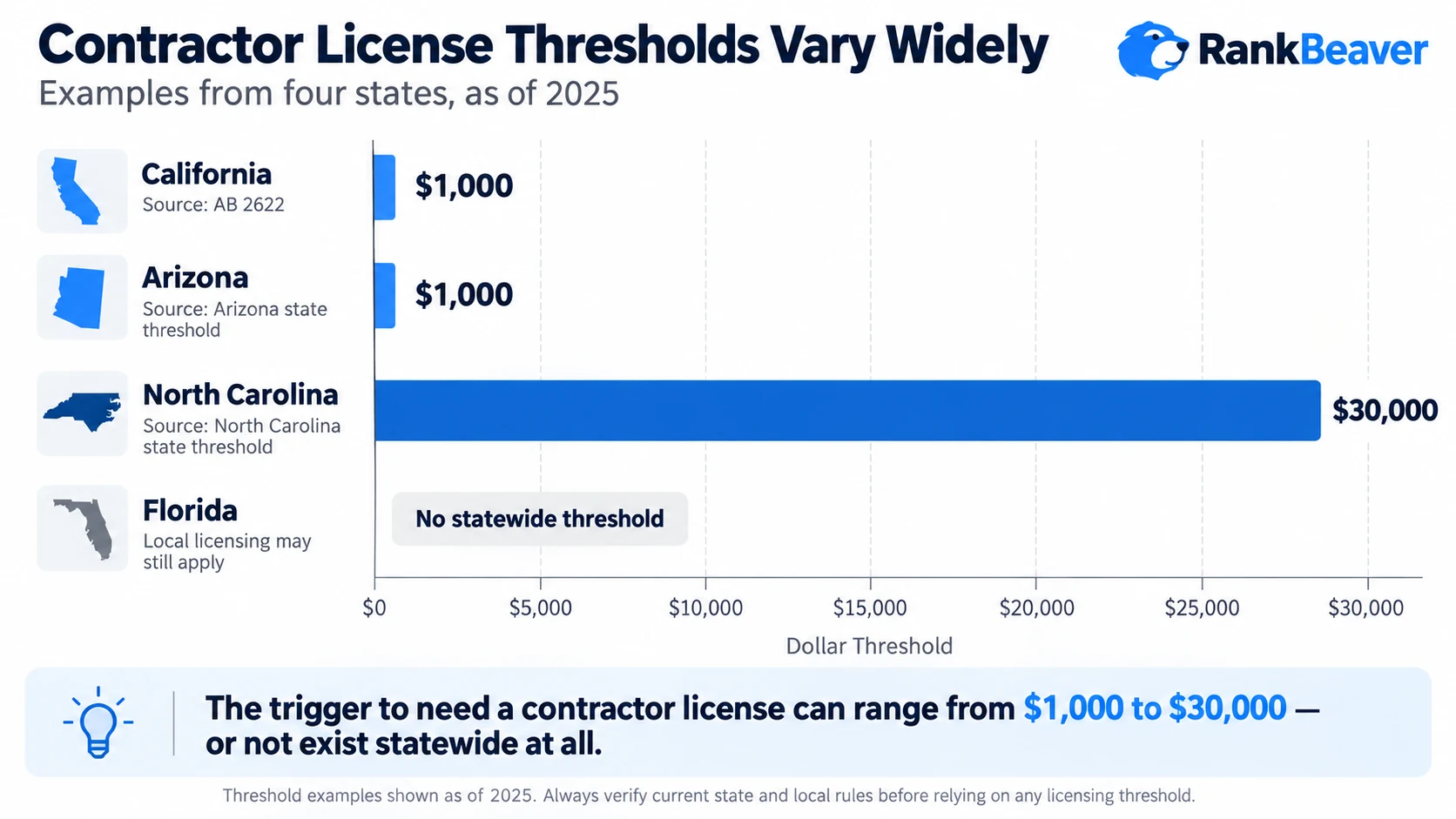
One trap worth naming: California's $1,000 figure is not a license to do $1,000 of unlicensed work. The exemption only holds if the job needs no permit and you use no employees on it, and hardscape or grading routinely needs a permit. Treat the threshold as the point where you must already be licensed, not a ceiling to work under.
Note that California's $1,000 figure is current as of 2025, and some official pages still show the old $500. Regulations in this area move, so confirm the number against your state board at the time you need it.
Irrigation and backflow are often a separate license. Connecting a sprinkler system to a home's water supply is regulated on its own in many states, sometimes under the contractor board and sometimes under plumbing or water rules. Texas, for one, requires a dedicated landscape irrigation license to sell, design, install, or repair systems. If you plan to offer irrigation, check it separately from your general contractor question.
Tree work can require an arborist credential. Trimming small shrubs is nothing special. Removing or heavily pruning large trees, especially near structures or power lines, can require certification, proof of training, or higher insurance limits. The line is roughly where the work gets tall and the equipment gets powerful.
Insurance, which is usually a license precondition
Insurance reads like an afterthought on most licensing pages, placed last and treated as optional. For a lawn care business it is neither. Several states will not issue a pesticide applicator license without proof of coverage, and most commercial clients and property managers will not let you on site without it, so it often has to be in place before the license, not after.
General liability is the baseline. It covers the predictable accidents of this trade: a rock thrown by a mower through a window, a client tripping over your equipment, damage to a sprinkler head. For lawn care specifically, Insureon reports a median general liability cost of about $46 a month, or $550 a year, across the policies it sells to lawn care businesses. A business owner's policy that bundles property runs higher.
Workers' compensation becomes mandatory the moment you hire. In most states the first employee triggers it, and it covers medical bills and lost wages for on-the-job injuries. Lawn care is physical, equipment-heavy work, so this is not a formality; skipping it invites fines and stop-work orders.
Commercial auto covers the truck. Your personal policy usually will not cover a vehicle used for the business, and a trailer full of equipment is a real exposure on the road.
Pro tip: Get your insurance quotes before you file your license application, not after. If your state makes coverage a condition of the license, having the certificate in hand saves you a second trip through the process.
Your licensing checklist, in order
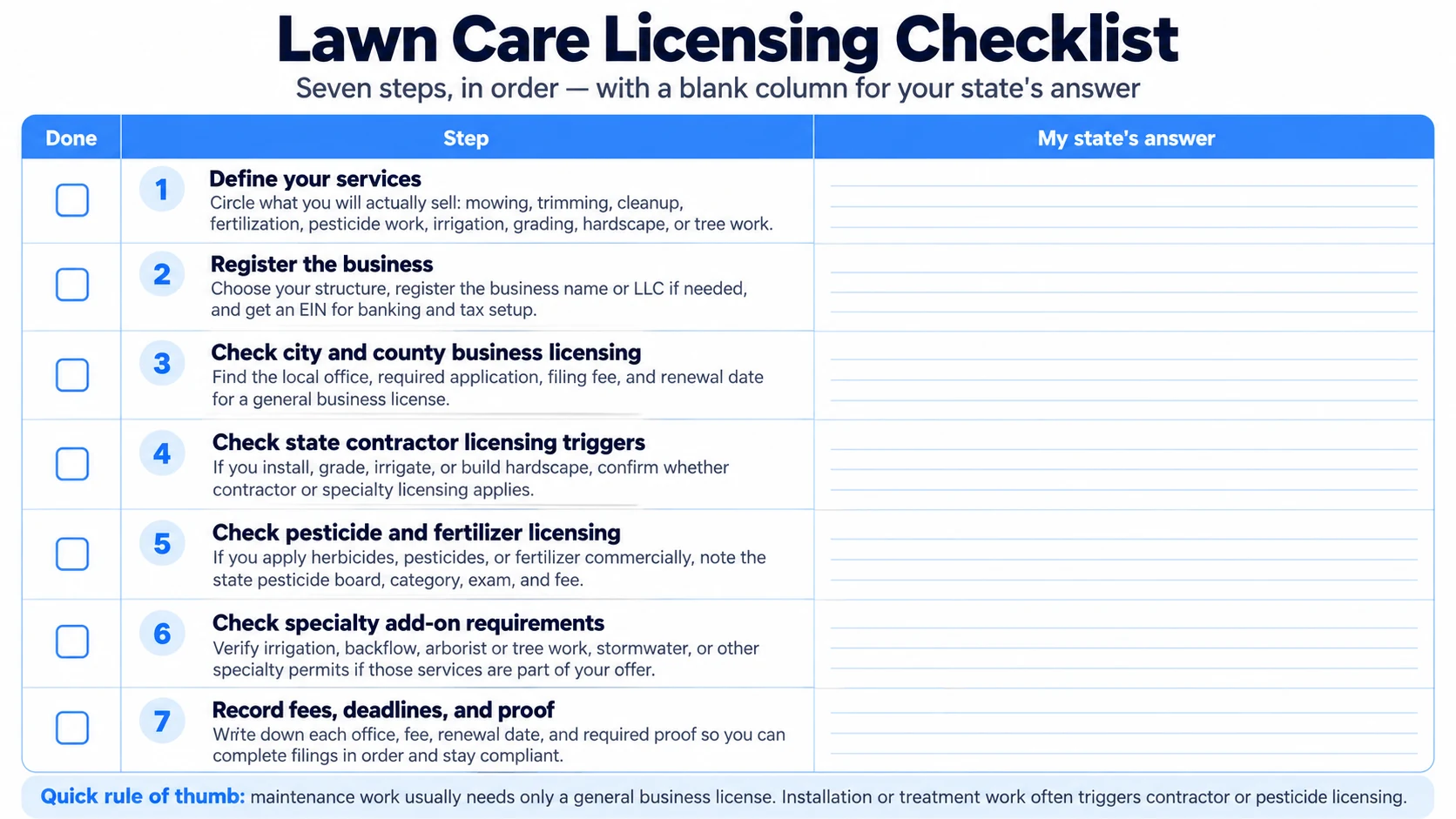
Most guides hand you a pile of license types and leave you to sequence them yourself. Here is the order that actually works, because each step unlocks the next.
- Choose your business structure and register the name. Sole proprietorship, LLC, or corporation. This decides your paperwork and your personal liability. The SBA website walks through the trade-offs.
- Get an EIN from the IRS. Free, online, required if you hire or form an entity.
- Apply for your general business license at your city or county office. This is the one you need before you can legally take money.
- Register for a sales-tax permit if your state taxes lawn care services or the materials you resell.
- Get insurance quotes and bind coverage. General liability at minimum, workers' comp if you are hiring.
- Get your pesticide applicator license before you spray anything for pay, or designate a licensed employee who holds it. Build this timeline in early; the exam and issuance take weeks, not days.
- Add contractor or specialty licenses only if and when you move into install work, irrigation, or tree removal.
You are licensed. Now make sure customers can find you.
Getting legal is the easy half. The harder question, the one that decides whether the business works, is whether a homeowner searching for lawn care in your town finds you or finds the operator three streets over. For a local service business run off a truck, that comes down to how you show up on Google, and it is the part no licensing guide ever covers.
Set up your Google Business Profile as a service-area business
A lawn care business visits customers; customers do not visit you. Google has a specific setup for that, and getting it wrong quietly caps how often you appear.
- Hide your address and set a service area instead. A service-area business should not display a street address. Google lets you define the area you serve, and the practical ceiling is roughly a two-hour drive, though for a lawn route you will want it far tighter than that.
- Do not use a PO box or a virtual office. Google rejects both for profile eligibility. A coworking space only qualifies if it is genuinely staffed and signed.
- Fill every field. Primary category, services, hours, service area, photos. A complete profile outranks a thin one, and most of your local competitors have thin ones.
Check whether you are showing up at all
Before you spend a dollar on anything else, find out where you currently stand. The fastest way is to run the search your customer would run and see if you appear. RankBeaver's free Local Search Result Checker does this without you having to guess, which answers the first question every new operator has: am I even in the results?
Watch how your ranking changes across your service area
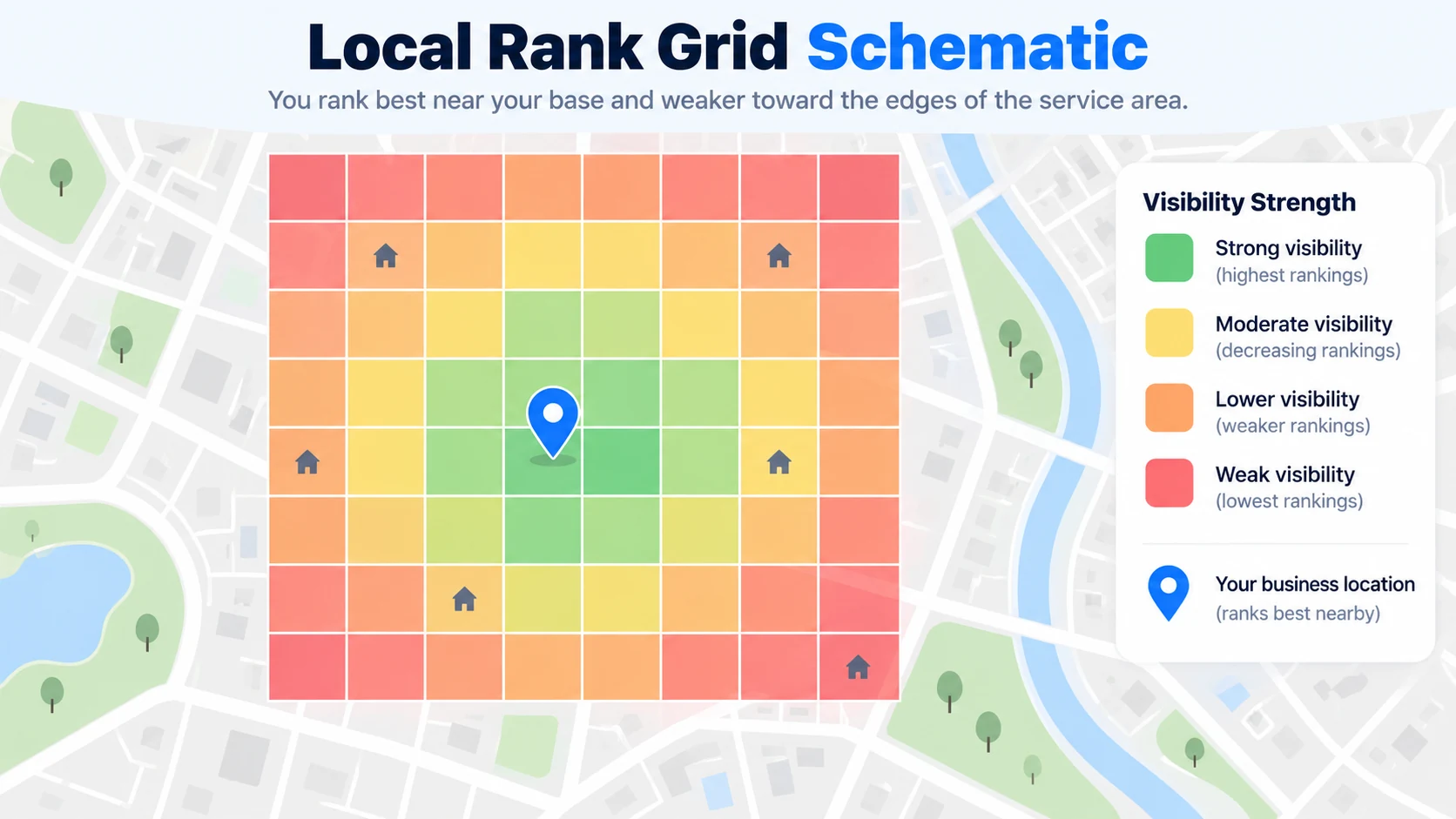
The result a customer sees depends heavily on where they are standing. You might rank well near your home base and vanish four miles away, which matters enormously for a business defined by a driving radius. A Local Rank Grid maps your position across the whole area you serve, so you can see the dead zones instead of assuming the single result you see from your kitchen is the whole story.
See how you stack up against the competition
Once you know where you stand, the useful next question is how you compare to the operators already winning in your town, on the things Google actually weighs: reviews, replies, posts, and profile depth. RankBeaver's free Benchmark lays your profile next to nearby competitors and points at the specific gaps worth closing first.
Frequently Asked Questions
Q.1 Do you need a license to mow lawns?
In most states, no occupational or trade license is required just to mow, edge, and do basic maintenance. You almost always still need a general business license from your city or county before you take paying work, and you may owe sales tax depending on your state. The licensing questions get more serious only when you add chemical application or installation work.
Q.1 Do I need a license to apply fertilizer?
Usually not for fertilizer on its own. The license requirement in most states is triggered by pesticides, herbicides, and fungicides, not fertilizer. A handful of states do regulate fertilizer application separately, often for runoff and water-quality reasons, so confirm with your state department of agriculture before you offer it as a service.
Q.2 How much does a lawn care business license cost?
The general business license is usually the cheapest part, often somewhere around $50 to $100 a year, though it varies by city. The pesticide applicator license fee is also modest. The real cost of that one is time: studying for the General Standards and category exams and waiting weeks for the state to issue the license. Contractor licenses for install work cost more and take longer.
Q.3 Do I need an LLC for a lawn care business?
A license and a business structure are two different things. A license is government permission to do the work; an LLC is how your business is legally organized. You can operate as a sole proprietor with the right licenses and no LLC at all. Many owners still form an LLC to separate personal and business assets, but it is a choice about liability, not a licensing requirement.
Q.4 Can I start a lawn care business as a side job?
Yes, and many operators do, but working part-time does not remove the licensing and insurance obligations. Earning less or mowing on weekends does not exempt you from the business license, the sales-tax rules, or the pesticide applicator license if you spray. Treat a side operation as a real business from the first paid job.
What to do next
Sort the licensing in the order above, get your general business license and insurance in place first, and build the pesticide applicator timeline in early if you plan to spray. Once you are legal, the question that decides whether the phone rings is whether customers can find you, so start by checking where you currently show up. RankBeaver's free Benchmark will tell you how your Google presence compares to the operators already winning in your area, and where to start closing the gap.