Most people looking for a pest control license are asking the wrong question.
They ask how to get one. The question that decides everything is which one, because there are two, they do different jobs, and in most states you cannot run a company on the first alone. The second usually requires years of documented field experience that no exam substitutes for.
So this guide starts with which license you need and whether you qualify today, then covers how to get it. If you are here to check somebody else's license instead, section 8 has the state portals.
Already running a business and planning what comes next? How to start a pest control business covers the rest of the launch.
The short version
Work out which of the two credentials you need, then whether you personally meet the experience requirement for the one that carries a company. If you do, it is exams, fees, an insurance certificate and an application. If you do not, pick one of the three paths in section 3 and start the clock deliberately rather than discovering the problem after you have bought a truck.
Then confirm everything with your state agency, because this changes.
What's in this guide
- The two pest control licenses you might need
- Do you qualify? The experience clock
- If you do not qualify yet: three paths
- What federal law does and does not do
- How to get a pest control license, step by step
- What a pest control license costs and how long it takes
- State by state: Texas, California, Florida, North Carolina
- How to check a pest control license
- Renewal and continuing education
The two pest control licenses you might need
This is the distinction the field routinely blurs, and getting it wrong is not a technicality. It is the difference between operating legally and not.
| Individual credential | Business or company license | |
|---|---|---|
| What it permits | You, personally, to apply pesticides, usually within named categories | Your company to contract for and sell pest control services |
| Typical names | Certified applicator, commercial applicator, registered technician, apprentice | Business license, company registration, structural pest control business license |
| Who holds it | A person | A company, attached to a designated qualified individual |
| How you get it | Training hours, then an exam | Application, fees, insurance certificate, bond where required, and a qualified individual whose credential the license rests on |
| Experience needed | Usually months, sometimes none for the entry tier | Usually years, documented and verifiable |
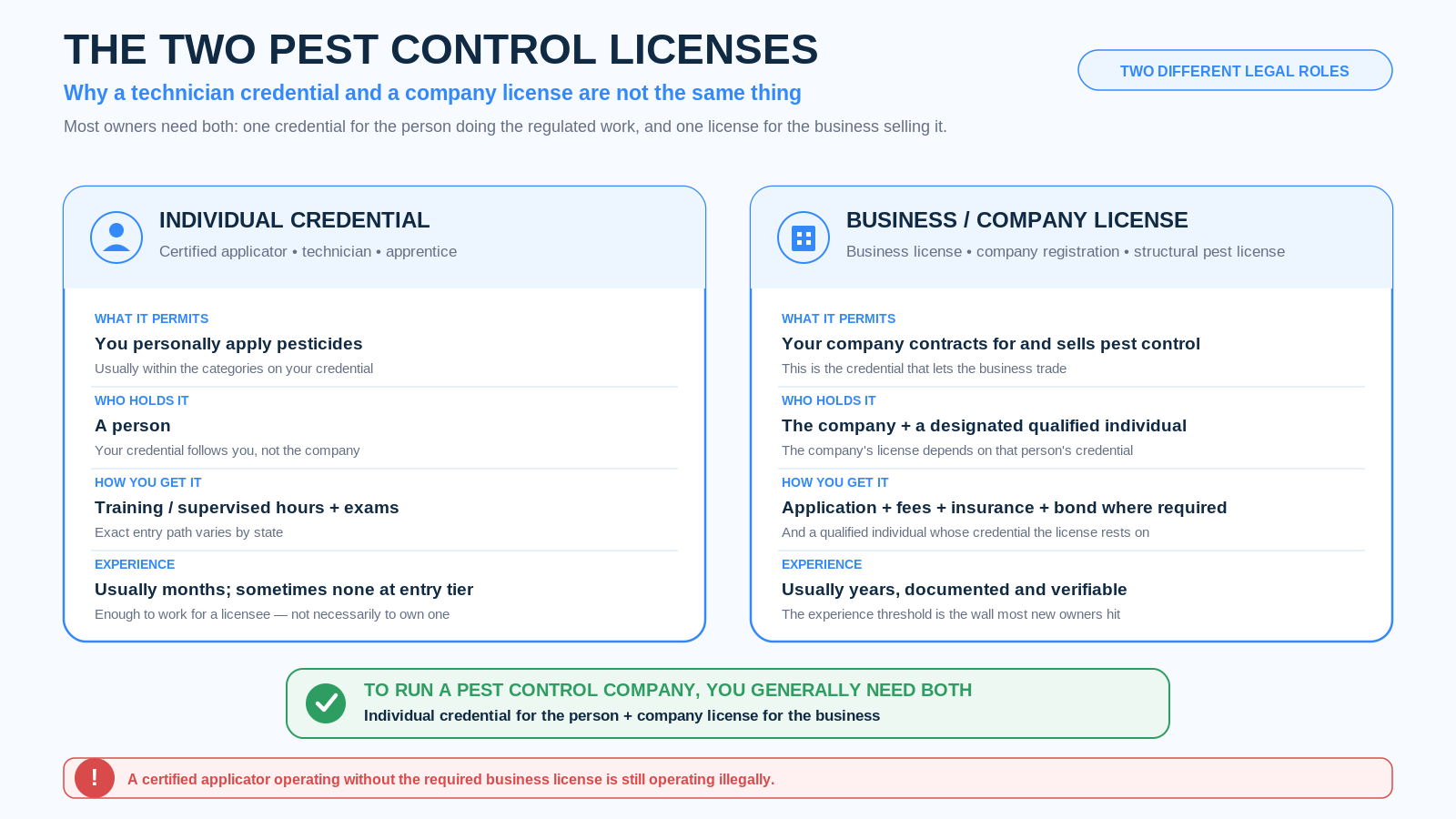
The designated qualified individual is the concept to understand. States call it different things: the certified operator in charge in Florida, the licensee in North Carolina, the qualifying manager in California. Whatever the name, the company's license depends on that person's credential and their continued involvement in the business.
Holding a certified applicator credential does not automatically make you that person. That is the wall most new owners hit, and they usually hit it after they have committed money.
Pro tip: When you call your state agency, ask specifically "what does the company need in order to hold a license, and who has to qualify it?" Asking "how do I get a pest control license" gets you routed to the individual applicator path, which is not the answer you need if you are starting a business.
Do you qualify? The experience clock
Here is the question no other guide walks you through. Work down it honestly.
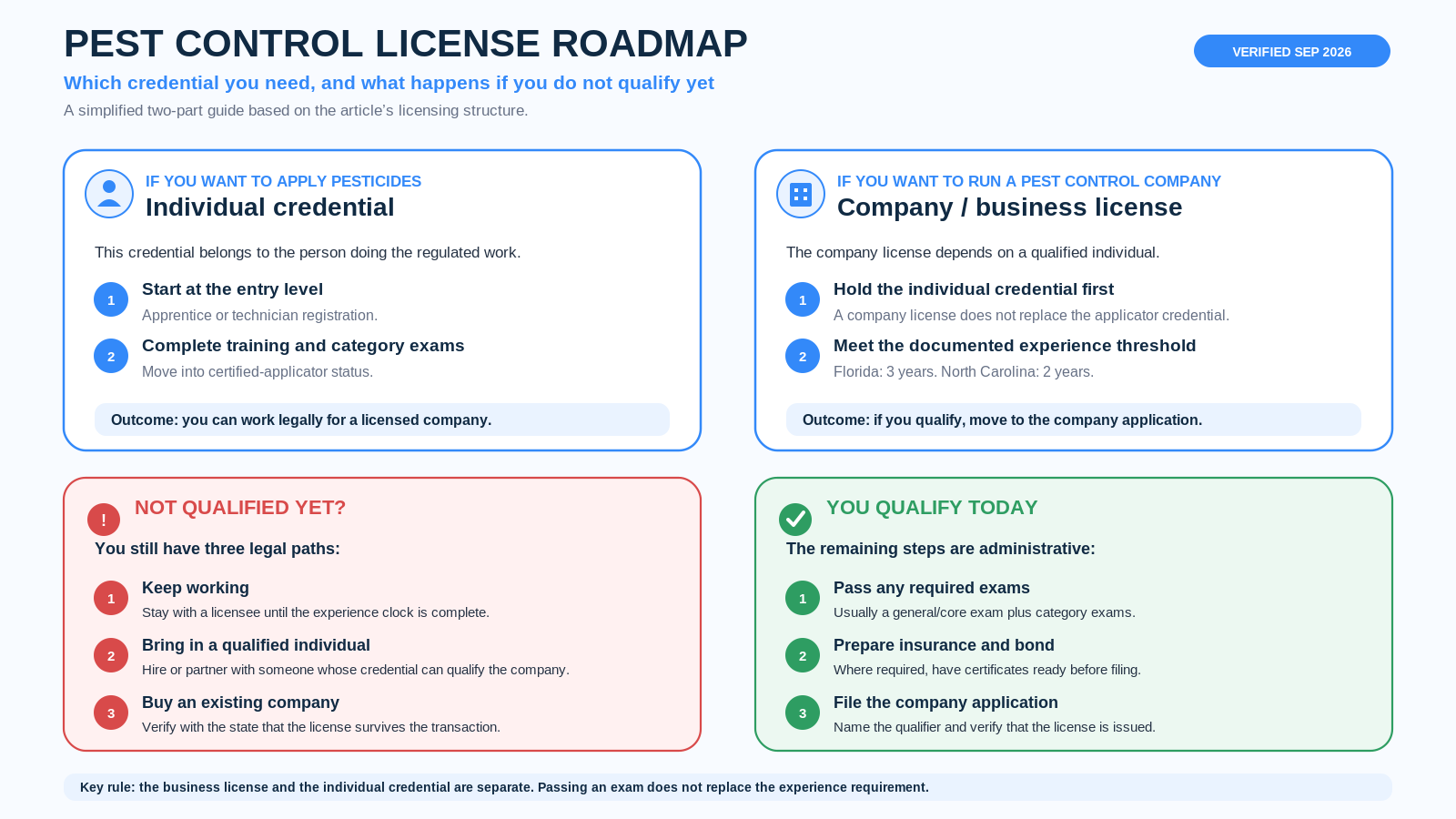
- Do you hold a current individual applicator or technician credential in your state? If no, that is the first step regardless of your plans, and it is covered in section 5.
- How many years of documented, verifiable experience do you have working for a licensed pest control company? Documented means your employer's records, your pay stubs, and their license number. Your own recollection is not evidence, and states ask for verification.
- Does that experience meet your state's threshold for the qualifying individual?
| State | Experience required to qualify a company | Source |
|---|---|---|
| Florida | Three years as a service employee of a licensee, one of which must be in Florida in the year immediately preceding application. A relevant degree with 20+ semester hours in entomology or a related field reduces it to one year | Fla. Stat. 482.132 |
| North Carolina | Two years of independently verifiable experience after reaching certified applicator status | NC Department of Agriculture |
| California | An Operator license, the only class that can run a company. An Applicator cannot work independently | CA Structural Pest Control Board |
| Texas | Certified applicator tied to a business license, reached through the apprentice and technician tiers | Texas Department of Agriculture |
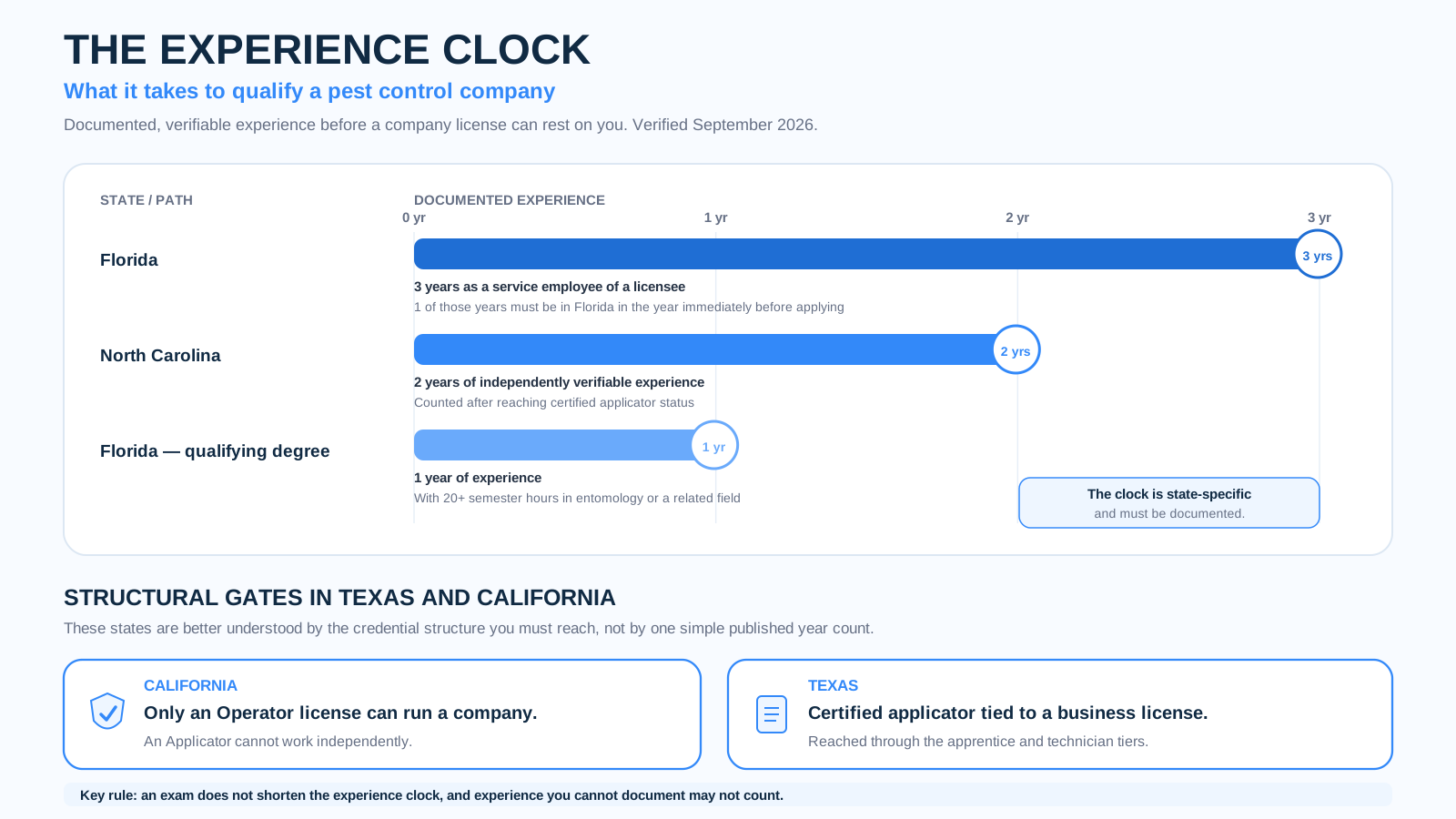
- Is your experience in the right state? Florida's rule is the one that catches people: three years total, but one of them in Florida, in the year immediately before you apply. Ten years in Georgia does not satisfy it on its own.
If you answered yes at every step, this is a paperwork exercise. Exams, fees, an insurance certificate, an application, and you are trading. Go to section 5.
If you answered no anywhere, you are not blocked, you are on a clock. Section 3 is for you, and the worst thing you can do is find this out after signing a truck lease.
What quietly invalidates your experience
Readers routinely lose years they thought they had. Five things do it, and all five are avoidable if you know about them early.
| What breaks it | Why |
|---|---|
| Time with an unlicensed employer | Experience generally has to be with a licensed company. Work for an operator who was not properly licensed and the state may not count it |
| Out-of-state years, where the state wants in-state time | Florida's rule is the sharp one: three years total, but one of them in Florida in the year immediately preceding application |
| The wrong categories | Several states count experience per category. Three years of general pest may not support a termite or WDO credential |
| Employment gaps | Some states require recency, so experience from a decade ago may not carry the same weight as recent work |
| Experience you cannot document | The most common failure of all. If your employer's records are gone or they will not confirm your dates, the years happened but do not count |
Build the evidence pack now, even if you are years out
This costs an hour and it is the single highest-return thing a technician planning to go independent can do.
Gather and keep, per employer:
- Their license number, written down, from the license itself or the state portal.
- Your exact service dates, start and end.
- Pay stubs or W-2s covering every period you will claim.
- The categories you actually worked in, and any certification numbers of your own.
- A supervisor's name and current contact, because people move and states call.
- Written confirmation of your service dates on company letterhead, requested as routine employment verification.
Ask for number six while you are still employed and on good terms. It is a normal request from a current employee and an awkward one from a former employee who left to compete.
Pro tip: Ask your current employer for written confirmation of your service dates and their license number now, framed as routine employment verification, while you still work there. States want independently verifiable experience, and that request is far harder to make after you resign to compete with them.
If you do not qualify yet: three paths
Every reader who fails the experience test has exactly three options. No commercial guide lays them out, and the choice materially changes your next two years.
Path 1: Keep working, document everything
The slowest and cheapest. Stay employed by a licensee until the clock runs out.
Do it deliberately rather than passively. Keep pay stubs, note your employer's license number, get your categories broadened if your state counts them separately, and ask for written verification annually rather than at the end. Time served that you cannot prove is time wasted.
Best when you are within a year or two of the threshold.Path 2: Bring in a qualified individual
Hire or partner with someone who already holds the credential and let the company license rest on them. California's board formalizes this as the qualifying manager role, and it is legal and common in most states.
The risk is structural. Your company's license depends on that person's continued involvement. If they leave, the license is in jeopardy and so is every contract under it.
Put it in writing before you start: their role and the hours they will genuinely be involved, what happens if they leave, notice periods, equity or compensation, and who owns the customer relationships.
Many states also require the qualifier to be genuinely engaged in the business rather than a name on a form, so a purely nominal arrangement can put the license at risk on its own terms.
Best when you have capital and a real candidate you trust.Path 3: Buy a company that already holds the license
The fastest route to trading legally, and it usually brings a book of accounts with it.
Small route-based pest control companies under $1 million in revenue traded at roughly 2.5 to 3.5 times seller's discretionary earnings in 2026.
The question that decides the deal: does the license actually come with it? In many states it does not transfer automatically, and the qualifying individual is frequently the departing owner, whose credential the company license was resting on the whole time. Buy the assets, lose the qualifier, and you have bought a book of accounts you are not licensed to service.
Ask these five before you sign anything, and get the answers from the state agency rather than the seller:
- Does the license survive a change of ownership in this state, and under what structure? Asset purchase and share purchase are often treated differently.
- Who is currently named as the qualifying individual? If it is the seller, what happens on completion.
- Will the seller stay on as qualifier during a transition, and for how long? Some states permit this; put the period, the compensation and the notice terms in the purchase agreement rather than a side conversation.
- What has to be re-applied for, and how long does it take? A gap of weeks between completion and a live license is a gap where you cannot legally service the route you just bought.
- Is there any disciplinary history attached to the license? Check the state portal yourself, from section 8, before diligence rather than after.
Best when you have capital and want to be operating this season.Pro tip: Call the state agency about the license transfer yourself, before you sign a letter of intent. Sellers are not being dishonest when they get this wrong; most have never had to know, because they qualified the company once and never thought about it again.
More in how to start a pest control business.
What federal law does and does not do
Two wrong beliefs circulate widely, and both come from the same misunderstanding.
There is no national pest control license. The EPA does not license anyone in a state. If a source tells you to get an EPA license, stop reading it.
What federal law actually sets is certification for people who apply or supervise the application of restricted use pesticides, under 40 CFR Part 171. That framework sets a minimum age of 18, fifteen commercial categories including "industrial, institutional, and structural pest control," and a maximum five-year recertification interval.
That five years is a ceiling, not a schedule. Many states recertify annually. "You renew every five years" is one of the most repeated errors in this subject.
Everything else is state law: who may apply general use pesticides commercially, what a company must hold, insurance minimums, bonds, termite and WDO standards, and continuing education. Many states require certification for all commercial applicators regardless of whether the product is restricted use.
How to get a pest control license, step by step
Assuming you qualify, this is the sequence. It is broadly consistent across states, and every specific belongs to your agency.
- Identify your state's agency and the exact license class you need. Most states run structural pest control through the Department of Agriculture; California uses a dedicated Structural Pest Control Board under Consumer Affairs. Start at the AAPCO directory of state pesticide officials rather than a fifty-state summary from a commercial site.
What to actually ask when you call
"Call your state agency" is where most guides stop. Here is what to ask, in this order. Ten minutes on the phone saves weeks.
- "What does the company need in order to hold a license, and who has to qualify it?" Ask this first. Asking "how do I get a pest control license" routes you to the individual applicator path, which is not your answer if you are starting a business.
- "What experience does the qualifying individual need, and how do you want it documented?" The second half matters as much as the first.
- "Does my experience with [employer] in [state] count toward that?" Name them. A general answer is not an answer.
- "Which categories do I need for [the specific work you plan to do]?"
- "What insurance and bond do you need on file, and does the license issue before or after that?" In several states the certificate is a precondition, which changes your sequence.
- "What is the current processing time from complete application to issued license?"
- "Is there anything that commonly delays or rejects applications like mine?" Licensing staff answer this generously and it is the most valuable question on the list.
Write down the name of who you spoke to and the date. Not to hold anyone to it, but because you will call back, and continuity saves you re-explaining.
- Confirm the categories you need. Category structures differ per state and cannot be generalized. Florida uses four categories, North Carolina three phases, California three branches, Texas a business license plus certified applicator, technician and apprentice tiers. Carry only the categories you will actually service; each one adds cost and continuing education.
- Complete the required training hours. Some states require documented training or supervised experience before you can sit an exam.
- Pass the exams. Typically a general or core exam plus one per category.
- Get insurance quoted and ready to bind. In several states the certificate must be on file before the license issues, which makes this a precondition rather than a later purchase. Texas requires $500,000 per occurrence and $1,000,000 aggregate. Florida requires either $250,000/$500,000 bodily injury plus $250,000/$500,000 property damage, or a $500,000 combined single limit.
- Post the bond if your state requires one. California requires $12,500. Tennessee requires $10,000 for most categories. Alabama requires $2,500 for subterranean termite work. Texas requires none.
- Register the business entity and file the company application with the qualifying individual named.
- Verify it is issued. Look yourself up in your state's public search, covered in section 8. Do not assume.
What a pest control license costs and how long it takes
Fees are modest almost everywhere. The bond and the insurance are the real gates.
| State | Fees | Bond | Minimum liability insurance |
|---|---|---|---|
| Tennessee | $150 per exam; $400 charter every two years; $50 per licensee per category | $10,000 for most categories | $250,000 / $500,000, plus errors and omissions of $100,000 / $300,000 for WDO work |
| California | $120 company registration; LiveScan $49 plus rolling fee | $12,500 | $500,000 general liability |
| Texas | Business license via the state portal | None | $500,000 per occurrence / $1,000,000 aggregate |
| North Carolina | Licensee $200 first phase, $75 each additional | Not required at licensee level | Proof required before issuance |
| Alabama | $175 main office, $75 branch, $50 sub-office, $100 per category | $2,500 for subterranean termite work | Certificate required |
| Louisiana | Set by the department | $2,000 | $250,000 per accident / $100,000 property damage |
On timing, the honest answer has two parts. The administrative process, once you qualify, commonly runs weeks: exam scheduling, application processing, insurance and bond in place.
The experience requirement is the real timeline, and it is measured in years. Any source telling you a pest control license takes 30 to 90 days is describing the paperwork for somebody who already qualifies, which is the part that was never the obstacle.
Pest control license requirements by state
Comparison depth here. Each of these states has enough procedural difference to need its own guide, so use the official agency links below to confirm the current requirements.
| Texas | California | Florida | North Carolina | |
|---|---|---|---|---|
| Agency | Texas Department of Agriculture | Structural Pest Control Board (Consumer Affairs) | FDACS | NC Department of Agriculture |
| Structure | Business license plus certified applicator, technician, apprentice | Three branches; Operator, Field Representative, Applicator | Four categories; certified operator in charge | Three phases (P, W, F); licensee and certified applicator |
| To qualify a company | Certified applicator tied to the business license | Operator license | Three years' experience, one in Florida in the preceding year | Two years' verifiable experience post-certification |
| Bond | None | $12,500 | Per statute | Not at licensee level |
| Insurance | $500k/$1M | $500k general liability | $250k/$500k or $500k CSL | Proof before issuance |
| Notable | No bond requirement | Branch 3 uniquely includes structural repairs, pulling termite repair into the pest license | The in-state year catches out-of-state applicants | Reciprocity with only four states, none at licensee level |
Pest control license in Texas
The pest control license Texas structure runs through the Texas Department of Agriculture: an apprentice registers, a technician works under supervision, a certified applicator holds the category credential, and a business license lets the company contract for work.
Texas is unusual in requiring no bond, and demanding among the highest insurance minimums here at $500,000 per occurrence and $1,000,000 aggregate. Budget the insurance rather than the fees.
This guide covers the core Texas requirements; confirm the current procedure with the Texas Department of Agriculture below.
Pest control license in California
California is the outlier structurally. Structural pest control sits with a dedicated Structural Pest Control Board under Consumer Affairs rather than with agriculture, and it runs three branches with three license classes: Operator, Field Representative and Applicator.
Only an Operator license can run a company, which is the whole answer to the pest control license California question for a would-be owner. Branch 3 uniquely includes structural repairs, pulling termite repair work into the pest license rather than a contractor license. A $12,500 bond and $500,000 general liability are required.
This guide covers the core California requirements; confirm the current procedure with the Structural Pest Control Board below.
Pest control license in Florida
Florida runs four categories through FDACS, and the company license attaches to a certified operator in charge.
The rule that catches out-of-state applicants: three years as a service employee of a licensee, one of which must be in Florida in the year immediately preceding application (Fla. Stat. 482.132). Ten years elsewhere does not satisfy it alone.
A relevant degree with 20+ semester hours in entomology or a related field cuts the requirement to one year.
This guide covers the core Florida requirements; confirm the current procedure with FDACS below.
North Carolina
Three phases, P, W and F, with the company license resting on a licensee who holds two years of independently verifiable experience after reaching certified applicator status. Insurance proof is required before issuance.
On reciprocity generally: assume it does not apply until you confirm the specific pair. North Carolina is the clearest example, reciprocating certified applicator status with only four states and having no reciprocal agreement at all at the licensee level. Moving a business across a state line usually means qualifying again.
Also planned: Arizona.
Pest control license check: how to look one up
Whether you are a homeowner checking a contractor, an owner verifying a hire, or an operator confirming your own license actually issued, most states publish a free public search. A pest control license check takes about a minute and almost nobody does it.
Search for your state's structural pest control license lookup and you will usually land on the agency's own portal. The four states in this guide are below, and the AAPCO directory finds the rest.
| State | Official license lookup |
|---|---|
| California | Structural Pest Control Board license search |
| Texas | TDA structural pest control current licenses |
| Florida | FDACS business search |
| North Carolina | NCDA credential search |
| Any other state | Find your agency in the AAPCO directory, then look for "license search," "credential search" or "licensee lookup" |
What to check, not just whether a record exists:
- The license is current, not expired or lapsed.
- The class covers the work. An applicator credential does not authorize a company to contract. A general pest category does not cover termite or WDO work in most states.
- The business license exists, separately from the individual's. This is the one people miss.
- The name matches the company on the quote, not a parent or a former trading name.
- Any disciplinary history, where the state publishes it.
If you are a homeowner: ask for the license number before work starts and look it up while the technician is in your driveway. A legitimate operator will not mind, and Florida's agriculture department publishes consumer guidance on exactly this question.
Pro tip: If you are hiring a technician, run the lookup during the interview rather than after the offer. Credentials are occasionally described more generously than the record supports, and it is a two-minute check that avoids a hard conversation later.
Renewal and continuing education
Renewal cycles are set by your state and are frequently shorter than people expect. The federal five-year interval applies to restricted use pesticide certification and is a maximum; many states run annual or biennial cycles for their own credentials.
Three things worth knowing:
- Continuing education is usually per category. More categories means more CEUs each cycle, which is one more reason to carry only what you service.
- A lapsed license is not always a simple renewal. Some states require re-examination after a lapse, which turns an administrative oversight into months of delay.
- Insurance and bonds have their own dates. In states where the certificate is a licensing precondition, a lapsed policy can put the license itself at risk. Diary the policy renewal separately from the license renewal.
Pro tip: Put every date in one place: license expiry, insurance renewal, bond renewal, and CEU deadlines per category. The most common cause of an unlicensed month is not a failed exam, it is a missed date nobody owned.
Frequently Asked Questions
Q.1 How do I get a pest control license?
Confirm which credential you need, since most business owners need two: an individual applicator license and a company license. Get certified as an applicator through your state's training and exam process, then check whether you meet the experience requirement to qualify a company, which is commonly two to three years of documented work for a licensee. Then apply with insurance and any required bond in place. Start at your state agency via the AAPCO directory of state pesticide officials.
Q.2 How much does a pest control license cost?
Fees are modest: California charges $120 to register a company, Tennessee $150 per exam plus a $400 two-year charter, North Carolina $200 for a licensee's first phase. The larger costs are the surety bond and the liability insurance your state requires before issuing. California requires a $12,500 bond and $500,000 general liability; Texas requires $500,000 per occurrence and $1,000,000 aggregate with no bond. Figures verified September 2026.
Q.3 How long does it take to get a pest control license?
The paperwork typically takes weeks once you qualify: exam scheduling, application processing, and getting insurance on file. The experience requirement is the real timeline and is measured in years. Florida requires three years as a service employee of a licensee, one of them in Florida immediately before applying, and North Carolina requires two years after certified applicator status. Guides quoting 30 to 90 days describe the paperwork rather than the qualification.
Q.4 Can I get a pest control license with no experience?
You can usually get an entry-level individual credential such as an apprentice or technician registration with little or no prior experience, working under supervision. You generally cannot qualify a company without documented experience. If you want to own a business now, your options are to bring in a credential holder as your qualifying individual or to buy a company that already holds the license.
Q.5 How do I do a pest control license check on a company?
Most states publish a free public license search. California uses the Structural Pest Control Board license search, Texas the Department of Agriculture's current licensee reports, Florida the FDACS business search, and North Carolina its credential search. Check that the license is current, that the class covers the work being quoted, that the business license exists separately from the individual's, and that the name matches the company on your quote.
Q.6 Does a pest control license transfer between states?
Assume it does not until you confirm the specific pair of states. Reciprocity is narrower than most people expect and often applies only to individual certification rather than to the credential that qualifies a company. North Carolina reciprocates certified applicator status with only four states and has no reciprocal agreement at the licensee level at all. Moving a business across a state line usually means qualifying again.
Conclusion
Start with the question this guide opened on: which credential do you need, and do you meet the experience requirement for the one that carries a company? If you do, book the exam. If you do not, pick one of the three paths and start the clock this month rather than discovering the gap after you have committed money to a truck.
Then call your state agency and confirm all of it, because this is the kind of thing that changes quietly.