Pest control is one of the best service businesses in America to own, and the people best positioned to own one are already driving the trucks.
Three numbers make the case. Gross margins run 58%. Nearly three quarters of revenue is recurring, so the accounts you sign this spring are still paying you in four years. And a solo owner running about 300 quarterly accounts clears roughly $61,000 before tax.
That last number is the one nobody at your branch will show you. Twelve to fifteen stops a day is around 600 accounts on a quarterly rotation. The business that replaces your paycheck is half the route you already run for somebody else.
You already know the work. This guide covers how to start a pest control business from the owner's side: what it earns, what it costs, how to get your first hundred customers, how to market it, and what actually kills new operators in year one.
If you have not worked in pest control yet, your route is longer: most states require years of documented experience before a company license can carry your name. Start with how to get a pest control license. The rest of this guide assumes you have the trade and need the business.
What’s in this guide
- What a pest control business actually earns
- What launching a pest control business actually costs
- Build a pest control route or buy one?
- Where you stand on the pest control license
- Which pest control services to carry at launch
- Pest control insurance and bonding
- Pricing pest control without a big company's density
- Your first hundred accounts without your old customer list
- How to market a pest control business
- Pest control software and business tools
- Leaving the job without burning the bridge
- Working capital: your first twelve months in pest control
- Hiring your first pest control technician
- What kills new pest control businesses
How to start a pest control business: the short version
To start a pest control business you need four things in place before your first paid job: the state credential that lets a company license carry your name, a liability policy and any required bond, a field service platform that bills a card on file, and about three to six months of living costs in reserve. Budget $4,000 to $8,000 if you already own a suitable vehicle, or $15,000 to $25,000 with a used truck. Launch on general pest and rodent service, work three or four zip codes until they are saturated, and expect twelve to twenty-four months before recurring revenue covers your fixed costs.
The rest of this guide is the detail behind each of those.
What a pest control business actually earns
You have seen the route for years. You have never seen the pest control profit and loss behind it, and its shape surprises most technicians who go on to start a pest control business.
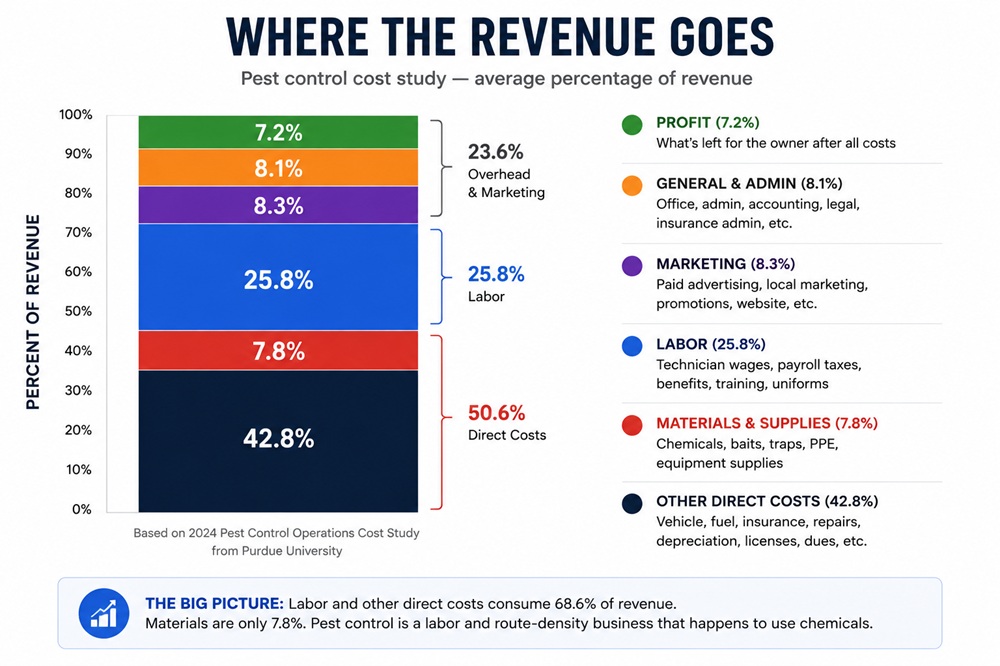
From the NPMA and PCO Bookkeepers 2025 cost study, drawn from 246 firms across 47 states with $584 million in combined revenue:
| Line | Share of revenue |
|---|---|
| Gross margin | 58% |
| Direct labor | 25.8% |
| Materials | 7.8% |
| Marketing and advertising | 6.6% |
| Operating profit margin | 15% |
| Recurring revenue as a share of income | 74% |
Three things in that table should change how you plan.
Materials are cheap and labor is not. Technicians assume chemical cost is a major line because they watch products get used all day. It is under 8%. What you are selling is a person's time arriving reliably at a property, which is why route density is the whole game and why an account thirty minutes away is worse than no account.
Marketing is a real line at 6.6%. Not an afterthought, not something you do when there is spare cash. Established firms spend it every month.
74% recurring is the structure, not an aspiration. Industry-wide, 85.4% of residential pest control revenue sits in recurring plans. A business built on one-time treatments is a different and worse business that has to be re-sold every January.
Dan Gordon, the CPA whose firm ran the study with the NPMA, put the finding plainly when it was released:
"What we are seeing is that companies with strong recurring revenue models and disciplined cost management are significantly outperforming their peers."
Dan Gordon, CPA, founder of PCO Bookkeepers & M&A Specialists
Both halves of that sentence are inside your control on day one, which is not true of much else in your first year.
What three hundred accounts actually pays you
This is the number from the opening, worked out in full.
Our model, built on the cost study percentages above. The account price is the variable that moves it most, so run it with your own.
| 300 residential accounts, quarterly, at $120 a service | $144,000 recurring |
| Plus one-time treatments, callbacks and inspection work, held deliberately low | $150,000 total revenue |
| Operating profit at 15% | $22,500 |
| Direct labor at 25.8%, which you are performing | $38,700 |
| To the owner-operator, before tax | ~$61,000 |
The trick is in the second-to-last line. As a technician you are paid the labor line and nothing else. As an owner doing your own routes you keep the labor line and the profit the branch was making on you. That is the entire difference, and it is why the same pair of hands is worth roughly a third more on its own truck.
Three honest caveats. The one-time line above is held deliberately low; at the industry's 74% recurring share it would be closer to $195,000, and we would rather under-promise.
The $61,000 is also before your own tax, and it assumes 300 accounts you have already built, which takes twelve to twenty-four months. This is the destination, not the first year.
It also shows you why 300 is the number rather than 600. Three hundred quarterly accounts is around five stops a day, which is a half-full route. The second half of your capacity is where the actual money is, because your fixed costs are already covered by the first half. Every account after break-even is worth several times the first ones.
Pro tip: Build your numbers from fixed costs upward and work out how many accounts cover them. Most new owners start from a revenue target and get surprised in month seven.
What launching a pest control business actually costs
Published ranges for starting a pest control business run from about $10,000 to $40,000, and the spread is not disagreement. It is different businesses. The two variables that move it are the vehicle and the categories you carry.
What your state actually charges
You will see vague licensing estimates quoted. Your state publishes real ones:
| State | Fees | Bond | Minimum liability insurance |
|---|---|---|---|
| Tennessee | $150 per exam; $400 charter every two years; $50 per licensee per category | $10,000 for most categories | $250,000 / $500,000, plus errors and omissions of $100,000 / $300,000 for WDO work |
| California | $120 company registration; LiveScan $49 plus rolling fee | $12,500 | $500,000 general liability |
| Texas | Business license via the state portal | None | $500,000 per occurrence / $1,000,000 aggregate |
| North Carolina | Licensee $200 first phase, $75 each additional | Not required at licensee level | Proof required before issuance |
| Alabama | $175 main office, $75 branch, $50 sub-office, $100 per category | $2,500 for subterranean termite work | Certificate required |
| Louisiana | Set by the department | $2,000 | $250,000 per accident / $100,000 property damage |
The paperwork is cheap almost everywhere. The bond and the insurance are the real gates, and in several states they must be in place before anything is issued.
Equipment and vehicle, by tier
This is our own model, built from current equipment pricing and the fee schedules above. Check your own market.
| Tier | Setup | Cost including state fees | Supports |
|---|---|---|---|
| 1. Existing vehicle | Your own sprayers, spreader, inspection gear, PPE, opening chemical stock | $4,000 to $8,000 | General pest, residential, solo |
| 2. Used truck | Above plus a used truck or van, lettering, larger inventory, termite equipment | $15,000 to $25,000 | General pest plus termite, solo, room to grow |
| 3. Truck plus technician | Above plus a second kit, a hire, spray rig, software | $35,000 to $60,000 | Two routes, commercial accounts |
You already know what equipment you prefer, so the useful advice is narrow: buy used from operators upgrading, never buy used PPE or respirators, and buy less chemical than feels right. Your first fifty jobs will tell you what you actually consume.
Deeper breakdowns are in what it really costs to start a pest control business and ways to reduce your startup costs.
Build a pest control route or buy one?
This decision shapes your first three years more than any other, and almost nobody starting a pest control business evaluates it properly.
The numbers above are what a mature route earns. This section is about which way you get one. Pest control businesses trade on a multiple of recurring revenue, because the recurring pest control book is the asset. Trucks depreciate, equipment is a commodity, and what a buyer is actually paying for is the renewal stream.
| Build | Buy | |
|---|---|---|
| Cash at risk | Low, spread over months | High, usually upfront plus a note |
| Time to positive cash flow | Twelve to twenty-four months | Immediate, if the book holds |
| What you control | Everything, including the mistakes | Somebody else's pricing, routes and service history |
| Main risk | Running out of money before the book accumulates | Attrition after handover, and what you paid |
| Licensing | Your own credential must qualify | The company may already hold the license and a qualifying individual |
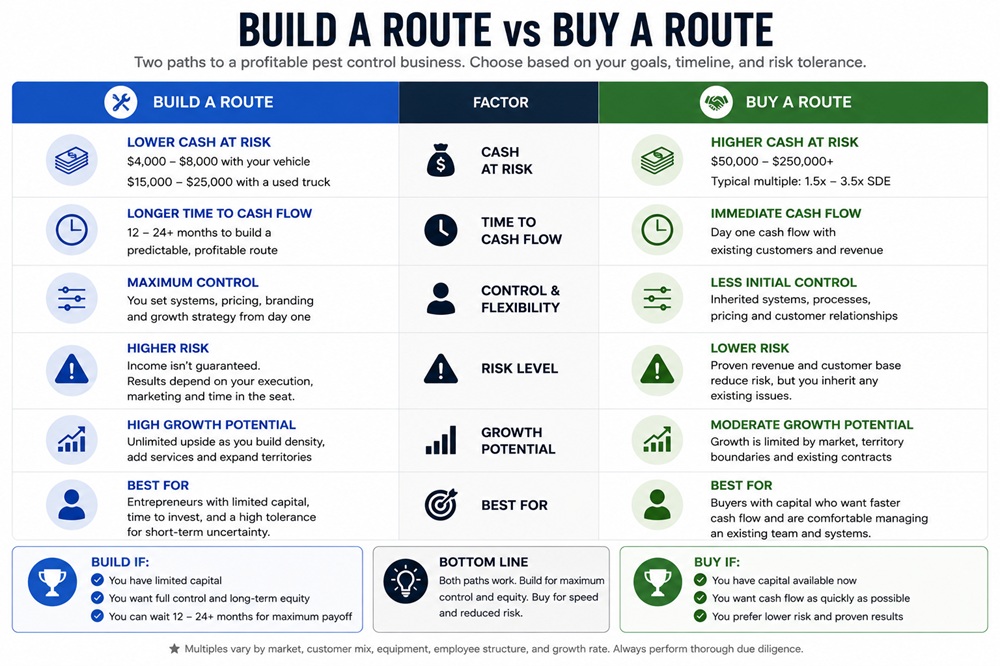
The case for buying is stronger than most technicians assume, particularly with capital and a credential gap. You inherit a book, a license structure and a route that already has density. You also inherit their pricing, which is frequently too low, and their churn, which is frequently understated.
What a book of accounts actually sells for
Nobody on the ranking pages will give you a number, so here is the published one. The M&A advisory firm Breakwater put out 2026 multiples in April, and the tier you would be buying into is the first row:
| Company profile | Multiple |
|---|---|
| Small residential route-based, under $1M revenue | 2.5x to 3.5x SDE |
| Termite-heavy or seasonal models | 1.5x to 2.5x SDE |
| Mixed residential and commercial, $1M to $5M | 3.5x to 5x EBITDA |
| Established operator, $5M to $10M | 5x to 7x EBITDA |
SDE is seller's discretionary earnings: the profit plus whatever the owner was paying himself and running through the business. On a route doing $250,000 with $70,000 of SDE, you are looking at roughly $175,000 to $245,000.
What moves that number is almost entirely the recurring share. Breakwater calls recurring revenue "the single most powerful valuation driver in pest control," and puts companies at 80% or more recurring meaningfully above those living on 50% one-time calls. Dan Gordon's benchmarks at PCO Bookkeepers land in the same place from the other direction, pricing a healthy pest control company at roughly two times revenue when it is returning about 20% of revenue in cash flow to its owner.
Read that as a buyer and it tells you where to look. A seller with a thin recurring book is asking you to pay for a business that has to be re-sold every year. A seller with a dense recurring book at 80% is expensive for a reason.
If you look at a book, the numbers that matter are the share of revenue that is recurring rather than one-time, annual attrition, average revenue per account, how geographically concentrated the route is, and how long the owner has been quietly under-pricing. Ask for three years, not one.
If you build, it is slower but it is being done. Matt Alexander of Arrow Pest Management in Blanchard, Oklahoma went from zero to $500,000 in under two years, which is fast and not typical, but it is a real number attached to a real company rather than a promise. Accept that the first twelve to twenty-four months are a cash problem, and read the working capital section before you resign.
Where you stand on the pest control license
You know the credential structure. The narrower question is whether the company license can carry your name today, or whether it needs somebody else's.
In most states the pest control business license attaches to a designated qualified individual: the certified operator in charge in Florida, the licensee in North Carolina, the qualifying manager in California. Holding a certified applicator credential does not automatically make you that person.
| State | Requirement to be the qualifying individual |
|---|---|
| Florida | Three years as a service employee of a licensee, one of which must be in Florida in the year immediately before applying. A relevant degree with 20+ semester hours in entomology or a related field reduces it to one year |
| North Carolina | Two years of independently verifiable experience after reaching certified applicator status |
| California | An Operator license, the only class that can run a company. An Applicator cannot work independently |
| Texas | Certified applicator tied to a business license, through the apprentice and technician tiers |
If you already qualify, this is a paperwork exercise. Exams, fees, insurance certificate, application, and you are trading.
If you are close but not there, the gap is usually months rather than years, and the cheapest move is to stay employed until you clear it. Document as you go, because states want verifiable employment records: keep pay stubs and write down your employer's license number while you still work there.
If you will not qualify soon, two structures work. Bring in a credential holder as your qualifying individual, which California's board formally recognizes as the qualifying manager role. Or buy a company that already holds the license, which is the route covered above.
Reciprocity is narrower than most people assume. North Carolina reciprocates certified applicator status with only four states and has no reciprocal agreement at all at the licensee level. If you are moving, verify the specific pair.
State procedures differ enough to need their own guides: Texas, California, Arizona, Florida.
Which pest control services to carry at launch
You have probably run several categories at your last employer, so the temptation is to offer everything from day one. Resist it. Every additional pest control category you carry adds a credential, an insurance line, an inventory position and a class of liability, and the ones with the biggest tickets carry the biggest tails.
| Category | Why it works at launch | What it costs you |
|---|---|---|
| General pest, recurring | Predictable, quarterly, low material cost, builds the book that is your actual asset | Nothing beyond your core license and standard liability |
| Rodent | Sells alongside general pest on the same visit, higher ticket, minimal extra kit | Exclusion work is construction-adjacent and slower than you expect |
| Mosquito or seasonal | Strong margin, easy add-on to an existing account | Violently seasonal, so it cannot carry the route |
| Termite and WDO | Largest tickets in residential pest control, plus realtor inspection work | Separate certification in most states, a termite bond in several, errors and omissions coverage, and a damage claim that can outlive the treatment by years |
| Commercial and food service | Contracted revenue, better retention | Documentation standards, audit readiness, night work |
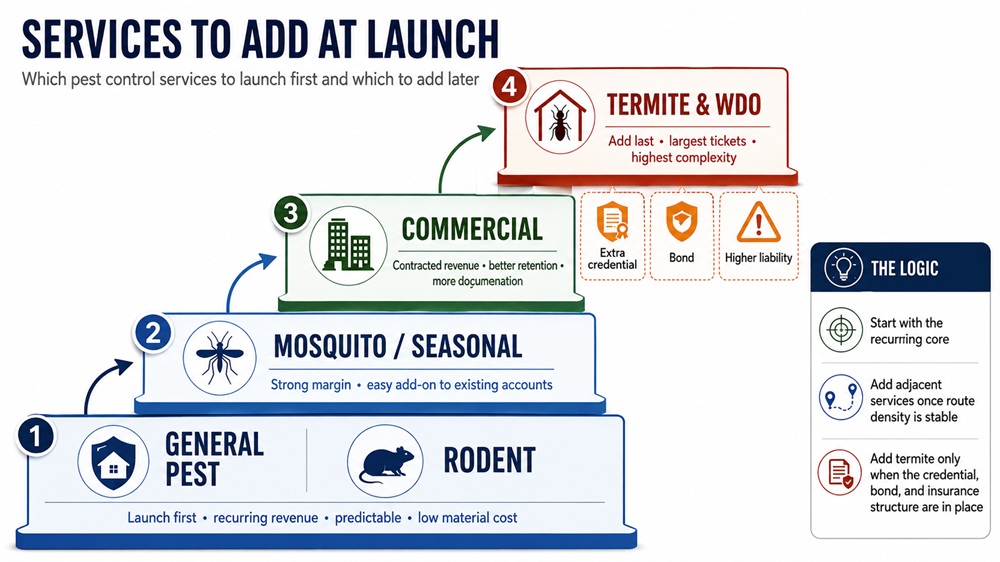
Launch on general pest and rodent, and add the rest deliberately. A general pest account signed in month two is still paying you in year four. A termite job in month two pays well once and hands you a liability you are carrying alone with no reserves behind it.
The exception is if you are buying a book that already carries termite work with the credential and bond in place. Then the category comes with the infrastructure, and the question becomes whether you can service it rather than whether you can afford to start it.
Pest control insurance and bonding
What surprises pest control technicians going independent is not the cost of insurance, it is the sequence. In several states the certificate must be on file before the license issues.
Texas requires $500,000 per occurrence and $1 million aggregate. Florida requires either $250,000/$500,000 bodily injury plus $250,000/$500,000 property damage, or a $500,000 combined single limit, and states plainly that a licensee may not operate without it. North Carolina requires proof before issuance.
Beyond general liability, budget for commercial auto, because your personal policy excludes business use, and workers' compensation the moment you hire. If you carry WDO work, Florida separately mandates errors and omissions at $250,000 per occurrence and $500,000 aggregate, and comparable requirements exist elsewhere.
Pro tip: Ask your carrier for the certificate PDF the day the policy binds. Your state wants it on file, and commercial prospects ask for it before they will accept a bid.
Pricing pest control without a big company's density
Here is the pricing trap for somebody coming out of a large pest control branch. The prices you are used to were supported by a route you did not build. A national can service a $110 quarterly account profitably because the truck is already on that street. On day one, yours is not.
So price from your own effective hourly rate including drive time, not from what your former employer charged.
The structures that work:
- Initial plus recurring. A higher first visit covering the heavy initial treatment, then a lower recurring fee. Standard for general pest and what customers expect.
- Annual agreement billed monthly. Smooths cash flow and raises retention, at the cost of a harder sell.
- Per job, appropriate for one-time treatments, real estate inspections and specialty work, and wrong for the core service.
Do not undercut your former employer to win the first fifty accounts. You will spend three years trying to raise those customers to a sustainable number, and some will leave when you do. Price at or slightly above market and compete on being the person who answers the phone.
More depth in setting competitive pest control prices and pest control estimates.
Your first hundred accounts without your old customer list
Finding accounts is the hard part of starting a pest control business, and it is harder than pest control licensing by a wide margin.
Build pest control route density deliberately, not opportunistically. Pick three or four zip codes you know carry real pest pressure and work them until you are saturated, rather than accepting every job across the county. Eighty accounts inside four neighborhoods is worth more, and costs far less to service, than a hundred and twenty scattered across a metro.
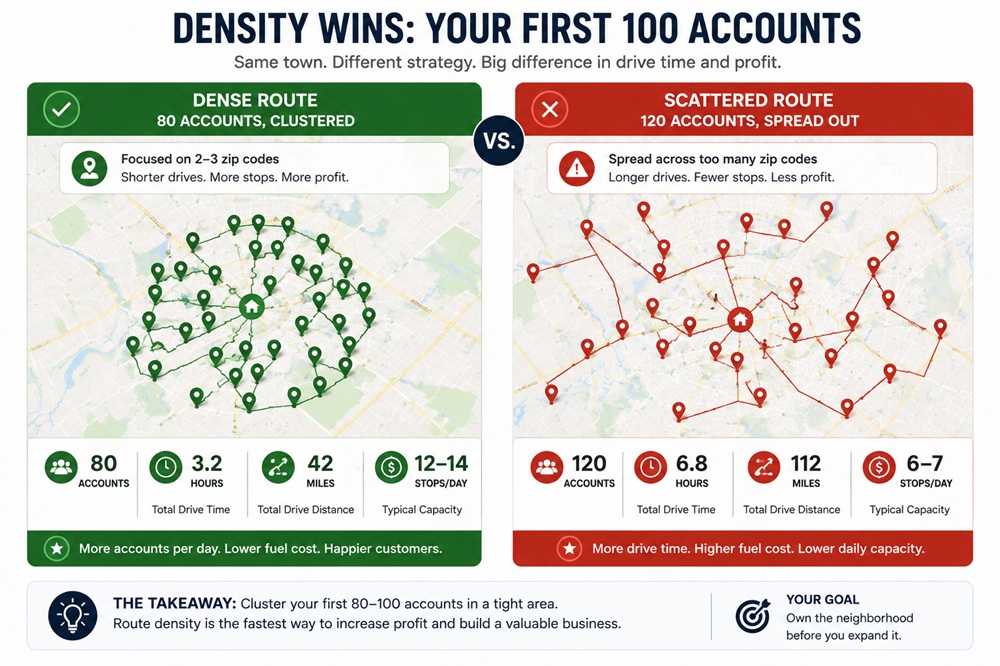
Operators who have done it recently say the same thing. Elliott Hahn's Olympia, Washington firm grew by more than $70,000 in 2025, and he credits the discipline rather than the volume:
"Steady, manageable, local growth helped us consolidate our routes, reducing stress."
Elliott Hahn, Bigfoot Pest Management, Olympia, Washington
The word doing the work there is local. Growth that arrives in the neighborhoods you already serve makes the route cheaper to run. Growth that arrives anywhere else makes it more expensive, and you feel that in your evenings long before you see it in your margin.
Where the first accounts actually come from:
- People who know you personally. Not customers from your old route. People who know you. The distinction is real and it matters legally.
- The street where you already have a job. One account on a block justifies working that block, and the drive is already paid for.
- Google Business Profile. Set it up in week one, before the website. It is free and it is where the "exterminator near me" calls come from. The marketing section below covers what to do with it.
- Property managers, realtors and general contractors. Slower to develop, worth far more. One property manager can be worth a hundred residential accounts, and agents generate WDO inspection work that pays well and repeats.
Convert one-time jobs into plans on the day you do them. A homeowner who has just watched you deal with a roach problem will sign a quarterly plan in a way the same homeowner will not three weeks later. Quote the plan as part of the original job, not as a follow-up call.
Pro tip: Ask for the review at the end of the appointment, in person, while you are still on the property. Highest-conversion moment you will get, and it does not repeat. Follow it with a text containing the direct link.
Getting found is its own discipline: pest control SEO covers local search and pest control marketing covers the wider mix.
How to market a pest control business
Your first hundred accounts come from hustle. Everything after that comes from marketing, and this is the line where most one-truck operators stall: the personal network runs out around account eighty and nothing has been built to replace it.
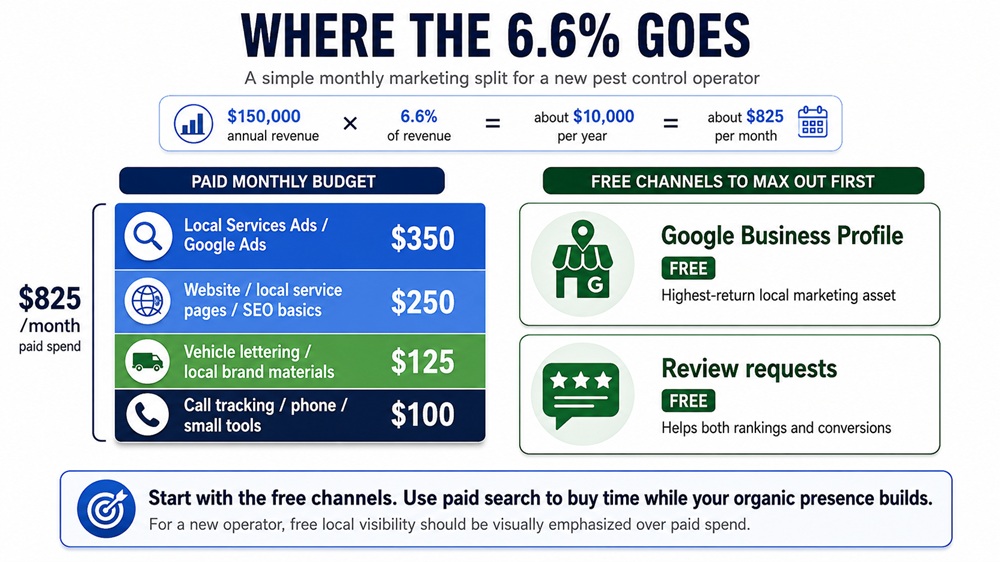
Budget it as a real line from month one. The cost study puts marketing and advertising at 6.6% of revenue across 246 firms. On the $150,000 business modeled earlier that is about $10,000 a year, or $825 a month. Established companies spend that every month, in season and out. A new operator who spends nothing until the phone goes quiet is always three months behind the demand curve.
Where the money actually goes
Google Business Profile is the highest-return thing you will ever do, and it is free. For "exterminator near me" and every variant of it, the map pack sits above the organic results, and most of the calls come from there. Complete every field, pick your categories carefully, post service photos regularly, and answer the questions section yourself. If you are running from home, hide your address: Google directs service area businesses to do that, and a visible residential address risks suspension.
Reviews are the ranking factor and the conversion factor at the same time. Nothing else you can influence does both jobs. Ask at the property, in person, at the end of the appointment, then follow with a text containing the direct link.
Your website's job is smaller than you think. For a solo operator it needs to load fast on a phone, say which towns you serve, name the pests you treat, and make the phone number tappable. Design comes later. Service area pages, written properly rather than spun, are what eventually earn you the surrounding towns.
Paid search buys time, not equity. Local Services Ads and Google Ads put you at the top tomorrow and stop the day you stop paying. There is a reasonable case for running them in your first season while your organic presence builds, as long as you treat the spend as rent rather than investment.
Vehicle lettering is the cheapest advertising in this trade. Your truck sits at the curb for forty minutes a stop, in exactly the neighborhood you are trying to saturate. It is a few hundred dollars once and it works for years.
Check your own numbers before you spend
Three free tools we built for this, none of which need an account:
- Local Search Result Checker answers the first question, which is whether you appear at all for the searches you care about.
- Local Rank Grid maps how your ranking changes across a service area, which is the direct test of the zip-code strategy above. You will usually find you are strong within a mile or two of your address and invisible six miles out.
- Benchmark compares you against the other companies in your target zip codes, which tells you whether a market is worth entering before you buy the truck lettering.
Do this yourself in year one. You have more time than money, the fundamentals above are learnable in a weekend, and nobody understands your service area better than the person who has driven it. Agencies charge from roughly $59 a month for a website through $499 for Google Business Profile management to $799 for full local SEO, and that math starts working when your route is full and your evenings are worth more than the fee.
Full depth in pest control marketing, pest control SEO, generating pest control leads and getting more reviews.
Pest control software and business tools
You have used a field service platform at your last employer, probably PestPac or Briostack, and you have opinions about it. Here is the thing worth knowing: the system you used at a twenty-truck branch is the wrong system for one truck, and buying it on day one is a common and expensive mistake.
Start with the smallest stack that lets you look professional and get paid.
| Category | What it does for a one-truck operation | Commonly used |
|---|---|---|
| Field service platform | Scheduling, recurring service plans, route order, service history, invoicing, card on file. The one purchase that genuinely pays for itself | GorillaDesk, Jobber, Housecall Pro, FieldRoutes, PestPac, Briostack |
| Accounting | Books, tax, and the profit and loss you now need to read | QuickBooks, Xero, Wave |
| Phone and call tracking | A business number that is not your cell, and a record of which marketing made the phone ring | CallRail, Google Voice |
| Reviews | Automated request after each completed job | Usually built into the field service platform; Podium and NiceJob are standalone |
| Website | The page your Google Business Profile points at | WordPress, Squarespace, or a platform-hosted site |
What you need in month one: the field service platform and accounting. That is it. Card on file at the time of service is the single feature that matters most, because chasing payment for completed work is unpaid labor.
What can wait: call tracking until you are spending real money on marketing, standalone review software until the platform's built-in requests stop being enough, and anything described as an enterprise feature until you have a second truck.
Pro tip: Pick the platform on how it handles recurring service plans and route sequencing, not on the feature list. Those two things are your whole business, and platforms built for general home services often handle quarterly recurring pest routes worse than pest-specific ones do.
Deeper comparisons live in what pest control software actually does, the best web-based pest control software and the best apps for owners and technicians.
Leaving the job without burning the bridge
The pest control industry in any given metro is smaller than it looks. Your former branch manager knows the distributor, the state inspector and half the property managers you are about to call on. How you leave is a business asset.
Your non-compete probably matters less than it did
If you signed a non-compete at Orkin, HomeTeam or Critter Control, it is no longer enforceable against you. In April 2026 the Federal Trade Commission ordered Rollins, their parent company, to stop enforcing non-competes against more than 18,000 employees and to notify current and former staff in writing that they are free to compete, in the FTC's own words, "including by starting their own business." The final consent order was approved in June, and thirteen other pest control companies received warning letters the same week.
Outside Rollins the ground has moved too. California, Minnesota, Oklahoma, Colorado and Virginia restrict or void non-competes to varying degrees, and courts have always been reluctant to stop somebody earning a living.
What an employer can still act on is what you take, not where you work.
| Generally defensible | Generally a problem |
|---|---|
| Working the same territory | Copying the customer list, route sheet or CRM export |
| Customers who find you or follow you unprompted | Systematically contacting accounts you serviced, where a valid non-solicit applies |
| Using the skills and product knowledge you built | Using their pricing sheets, margin data or bid documents |
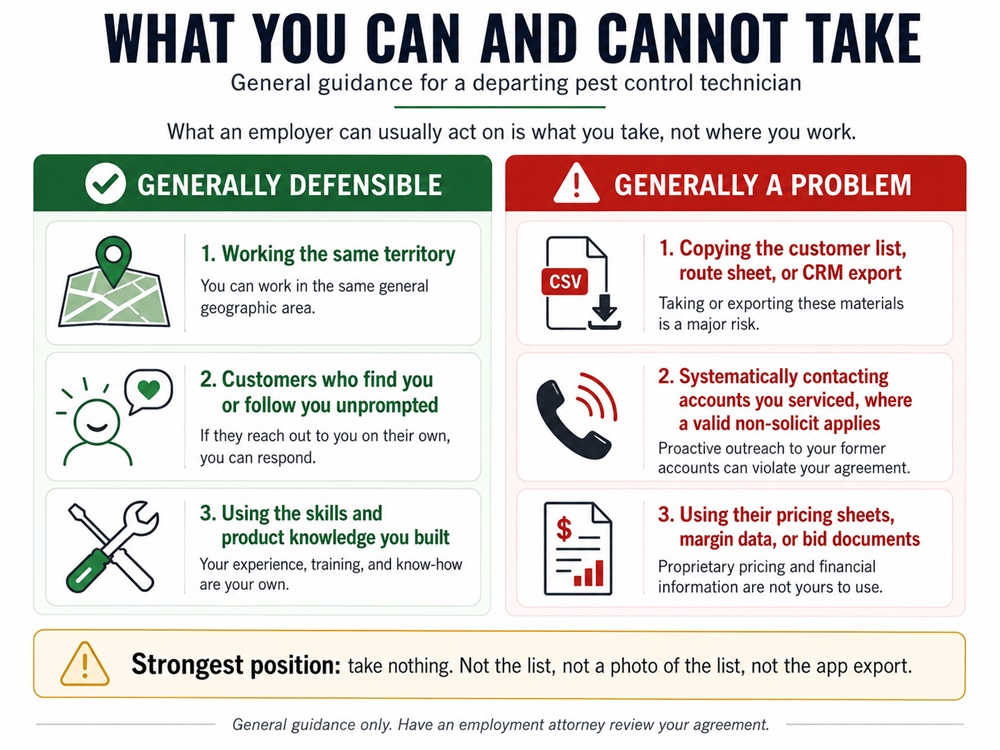
So take nothing. Not the list, not a photo of the list, not the app export. The strongest position available to you is one where your former employer's only complaint is that you exist. If your agreement carries a liquidated damages clause, have an employment attorney read it before you resign, because that clause is designed to turn a hard-to-prove competition claim into a simple breach of contract with a number already attached.
Getting out cleanly
Do the paperwork before you resign. License application in, insurance quoted and ready to bind, entity registered, bank account open. In several states the licensing timeline is measured in weeks after the exam, and every one of those weeks after your last paycheck is a week of runway spent on nothing.
Give real notice and work it properly. Two weeks, full effort, clean handover of your route notes to your replacement. The temptation to coast is strong and it is the single most expensive fortnight you can mishandle.
Say nothing to customers on your route. Not "I'm leaving," not "look me up." A departing technician announcing a new venture on somebody else's stops is the fact pattern that turns a weak non-solicit into a live claim. If a customer finds you later on their own, that is a different conversation and a defensible one.
Plan for the gap. Your last paycheck arrives on your employer's normal cycle. Your first pest control invoice gets issued after your first job, and if you offer net terms, paid two to four weeks after that. Assume eight to ten weeks between the two, and fund it before you hand in the letter rather than discovering it in week six.
Pro tip: Ask your employer for a written record of your service dates and their license number on your way out, framed as a routine employment verification. States want independently verifiable experience, and that request is far easier to make while you still work there.
Working capital: your first twelve months in pest control
Year one in pest control is a cash problem, not a sales problem. Recurring revenue is the model, which means the book accumulates slowly while insurance, the truck payment, the phone and your own living costs start immediately.
| Period | Focus |
|---|---|
| Months 1 to 3 | License and insurance in place, business registered, bank account open, equipment bought. First accounts from people who know you. Cash out, almost nothing in. |
| Months 4 to 6 | Density building in your chosen zip codes. First quarterly renewals arrive, which is the first real signal the model works. Reviews accumulating. |
| Months 7 to 9 | Recurring revenue starts covering fixed costs. This is the month most owners either relax or discover they mispriced. |
| Months 10 to 12 | Route tightening. Reprice or drop accounts that cost you drive time. Decide on a second category or a second truck. |
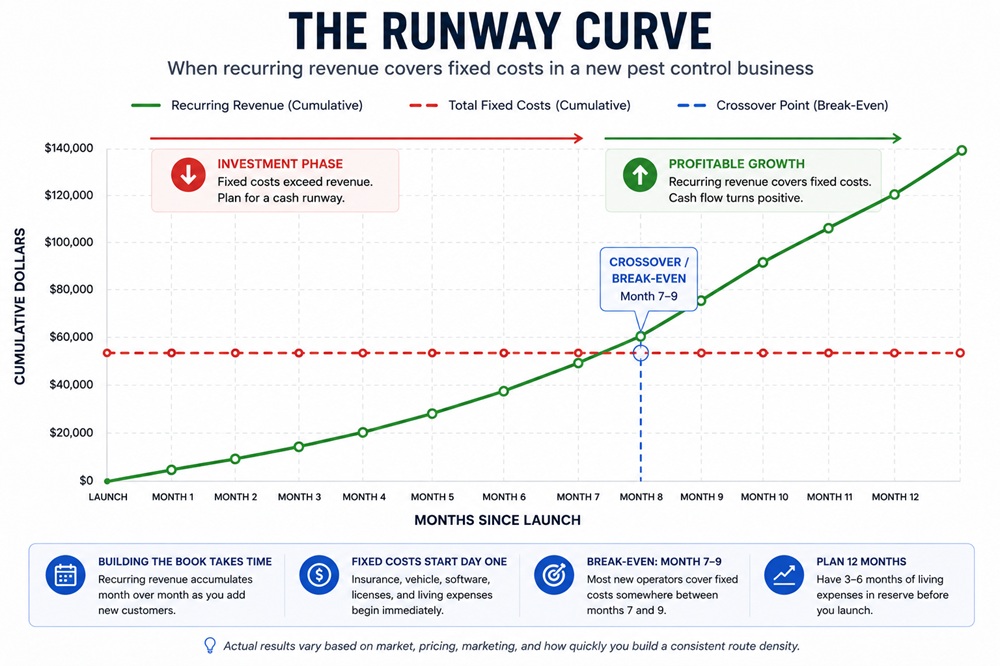
Carry three to six months of personal living costs separately from the business. The most common year-one failure is not a bad business. It is a good pest control business owned by somebody who ran out of runway before month nine.
Hiring your first pest control technician
The decision arrives sooner than most new pest control business owners expect, usually when the route is full and you are doing paperwork at nine at night. It is worth naming what it does to your cash.
A technician costs you money for roughly two to four months before they make you any. Wages start immediately, workers' compensation attaches immediately, the second kit and the second vehicle are upfront, and their route is not full yet. Direct labor runs 25.8% of revenue across the cost study firms, and that figure describes pest control businesses where the routes are already dense. Yours will run higher while you fill theirs.
Hire against a route you can already see, not against a hope. The practical trigger is when you are consistently turning work away in a zip code you already serve, because that is the only situation where a second technician inherits density on day one.
Then decide what you are hiring. A licensed technician costs more and produces immediately. An apprentice costs less and needs supervised hours before they can work alone, which in most states means your time, which is the resource you were short of in the first place.
Pro tip: Model the hire as a twelve-week cash hole and check you can absorb it while still paying yourself. If the answer is no, raise your prices first. That is a faster route to the same relief.
Hiring and keeping people is its own problem: hiring pest control technicians and technician training and retention.
What kills new pest control businesses
1. Underpricing pest control work to win the first fifty accounts. The most common mistake made by people coming out of large pest control companies, and the hardest to unwind.
2. Taking the customer list. It converts a defensible position into an indefensible one, and it is the one thing a former employer can genuinely act on.
3. Spreading the route. Saying yes to everyone is how you end up driving forty minutes for a $95 stop. Density is the margin.
4. Running out of runway in month eight. The book is usually working by then. The owner sometimes is not.
5. Adding pest control categories too early. Termite work carries bigger tickets and separate licensing, bonding, insurance and real inspection liability. Add it once general pest is stable.
6. Billing after the fact. Card on file, charged at service. Chasing money for completed work is unpaid labor and it scales badly.
Frequently Asked Questions
Q.1 How do I start a pest control business?
Qualify to hold or carry the state license, register the business, bind liability insurance and any required bond, buy a vehicle-based kit and a field service platform, set prices from your own effective hourly rate rather than your former employer's, then build density in three or four zip codes rather than accepting work across a whole metro. Expect $4,000 to $25,000 to launch depending on the vehicle, and twelve to twenty-four months before recurring revenue covers fixed costs.
Q.2 Can my employer stop me from starting a pest control business?
In most cases, no. In April 2026 the FTC ordered Rollins, parent of Orkin, HomeTeam and Critter Control, to stop enforcing non-competes against more than 18,000 employees and to notify current and former staff that they may compete, including by starting their own business. Several states also restrict or void non-competes outright. What an employer can usually act on is misappropriation of trade secrets, meaning customer lists, pricing sheets and route data, rather than competition itself.
Q.3 How much does it cost to start a pest control business?
Starting a pest control business costs between $4,000 and $8,000 if you already own a suitable vehicle and begin with general pest service, or $15,000 to $25,000 once you add a used truck and termite work. State fees are a small part of it: Tennessee charges $150 per exam and $400 for a two-year charter, California $120 to register a company. The larger fixed costs are the surety bond and the liability insurance your state requires before licensing.
Q.4 Should I buy a pest control route or build one?
Buying gives you immediate cash flow and often an existing license structure, at the cost of paying upfront for a book whose attrition and pricing you inherit. Small residential route-based pest control companies under $1 million in revenue sold for roughly 2.5 to 3.5 times seller's discretionary earnings in 2026, with termite-heavy and seasonal books lower at 1.5 to 2.5 times. Building costs less cash but takes twelve to twenty-four months to reach positive cash flow. Because recurring revenue is the largest driver of the multiple, examine the recurring share, annual attrition and geographic concentration of a route before you look at the asking price.
Q.5 How profitable is a pest control business?
The NPMA and PCO Bookkeepers 2025 cost study, based on 246 firms across 47 states, found average gross margin of 58% and operating margin of 15%, with recurring work at 74% of income. Direct labor is the largest cost at 25.8% of revenue and materials only 7.8%. Applying that structure, roughly 300 quarterly residential accounts at $120 a service produces about $150,000 in revenue and around $61,000 to a solo owner-operator before tax, because the owner keeps both the 15% profit and the 25.8% labor line he performs himself. Profitability is driven by route density, since unbillable drive time between stops is the largest hidden cost in a pest control business.
Q.6 Do I need my own license or can somebody else hold it?
Both structures are legal in most states. The pest control business license attaches to a designated qualified individual, which can be you if you meet the experience requirement, or somebody you bring in. California formally recognizes this as the qualifying manager role. If you use another person's credential, the arrangement needs written terms, because your company's license depends on their continued involvement.
Q.7 How long until a pest control business is profitable?
Most solo pest control business owners reach the point where recurring revenue covers fixed costs somewhere between months seven and twelve, assuming steady account acquisition and disciplined pricing. That timeline is why working capital matters more than sales skill in year one: accounts accumulate slowly while insurance, vehicle and living costs start immediately.
Conclusion
Most of how to start a pest control business comes down to arithmetic you can do at your kitchen table this weekend. Take your own average ticket, an honest account count, and the percentages on this page, and work out what your version of the 300-account number looks like. Then work out how many months of fixed costs you need behind you to get there.
The one thing that will not come out of a spreadsheet is whether customers follow you once the logo comes off the truck. You already have more evidence on that than you think, and it is sitting in the list of people who ask the office for you by name.