You can pay about $70 for a pest control lead and still come out ahead.
Most operators think the number is $25 and refuse every paid channel on the strength of that guess. Some think it is $200 and burn a season finding out otherwise. Almost nobody has worked it out, because working it out means knowing what an account is worth over three years, and nothing in this industry publishes that either.
So this guide starts with the money. What established firms actually spend, what an account is actually worth, and what you can therefore afford to pay to win one. Then the channels, ranked by what they cost you.
The tactics come last on purpose. A tactic you cannot afford is not a strategy, and twelve of them in a list is not a plan.
This guide leads with the single-location operator, because that is most of the market and the fundamentals are the same either way. If you run more than one location, everything here still applies and section 14 is written specifically for you, covering profiles, boundaries, brand architecture and budget allocation across markets.
New to the business entirely? How to start a pest control business covers what to have in place before marketing is your problem.
The short version
Set the pest control marketing budget at 6.6% of revenue and hold it through the slow months. Work out what a customer is worth over three years, divide by your close rate, and that is your ceiling on cost per lead.
Spend the free channels first: Google Business Profile, reviews, and the accounts you already have. Add paid once those are saturated and you know your numbers, then match the calendar to the season rather than spending evenly across a year that is not even.
What's in this guide
- What to actually spend on pest control marketing
- What a customer is worth, and what you can pay to get one
- Pest control marketing channels, ranked by what they cost you
- Google Business Profile and local search
- Pest control advertising: where paid actually fits
- Reviews as a marketing channel
- Your website's actual job in pest control marketing
- Offline pest control promotion that still works
- The referral program that actually gets used
- What a month of pest control marketing actually looks like
- Six pest control marketing mistakes that cost real money
- The seasonal calendar
- Keeping accounts is cheaper than winning them
- Marketing a multi-location pest control business
- How to tell what is working
- Your first ninety days
What to actually spend on pest control marketing
Here is the number nobody publishes.
The NPMA and PCO Bookkeepers 2025 cost study, drawn from 246 firms across 47 states with $584 million in combined revenue, puts marketing and advertising at 6.6% of revenue.
That is not a recommendation from an agency. It is what the industry actually spends, measured.
| Your annual revenue | 6.6% marketing budget | Per month |
|---|---|---|
| $150,000 | $9,900 | $825 |
| $250,000 | $16,500 | $1,375 |
| $400,000 | $26,400 | $2,200 |
| $750,000 | $49,500 | $4,125 |
| $1,500,000 | $99,000 | $8,250 |
Applying the study's percentage to revenue levels. Your own mix will vary.
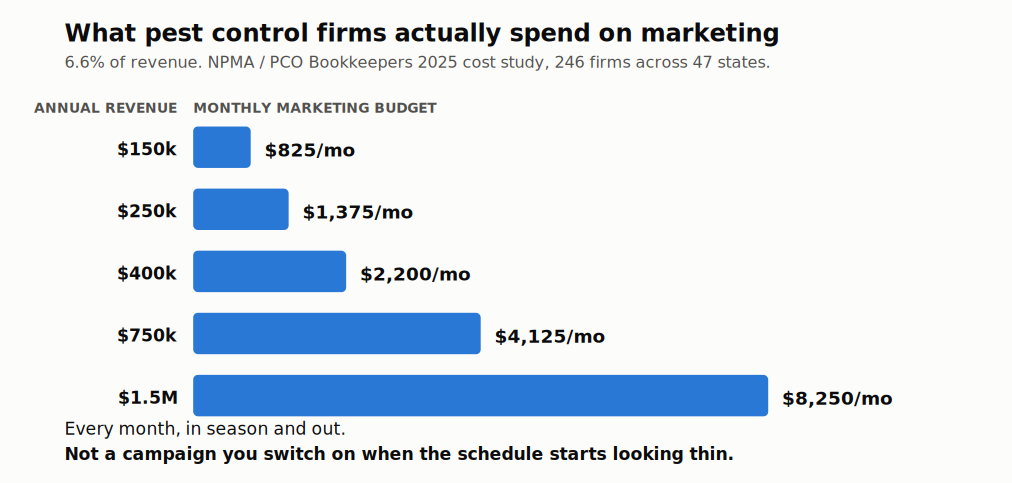
Three things follow from that table.
It is a monthly commitment, not a campaign. Established firms spend it every month. The most common failure in marketing a pest control business is spending nothing until the schedule looks thin, then spending heavily for six weeks, then stopping. Demand generation has a lag, so that pattern guarantees you are always three months behind.
Below roughly $150,000 in revenue, percentage-based budgeting breaks down. Six point six percent of $80,000 is $440 a month, which does not buy meaningful paid reach. At that stage the answer is to spend time instead of money on the free channels, which is exactly what the next sections cover.
A new business should budget above the benchmark, not at it. The 6.6% figure comes from firms with an established book. When you have no recurring base, you are buying the book itself, and 10% to 12% for the first year or two is a defensible investment rather than an overspend. That extra spend is buying an asset, since 74% of pest control revenue is recurring and the customer you win in March is still paying in year four.
Pro tip: Put the marketing budget on a standing monthly transfer to a separate account, the way you would a truck payment. Owners who budget marketing as leftover cash spend nothing in the months they most need to.
What a pest control customer is worth, and what you can pay to get one
This is the calculation that changes every other decision on this page, and no competing guide performs it.
Start with what an account is worth
Our model, using round numbers. Substitute your own average ticket and retention.
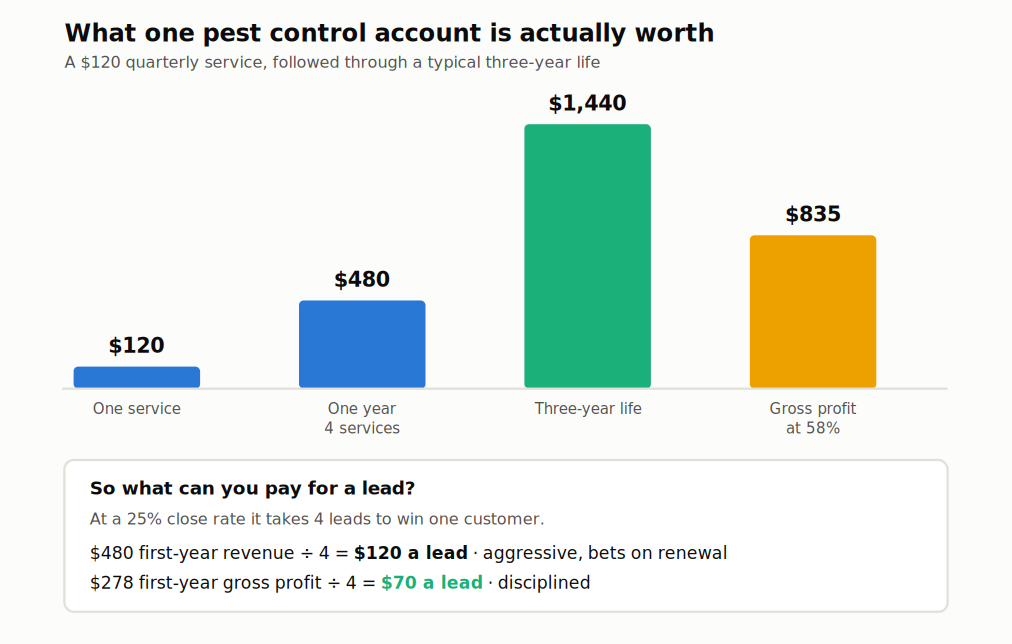
| Quarterly service at $120 | $480 a year |
| Typical account life, three years | $1,440 in revenue |
| Gross margin at 58% (cost study) | ~$835 in gross profit |
| Plus one-time work, referrals and the resale value of the book | Upside not counted here |
An account is not a $120 sale. It is roughly $1,400 of revenue arriving in small pieces over three years. Operators who price acquisition against the first invoice systematically underspend on marketing.
Then work backward to your maximum cost per lead
Two numbers turn customer value into a spending ceiling: your close rate, and how fast you need the money back.
| Leads needed to close one customer, at a 25% close rate | 4 |
| First-year revenue per customer | $480 |
| If you want the customer's first year to cover acquisition | $480 ÷ 4 = $120 per lead |
| If you want acquisition recovered from gross profit in year one | $278 ÷ 4 = ~$70 per lead |
Roughly $70 a lead is the disciplined number, and $120 is the aggressive one that bets on the account renewing. Both are far above what most operators think they can pay, which is why so many refuse paid channels that would work for them.
Run this with your own figures before you spend anything. The three inputs that move it most are your close rate, your average ticket, and your cancellation rate. Improve the close rate from 20% to 33% and your affordable cost per lead rises by two thirds without another dollar of spend.
Pro tip: Track close rate by channel, not overall. A referral closes at a completely different rate from a cold Google Ads click, and blending them hides which channel is actually profitable.
Pest control marketing channels, ranked by what they cost you
Not by popularity. By what each pest control marketing channel costs and what it returns.
| Channel | Cost | Speed | Best for |
|---|---|---|---|
| Google Business Profile | Free, time only | Weeks | Everyone. Nothing else returns as much |
| Reviews | Free, discipline only | Ongoing | Everyone. Ranking and conversion at once |
| Existing customers | Near zero | Immediate | Retention, upsells, referrals |
| Local Services Ads | Per lead | Days | Filling a thin schedule fast |
| Google Ads | Per click | Days | Specific high-value services, termite and WDO |
| Local SEO and content | Time or agency fee | 3 to 9 months | Durable ranking, lowest long-run cost |
| Vehicle wraps | A few hundred, once | Months | Density in the neighborhoods you already serve |
| Referral program | Percentage of value | Ongoing | Highest close rate of anything |
| Direct mail and door hangers | Per piece | Weeks | Saturating a target zip code |
| Social media | Time | Slow | Trust and proof, rarely direct leads |
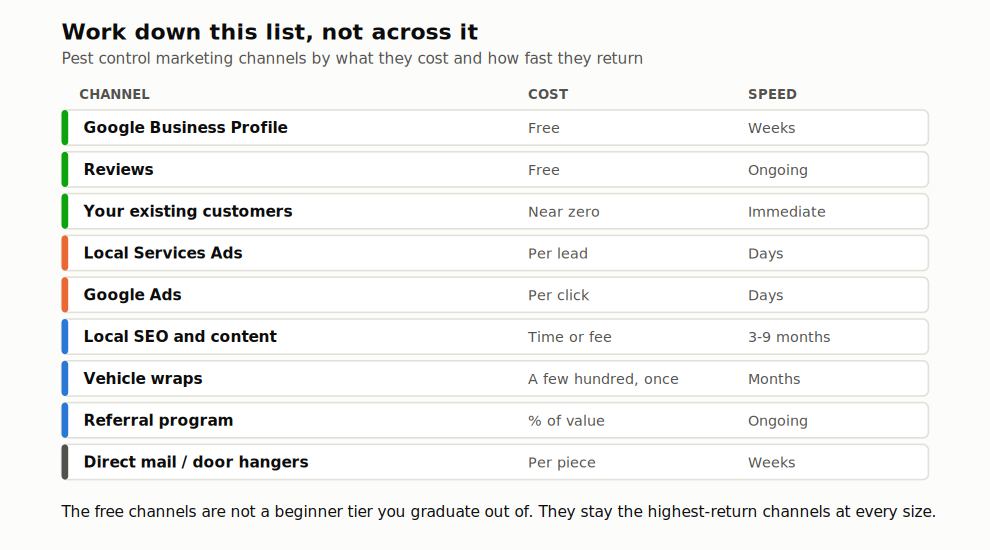
Work down this list, not across it. The free channels are not the beginner tier you graduate out of. They stay the highest-return channels at every size, and paid spend layered on top of a weak profile is expensive.
Google Business Profile and local search
For "exterminator near me" and every variant of it, the map pack sits above the organic results. That is where the calls come from, it is free, and most profiles are half-built.
Set up your pest control profile field by field
| Field | What to put in it |
|---|---|
| Primary category | Pest Control Service. Add secondary categories only for work you genuinely do, such as Animal Control Service. A category you cannot service produces refunds and one-star reviews |
| Business name | Your registered name, exactly. Not "Springfield Best Pest Control Exterminator". Keyword-stuffed names get reported by competitors and edited by Google |
| Address | Hide it if you work from home. Google directs service area businesses to do this, and a visible residential address risks suspension |
| Service areas | The towns and zip codes you actually run, not the whole metro. A service area wider than your route dilutes the signal and brings calls you cannot profitably take |
| Hours | Real hours, including whether you answer weekends, plus holiday hours. A profile showing open when nobody picks up turns a lead into a bad review |
| Services | Each one as its own entry with a description: general pest, termite and WDO, rodent, mosquito, bed bug, wildlife. Each entry is a phrase you can be found for |
| Products | Your recurring plans, with prices. Almost no pest control profile fills this in |
| Photos | Ten at setup, then two or three a week. Real trucks, real technicians, real jobs |
The fifteen minutes a week that keeps it ranking
- One post. A completed job, a seasonal warning, or a plan offer. Two sentences and a photo.
- Two or three photos from the week's stops.
- Answer every question and every review that arrived, including the good ones.
- Add one service or product entry you have not listed yet, until the list is complete.
Get your citations consistent while you are at it. Name, address and phone identical everywhere they appear. Inconsistency is a slow, quiet ranking drag. More in pest control citations.
Then check reality instead of assuming
Ranking varies street by street. Most operators are strong within a mile or two of their address and invisible six miles out, and they never find out because they only ever search from the office.
Our Local Search Result Checker answers whether you appear at all. The Local Rank Grid maps how it changes across your area.
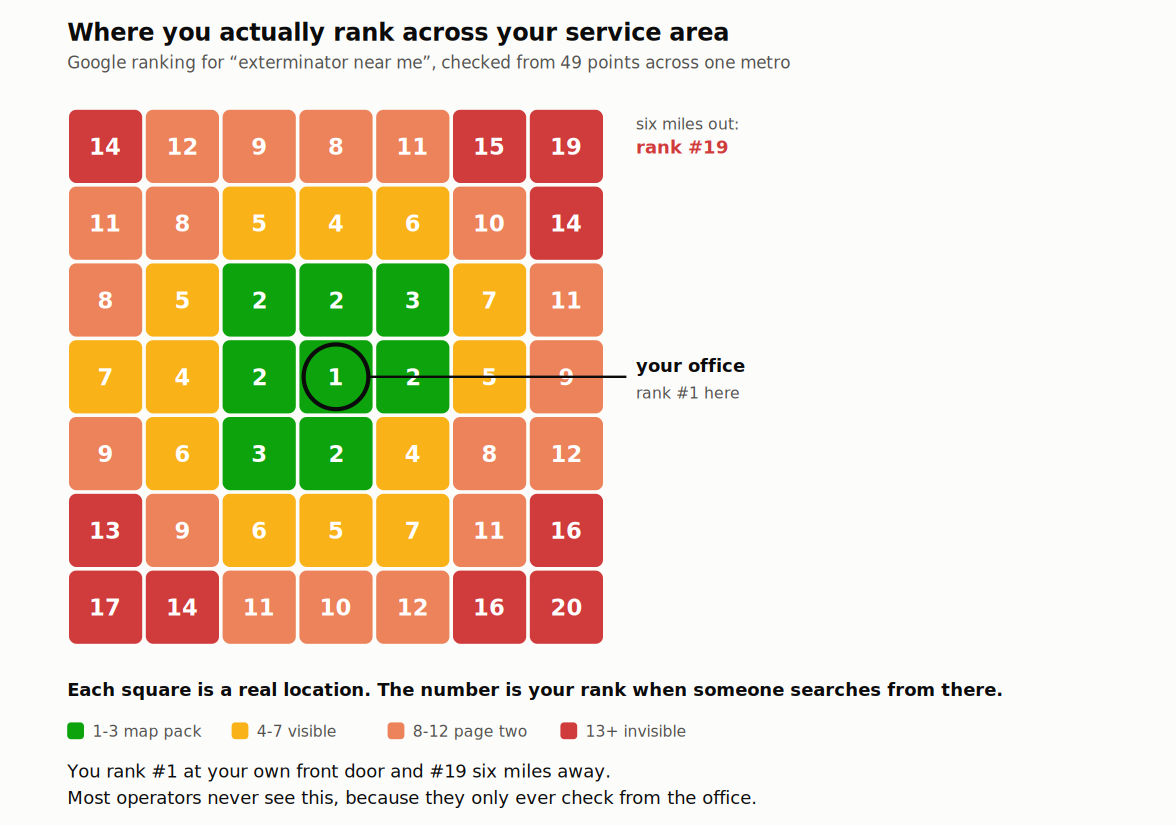
That picture is the whole argument. A single ranking number tells you nothing. Run the grid, find your red edge, and point your content and your ad geography at it.
The full treatment lives in pest control SEO.
Pro tip: Photograph every completed job, get the customer's nod, and post it. Real work in recognizable neighborhoods outperforms stock imagery on both ranking and conversion, and it costs fifteen seconds a stop.
Pest control advertising: where paid actually fits
Pest control advertising buys time, not equity. It works the day you switch it on and stops the day you switch it off, which makes it right for specific situations rather than as a foundation.
Switch it on when your schedule has real capacity, you know your maximum cost per lead, and your profile and reviews are already decent. Paid traffic landing on a weak profile converts badly and costs exactly the same.
Local Services Ads: the pest control ads setup
Google's LSAs sit above everything with a "Google Guaranteed" badge, and you pay per lead rather than per click. For pest control this is usually the first paid channel worth trying.
- Start verification now, before you plan the budget. License, insurance certificate and a background check. Allow one to two weeks.
- Set a weekly budget, not a daily one. Pest leads arrive unevenly, and a weekly cap lets a busy Tuesday spend Thursday's money.
- Select only the job types you actually do. Every extra type you tick produces leads you refund or regret.
- Match the service area to your route, not your ambition.
- Review and dispute leads every Monday. Wrong numbers, out-of-area calls and services you do not offer can be challenged. Operators who never bother quietly pay for leads they never had. Fifteen minutes a week.
Google Ads: the structure that stops it leaking
Pest control ads on standard search cost per click and need more management. They earn their place on high-value, high-intent work: termite and WDO inspection, bed bugs, commercial contracts. A $600 termite job supports a click cost $120 quarterly cannot.
| Setting | What to do |
|---|---|
| Campaign structure | One campaign per service line, not one campaign for everything. Termite, bed bug and general pest have different values and deserve different bids |
| Match types | Phrase and exact. Broad match on a small budget spends it on "pest control salary" and "how to kill ants naturally" |
| Negative keywords | Build the list before launch: free, DIY, how to, home remedy, vinegar, natural, salary, jobs, training, license, school, courses |
| Geography | A radius that matches your route, or the specific zip codes from your rank grid. Exclude the ones you cannot service |
| Ad schedule | Only the hours somebody answers the phone. A pest control click at 9pm that reaches voicemail is a click you paid for and lost |
| Extensions | Call extension with a tracked number, location, and callouts for licensed, insured and same-day where true |
Check the search terms report weekly for the first month. That is where you find the queries actually triggering your ads, and it is where the negative list gets its real entries.
The rule that keeps paid honest
Set the maximum cost per lead before you launch, then hold it. If a channel cannot deliver under roughly $70, it does not work for you at your current close rate. That is a measurement, not a defeat, and it points you back at the free channels or at fixing the close rate first.
Buying leads from third-party services is a related decision with its own arithmetic, in pest control leads.
Reviews as a marketing channel
Reviews are the only lever that improves ranking and conversion at the same time. Nothing you can buy does both.
The ask, word for word
At the end of the appointment, on the property, before you pack up:
"If you were happy with today, a Google review helps me more than anything else. I'll text you the link now while I'm standing here."
Then send it before you get in the truck. The link is the direct review link from your Google Business Profile, not your homepage.
The follow-up text, if they did not do it on the spot, sent the next morning:
"Thanks again for having us out yesterday. Here's that review link if you have a minute: [link]. Either way, call me if anything comes back."
The cadence
| Who | Does what | How often |
|---|---|---|
| Every technician | Asks in person at the end of every completed job | Every stop |
| Every technician | Sends the link by text before leaving | Every stop |
| Office | Chases anyone who said yes and did not | Weekly |
| Owner | Replies to every review | Within 48 hours |
Two reviews a week compounds into a position competitors cannot buy past. That is roughly a 20% ask-to-review conversion on a light route, which is achievable when the ask is in person.
Replying, including to the bad ones
A measured reply to a one-star review is read by the next fifty prospects, and it is read as evidence of how you handle problems. The pattern that works: thank them, name the specific issue without arguing, say what you have done, move it offline.
"Thanks for telling us, Dave. You're right that we missed the follow-up on the rodent exclusion, and that's on our scheduling. I've credited the visit and Marcus will call you today to book the re-treat."
Never buy reviews or trade them for discounts. Platform policies prohibit it, removal is routine, and the damage when it surfaces costs more than the slow route saves.
Depth in getting more pest control reviews.
Your website's actual job in pest control marketing
Smaller than most operators assume. For a one-to-five-truck business, the site exists to convert someone who already found you, usually from the map pack, usually on a phone, usually within thirty seconds.
The pages a pest control website actually needs
| Page | What goes on it |
|---|---|
| Home | Towns you serve, pests you treat, tappable phone number above the fold, three reviews, a photo of a real truck |
| One page per service | General pest, termite and WDO, rodent, mosquito, bed bug. What the treatment involves, what it costs or the range, how fast you can come |
| One page per town you actually service | The pests that are genuinely a problem there, the neighborhoods, work you have done locally |
| Plans and pricing | Your recurring plans with real numbers. Most competitors hide this, which is why publishing it converts |
| About | Your license number, years in the trade, photos of the actual people |
| Contact | Phone, form, service area map, hours |
Service area pages earn the surrounding towns, but only when each carries something real. Twenty near-identical pages with the town name swapped will not rank and can drag the whole site down.
The four checks that matter more than design
- Loads in under three seconds on a phone on cell data. Test it on your own phone away from the office wifi.
- The phone number is tappable and above the fold on every page.
- Every page has one obvious action. Call, book, or request an inspection. A page offering six equal choices produces fewer of all six.
- Your license number appears somewhere. It is a trust signal in a trade where anyone can print a magnet.
More in pest control website tips and website design best practices.
Offline pest control promotion that still works
Digital dominates, and three offline channels still earn their place in this trade specifically.
Vehicle graphics: the cheapest pest control advertising there is
The cheapest advertising in pest control. Your truck sits at the curb for forty minutes a stop, in exactly the neighborhood you are trying to saturate. A few hundred dollars once, working for years.
What goes on it, in order of size: what you do ("Pest Control"), the phone number, the towns or "Serving [County]", your license number. Not your full service list, which nobody reads at 30mph.
Door hangers on the street you are already working
You are there, the drive is already paid for, and the neighbors of a treated house are the most qualified prospects in the zip code. This is pest control promotion at its most efficient: no media cost and no targeting problem.
The mechanic: carry 25 in the truck. After each completed job, hang the eight nearest doors, four either side and four across. Ten minutes. Do it on the day, while your truck is visibly parked there.
What the hanger says: that you are working on this street today, what you treated in general terms, and the number. A neighbor's biggest question is whether you are a real local company, and a truck outside answers it.
Property managers, realtors and general contractors
Slower to develop, worth far more. One property manager can be worth a hundred residential accounts, and agents generate WDO inspection work that pays well and repeats.
The approach that works: turn up in person with a one-page sheet showing your license, insurance limits, response time and WDO turnaround. Ask what their current provider does badly. Most switch over response time, not price.
Direct mail still works for saturating a chosen zip code and is the most expensive per acquisition on this list. Try it after the free channels are saturated, not before.
Pro tip: Print door hangers that say a neighbor on this street is already a customer, without naming them. It converts far better than a generic offer, because it answers the question the homeowner is actually asking.
The referral program that actually gets used
Referrals close at a higher rate than any channel you can buy, and most pest control businesses have no mechanism for producing them beyond hoping.
Make the ask specific and timed. "If you know anyone with the same problem" produces nothing. "Do you know anyone else on this street with ants? I am here every quarter anyway" produces a name, because it is narrow, it is local, and it removes the effort.
Pay for the outcome, not the intention. A month of free service for a referral who signs a plan costs you roughly $30 of material and time against an account worth $1,400. Cash also works and is cleaner to track.
Build a partner list, not just a customer list. Property managers, realtors, home inspectors and general contractors each send work on a repeating basis. One property manager can be worth a hundred residential accounts, and a home inspector who trusts you generates WDO work that pays well and repeats.
Track referral rate as a number. Referrals as a share of new accounts, reviewed quarterly. If it is under 15% for a residential route, the mechanism is missing rather than the goodwill.
Pro tip: Ask for the referral at the second or third service, not the first. The customer needs to have seen you show up on schedule at least twice before their recommendation carries anything they are comfortable staking.
What a month of pest control marketing actually looks like
Budgets and channels are abstract until they are on a calendar. Here is a working month for a $400,000 business spending the benchmark $2,200.
| Where it goes | Monthly | What it buys |
|---|---|---|
| Local Services Ads and Google Ads | $900 | Roughly 13 leads at $70, about 3 new accounts at a 25% close |
| Local SEO and content | $700 | Two service area pages or one substantial guide, compounding |
| Website hosting, tools, call tracking | $200 | The measurement without which the rest is guesswork |
| Review generation and customer communication | $150 | Automated requests, follow-up texts |
| Print, door hangers, vehicle graphics amortized | $250 | Density in the zip codes you already serve |
| Total | $2,200 |
Our allocation, built on the benchmark and the cost-per-lead ceiling above. Yours will shift with season and market.
Two things to notice. Paid is the largest line but not the majority, because a business spending everything on ads owns nothing when it stops. And measurement gets a real line, because the alternative is repeating whatever you happened to do last year.
The weekly rhythm underneath it is smaller than the budget suggests: ask every customer for a review, post one Google Business Profile update, photograph two completed jobs, and once a month check the numbers in the measurement section below. That is most of it.
Six pest control marketing mistakes that cost real money
Each of these is common, each is expensive, and each is fixable this week.
1. Spending only when the schedule looks thin. Demand generation has a lag of weeks to months, so reactive spending guarantees you arrive after the demand. Hold the monthly budget through the quiet months.
2. Running pest control ads before the profile and reviews are ready. Paid traffic landing on a thin Google Business Profile with four reviews converts badly and costs exactly the same per click as traffic landing on a strong one.
3. Bidding across a whole metro. Clicks from thirty minutes outside your route are money spent on jobs you cannot service profitably, and drive time is already the largest hidden cost in this business.
4. Treating one-time jobs as the finish line. A homeowner who has just watched you deal with a roach problem will sign a quarterly plan on the spot in a way the same homeowner will not three weeks later. Quote the plan during the original job.
5. Measuring leads instead of acquired customers. A channel producing forty cheap leads that close at 5% is worse than one producing eight leads that close at 40%, and a leads-only report says the opposite.
6. Never asking for the review. Two a week compounds into a position no competitor can outspend. It costs nothing and it is the most commonly skipped item on this page.
The seasonal calendar
Pest demand is violently seasonal and most marketing budgets are flat. That mismatch is the most common structural error in marketing a pest control business.
Two lags govern the whole pest control marketing calendar. Search demand rises before the pests do, because homeowners search at the first sighting. And content takes three to six months to rank, so anything you publish in spring arrives after the season it was written for.
| Period | Demand | Where the money and effort go |
|---|---|---|
| Winter, Dec to Feb | Trough | Publish termite and spring content now so it ranks by March. Rebuild the website. Clean up citations. Ask the year's quiet customers for reviews. Paid spend at its lowest |
| Early spring, Mar to Apr | Rising fast, termite swarms | Paid spend up hard. Termite and swarm campaigns live. This is the highest-intent window of the year |
| Summer, May to Aug | Peak | Maximum paid spend while capacity allows. Push recurring plans over one-time treatments, since a summer one-time customer is a winter cancellation |
| Fall, Sep to Nov | Declining, rodents rise | Shift messaging to rodent exclusion. Begin retention work on accounts that renew in winter |
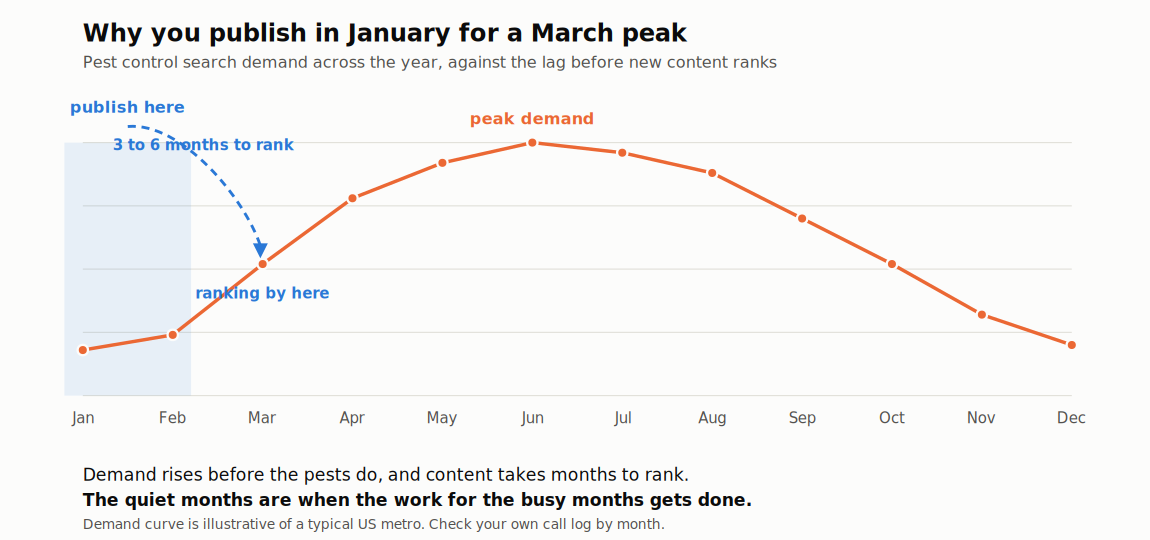
The winter trough is the most valuable and least used period in this business. Everyone else goes quiet. Content published in January is ranking when demand peaks, and the ad auction is cheapest when nobody is bidding.
Pro tip: Look at your own call log by month before you build a calendar from anyone's generalization. Regional variation is enormous, and your own data is more reliable than any national curve.
Keeping accounts is cheaper than winning them
In a business where 74% of revenue is recurring, retention is a marketing channel, and it is the one nobody on this SERP treats as such.
The arithmetic is direct. A customer worth roughly $1,400 over three years, lost after twelve months, cost you $960 in future revenue. Cutting cancellations by two percentage points across two hundred accounts is worth more than most campaigns, and costs almost nothing.
Where accounts actually leave:
- The technician changed and nobody said so. The relationship is with a person. Warn them.
- A missed or late service, unexplained. The service itself matters less than the silence around it.
- A price rise with no notice or reason. Raise prices, and give thirty days' warning with a plain explanation.
- A callback handled slowly. The moment that decides renewal is not the routine visit, it is the one where something went wrong.
- Silence between quarterly visits. Ninety days of nothing makes the invoice feel like a surprise.
The cheapest retention tactic in this trade: a short message a few days after each service saying what was found and what was done. It costs nothing, and it converts an invisible visit into visible work.
Marketing a multi-location pest control business
Nothing on the first page of results for this keyword addresses running more than one location, and the problems change materially the moment you cross a metro line. If you are here for this, it starts now.
Profiles: one per location, with a real address
This is the foundation and it is where most multi-location operators come unstuck.
| Rule | Why |
|---|---|
| A separate Google Business Profile per location | Without it the second market has no local presence at all and cannot appear in its own map pack |
| A real address with real staff | A virtual office or a mailbox is a suspension risk, and a suspended profile costs more than the market was worth |
| Its own tracked local phone number | Shared numbers confuse the local signal and make it impossible to tell which market produced the call |
| Its own hours and its own photos | Duplicated photo sets across profiles look exactly like what they are |
| A manager named per location | Someone has to own the reviews and the questions for that market |
Draw hard service area boundaries
Service area overlap is the quiet killer. Two of your own profiles competing for the same suburb split your signals and bid against each other in paid.
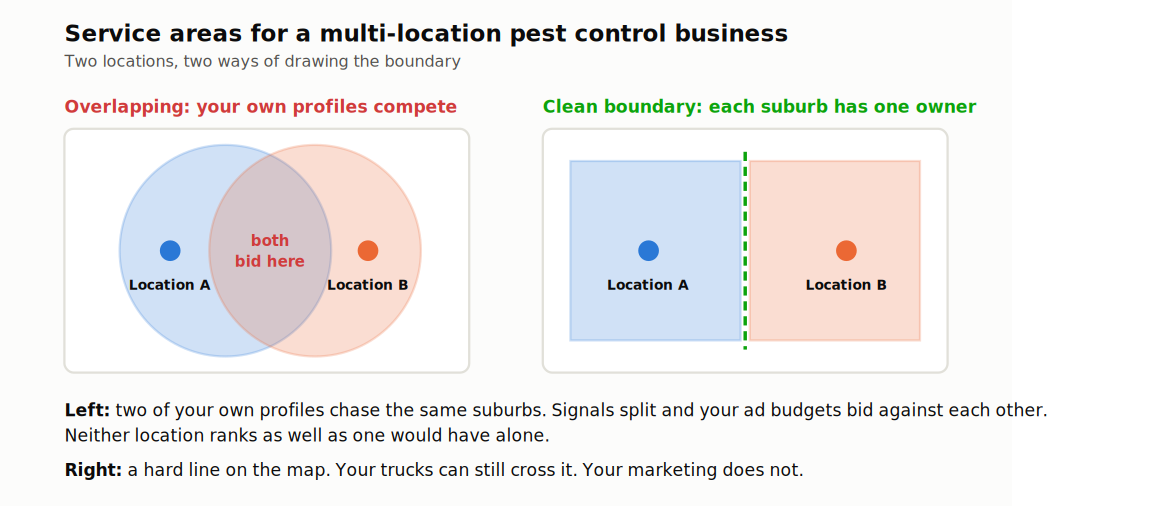
Draw the line on a map and hold it in your marketing even when the trucks cross it. Route flexibility is an operations decision. Boundary discipline is a marketing one, and they do not have to match.
One pest control brand or several?
Decide early, because it is expensive to reverse.
| One brand across markets | Separate brands | |
|---|---|---|
| Reviews and reputation | Compound across markets | Start from zero each time |
| Content and SEO | One site, one authority, service area pages per market | Every investment split |
| Risk | A problem in one market travels | Isolated |
| Acquisitions | Have to be rebranded, losing local recognition | Can keep their name and their reviews |
For most operators under five locations, one brand is the better trade. The compounding is worth more than the risk isolation. Above that, or when you acquire a company with genuine local standing, keeping the acquired name for a period is often the better call.
Allocate the marketing budget by market maturity, not evenly
Splitting the budget equally across locations is the most common multi-location mistake, and it starves the market that would have grown fastest.
| Market stage | Share of budget | What it needs |
|---|---|---|
| New, no presence | Highest per dollar of revenue | Paid to buy time while the profile and reviews build. Expect twelve months before organic carries any weight |
| Growing, ranking inconsistently | The largest absolute share | This is where spend converts fastest. Content, service area pages, review velocity |
| Established, ranking well | Lowest | Maintenance. Reviews and retention |
Run the Local Rank Grid per location and the allocation usually decides itself. A market that is green at the office and red everywhere else has a coverage problem worth spending on. A market that is green across the grid needs maintenance, not investment.
Centralize the systems, localize the content
Centralize: the review process, the reporting standard, the brand, the plan structure and pricing, the CRM.
Localize: photos, service pages, the pests you lead with, and the seasonal calendar. Pests, housing stock and seasons genuinely differ by market, and readers can tell when a page was written about somewhere else.
The test: if you could swap two of your location pages and nobody would notice, neither will Google.
We are writing a dedicated guide to multi-location pest control marketing. This section is the working version, and it covers the decisions. The dedicated post will go further on staffing local content, integrating acquired companies, and reporting across markets.
How to tell what is working in your pest control marketing
Most operators measure pest control marketing by total leads, which is the wrong number. Track cost per acquired customer by channel, because that is the only number that tells you where the next dollar should go.
Four things to have in place:
- A tracked phone number per channel. Without it you are guessing, and guessing favors whichever channel you happened to start most recently.
- The question asked at booking. "How did you find us?" recorded every time. Imperfect and still better than nothing.
- Close rate by channel, not overall.
- Cancellation rate, reviewed quarterly. It belongs in the marketing report because it is a marketing number.
| Metric | What good looks like |
|---|---|
| Cost per lead | Under your calculated ceiling, roughly $70 at a 25% close rate |
| Cost per acquired customer | Under one year of account revenue, roughly $480 |
| Marketing as a share of revenue | Near 6.6%, higher if you are still building the book |
| Close rate | Known per channel, and improving |
| Annual cancellation rate | Known, and falling |
Give a new channel ninety days before judging it, except paid, which reports within weeks. Local SEO and content take three to nine months, and killing them at month two is the most common way operators conclude that SEO does not work.
Our Benchmark tool shows how you compare with other pest control companies in your service area, which is the context a raw ranking number does not give you.
Your first ninety days of pest control marketing
If you are starting from nothing, in order:
Weeks 1 to 2. Claim and complete the Google Business Profile. Every field, real categories, real service areas, ten photos of real work. Free, and it outranks anything you can buy.
Weeks 3 to 4. Get the first ten reviews. Ask every customer in person, at the property. Set up a tracked phone number.
Weeks 5 to 8. A simple, fast website with your towns, your services and a tappable phone number. Get the truck lettered. Fix citations.
Weeks 9 to 12. Now add paid, having calculated your maximum cost per lead. Start with Local Services Ads, cap the budget, dispute bad leads. Begin publishing content aimed at next season, not this one.
Do not reverse this order. It is the most common sequencing error in marketing pest control business owners make when they first have budget to spend. Paid spend on top of an incomplete profile with no reviews converts badly and costs the same as paid spend on top of a strong one.
Frequently Asked Questions
Q.1 How much should a pest control company spend on marketing?
Around 6.6% of revenue, which is what 246 pest control firms across 47 states actually spend according to the NPMA and PCO Bookkeepers 2025 cost study. On $400,000 of revenue that is about $2,200 a month. A newer business with no recurring book should budget higher, in the range of 10% to 12%, because it is buying the recurring base rather than maintaining one.
Q.2 How much does a pest control lead cost, and what can I afford to pay?
Work backward from customer value rather than from a published benchmark. A quarterly account at $120 produces $480 a year and roughly $1,400 over a three-year life. At a 25% close rate, paying about $70 per lead recovers your acquisition cost from first-year gross profit, and about $120 recovers it from first-year revenue. Costs vary widely by market, so measure your own within the first month of any paid campaign.
Q.3 What is the best advertising for a pest control business?
Google Business Profile and reviews outperform anything paid, and both are free. Among paid options, Local Services Ads usually come first because you pay per lead rather than per click and the Google Guaranteed badge carries trust. Standard Google Ads earn their place on high-value services like termite, WDO inspection and bed bugs, where the job value supports the click cost.
Q.4 How do I get more pest control customers without a big budget?
Complete your Google Business Profile, ask every customer for a review in person at the property, letter your truck, and work door hangers on streets where you already have a job. Those four cost almost nothing and are the highest-return activities available at any size. Add paid channels once the free ones are saturated and you know your close rate.
Q.5 When should a pest control business spend the most on advertising?
Spend heaviest from early spring through summer, when termite swarms and peak pest activity drive the highest-intent searches of the year. Use the winter trough differently: publish content then so it ranks by March, since content takes three to six months to gain position, and bid less when the auction is quiet. A flat monthly ad budget across a violently seasonal year is the most common structural error in this trade.
Q.6 How is marketing a multi-location pest control business different?
Each location needs its own Google Business Profile with a real address, real staff and its own tracked phone number, since shared numbers confuse local signals. Draw hard service area boundaries so your own profiles do not compete for the same suburbs. Allocate budget by market maturity rather than evenly, with the heaviest investment in markets that are growing but ranking inconsistently. Centralize your review and reporting systems while keeping content genuinely local.
Conclusion
Do the arithmetic before the tactics. Take your average ticket, your close rate and your cancellation rate, and work out what a customer is worth and what you can afford to pay for one. Then spend 6.6% of revenue against that number, starting with the channels that cost nothing. Everything else on this page is a detail inside those two decisions.