

What's in this guide
- What pest control SEO is, and what it costs
- Why pest control SEO is not generic local SEO
- Your Google Business Profile for pest control
- Pest control service area pages that do not read as thin
- Building a content calendar around pest seasonality
- On-page SEO essentials
- Reviews and citations
- Technical SEO for a pest control site
- Getting your pest control company recommended by AI
- Five pest control SEO mistakes that cost the most
- Measuring the results that matter
- Should you hire a pest control SEO agency
Search "pest control near me" from your office right now. You will probably see yourself in the top three, and that result is worth almost nothing. You are standing on the one square of the map where you are guaranteed to rank.
Now drive four miles and run the same search. For most pest control companies, that is a completely different result, and it is the one their customers actually see.
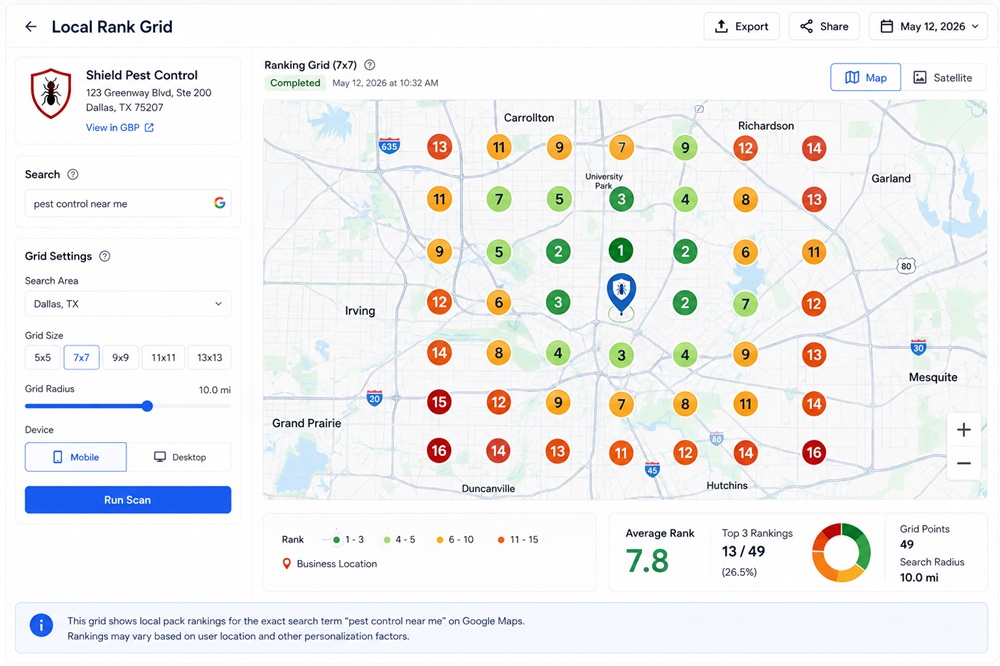
This is what catches experienced operators, and it is why the reports look better than the phone sounds. Google measures distance from the searcher, not from your office. So your visibility is not a position. It is a map, and yours has holes in it that you cannot see from your desk.
Everything else in pest control SEO follows from that: which towns deserve their own page, when to publish so you rank before swarm season instead of during it, and how to tell whether any of it turned into a booked job. Prices included, including ours.
What pest control SEO is, and what it costs
Pest control SEO is the work of getting your company into the map pack and the organic results for the searches homeowners and facility managers actually run when they need treatment. In practice pest control SEO splits into four buckets: your Google Business Profile, your service area pages, your content, and the signals other sites send about you.
What it costs. Managed local SEO for a pest control company generally runs $500 to $1,500 per month, and the range reflects real differences in scope rather than vendor greed. At the low end you get profile management and citations. At that price nobody is writing pest control content for you. At the upper end you get content, service area pages, and link work.
For a concrete reference point, our own pricing is public: $59 a month for a website only, $499 a month for Google Business Profile management, and $799 a month for a full local SEO program that combines site work, profile management, citations, and content. We publish it because vague pricing in this category usually means the number changes depending on how the sales call goes.
Pro tip: Anything priced under about $300 a month is almost always automated citation submission with a dashboard attached. It is not harmful, it is just not the thing that moves you in the map pack.
How long it takes. Google's own guidance is blunt about this: "Some changes might take effect in a few hours, others could take several months." Profile changes can move within days. Content and links generally take a quarter or more. Any agency promising first place in thirty days is selling something else.
Why pest control SEO is not generic local SEO
Three things make pest control different from a generic local business, and all three change what you should actually do.
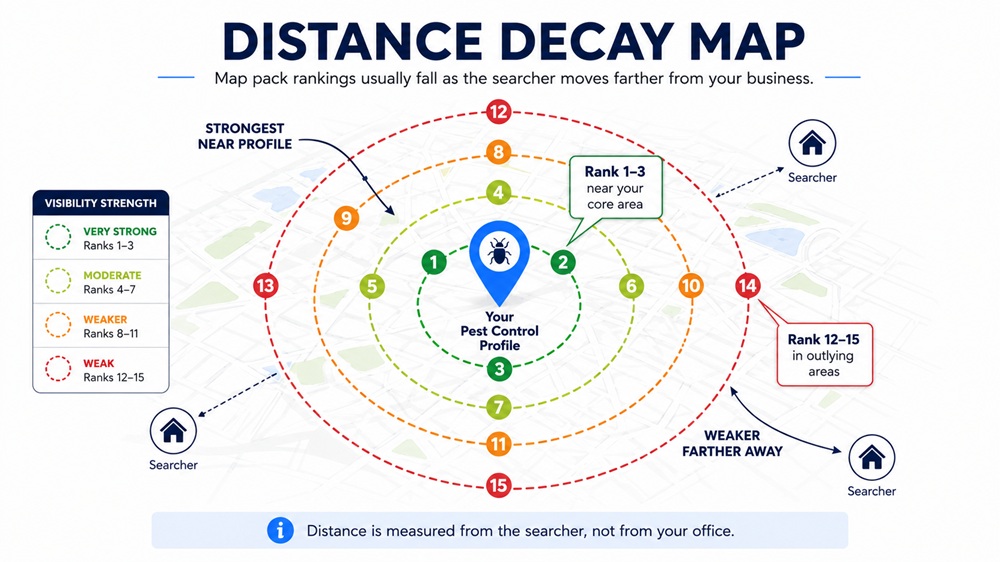
Distance is measured from the searcher. Google states its local ranking factors plainly: relevance, distance, and prominence. Distance is "how far each business is from the customer who's searching," not from your office. So your pest control company's visibility is not one number. It is a map, and it decays as you move away from wherever your profile is anchored. This single fact explains most of the confusion pest control operators have about their own rankings.
Demand arrives on a biological schedule. Termite swarmers emerge in a window measured in weeks. Mosquito calls follow rainfall. Rodent calls climb as temperatures drop. That means the searches you want are not evenly distributed across the year, and neither is the value of publishing.
The pest control buyer is often in a hurry and rarely loyal. Someone who finds ants in the kitchen calls one of the first three results and stops looking. That compresses the entire competitive question into map pack position for a handful of high-intent queries, which is a narrower and more winnable fight than it first appears.
Your Google Business Profile for pest control
Your Google Business Profile is the highest-leverage asset in pest control SEO, and for the "near me" searches that produce phone calls it matters more than your website does.
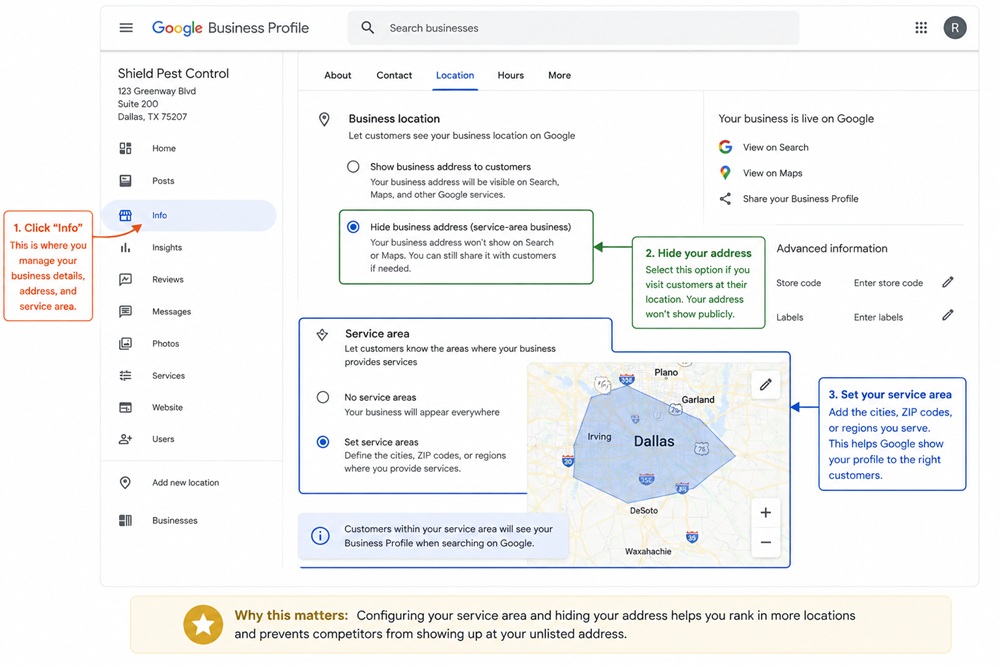
Complete every field, because relevance is built from information. Google's guidance on relevance is that complete and detailed business information helps its systems understand what you do. That means primary category (Pest Control Service), every secondary category that matches a service you actually sell, your full service list, hours, and phone number.
Hide your address if you operate from home or a yard, and set a service area instead. Google's guidelines direct service area businesses to hide the address, and a visible residential address on a service area profile risks suspension.
Photographs of your own work outperform anything else you can put there. Pest control technicians treating real properties, your trucks, your team. Not stock images of insects.
Pro tip: Add the pests you actually treat as separate services in your profile, spelled the way customers say them. "Bed bug treatment" and "termite inspection" are searches. "General pest" is not.
Once the profile is live, find out where you actually stand. Run our free Local Search Result Checker to see your position for a given search in a given area right now.
Pest control service area pages that do not read as thin
This is where most pest control SEO programs fail, and it is worth spending real time on because the failure is invisible until the pages have been live for months.
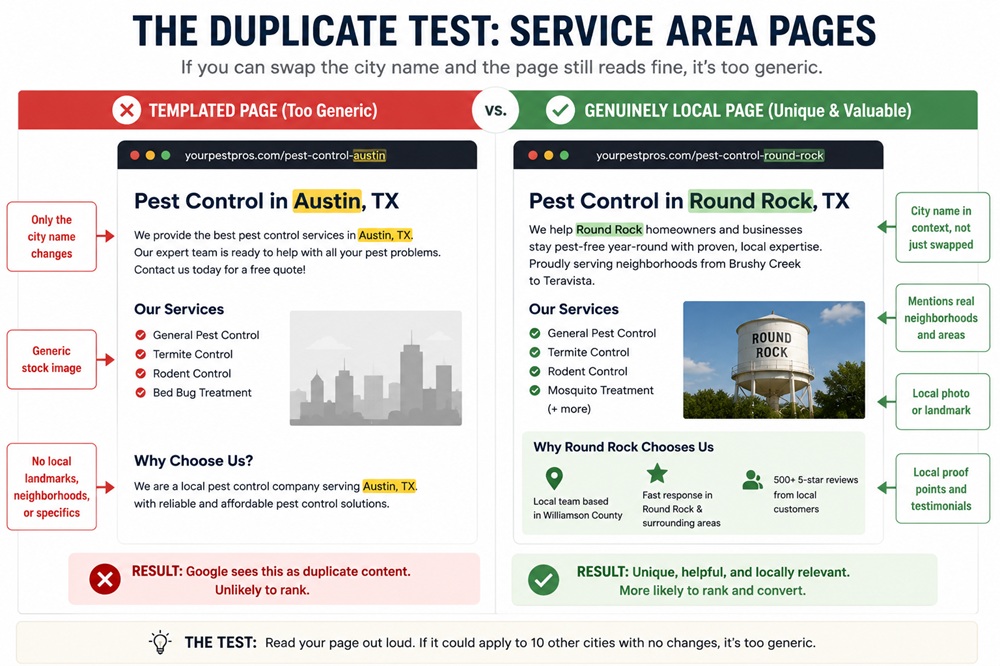
Our service area page playbook covers the architecture in depth. The logic is sound: your pest control company serves twenty towns, so you build twenty pages, one per town, each targeting "pest control in [town]." The execution is what breaks. Most of these pages are the same page with the city name swapped, and Google treats near-duplicate pages as having little independent value. They do not rank, and at volume they can drag on the rest of the site.
The test is simple. Read one of your city pages and swap in a different city name. If the page still reads correctly, it is a duplicate, and no amount of internal linking will save it.
What makes a city page genuinely different
- Local pest pressure. What actually gets called in there. Subterranean termites in one town, carpenter ants in another, German roaches in dense multi-family housing. This is knowledge you already have from your own pest control route data and almost no competitor bothers to write down.
- Named places. Neighborhoods, subdivisions, and landmarks a resident recognizes.
- Real jobs from that town. Before-and-after photos, with the property type named.
- Reviews from customers in that town, pulled through where your platform allows it.
- Service specifics that differ. Housing stock changes the pest control work. Slab construction, crawl spaces, and older brick housing all produce different treatment approaches, and saying so proves you have worked there.
Build pest control service area pages at the rate you can fill them. Five real city pages outperform twenty thin ones, and the twenty thin ones are harder to fix than they were to make. Add a town when you have the photos, the reviews, and something specific to say about it.
The anatomy of a city page that ranks
A working structure, in order. Every element below is something a templated page cannot fake.
| Element | What goes in it |
|---|---|
| H1 | Service plus city: "Pest Control in Franklin, TN" |
| Opening | The pest pressure that town actually has, named in the first sentence |
| Local pest section | Two or three species genuinely common there, with the housing or terrain reason |
| Service list | The treatments that town actually buys, not your full catalog |
| Proof block | Two or three job photos from that town, property type named |
| Reviews | Filtered to customers in that town where your platform allows it |
| Coverage detail | Named neighborhoods and subdivisions, not a radius |
| Local FAQ | Questions specific to that market, including seasonal timing |
| CTA | Phone number and form, with the town named in the confirmation |
Prioritize by where you are close, not where you are absent. A town where you sit fourth or fifth is a far better investment than one where you do not appear at all, because you are already partially relevant there and the gap is a matter of degree rather than of kind.
That is difficult to judge by eye, since your position changes block by block. Our free Local Rank Grid maps where you rank across your whole service area, which turns this from a guess into a list.
Building a content calendar around pest seasonality
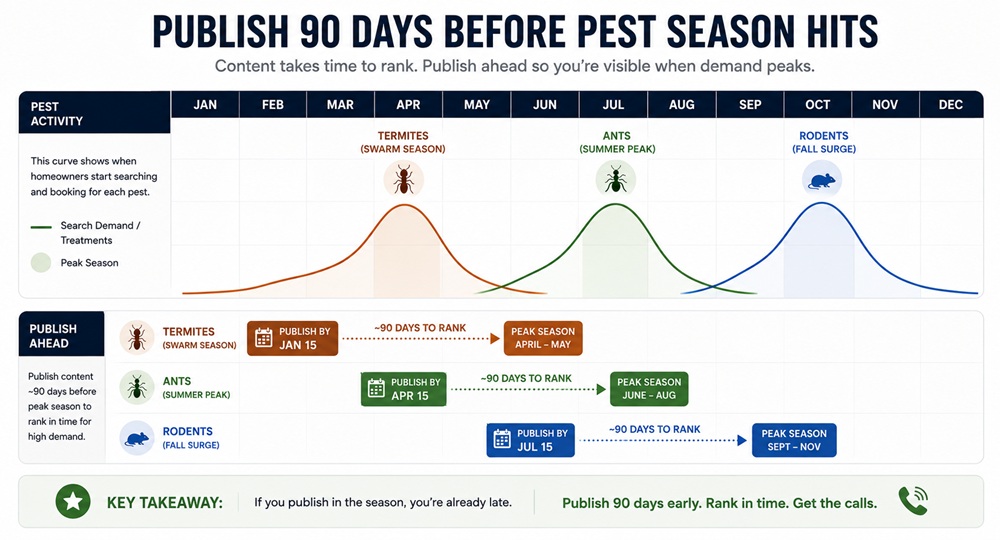
Here is the timing problem in pest control SEO, stated plainly. Content takes weeks to months to gain traction in search. Pest control demand arrives in windows measured in weeks. Publish a termite page in March and you have missed the swarm you were writing for.
So the calendar runs backward from emergence, not forward from January. Work out when each pest actually becomes a problem in your region, then publish roughly a quarter ahead of it.
Regional variation is real and documented. The NPMA's 2026 Bug Barometer, published March 3, 2026, forecasts early termite and mosquito activity in the Southeast from a warm, wet spring, early tick season in the North Central region, and monsoon-driven scorpion and spider pressure in the Southwest later in the season. Your region's pest control calendar is not your neighbor's.
A working sequence for a Southeast pest control company
| Publish | For | Ranking by |
|---|---|---|
| January | Termite swarmers, inspection, WDO questions | March swarm season |
| February | Mosquito prevention and yard treatment | Late spring |
| April | Ants, roaches, general pest | Summer peak |
| July | Stinging insects, wasps, yellowjackets | Late summer |
| September | Rodent exclusion and winter entry | First cold snap |
Other regions run on different clocks, and the differences are large enough to change your calendar entirely.
| Region | Publish early | For |
|---|---|---|
| Northeast | December to January | Early ant and stinging insect emergence after mild winters |
| Mid-Atlantic | January | Termites and overwintering pests emerging ahead of schedule |
| Southwest | March, then June | Cockroaches and flies through the season, then monsoon-driven scorpions and spiders |
| North Central | February | Early tick season, then midsummer yellowjackets and wasps |
| Great Lakes and Midwest | February to March | Spring pressure, then rain-driven indoor ant and cockroach activity |
Those windows come from the NPMA's regional forecasting. Adjust them against your own call log, which is better data than any national calendar because it reflects what your customers actually phone about.
Refresh, do not rewrite. A termite page that ranked last spring does not need replacing. It needs its dates, prices, and examples updated before the next season. Google's structured data guidance rewards pages that stay current, and an updated page carries the authority it already earned.
Pro tip: Put next year's publish dates in your calendar the week you finish this year's. Seasonal pest control content is the easiest thing to intend and the easiest thing to forget until the season has started.
Publishing ahead of the season is only half the job. The other half is being able to absorb the calls when they land, which is a staffing and scheduling problem rather than a search one. Getting your pest control business ready for the busy season covers the operational side, including how far ahead to hire.
The reverse problem arrives in November. What to sell during your pest control winter downtime is the companion piece, and it is worth reading before you build the calendar above, because your off-season offer determines what you should be publishing in September.
On-page SEO essentials for pest control pages
The basics still matter for a pest control site, and they take an afternoon.
- Title tags carry the city and the service: "Termite Control in Franklin, TN" beats "Services."
- Meta descriptions under 155 characters, written to be clicked.
- One H1 per page, describing what the page is actually about.
- Image file names and alt text that name the subject. "termite-damage-crawlspace.jpg" rather than "IMG_4821.jpg."
- Internal links from your service pages to the relevant city pages and back.
None of this fixes a site that loses visitors once they arrive. Pest control website design that converts covers layout, phone placement, and the pages that actually turn a visit into a call.
Reviews and citations for pest control companies
Reviews feed prominence directly. Google states that more reviews and positive ratings can help local ranking, and that responding to reviews helps a business stand out. For a pest control company the practical timing matters: ask at the end of the appointment, in person, while the technician is still on the property, then follow with a text containing the direct link.
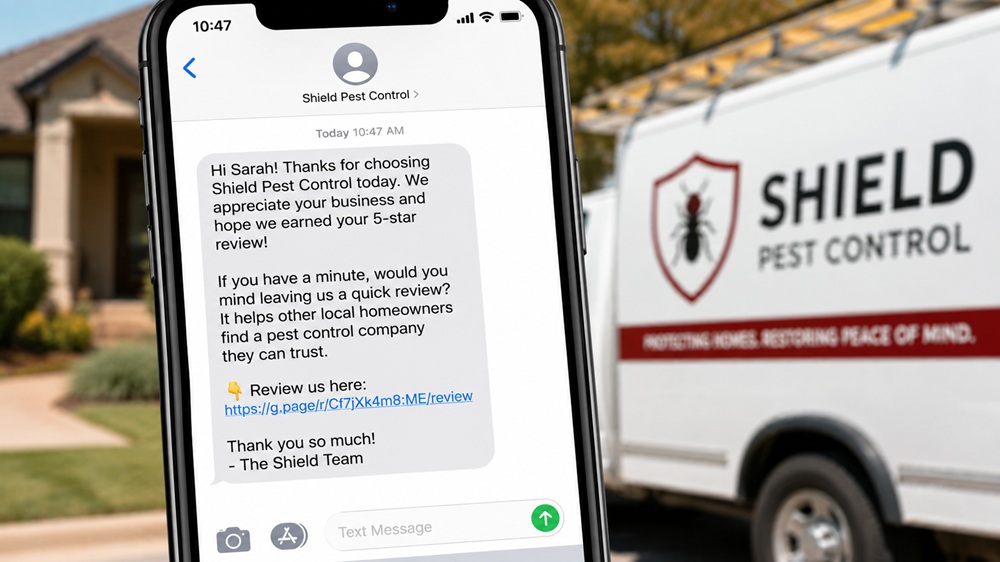
Doing that consistently across a crew is a process problem, not a marketing one. How to get more pest control reviews covers the technician scripts, the follow-up timing, and how to handle the negative ones.
Citations are table stakes for pest control SEO rather than an advantage. Consistent name, address, and phone number across the major directories. Get them right once, then stop thinking about them. Which pest control citations actually matter lists the directories worth your time and how to clean up inconsistencies already out there, which is the more common problem.
Pro tip: Train technicians to ask by name for a review of the specific service, not for a review of the company. "Would you mention the crawl space work?" produces reviews containing the words people search for.
Technical SEO for a pest control site
Site speed and mobile. Most pest control searches happen on a phone, often with a bug in the frame. A page that takes six seconds loses the call to whoever loads faster.
Structured data. Google notes that valid structured data makes pages eligible for enhanced search features including review stars. LocalBusiness schema on your site and FAQ schema on your service pages are the two that matter, and both also feed the AI systems covered next.
Getting your pest control company recommended by AI
This is the fastest-moving part of pest control SEO and the least contested. Almost nobody in this industry is working on it yet.
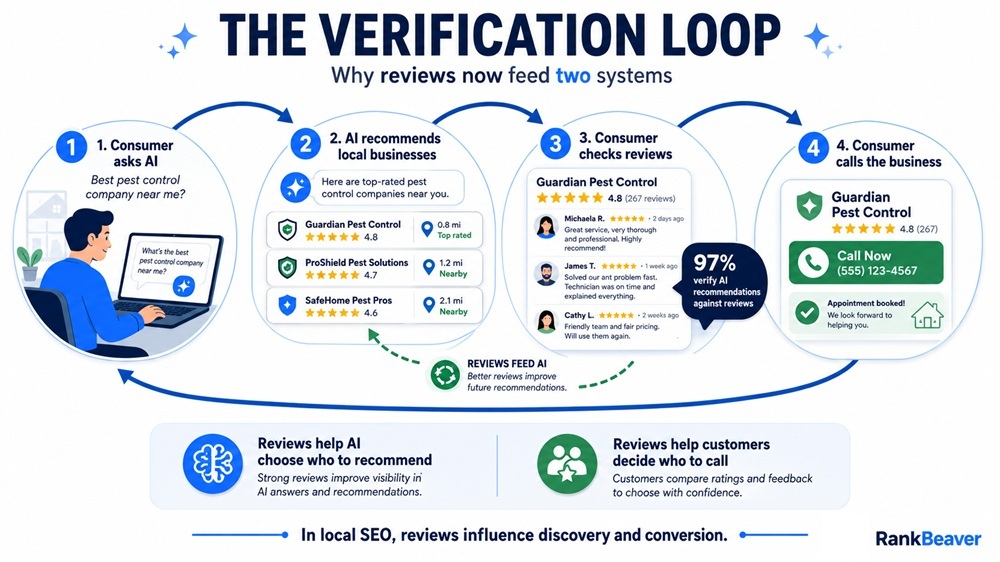
The behavior has already shifted. BrightLocal's 2026 Local Consumer Review Survey, a representative panel of 1,002 US adults, found that 45% of consumers now use AI tools to find local businesses, up from 6% a year earlier. ChatGPT leads at 31%, Google's AI Mode at 23%. AI now ranks as the third most-used discovery method behind Google and Facebook, ahead of Yelp. Adoption is highest among 30 to 44 year olds at 64%, which is squarely the homeowner demographic that buys recurring pest service.
Here is the part that changes what you should actually do. The same survey found that 97% of consumers double-check AI recommendations against real reviews, and 64% of AI users trust AI recommendations as much as they trust reviews. So AI is not replacing the review economy. It is routing through it. A pest control company with forty recent reviews and a complete profile is the company an AI recommends and the company that survives the verification click afterward. Your review work now does double duty.
What actually gets a local business cited
Consistency across the web, not just on your own site. These systems assemble an answer from many sources, and most of what they cite about a local business is not on that business's website. Directory listings, review platforms, local news, association memberships, and forum mentions all feed the picture. That means you cannot optimize your way into an AI recommendation purely on-site, which is the opposite of how most SEO advice reads.
Your name, address, phone, and service area matching everywhere. Inconsistency does not just split your citation signal, it makes you a less confident answer for a system that has to decide whether two listings are the same company.
Direct answers near the top of the page. Cited passages skew toward definitive statements that stand alone. "Termite inspections in Franklin cost $75 to $150" is quotable. "Pricing varies depending on several factors" is not.
A complete Google Business Profile, which Google's own AI surfaces draw on directly for local answers.
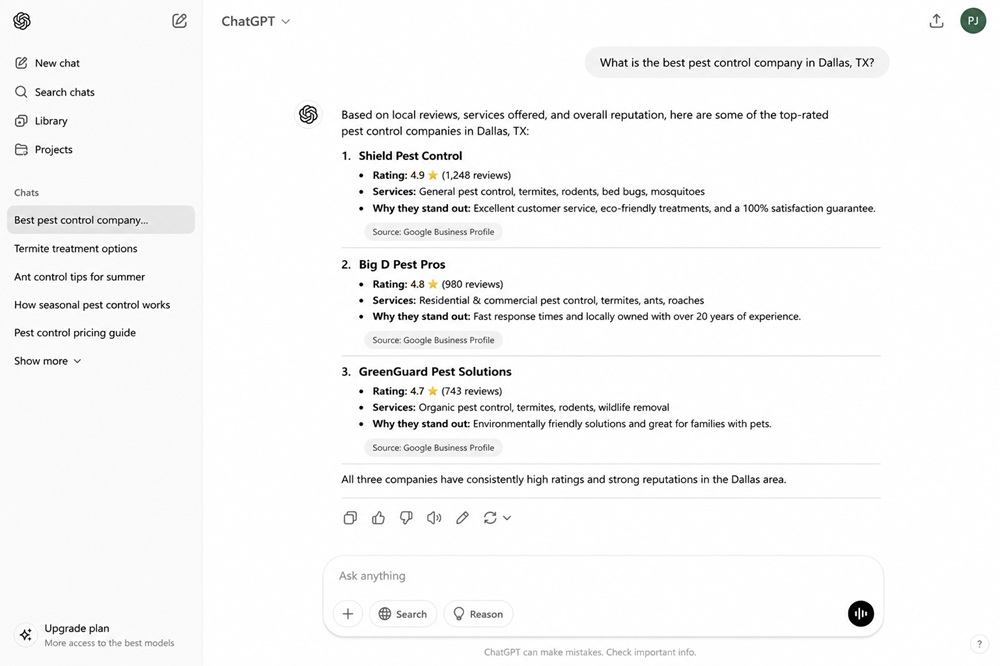
Pro tip: Ask the tools about yourself. Open ChatGPT and Google's AI Mode and type "best pest control company in [your town]" and "who should I call for termites in [your town]." That is your AI rank check, it is free, and it takes four minutes. Do it monthly and write down whether you appear, who does, and what the answer says about them.
What to do about it this quarter
- Fix name, address and phone consistency across your major listings before anything else.
- Put a direct answer in the first sentence under every heading on your service and city pages, including prices and timeframes where you can state them.
- Add FAQ schema to your service pages using the exact questions customers ask.
- Keep review velocity steady, because it is now feeding two systems instead of one.
- Run the manual AI check monthly and treat it as a metric, not a curiosity.
On measurement, be realistic. AI referrals are difficult to attribute today. Some arrive as direct traffic, some as branded searches after an AI mentioned you, and some as phone calls with no digital trail at all. Watch branded search volume and direct traffic for unexplained lifts, and ask new customers how they found you. That last one is unfashionable and still the most reliable instrument you have.
Five pest control SEO mistakes that cost the most
These are the ones that show up repeatedly, and each is expensive in a different way.
1. Chasing "pest control" instead of the searches people run. Nobody with roaches searches "pest control." They search "roach exterminator near me," "how to get rid of German cockroaches," or "bed bug treatment cost." The head term is competitive, expensive, and rarely converts. The service-plus-city and pest-specific terms are where the calls are.
2. Building the service area from ambition rather than routes. Every town you add dilutes your relevance in the ones that matter and produces leads you cannot profitably drive to. A pest control company that ranks first in four towns it can service beats one that ranks eighth in twenty.
3. Letting the profile go stale after setup. A Google Business Profile is not a form you fill in once. Categories change, services change, and a profile with no new photos or posts for a year reads as dormant to both customers and Google.
4. Publishing seasonal content in the season. Covered above, and worth repeating because it is the most common single error in pest control content. By the time you notice termite calls rising, the window to rank for them has closed.
5. Treating rankings as the outcome. A dashboard showing green arrows means nothing if the phone is not ringing. The metrics below are the ones that connect to revenue.
Pro tip: Pull your last hundred booked jobs and list the pest each one was for. That list, ranked by frequency and by ticket size, is your keyword priority order. It beats any keyword tool, because it is your actual demand rather than a national average.
Measuring the pest control SEO results that matter
Rankings are a leading indicator of pest control SEO performance. They are not the point.
Track these instead:
| Metric | Where | Why it matters |
|---|---|---|
| Calls from your Business Profile | Google Business Profile insights | The closest thing to a direct revenue signal |
| Direction requests | Profile insights | Shows which areas actually find you |
| Form fills by service area | Your site analytics | Tells you which city pages work |
| Booked jobs by source | Your field software | The only number that pays anyone |
| Cost per booked job | Spend divided by booked jobs | Makes SEO comparable to paid |
When the numbers are flat, diagnose in this order. Most operators start rewriting content, which is the slowest and least likely fix.
- Are you visible at all? Check position across the service area, not from your office. If you are invisible three miles out, that is a profile and service-area problem, not a content one.
- Are you visible but not clicked? Your profile photos, review count, or review rating are losing the comparison in the map pack.
- Are you clicked but not called? The landing page is the problem. Phone number placement, load speed, or a form nobody wants to fill out.
- Are you called but not booking? That is a sales and scheduling problem wearing an SEO costume, and no amount of ranking work fixes it.
Running more than one branch changes the structure. Each physical location needs its own Google Business Profile with its own address, its own reviews, and its own landing page on your site. Do not point two profiles at one page, and do not create a profile for a location where nobody works. Both are common causes of suspension.
A first-place ranking in a zip code you cannot profitably reach is worth nothing. Route density is still the economics of a pest control business, so weight your SEO investment toward the areas where an additional stop is cheap, not toward wherever you happen to rank worst.
Cost per booked job is also what lets you compare SEO against paid honestly, since both buy the same clicks on a different basis. What Google Ads costs for pest control gives the paid side of that comparison, so you can see which channel is actually cheaper in your market rather than assuming.
If the calls are arriving and not closing, none of the above is your problem. That is a follow-up and sales issue, and turning pest control leads into long-term customers is where to start instead.
Should you hire a pest control SEO agency?
Do your own pest control SEO if you have one or two service areas, someone with a few hours a week, and patience. Profile optimization, review collection, and five good city pages are genuinely achievable in-house, and they are most of the available return.
Hire a pest control SEO agency when you are managing more than about five service areas, competing against companies with dedicated marketing staff, or your own time is worth more than the work. The break-even is straightforward: if a managed program costs $800 a month and your average customer is worth $600 a year in recurring service, it pays for itself at roughly two new customers a month.
What to ask any pest control SEO agency before signing: which specific service areas they will target and why, what they will publish and when, how they measure success beyond rankings, and whether you own the site and content if you leave. That last one eliminates more vendors than the first three.
Search is one channel of several, and it works better alongside the others than instead of them. Pest control marketing: let's make that phone ring is the wider picture, including where search sits against referrals, direct mail, and paid.
Frequently Asked Questions
Q.1 What is pest control SEO?
Pest control SEO is the practice of improving a pest control company's visibility in Google's map pack and organic results for the searches customers use when they need treatment. It covers Google Business Profile optimization, service area pages, seasonal content, reviews, citations, and technical site work. It differs from general SEO mainly in how heavily it depends on geography and season.
Q.2 How much does pest control SEO cost?
Managed local SEO for a pest control company typically costs $500 to $1,500 per month depending on scope. RankBeaver's published pricing is $59 per month for a website only, $499 per month for Google Business Profile management, and $799 per month for a full local SEO program. Programs priced under roughly $300 per month are usually automated citation submission rather than active optimization.
Q.3 How long does pest control SEO take to work?
Google states that some changes take effect in hours while others take several months. In practice, Google Business Profile changes can show movement within days to weeks, while content and link-based improvements generally take a quarter or more. Seasonal content should be published roughly ninety days before the pest season it targets.
Q.4 Can I do SEO for pest control myself?
Yes, particularly if you serve one or two areas. Completing your Google Business Profile, hiding your address as a service area business, collecting reviews consistently, and writing a small number of genuinely specific city pages will produce most of the available benefit. The work becomes harder to do in-house once you are managing more than about five service areas.
Q.5 Why does my pest control company rank in one town but not the next one over?
Because Google measures distance from the searcher, not from your business. Google's stated local ranking factors are relevance, distance, and prominence, so your visibility decays as searchers move away from wherever your profile is anchored. A service area page for that town, plus reviews from customers in it, is the usual fix.
Q.6 How do I get my pest control company recommended by ChatGPT and AI search?
Consistency and reviews matter more than on-site optimization, because AI systems assemble local answers largely from sources other than your own website. Fix your name, address and phone consistency across directories, keep review volume steady, put direct answers in the first sentence under each heading, and add FAQ schema. Then check monthly by asking ChatGPT and Google AI Mode who they would recommend in your town.
Q.7 How many service area pages should a pest control company have?
Only as many as you can make genuinely distinct. A useful test: if swapping the city name leaves the page reading correctly, it is a duplicate and will not rank. Five substantial city pages with local pest detail, named neighborhoods, real job photos, and local reviews will outperform twenty templated ones.
Conclusion
Before you change anything, find out where you actually stand. Run the free Local Rank Grid across your service area and see which towns you are close in. That list, not a general audit, is where the next quarter's work should go.