A good pest control logo should be recognizable on a truck parked across the street and small enough to fit inside a browser tab. It should tell customers who you are without relying on complicated illustrations, excessive colors or lettering that's difficult to read.
Shields, insects and exterminator mascots are common choices, but the right design depends on your business. A new company can start with a simple visual identity and develop it as its customer base grows. An established business should also consider which parts of its existing identity customers already recognize.
What makes a good pest control logo?
A good pest control logo is recognizable, relevant to your services and easy to reproduce across different materials. It can consist of a symbol, a wordmark featuring your company name, or a combination of both. It doesn't need to include every insect or animal you treat.
If your company name doesn't immediately explain what you do, include a service descriptor such as "Pest Control." A tagline is optional and can appear separately from the main logo, giving you more flexibility when designing uniforms, vehicle graphics and smaller digital assets.
| Design quality | What to check |
|---|---|
| Readability | Can customers read the company name without zooming in? |
| Distinctiveness | Does it look different from competing local businesses? |
| Relevance | Can customers identify your services from the design or descriptor? |
| Scalability | Does it work as a small icon and a large vehicle graphic? |
| Reproduction | Can it be printed or embroidered in one color? |
| Customer fit | Does it suit your residential, commercial or specialist customers? |
| Flexibility | Will it remain relevant if you introduce additional services? |
A detailed mascot might look excellent on a truck but become unrecognizable as a website favicon. Create several versions of the same logo for different applications. This gives you the freedom to use detailed artwork where space permits and simplified versions where readability matters.
Pro tip: Review your initial logo concepts in black and white. Without color influencing your judgment, it's easier to identify problems with lettering, spacing, proportions and the overall shape.
15 pest control logo ideas to inspire your business
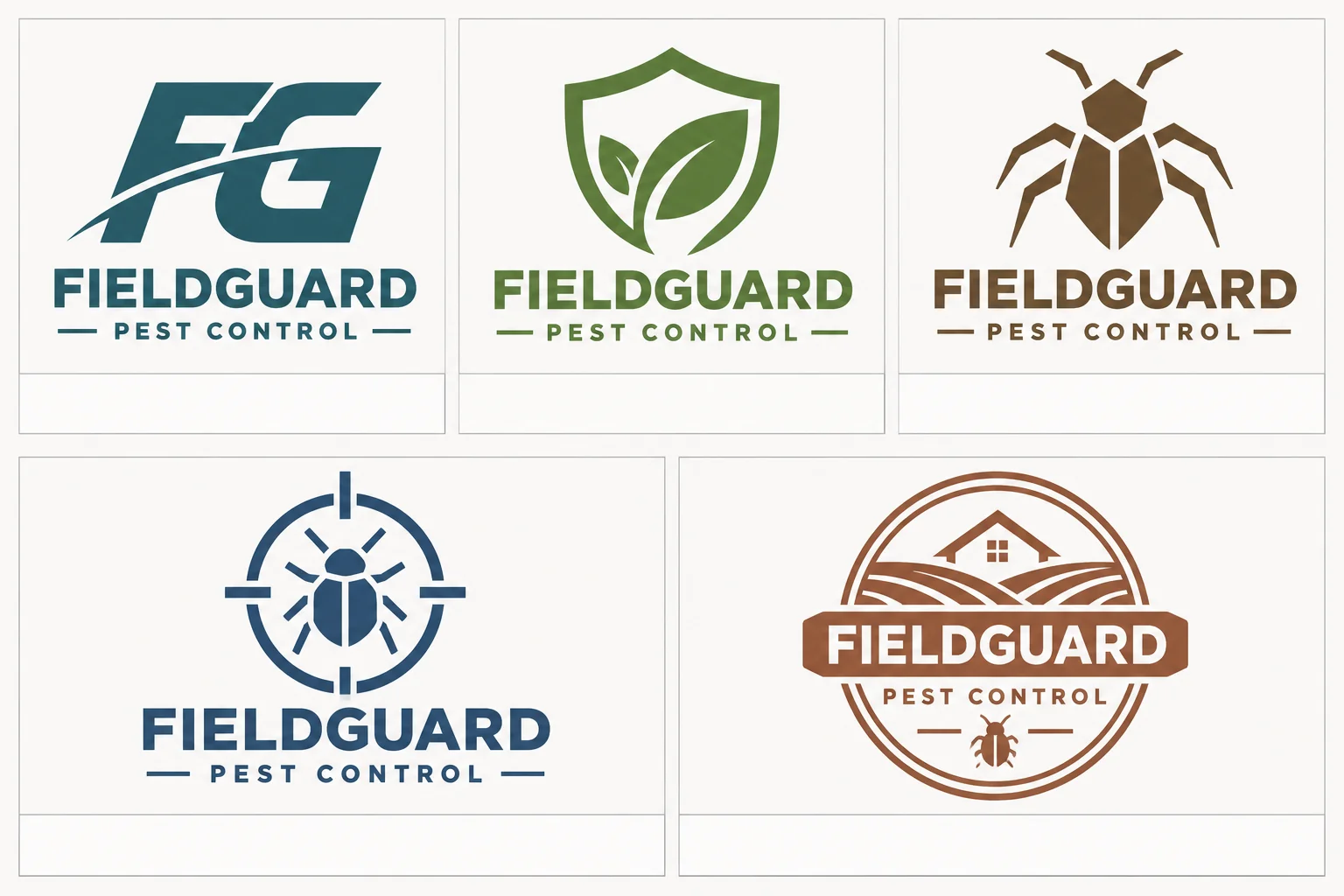
The following pest control logo ideas cover residential services, commercial pest management, specialist businesses and established family-owned companies. These are original design directions for inspiration, not existing company logos or trademark-cleared artwork. Choose two or three concepts that suit your services and customer base.
| Logo idea | Design concept | Best suited for | What to avoid |
|---|---|---|---|
| Protective shield | Broad shield with a simple interior cutout | General pest control and recurring service plans | Generic shield shapes |
| Home protection | Roofline combined with a protective symbol | Residential perimeter treatments | Resembling a roofing company |
| No-pest symbol | Stylized insect inside a prohibition circle | General extermination | Stock graphics and excessive detail |
| Friendly mascot | Character with a recognizable silhouette and expressive face | Neighborhood residential services | Illustrations too complex for embroidery |
| Bold wordmark | Custom lettering with a clear service descriptor | Commercial and general pest control | Poor letter spacing and generic typography |
| Monogram | Two company initials combined into one symbol | Family-owned and premium businesses | Initials that fail to communicate the service |
| Nature-inspired logo | Leaf or growing form combined with a protective barrier | Prevention-focused services | Unsupported environmental claims |
| Geometric insect | Simplified insect constructed from angular shapes | Modern pest control businesses | Insects that become difficult to recognize |
| Precision target | Minimal target or inspection-inspired symbol | Inspection-focused businesses | Excessively aggressive imagery |
| Heritage badge | Circular emblem with prominent central lettering | Established family-owned companies | Small, unreadable outer lettering |
| Negative space logo | House or protective symbol formed inside another shape | Distinctive multi-service businesses | Hidden shapes that are difficult to identify |
| Termite specialist | Simplified termite combined with a structural element | Termite inspections and treatments | Restricting future brand expansion |
| Mosquito specialist | Recognizable winged insect with bold typography | Seasonal mosquito control services | Thin strokes and fragile wing details |
| Wildlife control | Animal silhouette or paw symbol with a service descriptor | Wildlife removal and exclusion | Resembling a pet care business |
| Premium abstract logo | Refined abstract symbol with restrained typography | Discreet residential and commercial services | Missing or unreadable service descriptors |
Insect logos, shields or mascots: which should you choose?
An insect logo immediately communicates the type of business you operate, but it isn't necessary if your company name already explains your services. Shields and house-shaped symbols communicate protection without requiring you to put a large cockroach or other pest illustration on your vehicles.
A mascot gives your business a character you can use in advertisements, yard signs and technician materials. Detailed mascots require additional illustration work and simplified versions for smaller applications. Request a separate wordmark or recognizable character silhouette for uniforms, favicons and compact printed materials.
Wordmarks are worth considering if you serve restaurants, offices or residential customers who prefer discreet pest control services. Commercial businesses can still use mascots, provided the design suits their customers and remains practical across proposals, reports, vehicles and other business materials.
How to design a pest control logo step by step
Start by defining what your logo needs to communicate, researching competing businesses and developing several design concepts. Test the selected design on actual applications before spending money on truck wraps, uniforms or printed materials.
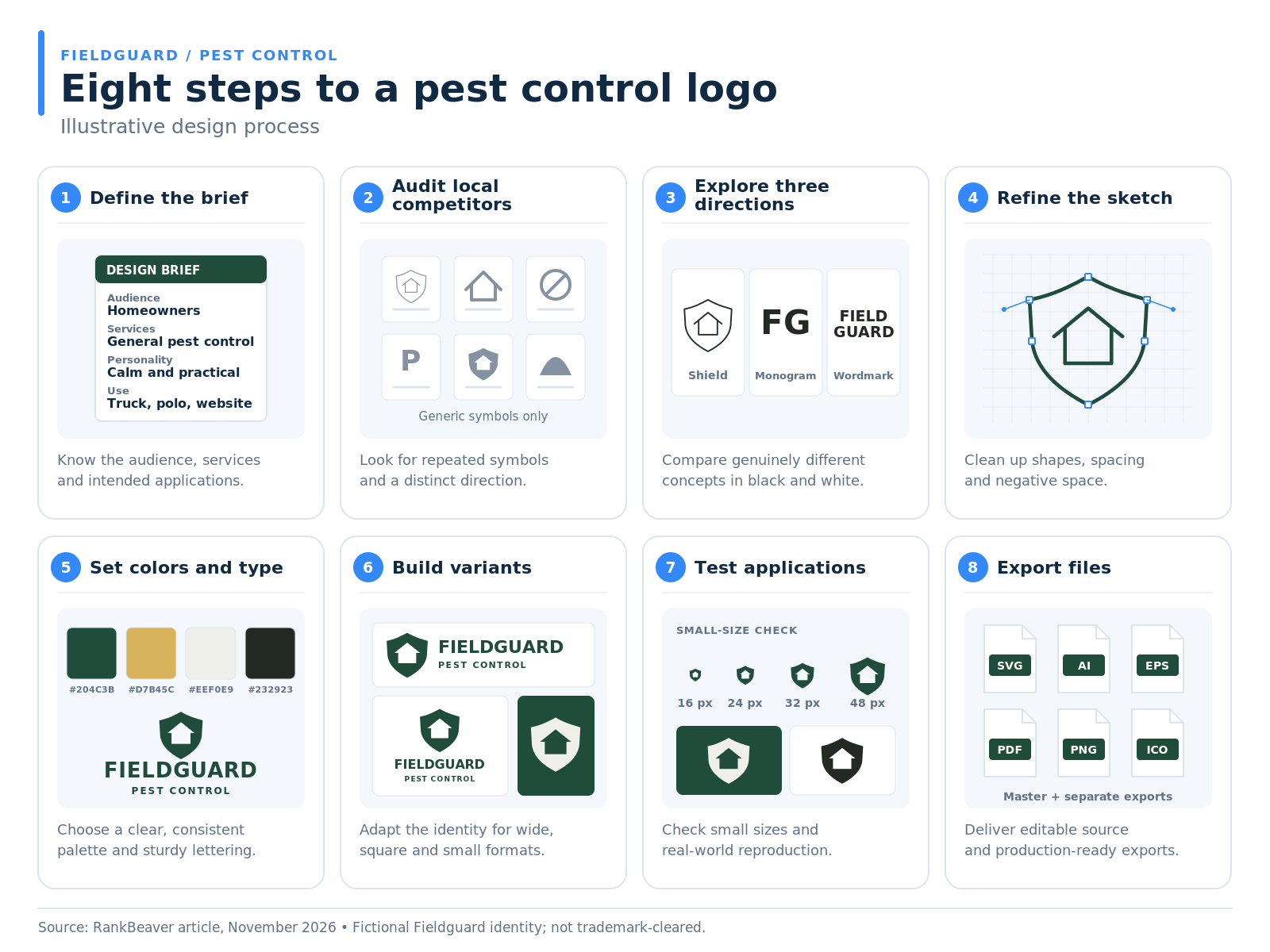
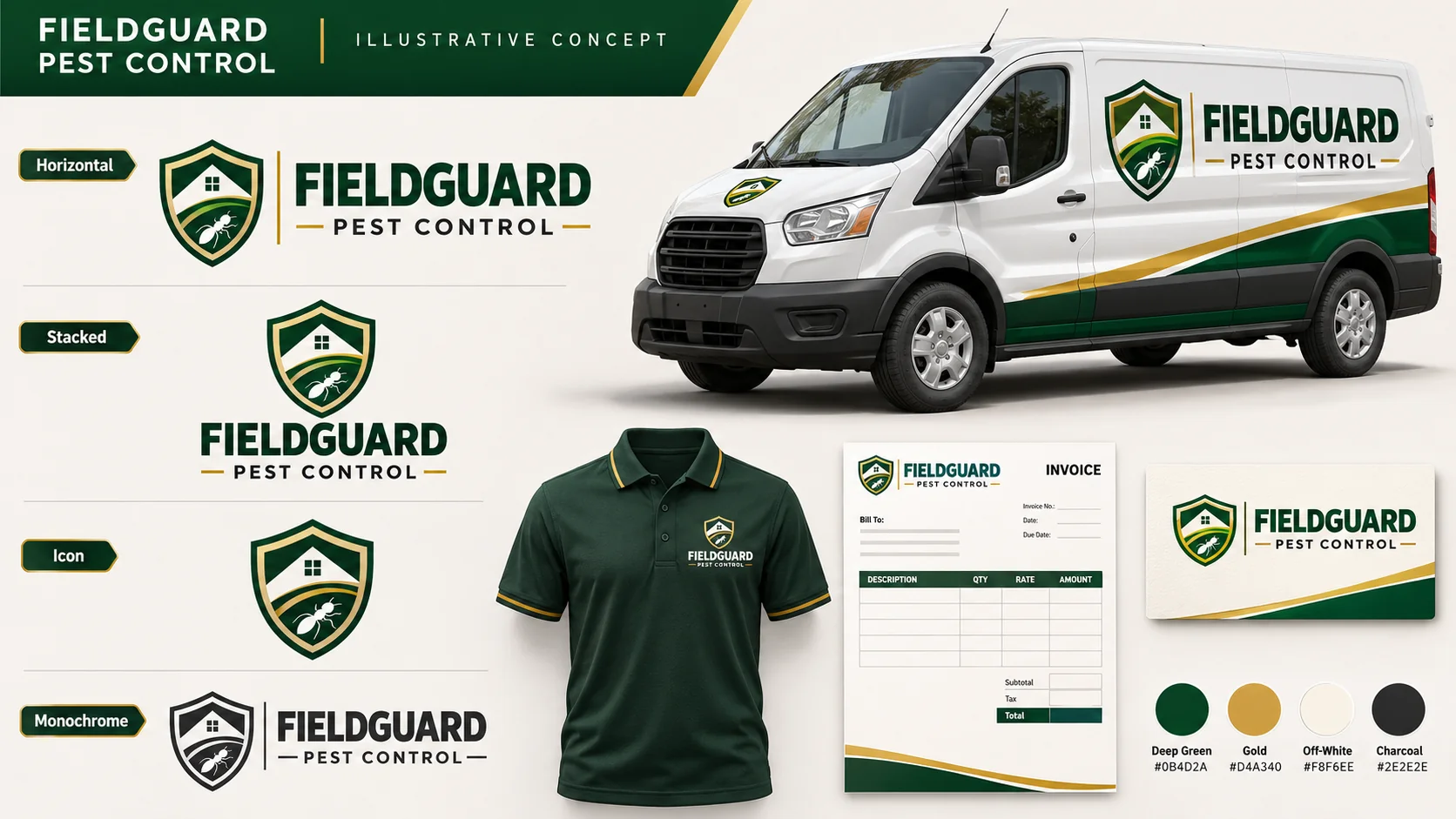
For this example, we'll use a fictional company called Fieldguard Pest Control. Its proposed identity consists of a shield with a house-shaped cutout, a bold company name and a smaller service descriptor. Both the name and design are illustrative examples and haven't been cleared for commercial use.
Step 1: Define your pest control brand
Write a short design brief before contacting a graphic designer or opening a logo maker. Describe your customers, current services, service area and future business plans. Include the materials where your logo will appear so the designer understands the practical requirements from the beginning.
Here's an example design brief for Fieldguard Pest Control.
| Brand requirement | Fieldguard example |
|---|---|
| Primary customers | Homeowners looking for recurring general pest control |
| Current services | Inspections, perimeter treatments and general pest management |
| Service area | A defined metropolitan area and surrounding neighborhoods |
| Brand personality | Calm, direct and practical |
| Future services | Potential expansion into termite control, subject to licensing |
| Required applications | White service truck, dark polo shirt, website, reports and square profile image |
| Visual direction | Protective symbol without realistic pest illustrations |
| Design restrictions | Unsupported safety claims and similarities to local competitors |
If you're launching a new business, confirm your company name and operating requirements before investing in permanent branding materials. RankBeaver's guide to starting a pest control business covers the business decisions you should make before introducing your new identity.
Step 2: Research competing pest control logos
Identify 10 local pest control companies that prospective customers might compare with yours. Search for general pest control businesses and specialists offering similar services in your town and surrounding areas. Review their websites, business listings and publicly available photographs of their service vehicles.
Record each company's name, dominant colors, logo symbol, typography, service descriptor and apparent target audience. Look for repeated design choices. If several nearby businesses use dark blue shields, consider developing a different symbol or color combination rather than introducing another similar-looking logo.
Ask someone familiar with your service area which competing logos they find difficult to distinguish. This exercise helps you understand your local market rather than national design trends. Use competing brands as research references without tracing, adapting or copying their artwork.
Step 3: Develop three different logo concepts
Create three genuinely different concepts instead of producing minor variations of the same design. Fieldguard, for example, could explore a shield containing a house, a custom monogram combining the letters F and G, and a wordmark built around a distinctive letterform.
Sketch each concept in black and white with the company name beside it. Remove designs that require lengthy explanations or resemble another local business too closely. Refine the remaining concepts until you have a recognizable symbol, readable lettering and a clear connection to your services.
Step 4: Create a mood board and refine the design
Collect typography references, symbols, vehicle graphics and uniform designs that suit your intended identity. Look at other home service industries for examples of readable lettering and effective vehicle layouts. Use these references to guide your design without copying another company's visual identity.
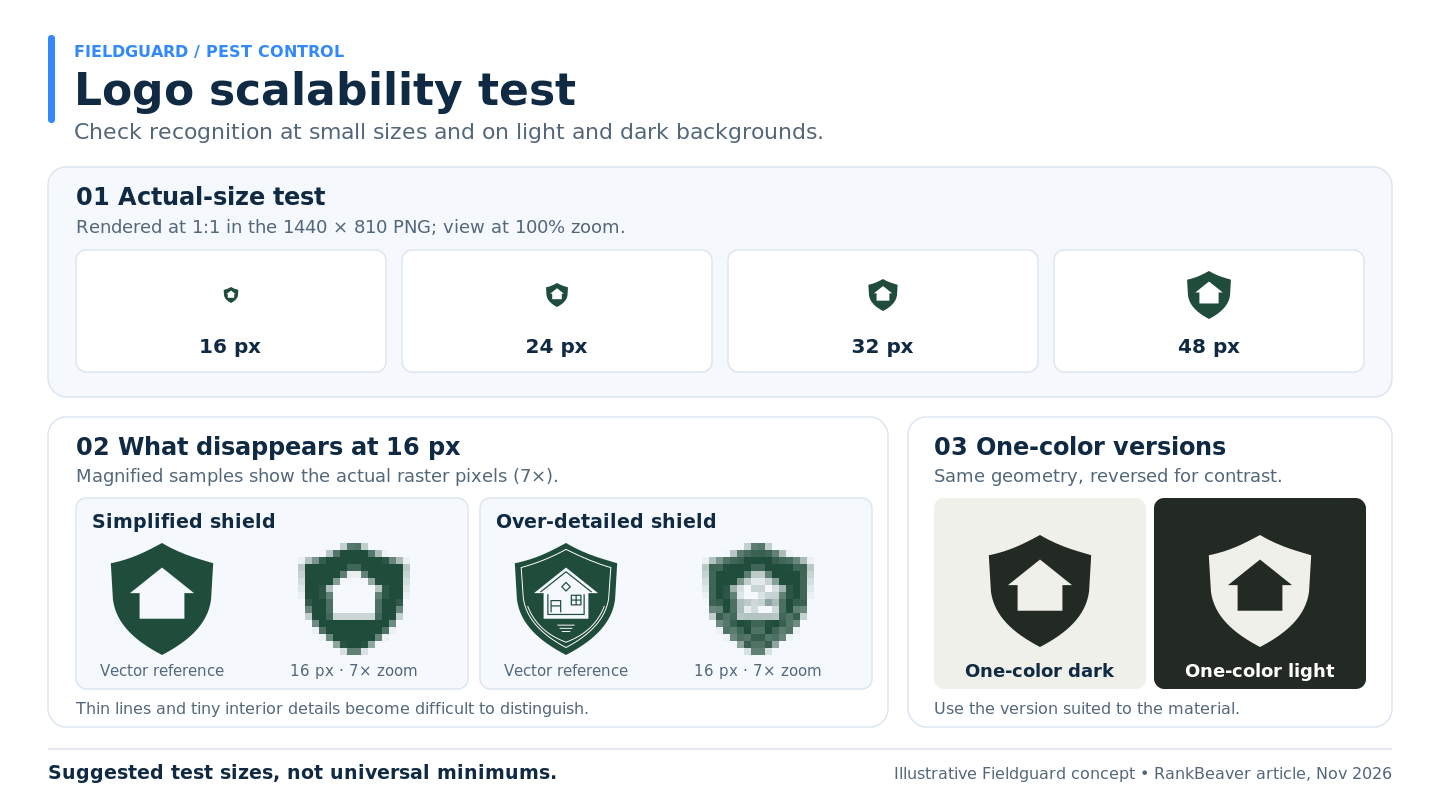
Recreate the selected sketch in a vector design application. Remove unnecessary lines, correct inconsistent spacing and check whether negative spaces remain visible when the symbol becomes smaller. Fieldguard's house-shaped cutout, for instance, should remain recognizable even when the surrounding shield is reduced considerably.
Step 5: Choose your brand colors and typography
Fieldguard's proposed color palette combines deep green #204C3B, gold #D7B45C, off-white #EEF0E9 and dark charcoal #232923. Green and off-white can appear throughout the identity, with gold reserved for smaller accents and charcoal available for darker design elements.
Pair the symbol with a sturdy sans-serif typeface and a smaller, readable service descriptor. Adjust the spacing between individual letters instead of stretching the company name to fill the available space. Test the selected colors and typography against the backgrounds used on your vehicles, uniforms and website.
Step 6: Create multiple versions of your pest control logo
Your main logo won't fit every application. Create horizontal, stacked, symbol-only and one-color arrangements that share the same visual identity. Keep the recognizable shapes and proportions consistent so customers can identify your business regardless of which version they encounter.
| Logo version | Where to use it |
|---|---|
| Horizontal | Website headers, truck doors and invoices |
| Stacked | Square signs, social media graphics and business cards |
| Symbol-only | Favicons, profile pictures and small embroidered logos |
| One-color dark | Monochrome printing and light backgrounds |
| One-color light | Dark uniforms and dark vehicle panels |
Establish a minimum usable size for each version based on actual testing. Define the clear space surrounding your logo using a consistent measurement derived from the symbol. This prevents nearby text, photographs and decorative elements from making your identity look crowded.
Step 7: Test your logo before approving it
A logo may look clear on a large computer screen while performing poorly on printed materials or smaller displays. Use the following tests to evaluate its practical performance. These measurements are suggested starting points rather than universal logo design standards.
- Export the standalone symbol at 16, 24, 32 and 48 pixels, then inspect each file at its actual size.
- Place the horizontal logo inside a 320-pixel-wide mobile website layout alongside navigation and a call button.
- Print the logo in black and test a reversed white version on a dark background. Check for disappearing details and closed gaps.
- Create a scaled proof or full-size truck graphic and inspect its readability from 20 and 50 feet using a stationary vehicle or equivalent proof.
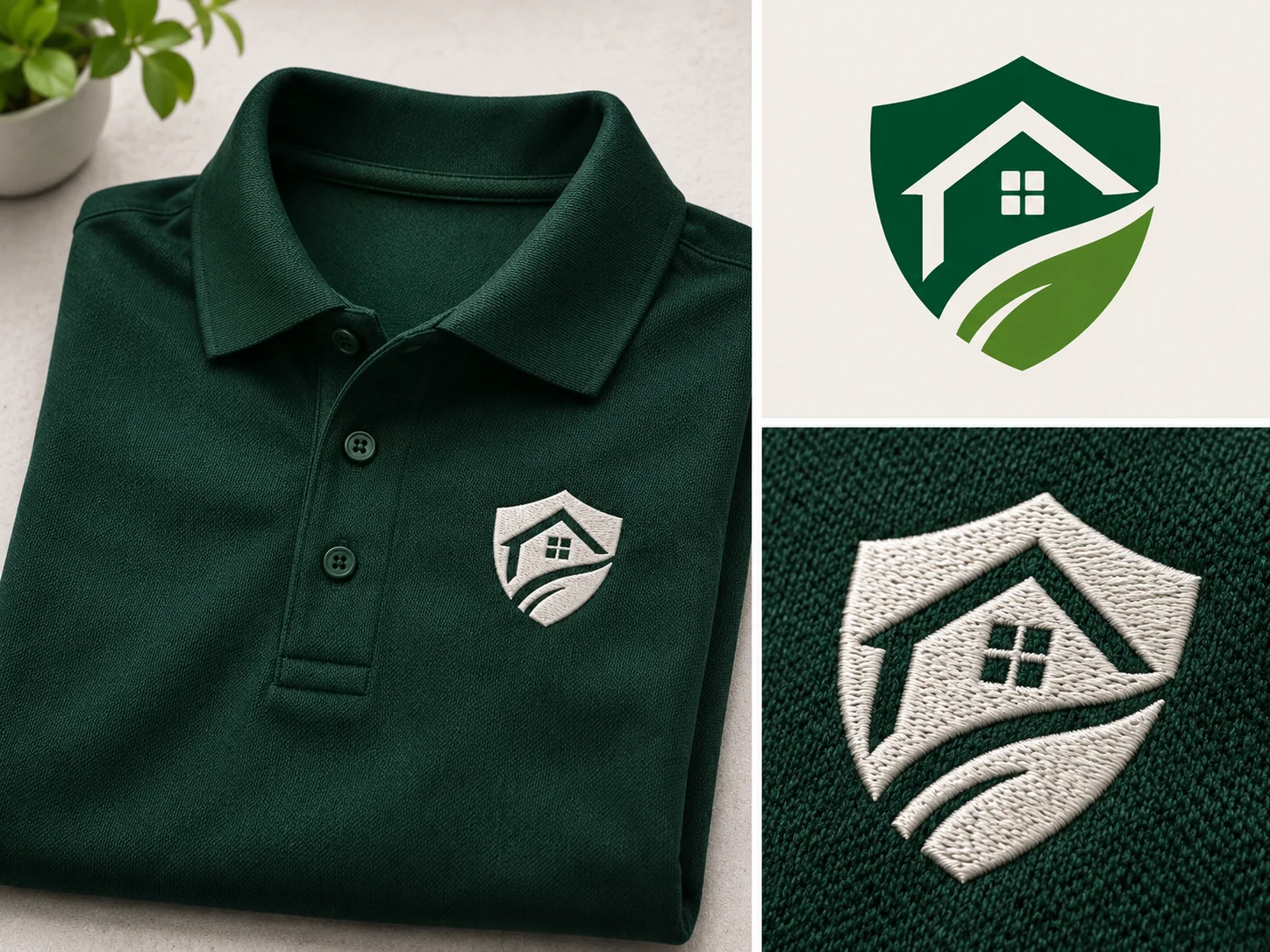
- Request an embroidered sample at the actual chest-logo size before approving uniform production.
Show your shortlisted concepts to a few people who resemble your typical customers. Ask what type of business each logo represents and which company name they remember afterward. Their answers can help identify confusing design choices, although a small feedback group isn't statistically representative of your customer base.
Pro tip: Ask your vehicle wrap installer and embroidery supplier to review the logo before final approval. Their production equipment may require thicker lines, larger lettering or additional spacing between design elements.
Step 8: Export your logo in the correct file formats
Request an editable master file and separate exports for digital and print applications. Your printer shouldn't need to recreate your artwork from a screenshot, and your website designer shouldn't have to remove a white background from a JPEG every time the logo is used.
| File format | Primary use |
|---|---|
| SVG | Scalable website graphics and digital applications |
| AI or native editable file | Future design changes, where available |
| EPS | Vector-based production workflows that require it |
| Print production when correctly exported as vector artwork | |
| PNG | Transparent raster graphics |
| JPG | Raster applications requiring a solid background |
| ICO or PNG | Website favicons where appropriate |
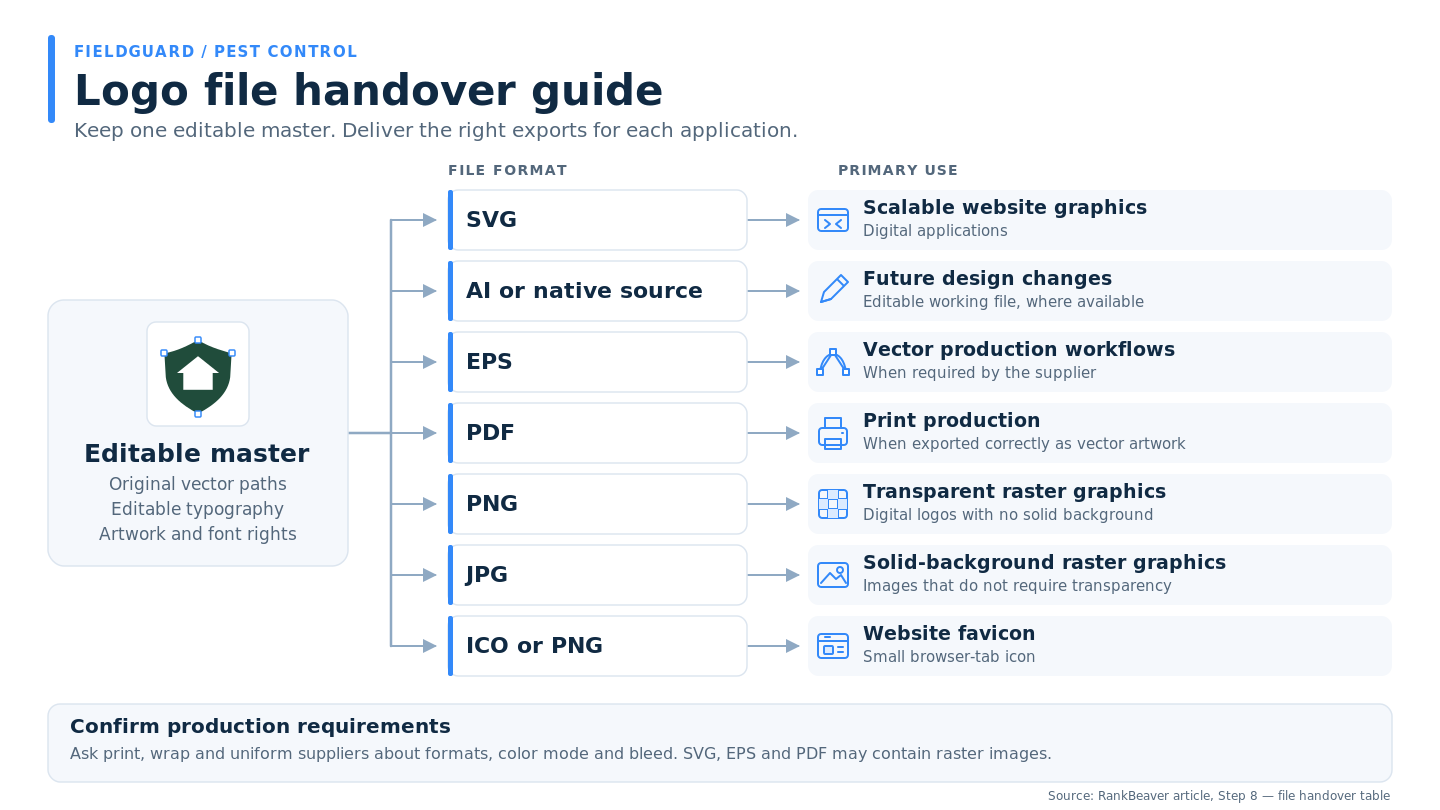
An SVG, EPS or PDF file can still contain an embedded raster image, so confirm that the artwork contains editable vector paths where practical. Request a source file with editable typography, an outlined production version and written documentation covering font and artwork licenses.
Check the required color mode, bleed and file specifications with your printer or vehicle wrap installer. Different suppliers have different production requirements, and confirming them before handover reduces the chances of paying for unnecessary artwork adjustments later.
Best colors for pest control logos
The best colors for pest control logos are easy to recognize, provide sufficient contrast and distinguish your company from nearby competitors. No particular color guarantees customer trust or increased sales, so choose your palette around your intended identity and the materials where it will appear.
The following six color palettes offer different creative directions for pest control branding. Their names describe the intended visual style rather than scientifically established psychological effects.
| Color palette | Primary | Accent | Light | Dark |
|---|---|---|---|---|
| Protective and professional | #163B5C | #E4AA32 | #F3F5F6 | #15232C |
| Natural and prevention-focused | #284D35 | #8DAD67 | #ECE9DB | #242B25 |
| Bold and recognizable | #192B3B | #F47A25 | #F4EDE0 | #262626 |
| Premium and discreet | #222D32 | #AD9562 | #EDEBE5 | #657079 |
| Friendly and approachable | #226E79 | #F2CA50 | #F7F2E6 | #22373D |
| Specialist and technical | #542D2B | #B65D37 | #F1E9DD | #292A28 |
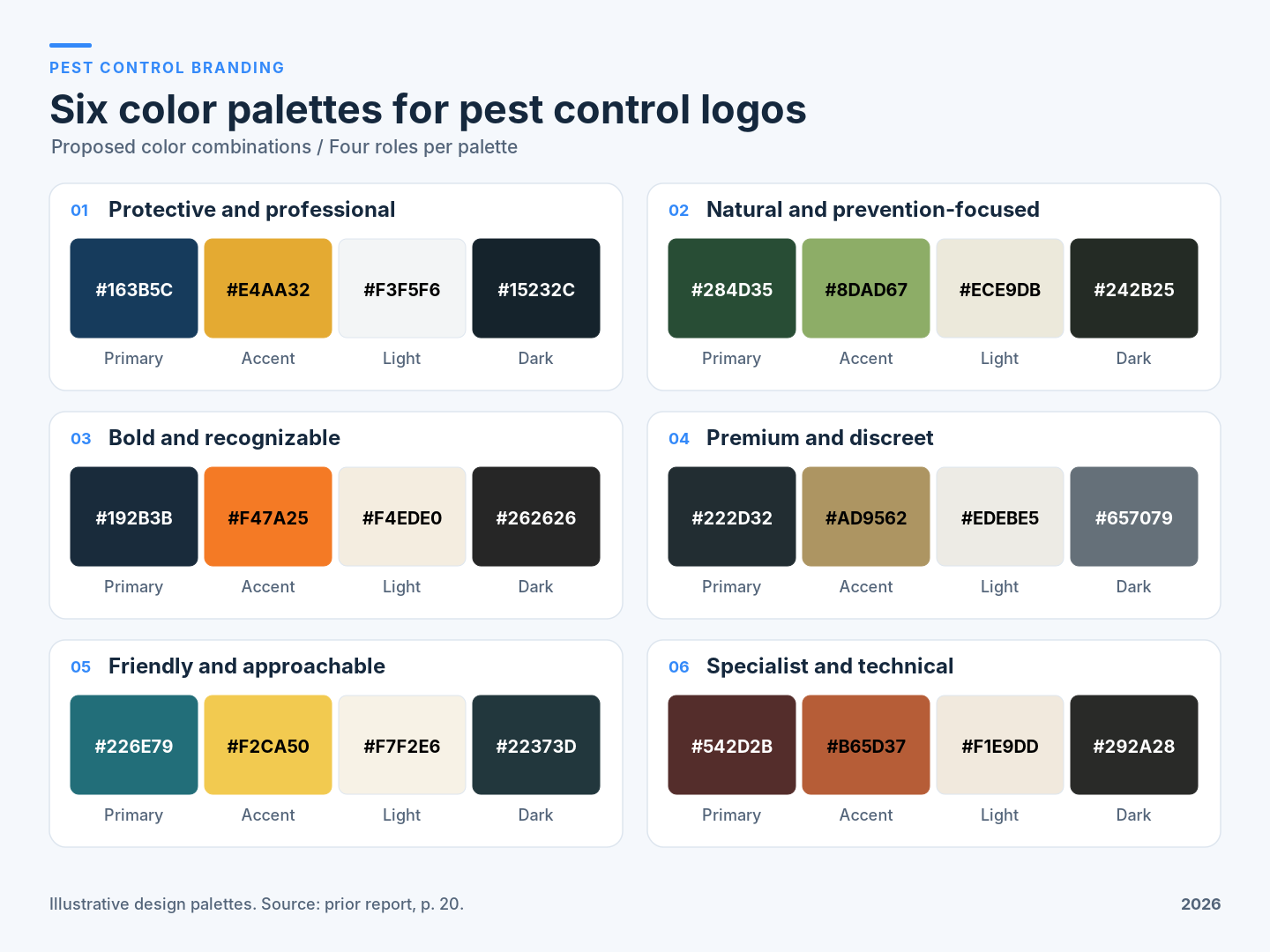
Start with a primary color, an accent and a neutral background. You don't need to include every brand color in the logo itself. A navy wordmark on a white truck might use a small orange accent, while the website uses navy headings and maintains readable body text.
HEX codes define digital colors, but printed vinyl, uniform fabrics and embroidery threads can reproduce those colors differently. Request physical samples from your production suppliers and approve the final colors before ordering graphics or uniforms for multiple technicians and service vehicles.
Best fonts for pest control logo design
Choose a typeface with recognizable letterforms, sufficient weight and comfortable spacing. Thin strokes, decorative details and tightly spaced capital letters can make company names difficult to read at smaller sizes or from a distance, particularly when they're printed on service vehicles.
| Font | Recommended weight | Suitable design direction |
|---|---|---|
| Barlow Condensed | 700–800 | Compact wordmarks and vehicle lettering |
| Montserrat | 700–800 | Contemporary residential pest control |
| Archivo Black | Regular (400) | Large, prominent company names |
| Oswald | 600–700 | Condensed service-business identities |
| Sora | 600–800 | Modern, technical branding |
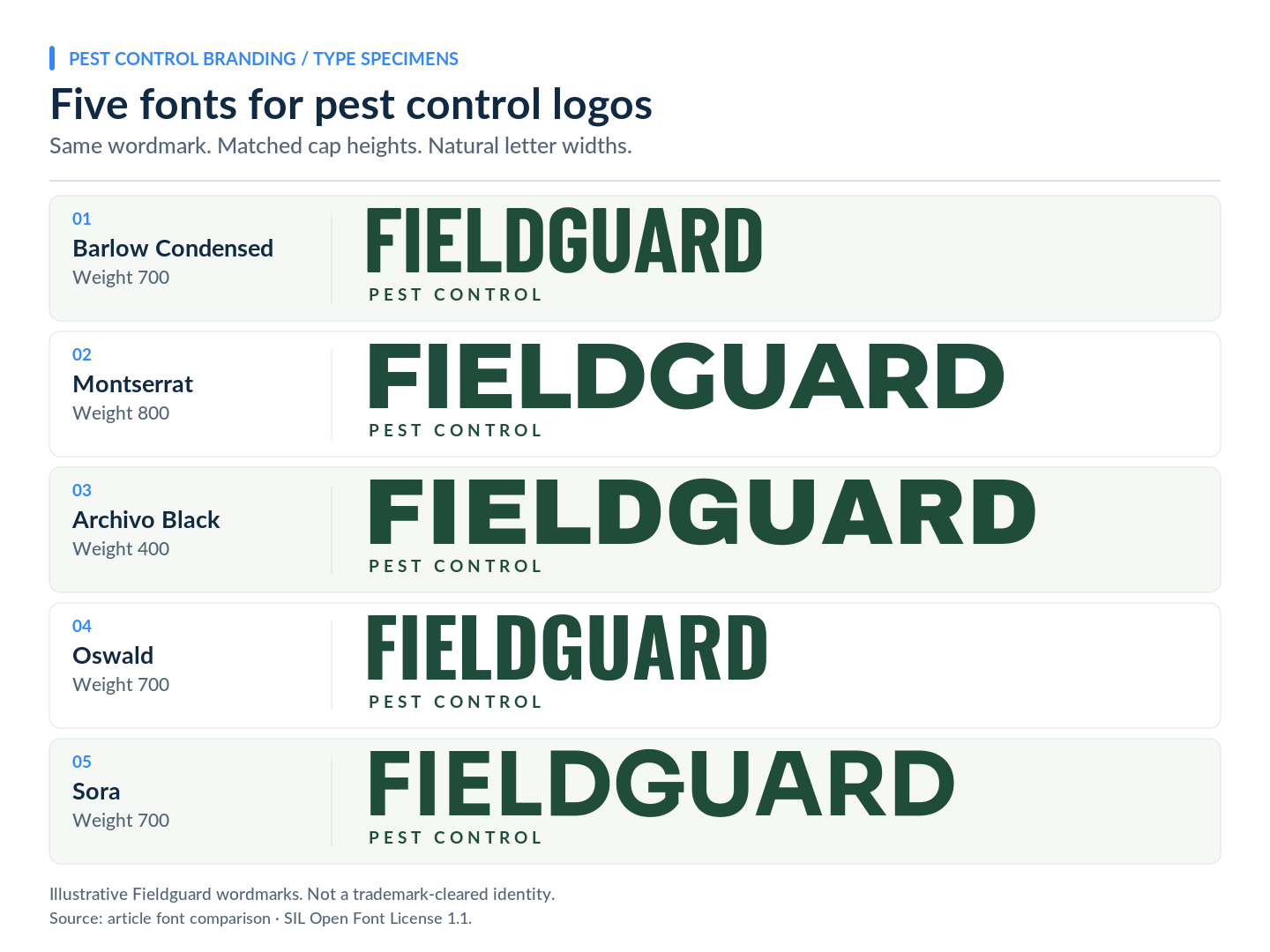
These fonts are design suggestions rather than a measured legibility ranking. Test the actual letterforms at their intended sizes and verify the license for the specific font files you use. Serif typefaces can also work for established or premium businesses when their smaller details reproduce clearly.
Keep important information such as your phone number and the words "Pest Control" easy to read. A decorative font might complement a mascot, but using that same typeface for contact details can make your vehicle graphics and marketing materials harder to understand.
Choose a logo for your type of pest control business
Your logo should reflect the services you provide, the customers you serve and how visibly you want to identify your business. A company specializing in one pest can use more specific imagery, while a business planning to expand may benefit from a broader visual identity.
| Pest control business type | Recommended design direction | Practical consideration |
|---|---|---|
| Residential general pest control | Shield, house or friendly mascot | Recognition throughout neighborhood service routes |
| Commercial pest management | Wordmark, monogram or restrained symbol | Readability on proposals and inspection reports |
| Termite control | Structural element or simplified termite | Flexibility when introducing additional services |
| Bed bug specialist | Discreet wordmark or abstract symbol | Customers may prefer less conspicuous service vehicles |
| Mosquito control | Winged insect or distinctive lettering | Seasonal marketing and outdoor visibility |
| Wildlife control and exclusion | Animal silhouette or entry-point symbol | Clear identification of the actual service |
| IPM and prevention-focused services | Nature-inspired symbol or protective barrier | Environmental messaging consistent with treatment methods |
Be careful with brand promises such as "family safe," "non-toxic" and "eco-friendly." Make sure these claims can be supported for the products and services you provide. A leaf symbol doesn't establish that a treatment is harmless, and your marketing should accurately describe what customers receive.
Pest control branding: turn your logo into a complete identity
Pest control branding includes your logo, colors, typography, messaging and the experience customers have with your business. Use the same visual identity from the moment customers find you online through their first treatment, subsequent service visits and recurring plan renewals.
In a July 2021 interview with Pest Management Professional, Mike Vialpando, then a brand and marketing strategist at Truly Nolen, explained that "The marketing team handles every request for a logo or creative asset directly".
Smaller pest control companies can follow the same approach without maintaining a dedicated marketing department. Store approved artwork in a shared brand folder and assign one person responsibility for reviewing changes. Give technicians, printers and other suppliers access to the correct logo files.
Brand your pest control website
Place the horizontal logo in your website header and use the simplified symbol as your favicon. Keep the header compact, particularly on mobile devices, so customers can easily access your navigation, phone number and booking button without the logo occupying unnecessary space.
Your homepage should clearly explain your services, service areas, contact information and how customers can schedule an appointment. Use real photographs of technicians and vehicles when possible. Display service names as readable text instead of embedding important information inside images.
Give your website logo an accessible name when it links to the homepage. Follow Google's favicon guidelines if you want your site icon to be eligible for display in search results. Changing your logo or favicon doesn't guarantee improved rankings.
For the other factors that affect your website's search visibility, read RankBeaver's pest control SEO guide, which covers the search optimization decisions involved in attracting customers within your service area.
Update your Google Business Profile and social media accounts
Prepare a square version of your logo with enough surrounding space to accommodate circular cropping. Upload it to your verified Google Business Profile using Google's photo and logo instructions. Use suitable profile images and separate cover photographs on social media platforms where available.
Keep your actual business name, contact information and website consistent across your profiles. Don't add service keywords to your Google Business Profile name simply because they're part of a new slogan or branding campaign. Your profile should use your real business name.
Google identifies relevance, distance and prominence or popularity as factors affecting local search rankings. A redesigned logo can change how customers recognize your company, but it isn't a local SEO strategy by itself. Read Google's local ranking guidelines for more information.
Design readable pest control truck graphics
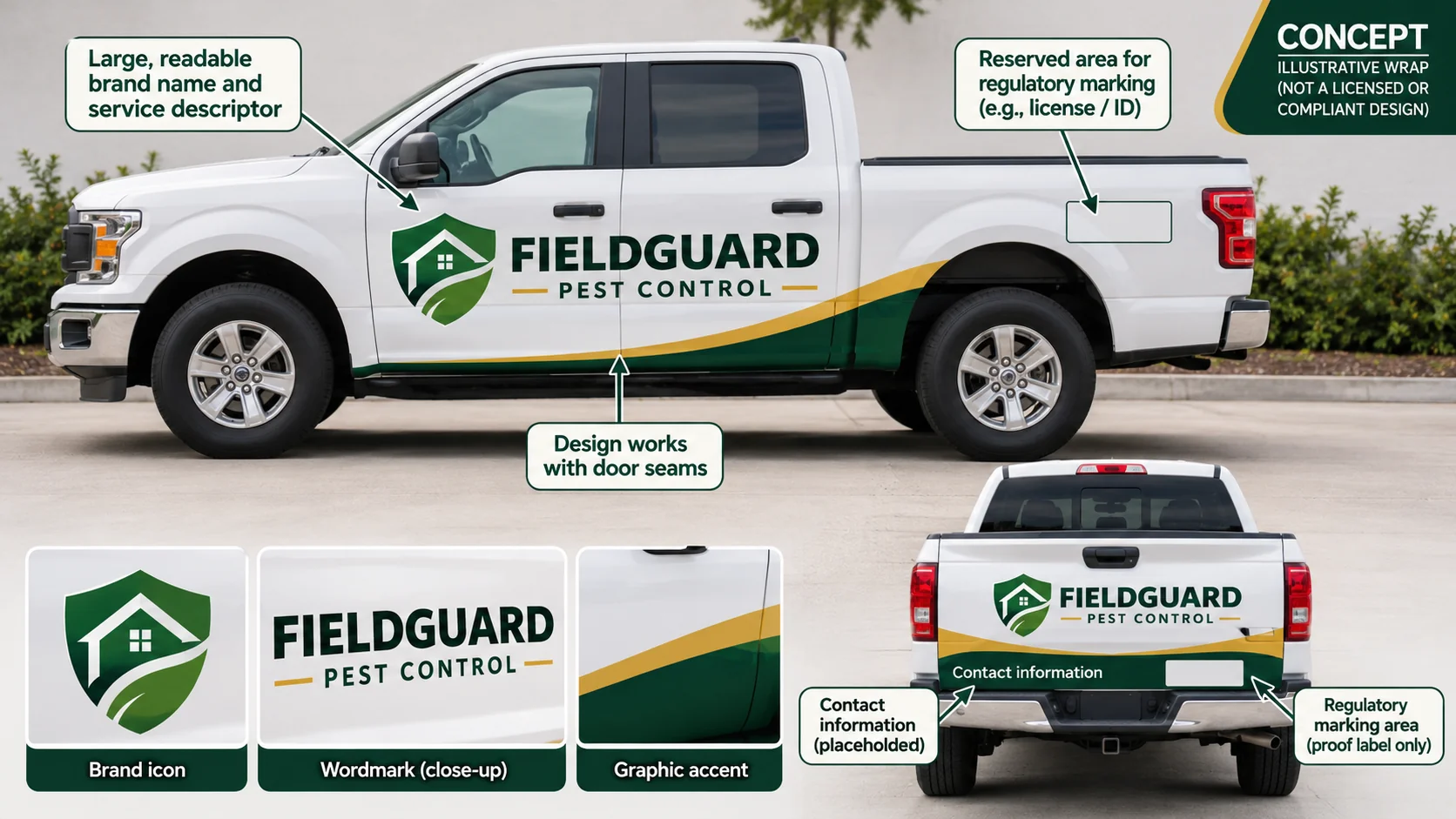
Your truck graphics should prioritize your company name, service description and a useful contact method. Leave enough room for mandatory regulatory information. If including both a phone number and website address creates a crowded layout, choose the contact method you want customers to use first.
Dennis Jenkins, then president of ABC Home & Commercial Services in Dallas, explained in a March 2023 Pest Management Professional article that vehicle graphics should make the company's services easy to understand. Test the company name and service description from a distance before approving the design.
Use an accurate template or photograph of the vehicle you're wrapping. Account for door handles, panel seams, wheel arches, windows and sections covered when doors open. Review both sides and the rear independently because a design that fits one panel may not work on another.
Vehicle advertising and license-number requirements vary by state. The Texas Department of Agriculture's self-audit guidance, for example, specifically addresses TPCL numbers on service vehicles. Confirm your own state's current requirements before sending the artwork to production.
Pro tip: Request a dimensioned, flat artwork proof showing every line of text and required regulatory marking. Review the rear of the vehicle separately instead of approving the entire wrap based on an attractive side-view mockup.
Standardize technician uniforms and customer paperwork
Choose a consistent polo shirt or work uniform with a simplified embroidered version of your logo. Recognizable uniforms help customers identify the company arriving at their property. Continue following your established technician identification and customer-safety procedures alongside your uniform requirements.
Apply the same company name, colors and logo to estimates, invoices, inspection reports, service agreements, renewal notices, yard signs and business cards. Keep required notices and service information readable. On documents such as inspection reports, prioritize the findings over large decorative branding.
For help planning customer acquisition and allocating your advertising budget beyond visual branding, read RankBeaver's pest control marketing guide.
Should you use a logo maker or hire a designer?
Use a logo maker if you want to explore initial ideas on a limited budget. A freelance graphic designer is suitable for businesses that need custom artwork and editable logo variations. A branding agency may be appropriate when coordinating an identity across multiple vehicles, locations and business systems.
| Design method | When to use it | What to confirm |
|---|---|---|
| Template or logo maker | Exploring concepts or creating a basic startup identity | Export quality, shared assets, commercial terms and exclusivity |
| AI-assisted design | Generating initial symbols and layout ideas | Asset origins, output rights, similarities and vector cleanup |
| Freelance designer | Creating custom logos and practical variations | Revisions, source files, ownership and production support |
| Branding agency | Developing positioning, visual identity and rollout plans | Project scope, approvals, handover and implementation costs |
Namecheap's logo maker, Zenn and 99designs are examples of services you can explore for logo inspiration or commissioned design work. RankBeaver hasn't tested or ranked these services. Review their current terms, commercial rights and export options before choosing one.
How much does a pest control logo cost?
The cost of a pest control logo depends on how much original design work is involved, the artwork rights you receive and the files included in the final package. Compare itemized quotes because a template download, a custom illustrated mascot and a complete fleet rebrand involve different amounts of work.
For a business operating its first truck, request quotes for a core logo with horizontal, stacked, symbol-only and one-color versions. Confirm whether the price includes revisions, editable vector files and a basic usage guide before comparing proposals from different designers.
Established pest control companies should budget separately for brand strategy, logo design, vehicle artwork, removal of existing vinyl, printing, installation, uniforms and website updates. This makes it easier to understand the full cost of introducing the new identity across existing business assets.
The following $1,000 example shows how you might allocate a hypothetical branding budget before physical production. These figures aren't market price estimates or actual vendor quotes.
| Design expense | Example budget |
|---|---|
| Custom logo and variations | $500 |
| Truck artwork preparation | $250 |
| Initial print and uniform proofs | $150 |
| Contingency | $100 |
| Total before physical production | $1,000 |
Physical decals, vehicle wraps, uniform orders, legal reviews and website work would cost extra in this example. Replace the suggested amounts with written supplier quotes. Avoid spending your entire launch budget on an elaborate mascot or full vehicle wrap if a simpler logo and compliant vehicle lettering meet your immediate needs.
Common pest control logo design mistakes
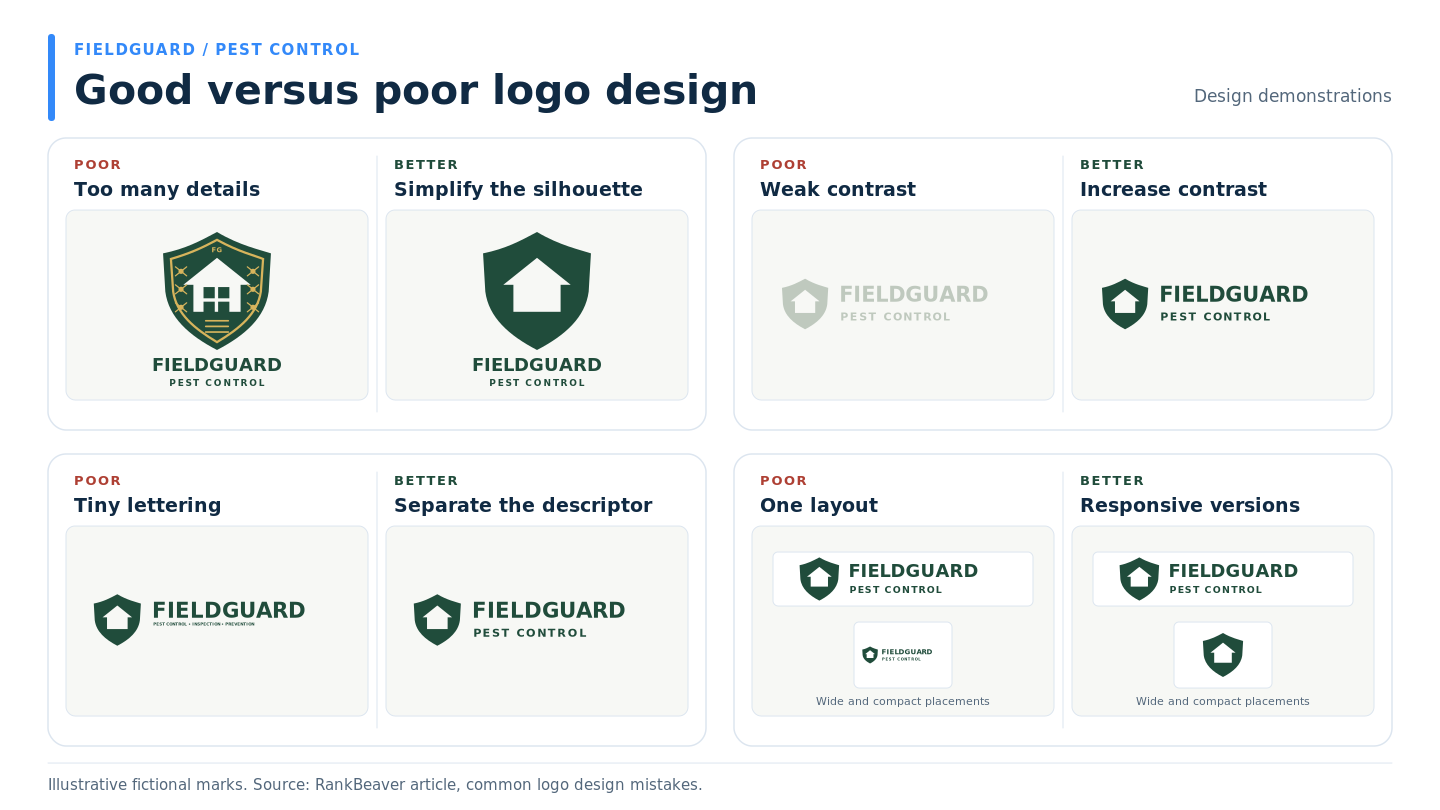
Logo design mistakes become expensive when you discover them after ordering printed materials. An unreadable company name, complicated insect illustration or unsuitable color combination can require you to replace vehicle decals, uniforms and stationery that you've already paid to produce.
| Common mistake | How to fix it |
|---|---|
| Detailed insects with thin legs | Use simplified silhouettes with sufficient spacing |
| Generic stock shields | Develop a distinctive shape or customized interior cutout |
| Too many fonts and competing colors | Reduce the number of type styles and establish a clear visual hierarchy |
| Tiny tagline inside the logo | Place it outside the main logo or remove it from smaller versions |
| Light lettering on a pale vehicle | Increase contrast between the lettering and background |
| Using one PNG for every application | Request editable vectors and multiple logo layouts |
| Unlicensed stock artwork | Verify usage rights and replace restricted assets |
| Branding focused on one pest despite expansion plans | Create a broader company identity with separate service descriptors |
| Different logos across marketing channels | Maintain one approved collection of artwork |
Avoid incorporating association logos, certification badges or official seals into your company logo unless you've confirmed permission and meet the applicable usage requirements. Display these credentials separately from your primary identity where appropriate, making it easier to update or remove them when necessary.
How to protect and manage your pest control logo
Search for potentially conflicting company names and logo designs before investing in branding materials. The USPTO federal trademark search guidance explains how to investigate both word and design elements. A comprehensive trademark clearance search also considers state records, marketplace use and other sources beyond federal registrations.
Look for similar names, alternative spellings, pronunciations and relevant design elements used by businesses offering the same or related services. An available domain name or approved state business registration doesn't establish trademark clearance. A qualified trademark attorney can explain potential conflicts and registration options for your specific identity.
Before hiring a designer, agree in writing on commercial usage rights, ownership or licensing arrangements, editable file delivery, third-party artwork, font licenses and permission to display the work in a portfolio. These agreements should be clear before the designer begins developing your logo.
If you're using an AI logo generator or template-based design service, review its commercial terms, shared asset policies and restrictions on trademark use. Don't assume that every generated logo qualifies for copyright protection or gives your company exclusive ownership of the resulting artwork.
Pro tip: Maintain a shared brand folder containing approved master files, exported logo variations, color specifications, licenses, production proofs and a short usage guide. Give technicians and suppliers access to the exported files rather than allowing everyone to edit the original artwork.
Pest control logo design checklist and scorecard
Compare two or three shortlisted logo concepts using the same evaluation criteria. Give each design a rating from zero to ten for every category. Multiply the rating by the category's point weight and divide by ten, then add the results to calculate its total score out of 100.
| Evaluation criteria | Weight | Example rating | Weighted score |
|---|---|---|---|
| Readability | 20% | 7/10 | 14 |
| Distinctiveness | 20% | 6/10 | 12 |
| Industry relevance | 15% | 8/10 | 12 |
| Scalability | 15% | 7/10 | 10.5 |
| Color contrast | 10% | 8/10 | 8 |
| Versatility | 10% | 7/10 | 7 |
| Brand positioning | 10% | 7/10 | 7 |
| Total | 100% | 70.5/100 |
Use these suggested score ranges to decide whether a logo is ready for approval or needs further design work.
| Logo score | Recommended action |
|---|---|
| 85–100 | Proceed with final approval checks |
| 70–84.99 | Refine the weaker design elements |
| 50–69.99 | Make substantial revisions |
| Below 50 | Reconsider the design direction |
This scorecard helps you compare designs consistently, but it isn't a validated predictor of marketing performance. A high score doesn't resolve trademark conflicts, commercial usage restrictions or regulatory problems. Complete those checks separately before approving artwork or committing to physical production.
Final pest control logo approval checklist
- The company name remains readable at the intended minimum size.
- Truck graphics are readable in a physical or scaled proof.
- The one-color version reproduces clearly.
- The design is distinguishable from local competitors.
- The identity suits your intended customers.
- Light and dark versions work on their respective backgrounds.
- An actual embroidery sample has been approved.
- Editable vector artwork has been delivered.
- Transparent digital logo files have been delivered.
- Commercial usage rights are documented.
- Potentially conflicting trademarks have been investigated.
- Future service expansion has been considered.
- Website and marketing materials use consistent logo versions.
- Brand colors, fonts and usage rules are documented.
How to rebrand an established pest control company
Before replacing an established pest control logo, identify which parts of the existing identity customers recognize. Familiar company names, colors and vehicle designs may be worth retaining if they still suit your business. A full redesign isn't necessary when a refinement can resolve the existing problems.
When Pest-End announced its company-wide rebrand in 2022, then-COO and co-owner Courtney Carace told Pest Management Professional that "Marketing and brand recognition were two areas we prioritized." The company planned changes to both its visual identity and language.
Define what your rebrand needs to accomplish before commissioning new artwork. Inventory your vehicles, uniforms, signage, business cards, website, Google Business Profile, social media accounts, invoices, service agreements, email templates and customer notifications to understand which materials will require replacement.
Calculate the replacement cost of each asset and determine whether it needs an immediate update or can wait until its normal replacement date. A phased rollout allows you to coordinate changes across your business without replacing every physical item on the same day.
| Rebranding phase | Recommended actions |
|---|---|
| Before announcement | Resolve artwork rights, approve designs, obtain production proofs and confirm the budget |
| Launch | Update the website, profile images, office scripts and digital documents |
| Following weeks | Replace uniforms and vehicle graphics in a coordinated sequence |
| Transition | Tell existing customers which identity to expect and retain familiar contact information if unchanged |
| Follow-up | Identify remaining outdated artwork and collect feedback from customers and technicians |
Treat a company name or domain change as a separate migration project. Update business and regulatory records where required, plan website redirects and maintain consistent information across your business listings. Don't create a duplicate Google Business Profile simply because you're introducing a new logo.
Monitor branded search queries, direct inquiries and customer responses about how they discovered your company. Compare equivalent periods while accounting for advertising changes, seasonal demand and changes to service coverage. These indicators can help assess the rollout, but they can't isolate the effect of the new logo alone.
Frequently asked questions
What should a pest control logo look like?
A pest control logo should have a recognizable symbol or company name, readable typography and sufficient contrast. Insects, shields, houses, initials, mascots and abstract symbols can all work. Choose a design that remains clear across your mobile website, technician uniforms, service trucks and customer documents.
Should a pest control logo include an insect?
No. A shield, house symbol or clearly labeled wordmark can communicate pest control without depicting an insect. A general pest control company planning to introduce termite or wildlife services may prefer broader imagery, while a mosquito control specialist might benefit from a recognizable insect symbol.
Can I create a pest control logo for free?
Yes. You can use free logo makers or create your own artwork using appropriately licensed design tools and assets. Check whether the free plan includes editable vector exports, commercial usage rights and the necessary logo variations. Shared template graphics and free access don't guarantee trademark clearance.
What file formats should I request from my logo designer?
Request an editable master file, SVG artwork, production-compatible PDF or EPS files where required, and transparent PNG exports. Obtain horizontal, stacked, icon-only and one-color versions. Confirm file requirements with your printer and vehicle wrap installer, since a vector file extension doesn't necessarily mean the artwork contains editable vector paths.
Does changing a pest control logo affect Google rankings?
Changing your logo isn't an established way to improve local Google rankings, although it can affect how customers recognize your business online. Maintain accurate company information, preserve functioning website pages and update your profile imagery. If you're changing your business name or domain, plan the website and listing migration separately.
When should a pest control company rebrand?
Consider rebranding when your existing identity no longer represents your services, resembles competing businesses, reproduces poorly or has become inconsistent across a growing fleet. If customers already recognize your logo and it remains functional, a smaller design refinement may be sufficient. Calculate physical replacement costs before approving a complete redesign.