

Most residential lawn mowing services charge between $40 and $85 per visit, according to published 2026 pricing guides. However, the amount you should charge depends on your labor costs, property size, travel time, and operating expenses. A rate that works for another lawn care business might leave you with very little profit.
A lawn care pricing chart gives you a starting point for comparing local rates and estimating service costs. You can use the market prices below to check your rates before calculating what each job actually costs your business. The free lawn care price sheet also provides a way to organize those calculations and prepare quotes for customers.
Lawn care pricing chart for 2026
Lawn care prices vary according to the amount of grass being maintained, the services included, and how long the work takes. Published rates also differ because pricing guides use different property sizes and service definitions. The following figures are based on pricing information published by LawnStarter, HomeGuide, and Jobber.
Lawn mowing prices by lawn size
Lawn mowing prices generally increase with lawn size, although the total property area can be misleading. A half-acre property with a house, swimming pool, and several flower beds may have less grass to mow than a smaller property. Measuring the actual mowing area gives you a better estimate of the work involved.
| Lawn size | Property type | Typical price per visit (2026) | Pricing considerations |
|---|---|---|---|
| Up to 5,000 sq ft | Small urban lawn | Usually near the minimum service charge | Travel and setup costs may make lower rates unprofitable |
| 5,001–10,000 sq ft | Standard suburban lawn | $40–$65 | LawnStarter reports $41–$61 for lawns up to a quarter-acre |
| Quarter-acre (10,890 sq ft) | Common residential lawn | $45–$85 | HomeGuide reports $45–$85; Jobber lists $25–$60 |
| Half-acre | Larger residential lawn | $65–$120 | Trimming, edging, and obstacles affect the cost |
| One acre or more | Large residential or rural property | $100 and up | Equipment efficiency, terrain, and access affect pricing |
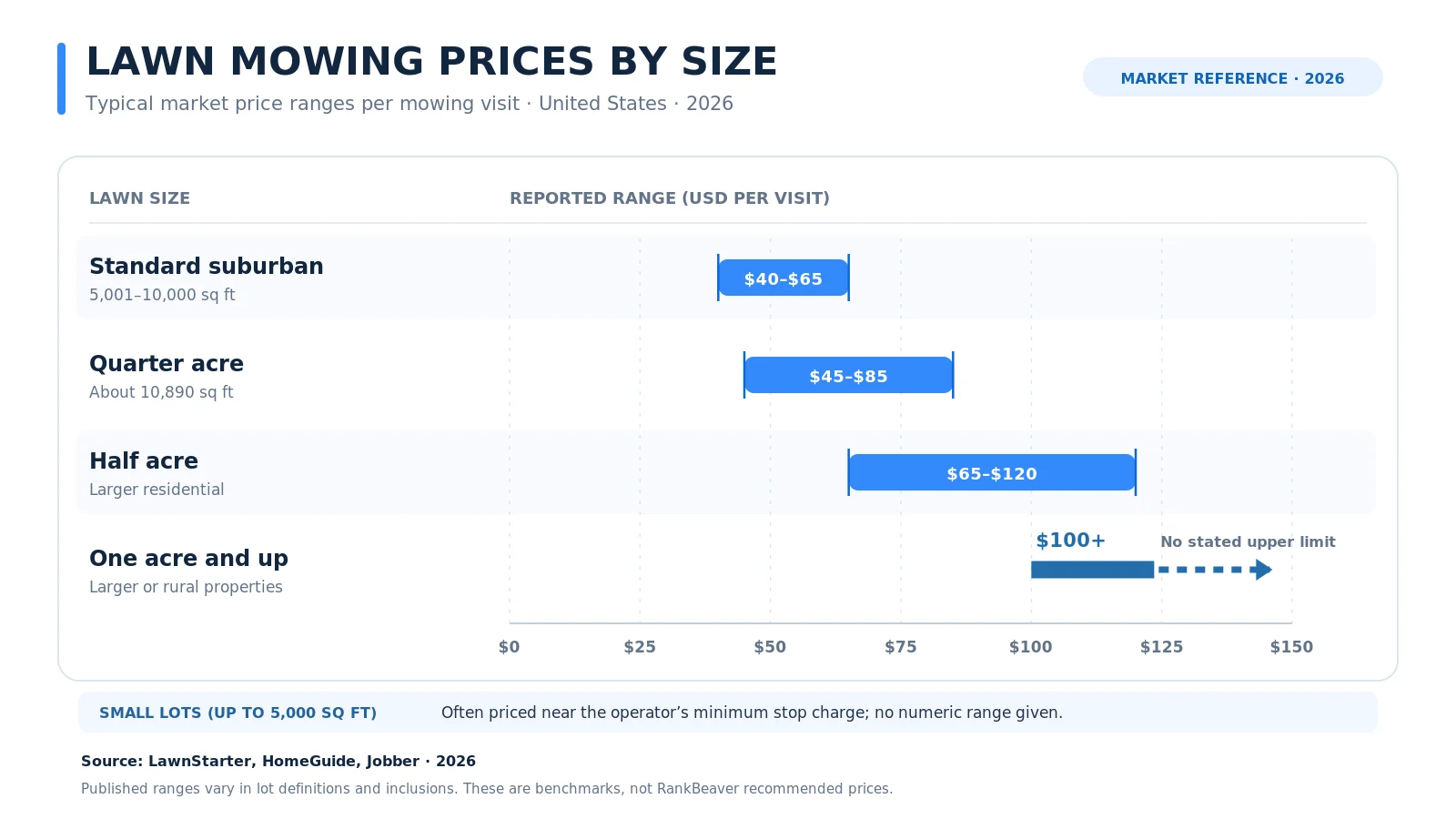
Sources: LawnStarter mowing cost data (October 2025–October 2026), HomeGuide (February 2026), and Jobber (March 2026).
These figures are market estimates, so you shouldn't average them into a single rate. Each source uses slightly different property sizes and may include different services. Compare the published ranges with your calculated costs before deciding what to charge.
A small lawn can sometimes produce a better hourly return than a large property. For example, mowing a 3,000-square-foot lawn in 20 minutes at your minimum service charge may pay better than spending 90 minutes on an acre. The distance between jobs also affects how much work your crew can complete in a day.
Lawn care rates by service
Mowing is usually the main service on a residential lawn care price sheet, but additional services need their own rates. Fertilization, mulching, aeration, and cleanup work involve different labor requirements and material expenses. Separating these charges makes it easier to calculate costs and see which services are profitable.
| Lawn care service | Pricing unit | Typical 2026 market rate | Pricing considerations |
|---|---|---|---|
| Lawn mowing | Per visit | $40–$85 | Apply your minimum service charge |
| String trimming and edging | Per visit | Included or $10–$25 | Time depends on perimeter length and obstacles |
| Lawn fertilization | Per application | $50–$100 | Based on treated area and fertilizer cost |
| Weed control | Per application | $50–$100 | Chemical treatments may require state licensing |
| Lawn aeration | Per visit | $75–$200 | Equipment requirements and soil conditions affect rates |
| Dethatching | Per visit | $100–$250 | Account for labor and debris removal |
| Overseeding | Per visit | $75–$200 | Frequently offered with aeration |
| Mulching | Per cubic yard installed | $60–$120 | Includes materials and spreading labor |
| Leaf removal and seasonal cleanup | Per visit or hourly | $150–$400+ | Depends on debris volume and disposal requirements |
These ranges reflect published 2026 pricing guides for lawn care operators and homeowners. Each service should have a clearly defined pricing unit because the work involved differs. For example, fertilizer is usually priced per application, whereas mulch installation is commonly calculated by cubic yard.
Download the free lawn care price sheet
The free lawn care price sheet is designed for two purposes: calculating your internal service costs and presenting prices to customers. The download includes printable PDF versions along with an editable Excel (.xlsx) workbook and CSV files. All are available without entering an email address.
Editable lawn care pricing worksheet and customer price list
Calculate quotes from your own expenses, then share a clean price list with customers. The sample figures are fictional and for illustration only.
Also included: an editable CSV, a filled PDF example, and a printable blank PDF. View blank price sheet (PDF)
The private worksheet contains fields for labor costs, travel time, equipment expenses, materials, overhead, and your desired profit margin. It helps calculate a price for each service based on what the job costs your business. Keep this worksheet private because customers only need the final quote and its included services.
The customer price list contains service names, pricing units, descriptions, exclusions, and your minimum charge. It should also show your business contact information, service area, and the date the prices were updated. A completed sample can help you see how the finished price sheet should look.
Keep an additional version without fixed prices for properties that require an inspection before quoting. Narrow gates, steep slopes, restricted access, and overgrown lawns can change how long a job takes. Quoting these properties after seeing them helps you account for the extra work.
How to calculate lawn care prices
Start by calculating what your business spends to complete one job, including the time spent driving between customers. Add equipment expenses, materials, and a share of your operating overhead. Once you know the total cost, apply your target profit margin to calculate the selling price.
The basic formula is:
Lawn care price = Total job cost ÷ (1 − Target profit margin)
For example, if a job costs $60 and you want a 25% profit margin, divide $60 by 0.75. The resulting price is $80, leaving $20 after covering the calculated job costs. Using this formula consistently helps you avoid setting prices that cannot cover your expenses.
Calculate your actual labor costs
Employee wages are only one part of what your business pays for labor. Payroll taxes, workers' compensation, and employee benefits increase the amount you spend for every paid hour. These additional expenses are included in your loaded labor cost.
The U.S. Bureau of Labor Statistics reported a median annual wage of $38,470 for grounds maintenance workers in 2024. That figure provides wage context, although your actual labor cost depends on your employees and business expenses. Use your own loaded hourly labor cost when calculating service rates.
Travel and setup time also count toward paid labor hours. Your crew spends time driving between properties, unloading equipment, and preparing to work before mowing begins. Include those minutes in each job's cost even when customers are charged a flat rate.
Include equipment, materials, and overhead
Equipment expenses include fuel, routine maintenance, repairs, and depreciation. Mowers and trimmers accumulate operating costs whenever they are used, so those expenses should be included in your hourly equipment rate. Materials such as fertilizer, grass seed, mulch, and disposal bags should be calculated separately for each job.
Your business also pays expenses that are not tied directly to one lawn. Insurance, administrative work, software subscriptions, and vehicle expenses all contribute to your operating costs. Allocate a reasonable share of these expenses across the jobs your business completes.
Example: Calculating a mowing price for a two-person crew
Suppose a two-person crew spends 35 minutes mowing a residential lawn and another 12 minutes driving from its previous stop. The job uses 47 minutes of paid crew time, including travel. At a loaded crew labor cost of $50 per hour, the total labor expense is $39.17.
Equipment and materials add another $7, while the allocated overhead is $8. That brings the total job cost to $54.17 before profit. With a target margin of 25%, the calculated selling price is $72.23, which can be rounded to $73.
| Cost component | Amount |
|---|---|
| Time spent on property | 35 minutes |
| Travel time | 12 minutes |
| Total paid crew time | 47 minutes |
| Loaded crew labor rate | $50/hour |
| Total labor cost | $39.17 |
| Equipment and materials | $7.00 |
| Allocated overhead | $8.00 |
| Total job cost | $54.17 |
| Selling price at 25% target margin | $73.00 |
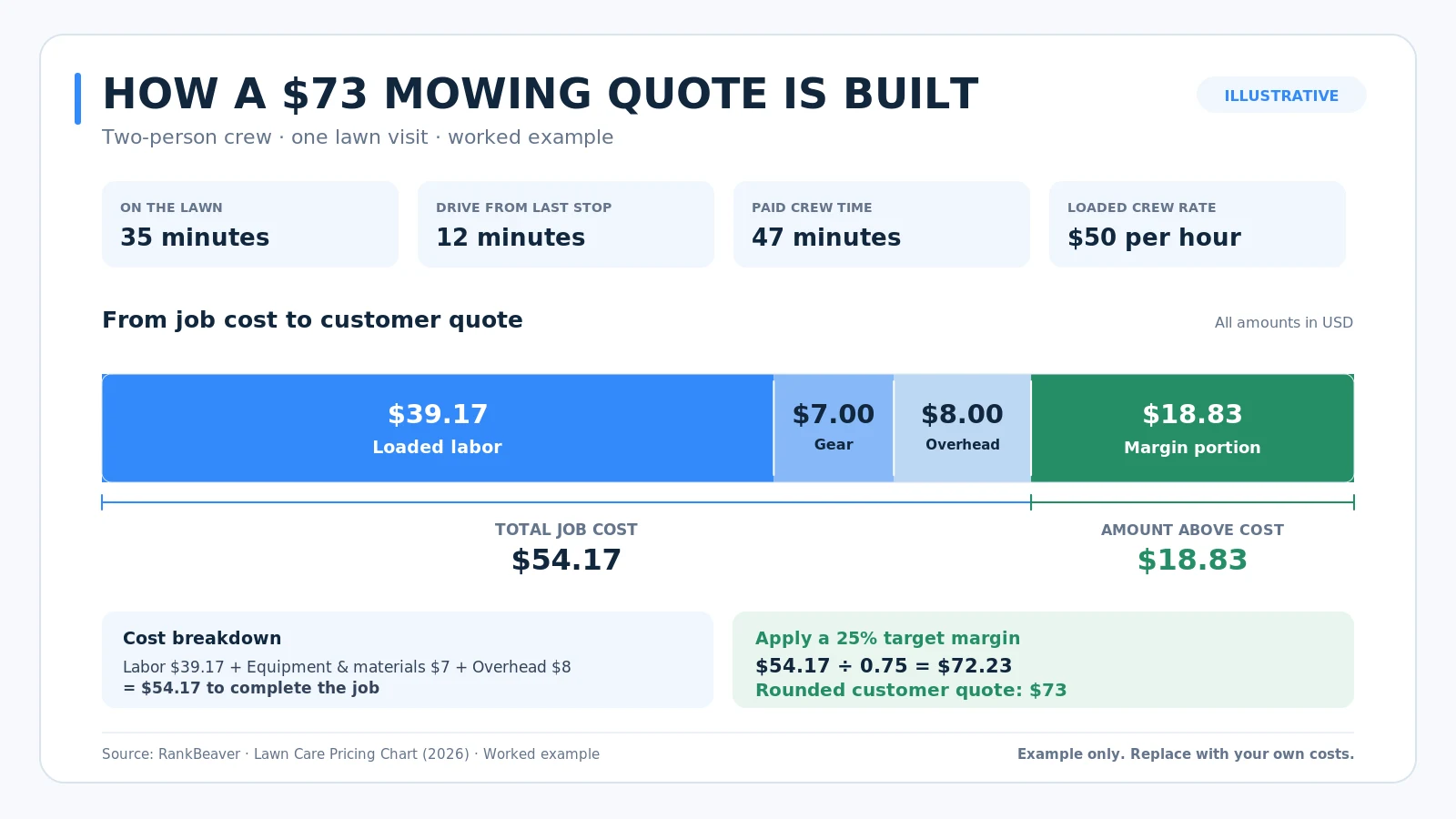
All figures in this example are illustrative. Replace the labor rate, travel time, and expenses with figures from your own operation before using the calculation. The resulting price should also be compared with local market rates.
Now suppose the same property is 20 minutes from your previous stop instead of 12 minutes. Your total paid crew time increases to 55 minutes, bringing the job cost to approximately $60.83. Charging the original $73 would reduce your margin to about 17%.
This difference explains why route planning affects lawn care pricing. Two properties with identical lawns may have different operating costs because of their locations. Jobs grouped close together require less travel time and allow the crew to complete more visits during the same working day.
Understand the difference between markup and profit margin
Markup measures profit as a percentage of your cost, whereas profit margin measures it as a percentage of the selling price. The calculations use different starting points and produce different prices. Confusing them can cause you to charge less than your intended profit margin.
For example, adding a 25% markup to a $60 job cost gives you a selling price of $75. Your profit is $15, which represents only 20% of the selling price. To earn a 25% margin on the same job, you would need to charge $80.
| Pricing method | Selling price | Profit margin |
|---|---|---|
| 25% markup on a $60 cost | $75 | 20% |
| 25% profit margin on a $60 cost | $80 | 25% |
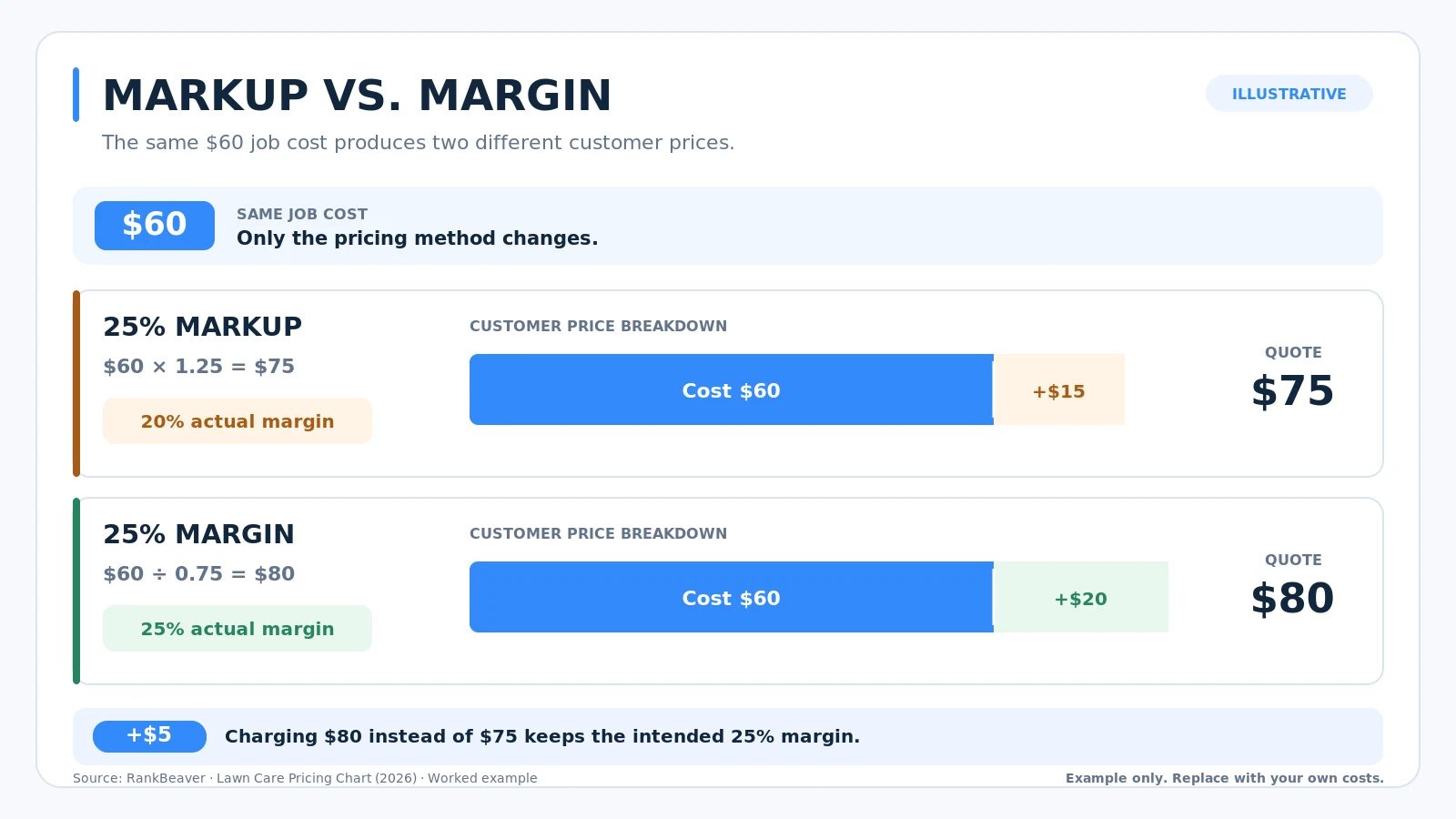
The difference is $5 per visit in this example. Across a recurring mowing schedule, that difference adds up with every completed job. Use the margin formula when you want a specific percentage of your revenue to remain after job costs.
Choosing a lawn care pricing model
Lawn care businesses can charge by the hour, per visit, by property area, or through a recurring contract. Each model suits different types of work and creates different expectations for customers. Choose the method that matches the service while keeping your minimum service charge in place.
| Pricing model | Suitable services | Advantages | Limitations |
|---|---|---|---|
| Flat rate per visit | Routine residential mowing | Predictable pricing for customers | Requires an accurate estimate of job time |
| Hourly pricing | Overgrown lawns and unpredictable cleanups | Charges for actual working time | Customers may want a maximum price or estimate |
| Per square foot or acre | Large residential and commercial properties | Useful for pricing extensive mowing areas | Small properties may fall below the cost of setup |
| Recurring contract | Seasonal residential and commercial maintenance | Regular billing and easier route planning | Requires accurate seasonal estimates and consistent agreed rates |
Flat-rate pricing
Flat-rate pricing works well when you know how long a property normally takes to maintain. The customer pays a fixed amount per visit, making the cost predictable throughout the service agreement. Calculate that rate using the expected labor time and operating expenses before offering it.
A flat rate should also account for routine trimming and edging when those services are included. If a property requires substantially more work than a standard lawn, adjust the quote accordingly. Avoid setting a fixed price based only on lawn area without considering access and mowing conditions.
Hourly pricing
Hourly pricing is useful for jobs where the amount of work is difficult to estimate in advance. Heavy leaf removal, overgrown properties, and neglected lawns may take considerably longer than routine maintenance. Charging for actual working time allows you to account for those conditions.
Customers may be uncomfortable agreeing to an open-ended hourly charge. Providing an estimate or setting an agreed maximum can make the arrangement clearer. Explain which activities count toward billable time before starting the job.
Pricing per square foot or acre
Pricing by area is practical for large properties with substantial mowing space. Commercial lawns and rural properties can often be measured and quoted using a square-foot or per-acre rate. The calculation becomes more accurate when you account for the equipment and crew needed to maintain the area.
Small properties require a different approach because travel and setup costs remain even when there is very little grass to cut. A strict square-foot calculation may produce a price below your operating cost. Apply your minimum stop charge to prevent this.
Recurring lawn care contracts
Recurring contracts provide a defined maintenance schedule and more predictable billing. They also make it easier to organize customers into routes that reduce travel between appointments. A regularly maintained property can be priced using the expected work across the full agreement.
A customer on a nearby recurring route may be more profitable than a higher-priced one-time customer across town. The one-time visit creates additional travel requirements and may involve unfamiliar property conditions. Calculate recurring contract rates using the full season's expected workload and maintain the agreed pricing terms.
Adjusting prices for different lawn conditions
Two lawns with similar square footage can require very different amounts of work. Terrain, access, obstacles, and grass height all affect the time and equipment needed to finish a visit. Account for these conditions when preparing the quote instead of relying entirely on a standard lawn care pricing chart.
First-time mowing and overgrown lawns
The first visit to an overgrown property may require additional cutting, trimming, and cleanup. A lawn that has gone several weeks without maintenance should be evaluated separately from one receiving regular service. The first-cut price should cover the extra labor without changing the rate for future routine visits.
A common approach is to add a first-cut surcharge of approximately $25 to $75. For properties with extensive growth or uncertain conditions, an hourly rate may be more appropriate. Once the lawn reaches a manageable condition, regular mowing can be billed at its normal recurring rate.
Slopes and uneven terrain
Steep slopes and rough ground can reduce mowing speed and make equipment handling more difficult. These conditions may also increase the risk associated with the work. Estimate the additional time required and include it in your price.
A property with difficult terrain may take longer to maintain than a larger, level lawn. Charging only by square footage can overlook that difference. Base the adjustment on the actual working conditions and expected labor.
Narrow gates and restricted access
Gate width determines which equipment can reach parts of a property. A backyard that cannot accommodate a riding mower may need to be cut with a smaller push mower. That change can sometimes double the time required to mow the backyard.
Restricted parking and long distances between the truck and the lawn also increase labor time. Crews may need to carry equipment farther or make additional trips to move materials. Include these minutes in the quote when access is difficult.
Trees, flower beds, and other obstacles
Trees, landscaping beds, playground equipment, and other obstacles increase the amount of trimming required. A property with several obstacles may take longer than an open lawn of the same size. The perimeter that needs trimming can be a better indicator of labor than total lawn area.
Inspect these features before quoting the job, particularly when the property has extensive landscaping. Calculate mowing and trimming time separately if necessary. Combine them into the final service price when both are included.
Grass clipping removal and bagging
Routine mowing may leave mulched grass clippings on the lawn, depending on the service agreement. Collecting and bagging clippings requires additional labor and may involve transport or disposal charges. These costs should be included when the customer requests clipping removal.
The same principle applies to other services that generate debris. Calculate collection and disposal time based on the expected volume. State clearly whether debris removal is included in the quoted service.
Travel time between properties
The distance from one customer to the next affects how many jobs your crew can complete. A lawn located four minutes from your previous stop costs less in travel labor than an identical lawn 20 minutes away. Both jobs may require the same mowing time while producing different operating costs.
Keep these travel calculations in your internal pricing worksheet. Customers can receive one fixed quote that accounts for the property and route requirements. There is no need to list every internal surcharge separately on the customer-facing sheet.
Weekly, biweekly, monthly, and seasonal lawn care pricing
A recurring lawn care plan should state how often the crew visits and how many visits are included in the agreement. Weekly and biweekly schedules involve different amounts of work per visit, especially during periods of rapid grass growth. Monthly and seasonal billing arrangements also need clearly defined visit counts.
Weekly vs. biweekly lawn mowing
Weekly mowing generally requires less cutting time per visit because the grass is maintained more frequently. A biweekly schedule allows two weeks of growth between appointments, which may increase mowing time during the growing season. The per-visit price should account for that additional work.
Many lawn care operators charge approximately 15% to 30% more per visit for biweekly mowing than for weekly mowing. The customer receives fewer visits, so the total monthly expense may still be lower. Base the final difference on the actual cutting conditions and labor required.
Monthly and seasonal billing calculations
Suppose a customer receives 26 mowing visits during the season, with each visit priced at $73. The total seasonal charge would be $1,898. You can bill that amount during the mowing months or spread it across the full year.
| Billing arrangement | Calculation | Customer payment |
|---|---|---|
| Per-visit billing | 26 visits × $73 | $73 per visit |
| Total seasonal billing | 26 visits × $73 | $1,898 per season |
| Seven-month billing | $1,898 ÷ 7 months | $271.14/month |
| Twelve-month billing | $1,898 ÷ 12 months | $158.17/month |
Both monthly arrangements collect approximately the same seasonal total, allowing for rounding. Seven-month billing matches payments more closely to the active mowing season. Twelve-month billing spreads the expense evenly and provides the business with payments during months when mowing may be limited.
Put the number of visits and billing schedule in the service agreement. Customers should know whether they are paying for individual visits or an agreed seasonal service package. This helps avoid disagreements when the amount of work changes during the year.
How to create a lawn care price list for customers
A customer-facing price list should make it easy to understand what each service costs and what is included. Keep your internal labor calculations, overhead, and profit margins on a separate worksheet. Customers only need the service details and prices that apply to their properties.
List each service and its scope
Start with the services your business offers, such as mowing, edging, fertilization, aeration, and seasonal cleanup. Specify whether the price applies per visit, per application, per hour, or per cubic yard. Include a short description of the work covered by each charge.
For example, a mowing service can state that string trimming and edging are included in the visit price. If grass clipping removal or heavy cleanup costs extra, mention that separately. Clear service descriptions reduce confusion when customers compare estimates.
Include your minimum service charge
Your minimum stop charge is the lowest amount your business accepts for a service visit. Published minimum charges commonly fall between $40 and $55, although your actual minimum should reflect your operating costs. Travel, unloading, and setup expenses still apply when a lawn takes only a few minutes to mow.
Calculate the minimum using the crew time and expenses required to complete your smallest typical job. Include enough margin to make the visit worthwhile. A customer whose property falls below that minimum would still pay the stated minimum charge.
Explain when additional charges apply
Some properties require an inspection before you can provide an accurate price. First-time mowing, heavily overgrown lawns, steep slopes, and substantial cleanup work may need separate estimates. State these exclusions on the price list so customers understand why the final quote may differ from the published starting rate.
Avoid advertising an unrestricted price such as "Lawn mowing — $45" without explaining the service scope. Customers may assume that amount applies to every property, regardless of size or condition. A starting price or clearly defined service description provides more useful information.
Add business information and quote details
Include your business name, contact information, service area, and the date the price list was updated. You should also provide clear quote line items and simple authorization language for customers approving the work. These details help connect the published rates to the actual service agreement.
Keep your price list current on your website and Google Business Profile wherever the relevant service and pricing information can be displayed. Local customers may check these listings before contacting you. Accurate descriptions also help them understand which services are available in their area.
For more information on finding customers in your service area, see How to market your lawn care business. The lawn care services list can also help organize your services into clearly defined offerings. Both are useful when preparing the service descriptions that appear on your website.
Common lawn care pricing mistakes
Underpriced jobs often result from expenses that were left out of the original estimate. A business may calculate the mowing time accurately while overlooking the paid hours between appointments. Reviewing the following mistakes can help identify where your price sheet needs adjustments.
Forgetting to charge for travel time
Travel time is part of the labor required to complete a service visit. If a crew spends 35 minutes on a lawn and 12 minutes driving to it, the job uses 47 minutes of paid time. Pricing only the 35 minutes leaves some labor costs uncovered.
Track the average distance between appointments when reviewing your routes. Jobs located farther apart may need higher rates to account for additional travel. A well-organized route can reduce these expenses.
Using lot size instead of mowable lawn area
A property's total square footage includes buildings, driveways, landscaping, and other spaces that may not require mowing. Using the entire lot size can produce an inaccurate estimate of the work. The actual mowing area should be measured or assessed before pricing.
A half-acre property with limited grass may require less mowing time than a smaller property covered almost entirely in turf. Landscaping obstacles can also add trimming work. Consider both the grass area and the property's layout.
Leaving out payroll expenses
Calculating labor costs from hourly wages alone can underestimate the amount spent on employees. Payroll taxes, workers' compensation, and benefits may increase labor expenses by approximately 20% to 30%. The actual percentage depends on your business and employment costs.
Use loaded labor rates when calculating service prices. Update those rates when wages or employee-related expenses change. Otherwise, the difference between estimated and actual costs reduces your margin.
Copying competitors' prices
Competitor rates are useful for understanding what customers may be paying locally. They do not reveal another company's labor costs, route distances, or operating expenses. Copying a published rate without checking your own costs can result in unprofitable jobs.
Use competitor prices as a comparison after calculating your cost-backed rate. If your price is considerably higher, review the assumptions behind your quote. Any adjustments should still leave enough revenue to cover the work and your target margin.
Overlooking licensing and tax requirements
Sales tax rules for lawn care services vary by state, so the amount you collect may depend on where the work is performed. Commercial applications of pesticides and herbicides may also require specific certifications. These requirements should be checked before adding chemical treatment services to your price list.
Confirm the rules with your state licensing or regulatory agency. The EPA also provides guidance on pesticide applicator certification requirements. Do not assume that permission to provide one type of lawn service automatically covers chemical applications.
Giving a fixed quote before inspecting the property
A quote based on limited information may overlook problems that increase working time. Narrow gates, slopes, obstacles, overgrown grass, and restricted access can all affect service costs. Inspect unusual properties before committing to a fixed rate.
If the job requires additional work, explain the scope and price before beginning. Keep the agreed services documented so the customer knows what the quote includes. This is especially useful for first-time visits and seasonal cleanups.
Frequently asked questions
What is a minimum charge for lawn care?
Many lawn care operators publish minimum service charges between $40 and $55 per visit. The minimum covers the basic cost of reaching a property, preparing equipment, and completing the work. Set your own minimum using your loaded labor rate, travel time, and other operating expenses.
How much should I charge to mow a quarter-acre lawn?
Published 2026 prices for mowing a quarter-acre lawn range from approximately $45 to $85 per recurring visit, although some sources report rates as low as $25. Your price should account for mowing time, trimming requirements, travel expenses, and the profit margin you want to earn. Use the market range to compare your calculated rate with published prices.
How much more should I charge for biweekly lawn mowing?
A biweekly mowing visit commonly costs about 15% to 30% more than a weekly visit because the grass has had longer to grow. The additional cutting and trimming time can increase labor costs. Customers may still pay less over a month because they receive fewer visits.
Should edging and trimming be included in the mowing price?
Including edging and string trimming in a standard recurring mowing service gives customers one price for routine lawn maintenance. The quote should account for the total time needed to mow and finish the property. Perimeter length, landscaping beds, and obstacles can increase trimming time, so consider these details before setting the rate.
How often should I update my lawn care price sheet?
Review your price sheet at least once a year before the mowing season begins. Labor, fuel, and insurance costs changed during 2026, so older rates may no longer cover current expenses. Recalculate your loaded hourly labor cost and minimum service charge first, then review the prices of individual services.
Can I offer chemical weed control in every state?
Commercial pesticide and herbicide applications are regulated, and many states require applicator certification. Licensing categories and other requirements differ depending on the location and products being applied. Check your state agency's rules and the EPA's applicator certification guidance before advertising or charging for chemical treatments.
Review your lawn care prices using an actual job
Choose a property you already maintain and record how long the entire visit takes, including travel and setup. Calculate the labor, equipment, material, and overhead costs using the pricing formula above. Compare the result with the amount you currently charge to identify any difference in your expected profit margin.
Repeat the calculation for other services as you update your price sheet, starting with jobs where you suspect the costs are higher than your current rates. Keep your customer price list separate from the internal calculations. Update both documents whenever your operating costs or service prices change.
Once your rates are established, you can check how visible your lawn care business is to local customers. RankBeaver's Local Rank Grid shows where your business appears in local lawn care searches across your service area. You can also use Benchmark to compare your local search coverage with nearby competitors.