A $300 customer acquisition cost can work for a lawn mowing business.
At $55 per cut, $300 is more than five visits' worth of revenue. You still have to pay for the crew, fuel, and equipment.
A weekly mowing customer might book 26 visits in a season. At $55 per cut, that is $1,430 in mowing revenue for the year. Add seasonal services, subtract direct costs, and the example later in this article comes to about $720 in annual gross profit. If the customer stays two seasons, that is roughly $1,440 in gross profit against one $300 acquisition cost. Looking at the full account changes how much you can reasonably spend to get it.
The budget starts with what a customer is worth and how many more customers your crew can handle. From there, you can decide what to spend on local search, ads, referrals, and direct mail. If your route is nearly full, pay particular attention to retention and route density. More leads will not help much if you cannot service the jobs profitably.
What this guide covers
- What lawn care marketing actually means
- Start with the route and customer you want
- What should you spend on marketing?
- Set your budget from gross profit, not a percentage
- Where to spend: a channel-by-channel plan
- What a lawn care lead actually costs
- How to calculate your real cost to acquire a customer
- What a lawn care customer is worth
- How route density changes the math
- Spend by season
- The numbers to track every month
- Mistakes that quietly drain the budget
What lawn care marketing actually means
Lawn care marketing covers how you find customers in your service area, persuade them to book, and keep them coming back. Advertising is one part of that work.
Acquisition brings in new accounts through local search, ads, door hangers, and referrals. Retention keeps existing customers through reliable service, timely renewal reminders, and regular communication. When much of your revenue comes from weekly or seasonal work, both belong in the marketing budget. An established route may get more value from retaining customers than from adding new ones.
Keep recurring lawn care separate from landscaping and hardscaping when comparing marketing costs. Installing a patio is a large, mostly one-time job. Weekly mowing produces smaller payments throughout the season, sometimes over several years. Some published "landscaping" benchmarks combine those services. Check what each dataset includes before using its numbers for a mowing business.
Start with the route and customer you want
Decide which customers you want and which streets you want to serve before choosing where to advertise. In lawn care, the distance between jobs affects what each visit costs.
A customer next door to an existing stop usually adds less travel time than one across town. Start with neighborhoods where you already have work, or where you want to build a regular route. Target those areas in your ads and offline marketing instead of spreading the budget across every ZIP code you could serve.
"You need to micro-market to your chosen demographics."Jack Robertson, Robertson Lawn Care, Springfield, Illinois (Turf Magazine)
Robertson's advice fits a business that sends crews out on fixed routes. You have a limited number of hours to mow, so leads outside your preferred neighborhoods can add travel costs. Choose the territory first, then advertise within it.
Pro tip: Mark your ten most profitable stops on a map. Look at the streets within a few blocks of them before expanding your ad targeting. Nearby jobs can add revenue with relatively little extra driving.
What should you spend on marketing?
Marketing budgets are often quoted as a percentage of revenue, but that figure says little about crew capacity or customer profitability. You can use published guidelines as a rough check, then calculate a budget from your own numbers.
| Framework (publisher) | Suggested spend | What it covers |
|---|---|---|
| Angi | 2% to 3% of gross revenue | Advertising only, not total marketing |
| Marketing 180 | ~5% maintaining, 8% to 12% growing, 15%+ aggressive expansion | Total marketing |
| CEOHero | 5% to 10% of target revenue | Total marketing |
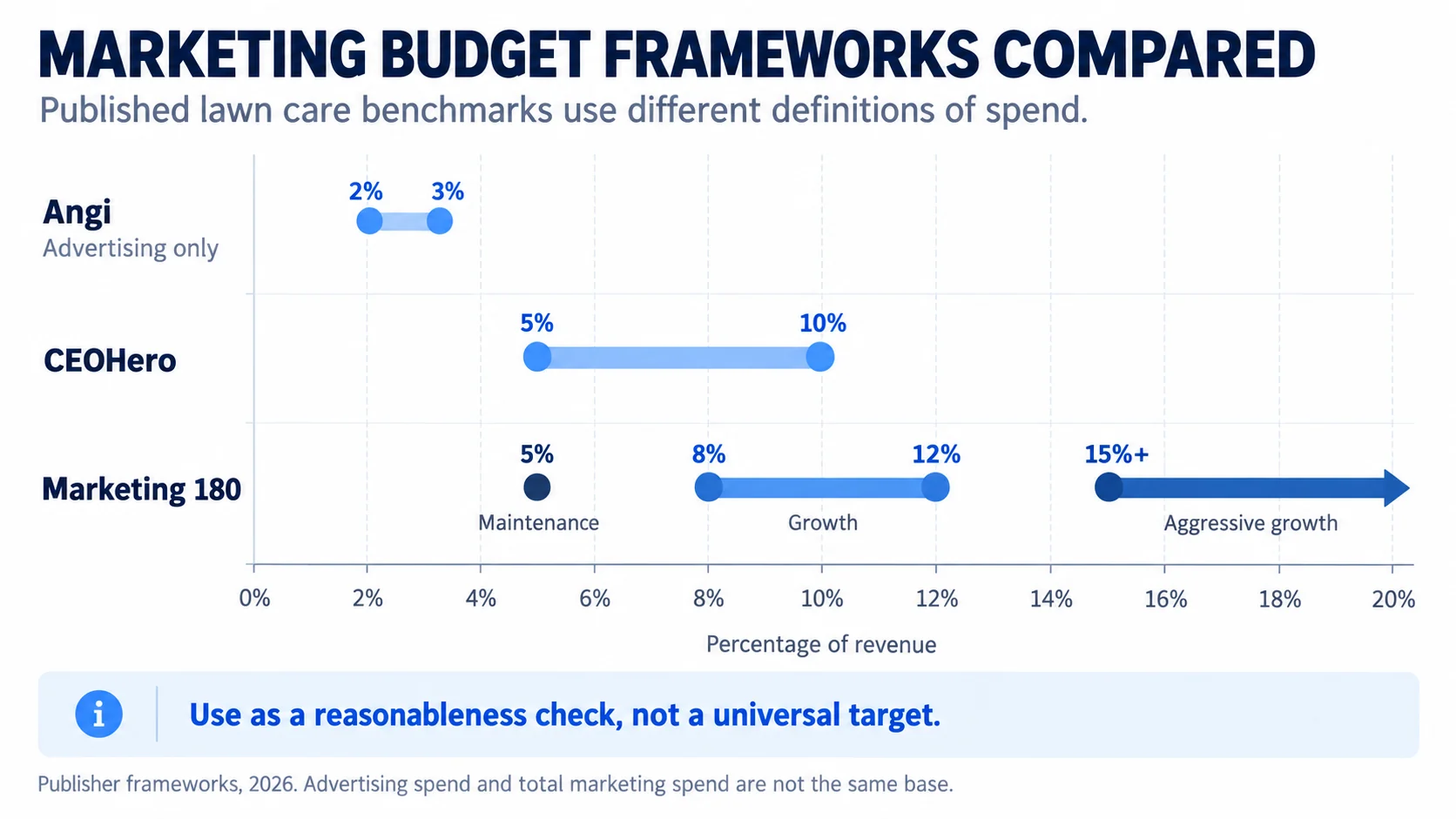
Do not average these percentages. Angi's figure covers advertising, while the others cover total marketing. Advertising is what you pay to place ads. Marketing also includes the website, photos, printed mailers, postage, referral credits, call tracking, and time spent managing campaigns. Count those costs separately so you know what you are actually spending.
A very low marketing budget may explain why you are not getting enough inquiries. A high budget makes little sense if your schedule is full and you are turning work away. Neither percentage tells you what one more customer is worth.
Set your budget from gross profit, not a percentage
Work backward from the gross profit on a customer and the number of new accounts you have room for:
- Calculate annual gross profit per customer. Subtract direct costs such as crew time, fuel, materials, and equipment wear from annual customer revenue.
- Set a maximum acquisition cost. One possible ceiling is a season's gross profit. That gives you a target for recovering the acquisition cost during the first year, provided the customer completes the season.
- Check how many customers you can serve. If your crew has room for 40 more weekly accounts and your acquisition ceiling is $300 each, that is roughly $12,000 to acquire those accounts, spread across the season.
- Include costs beyond ad spend. Add website work, tracking, referral rewards, and direct-mail production to your budget.
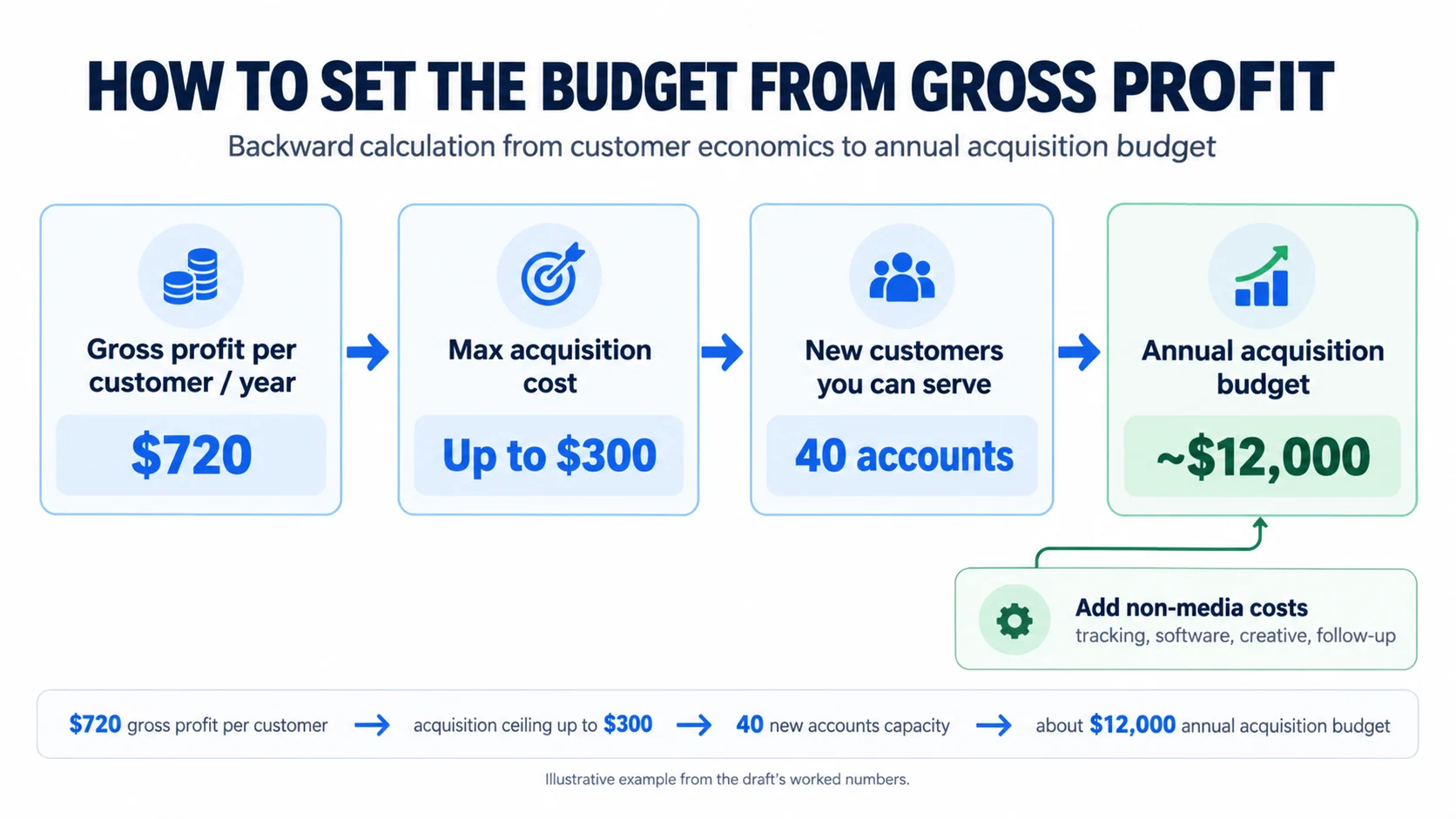
This calculation gives you a spending limit tied to the work you can actually take on. It also gives you a reason to hold back when the route is full or the new jobs would require too much driving.
Pro tip: Check missed calls, response times, and open spots in the schedule before increasing ad spend. If leads go unanswered or your crew has no capacity, a larger budget will not solve either problem.
Where to spend: a channel-by-channel plan
Each channel needs a different setup. The sections below cover practical settings, outreach scripts, and ways to track results so you can decide where your budget belongs.
Start with the channels you control, then consider paid search and offline campaigns where they fit your routes.
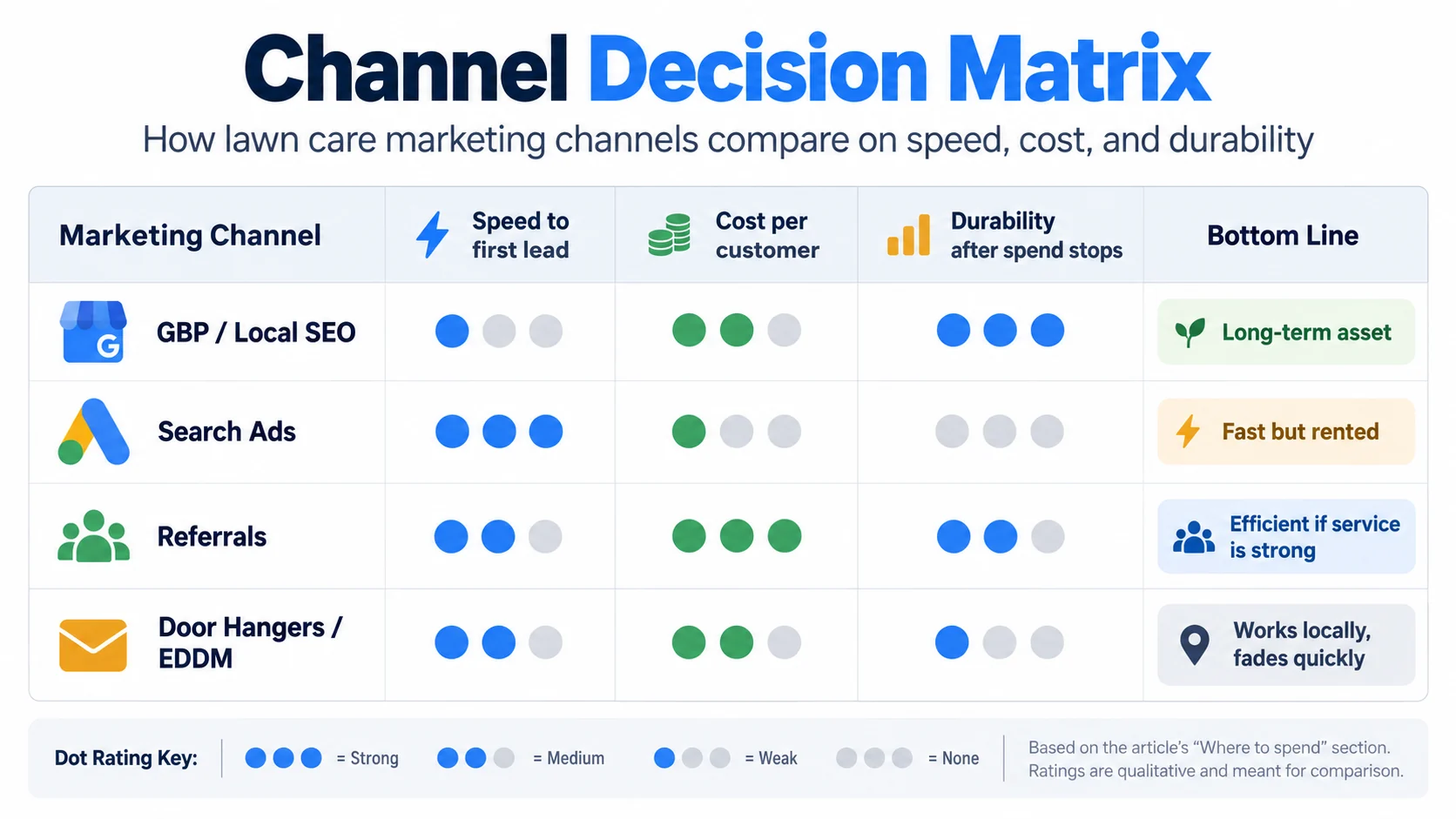
Google Business Profile and local search (start here)
Your Google Business Profile can appear when nearby customers search for "lawn care near me" or "lawn mowing [town]." It gives people your services, service area, photos, reviews, and a way to contact you without visiting your website. Unlike paid ads, a profile does not charge you for each click.
Fill out the profile carefully, and keep the details current. Missing or inaccurate information makes it harder for customers to work out whether you serve their address.
| Field | What to put in it |
|---|---|
| Business name | Your real business name, no keyword stuffing ("Joe's Lawn Care," not "Joe's Lawn Care Mowing Fertilizing Cheap") |
| Primary category | "Lawn Care Service" |
| Additional categories | Add only what you actually do: "Landscaper," "Snow Removal Service," etc. |
| Service area | The towns or ZIP codes you serve, up to 20 areas, kept inside roughly a two-hour drive |
| Address | Hide it. A service-area business that does not receive customers at its address should not display one |
| Services | List each service as its own item with a short description |
| Hours | Real hours, including seasonal changes |
| Photos | 10 or more real job photos, before-and-after where you have them, plus the truck and crew |
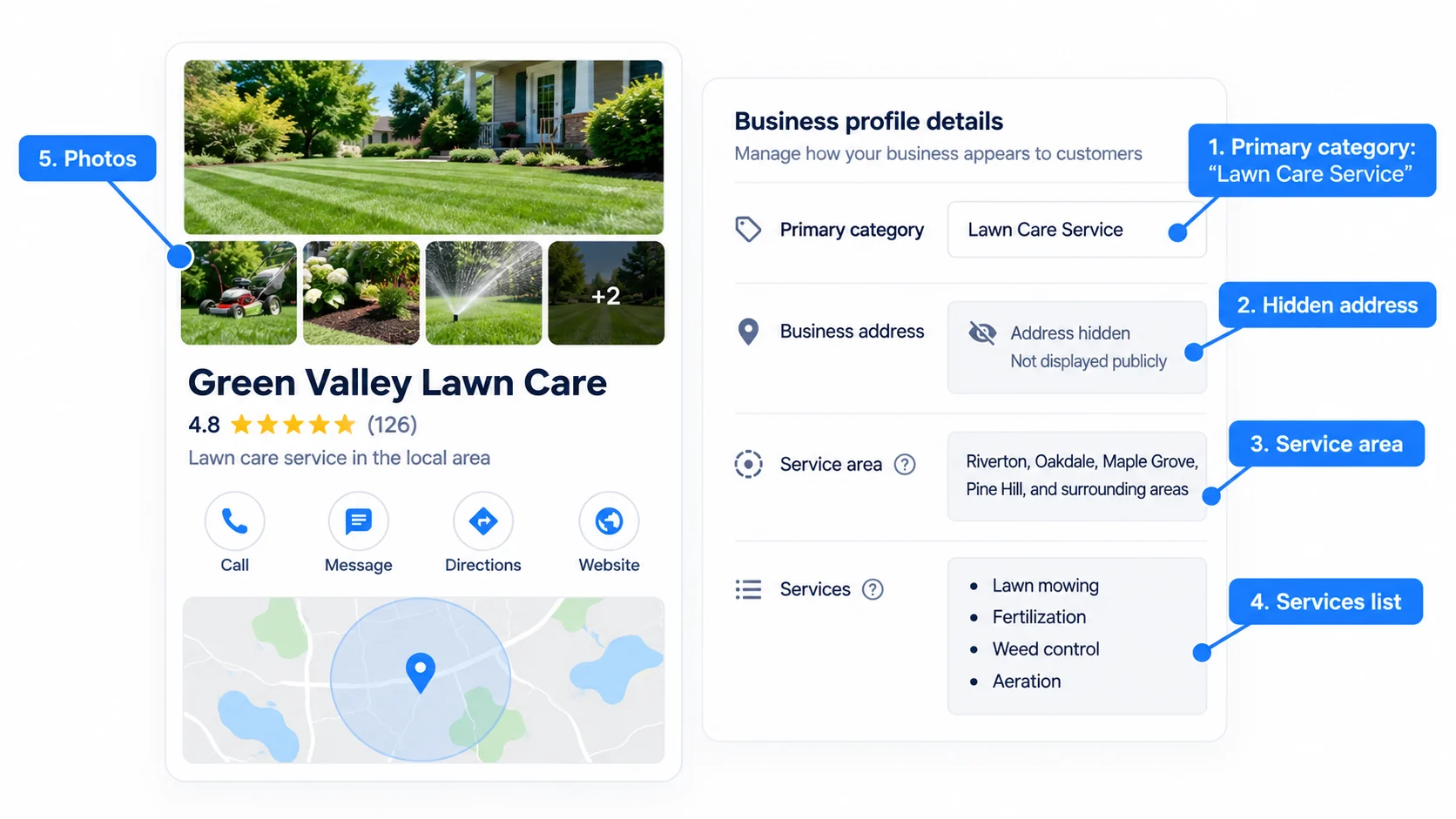
Weekly upkeep: Aim for one post and three recent job photos each week, and reply to reviews within a day or two when you can. Set aside about fifteen minutes a week to start. The aim is to keep the profile useful and current; posting more often does not guarantee higher rankings.
Ask customers for reviews after a completed job. Make it easy by sending a direct review link. Do not offer discounts or gifts in exchange for reviews, selectively request reviews only from happy customers, or pressure people to leave a particular star rating. Those practices can violate Google's review policy.
A short, specific request works better than a long message:
"Glad the yard looks good. If you have thirty seconds, would you leave us a quick Google review? It is the main way new customers in the neighborhood find us. I can text you the link right now."
Reply to negative reviews as well. Potential customers may read how you handle a complaint:
"I am sorry we missed the mark here, [name]. That is not the service we want to give. I would like to make it right, could you call me at [number] so I can fix it?"
Pro tip: Check results for your business name and "lawn care [your town]" from more than one location. Local rankings can change depending on where the search happens. RankBeaver's Local Rank Grid maps your visibility across different points in your service area instead of showing one ranking.
You can also use RankBeaver's Local Search Result Checker to check whether your business appears in relevant local results.
Local website and service pages
Your website should make it easy to call or request a quote. Keep the phone number visible, use a short form, and give each service you offer its own useful page. Create town-specific pages only when you have enough distinct information to help customers in each area. Repeating the same page with a different town name is unlikely to help your search visibility.
Track calls, quote requests, and booked jobs alongside website traffic. If people visit but do not contact you, check the page and its offer before spending more to bring in visitors.
For page layouts, quote forms, and service-page guidance, see how to design a lawn care website that books jobs.
Google Search Ads
Google Search Ads can bring in calls while you have room for new work. Unlike SEO, ads can start appearing as soon as a campaign is running, but you pay for the clicks. Make sure you can track calls and keep the ads within your service area.
For a local campaign, start with these settings:
| Setting | What to use |
|---|---|
| Campaign type | Search only. Turn off the Display Network and Search Partners to start |
| Match types | Phrase and exact match. Avoid broad match until you know your terms |
| Location targeting | A tight radius around your profitable routes, set to "presence" (people in the area), not "interest" |
| Negative keywords | Add "jobs," "salary," "free," "DIY," "how to," "equipment," "rental," "parts," plus the names of nearby towns you will not drive to |
| Ad schedule | Your actual answering hours. An ad that runs at 2am sends calls to voicemail |
| Conversion tracking | Call conversion tracking turned on before you spend, so you count calls, not clicks |
One agency's 2025 lawn care campaigns averaged $4.67 per click and $84.24 per lead, with 5.5% of clicks becoming leads. A larger 2024–2025 landscaping sample reported about $8.76 per click and $117.92 per lead. These are figures from specific advertiser groups, not prices you can expect in every town. Use your own campaign results to set future budgets.
For sample ads and a fuller campaign setup, see lawn care advertising examples and tips.
Google Local Services Ads
Google Local Services Ads can appear above standard Search Ads and generally charge for leads rather than clicks. Before planning around them, check whether your service category and location qualify and what screening is required. Eligibility and verification can involve licensing and insurance checks. The setup may take time.
Track how many Local Services Ads inquiries are valid and how many turn into jobs. Check the platform's current rules for disputing spam or out-of-area leads; some may qualify for credit.
Referrals
Referrals can bring in customers who already know someone you work for. Ask for them regularly instead of waiting for customers to mention your business on their own.
Offer a reward when a referred customer signs up and completes their first job, not simply for providing a name. For example, give both households a credit toward their next cut. Record those credits as acquisition costs so you can compare referrals with your other channels.
You could say this after finishing a job:
"If you know a neighbor who could use us, send them my way. You both get $25 off your next cut once they are signed up. It helps me more than any ad."
Door hangers and yard signs
Door hangers and yard signs work best when they help you find customers close to existing stops. A new account on the same street usually adds less driving than one on the other side of town.
Keep 25 door hangers in the truck. After a job, leave them at eight nearby homes where local rules allow it. That might take ten minutes, and those households can see the lawn you have just serviced. Ask the customer before putting a yard sign on their property.
Count printing and crew time, and check local solicitation rules. Use a separate phone number or offer code to find out which streets produce inquiries.
EDDM postcards
USPS Every Door Direct Mail (EDDM) lets you mail postcards along selected carrier routes without buying an address list. Postage is estimated at about $0.26 per piece for retail flats, with 200 to 5,000 pieces per ZIP code per day. That covers postage only. Add printing, design, and staff time to the total cost.
Choose postal routes that overlap your mowing routes. Put one offer, one phone number, and a tracking code on each card. For seasonal markets, mail before the spring rush so households see your offer while choosing a provider.
Email and SMS for renewals and winbacks
Send different messages to current customers, customers who did not renew last season, and people who previously requested quotes. Contact existing customers before the season starts to confirm whether they want to continue service. Earlier renewals give you a clearer picture of which route slots are still open.
Follow applicable consent and opt-out requirements for email and SMS. Do not assume you can text a purchased list, and check the rules that apply to renewal messages before sending them.
Paid social and lead marketplaces
Facebook and Instagram ads can show your work to nearby homeowners, especially with real before-and-after photos. Unlike someone searching for lawn mowing, a person scrolling through social media may not be looking to hire anyone that day. Start with a small budget and measure signed accounts, not just form fills.
Some lead marketplaces send the same inquiry to several contractors. Ask whether leads are exclusive, what a lead costs, and whether you can keep contacting the customer afterward. A cheaper shared lead is not necessarily a cheaper signed account.
What a lawn care lead actually costs
A lead is someone who contacts you after seeing your marketing. They may ask for a quote, but they have not necessarily booked a job.
Cost per lead (CPL) equals what you spent on a channel divided by the number of leads it produced. The 2025 lawn care paid-search sample cited above came to about $84 per lead; the broader landscaping sample came to about $118. Neither figure is a national average. Google Business Profile inquiries do not carry an ad fee per click, but building and managing the profile still takes time or money.
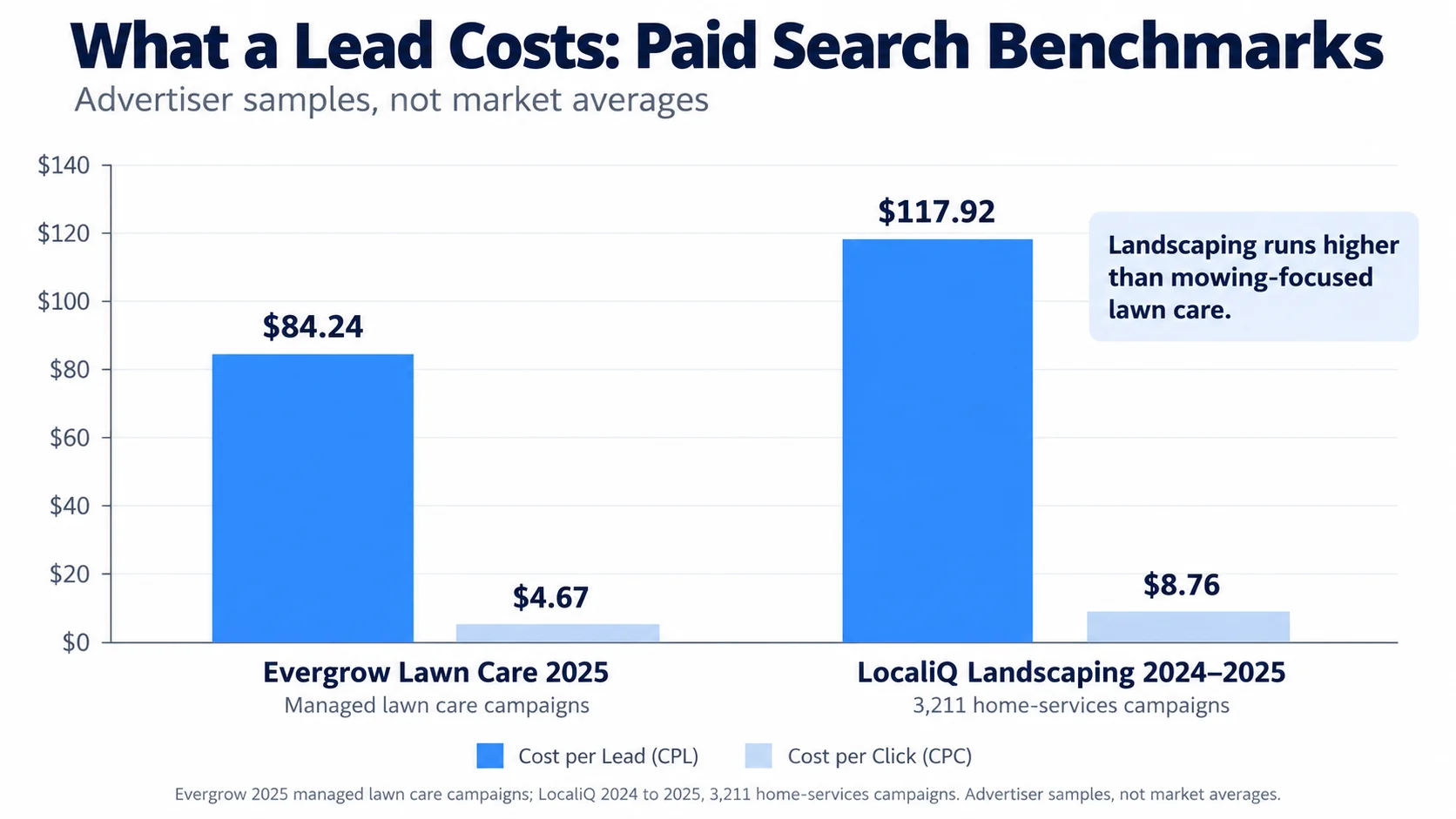
A low CPL is useful only if enough of those leads turn into paying customers.
How to calculate your real cost to acquire a customer
Customer acquisition cost (CAC) is your total acquisition spend divided by the number of new customers who signed up. Count marketing fees and tracking costs if you are calculating fully loaded CAC. Do not divide by calls or quotes.
The following numbers are illustrative, not industry averages:
| Step | Figure |
|---|---|
| Search ad spend for the month | $1,200 |
| Leads produced (at ~$85 CPL) | 14 |
| Qualified leads (in area, want a service you offer) | 12 |
| Lead-to-customer close rate | ~33% |
| New signed customers | 4 |
| Media-only CAC ($1,200 / 4) | $300 |
| Add agency or tracking fees ($300) | |
| Fully loaded CAC | $375 |
In this example, ads cost $300 per signed customer even though each lead costs about $85. Only four of the 14 leads became customers. Adding $300 in agency or tracking fees raises CAC to $375. Use the same cost categories every month so you can compare results.
Connect each inquiry to its outcome. Set up call tracking, ask "How did you hear about us?" on the quote form, and record in your CRM whether the lead signed. Otherwise, you will not know which channel paid for itself.
What a lawn care customer is worth
A recurring mowing customer may book dozens of cuts across several seasons. Customer lifetime value helps you estimate the revenue and gross profit from those visits, instead of judging the account by its first job.
Consider this hypothetical weekly mowing account:
| Input | Value |
|---|---|
| Price per cut | $55 |
| Cuts per season | 26 |
| Mowing revenue per season | $1,430 |
| Seasonal upsells (aeration, cleanup) | ~$170 |
| Annual revenue per customer | ~$1,600 |
| Gross margin after direct costs | 45% |
| Annual gross profit per customer | ~$720 |
The amount changes with how long the customer stays:
| If the customer stays | Revenue lifetime value | Gross-profit lifetime value |
|---|---|---|
| 1 season | $1,600 | $720 |
| 2 seasons | $3,200 | $1,440 |
| 3 seasons | $4,800 | $2,160 |
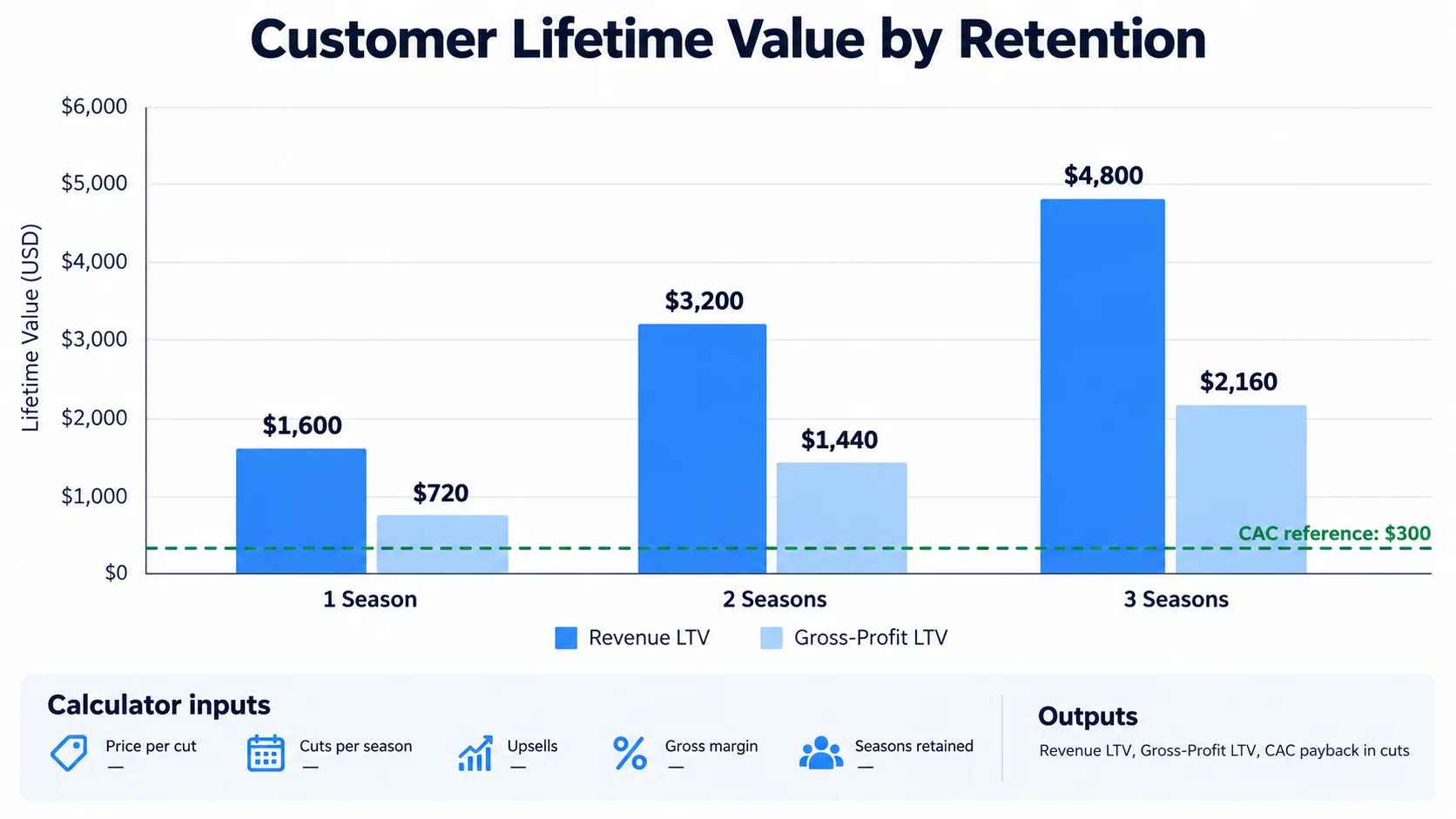
At $720 in seasonal gross profit, a one-season customer generates more than twice the $300 spent to acquire them. Three seasons produce $2,160 in gross profit, or 7.2 times the acquisition cost. Overhead and other operating expenses still need to be covered.
"Retention of long-term employees is key. Retention of customers is imperative."Jack Robertson, Robertson Lawn Care, Springfield, Illinois (Turf Magazine)
Using the figures above, keeping a customer for three seasons instead of one adds about $1,440 in gross profit without paying a second acquisition cost. Sending a timely renewal reminder may be cheaper than finding a replacement account.
For renewal and retention ideas, see how to keep lawn care customers from season to season.
CAC payback, in cuts. At a 45% gross margin, a $55 cut produces about $24.75 in gross profit. Divide the $300 acquisition cost by $24.75 and you get roughly 12 visits to recover that cost. For a customer on a 26-cut schedule, that is around the first half of the season. It is a useful number to check against the jobs on your calendar.
How route density changes the math
Two customers paying $55 per cut can produce different profits if one requires a longer drive.
| Customer next to your route | Customer across town | |
|---|---|---|
| Price per cut | $55 | $55 |
| Cost to deliver per visit | $25 | $35 |
| Gross contribution per visit | $30 | $20 |
| Per season (26 visits) | $780 | $520 |
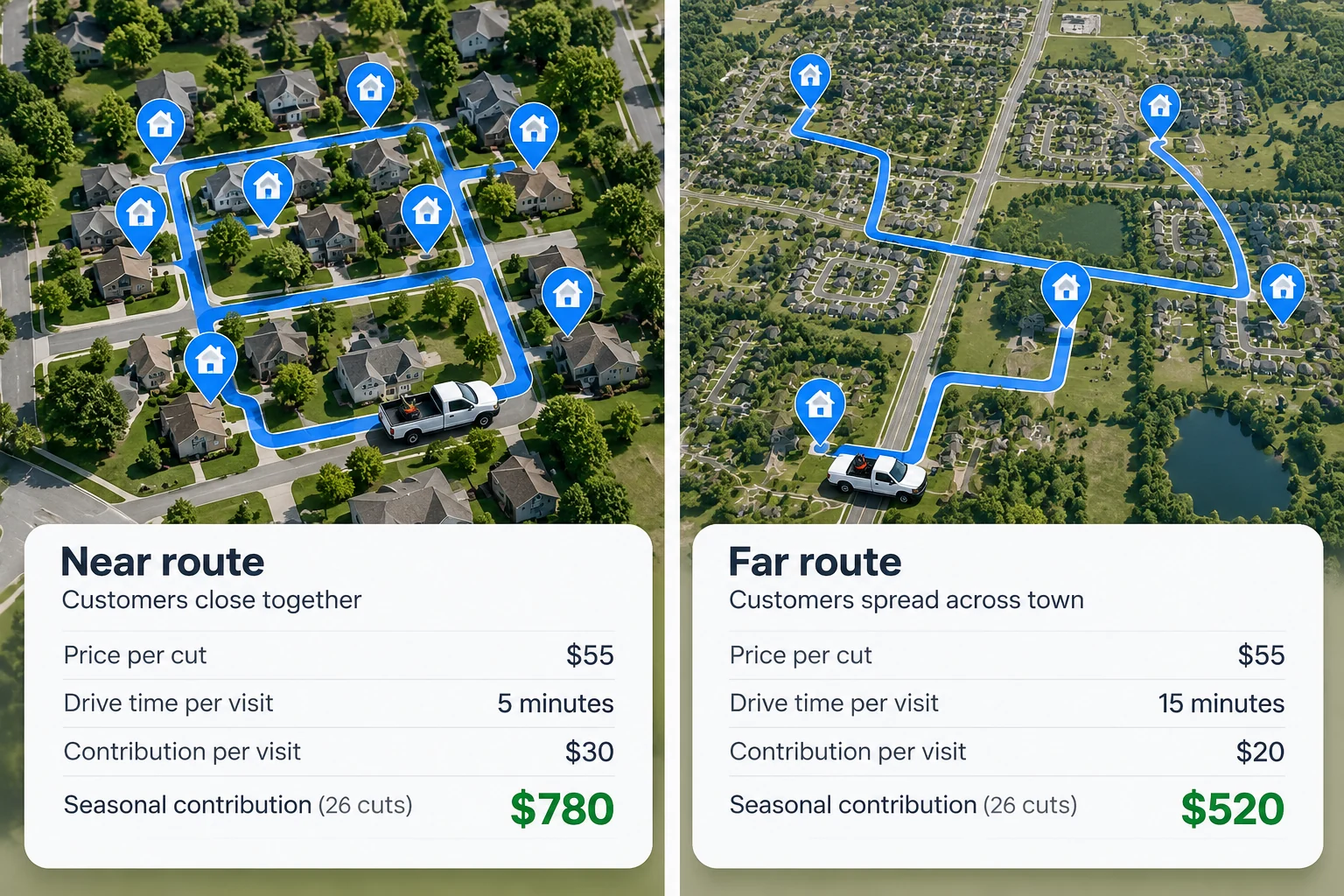
The example shows a $260 difference over 26 visits. That comes from the higher direct cost of serving the distant customer and does not include other jobs you might have completed during the extra driving time.
"That means we can keep an eye out on our properties because we're driving by them all the time."Jack Robertson, Robertson Lawn Care, Springfield, Illinois (Turf Magazine)
This matters when comparing marketing channels. A $30 lead from outside your usual route may be less valuable than a $50 lead from a house next to an existing customer. Compare the profit on signed accounts, not just what it cost to get each inquiry.
RankBeaver's Benchmark tool compares competitors' local search visibility across an area. That can help you decide which neighborhoods to research further before expanding your marketing.
Spend by season
In areas with a defined mowing season, demand for new lawn care providers often rises before spring service begins. Your acquisition budget should account for those busier weeks rather than being split evenly across all 12 months.
For example, you could divide an $8,000 annual acquisition budget this way in a cool-season market. Adjust the months for warm-season or year-round service areas.
| Period | Share of budget | Why |
|---|---|---|
| February to May | 60% | Buyers decide on a provider for the whole season here. This is the window |
| June to August | 25% | Fill gaps and sell upsells to existing customers |
| September to January | 15% | Fall cleanup and aeration offers, plus renewal outreach for next spring |
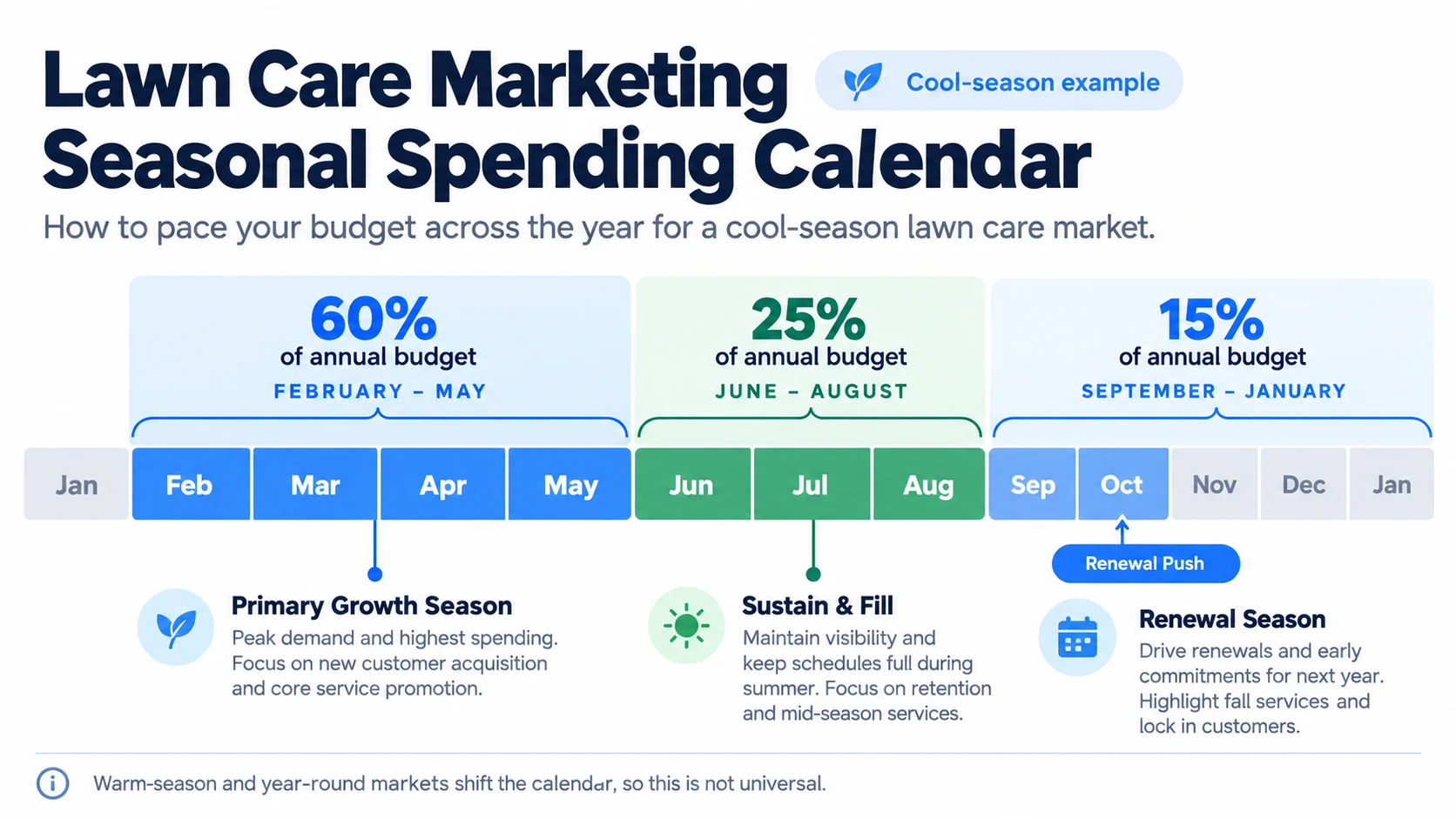
Use slower months to contact current customers and those who did not renew. Confirming those accounts before spring helps you plan the route and see how much space is left for new work.
The numbers to track every month
Your monthly report should show which inquiries turned into signed accounts and what each account cost. Track these figures by channel:
- Spend by channel. Include ad spend and related fees.
- Leads and qualified leads. Separate all inquiries from those in your service area who need work you actually offer.
- Signed recurring accounts. Count customers who agreed to ongoing service.
- Cost per lead and fully loaded CAC. Calculate both for each channel.
- Close rate. Divide signed accounts by qualified leads. If the rate falls, check response times, prices, and quote quality.
- Gross profit per visit and payback in cuts. Track how many visits it takes to recover acquisition costs.
- Retention. Record how many customers return for a second and third season.
Review the report every month during the season. Look for channels that produce inquiries but few bookings, and for changes in the number of qualified leads you close.
For software that can help with tracking, see the apps lawn care operators use to run the business.
Mistakes that quietly drain the budget
- Increasing ad spend while missing calls. Follow up on existing leads promptly before paying for more.
- Tracking only cost per lead. CPL does not tell you how many inquiries became customers. Calculate CAC too.
- Buying leads too far from your route. Include extra driving and crew time when deciding whether those jobs are worthwhile.
- Leaving costs out of the budget. Count website work, agency fees, printing, tracking, and referral credits alongside ad spend.
- Forgetting about renewals. Contact existing customers before spending the entire budget on replacements.
- Neglecting local search. Keep your Google Business Profile accurate and your service pages useful so customers can find you without an ad click.
Should you run this yourself or hire it out?
A solo operator can handle many of these tasks: updating a Google Business Profile, requesting reviews, distributing door hangers, and sending renewal reminders. They take time, even when there is little direct spending involved.
Local SEO takes regular attention, and it can be difficult to keep up during the mowing season. If you have room to grow but cannot maintain the website and profile yourself, consider hiring help. RankBeaver lists website plans at $59 per month, Google Business Profile management at $499 per month, and full local SEO at $799 per month. Compare any service fee with the gross profit from the customers you can reasonably expect it to bring in.
Frequently Asked Questions
Q.1 How much should a small lawn care business spend on marketing each month?
Start with your gross profit per customer and the number of open slots on your route. In the example above, a customer produces around $720 in seasonal gross profit. You might set an acquisition ceiling below that amount, then multiply it by the number of customers you can serve. Published total-marketing guidelines often fall around 5% to 10% of revenue, but use that as a comparison, not your budget formula.
Q.2 How is cost per lead different from cost to acquire a customer?
Cost per lead is the average cost of an inquiry. CAC is the cost of signing a paying customer, including the acquisition expenses you choose to track. In the worked example, about $85 per lead becomes $300 in ad spend per new customer, or $375 when fees are included.
Q.3 Are Google Ads and Google Local Services Ads the same thing?
No. Google Search Ads generally charge per click. Local Services Ads charge for leads and require eligibility checks and verification. They may appear above regular search ads. Check the current eligibility, badge, and billing terms for your service and location before choosing a format.
Q.4 How do you calculate the lifetime value of a mowing customer?
Multiply annual gross profit by the number of seasons a customer stays. At $1,600 in annual revenue and a 45% gross margin, that is about $720 in gross profit per season or $2,160 across three seasons. That figure is before acquisition costs and overhead.
Q.5 When should a lawn care company spend more or less on advertising?
In seasonal markets, spend more before and during spring if your crew has room for new accounts. When the route fills up, reduce acquisition spending. Use slower months to promote renewals and services such as cleanup or aeration.
Q.6 Does route density really change what a customer is worth?
Yes. In the example above, a $55 cut leaves $30 in gross contribution next to an existing stop but $20 for a customer across town. That $10 difference adds up to $260 over 26 visits, before allowing for other jobs you could have done during the drive.
Conclusion
If your Google Business Profile is incomplete, finish it this week. Ask your next three customers for a review and make sure your phone number, services, and service area are correct. If the profile is up to date and your route has open slots, test a tightly targeted Search Ads campaign. Track signed customers and acquisition cost from the start. Before increasing the budget, check that leads get a quick response and that the new jobs fit your routes.