

A basic lawn care business can start with mowing, string trimming, edging, and blowing. Once you have regular customers, you can offer seasonal cleanups, leaf removal, mulch installation, aeration, overseeding, and other services at properties you already maintain. Some services need little additional equipment. Others require specialized machines, trained workers, or state licenses.
For example, a business mowing 40 lawns each week already has 40 customers who might need additional work throughout the year. The same property could need a spring cleanup, regular mowing through summer, aeration and overseeding, mulch installation, and fall leaf removal. The services you add should depend on customer demand, your equipment, your crew's experience, and whether the work is profitable after travel and other costs.
On this page
- Complete lawn service list: 30 services you can offer
- Basic lawn care services to offer first
- Seasonal lawn care services and add-ons
- Lawn health services: aeration, overseeding, and turf repair
- Lawn treatment services that may require licensing
- Additional property services to consider
- Which lawn care services should you offer first?
- How to create lawn care service packages
- How to price lawn care services
- How to get customers to find your lawn care services online
- Frequently asked questions
- Checklist before publishing your lawn service list
Complete lawn service list: 30 services you can offer
Lawn care services generally fall into five groups:
- Basic maintenance: Regular mowing, trimming, edging, blowing, and minor yard work.
- Seasonal services: Spring and fall cleanups, leaf removal, mulching, and shrub maintenance.
- Lawn health services: Aeration, overseeding, dethatching, soil testing, and turf repair.
- Lawn treatments: Fertilization, weed control, insect control, and disease treatments that may require licensing.
- Additional property services: Irrigation, drainage work, snow removal, and landscaping projects.
The table covers 30 services, their usual frequency, the equipment required, and the qualifications or safety precautions to check before offering them.
| Lawn care service | Frequency | Equipment needed | Requirements and when to offer |
|---|---|---|---|
| 1. Lawn mowing | Weekly or biweekly | Mower, trimmer, blower | Basic service; check local business rules |
| 2. String trimming | Every mowing visit | String trimmer, eye and ear protection | Include with mowing |
| 3. Lawn edging | Every visit or monthly | Edger or string trimmer | Basic safety precautions |
| 4. Blowing and cleanup | Every mowing visit | Handheld or backpack blower | Include with mowing; protect surrounding property |
| 5. Grass clipping collection | As requested | Bags, transport vehicle, disposal access | Check local disposal rules; charge separately |
| 6. Hand weeding | Periodically | Hand tools and gloves | Suitable for small beds; no chemical application |
| 7. Spring cleanup | Once each spring | Rakes, blower, trailer | Check disposal rules and load limits |
| 8. Fall leaf removal | Several visits in fall | Rakes, blower, vacuum or bagging equipment | Useful in areas with heavy leaf fall; follow municipal rules |
| 9. Storm debris cleanup | After storms | Trailer, protective equipment | Trained crews only; avoid hazardous trees and power lines |
| 10. Mulch installation | Spring and sometimes fall | Wheelbarrow, shovel, rake | Suitable add-on; confirm property boundaries |
| 11. Flower bed edging | Spring and as needed | Spade or bed edger | Suitable add-on; confirm bed boundaries |
| 12. Hedge and shrub trimming | Several times annually | Hedge trimmer, protective equipment | Only within crew skills and safe working height |
| 13. Plant and flower bed maintenance | Periodically | Hand tools | Requires plant knowledge; chemicals may need licensing |
| 14. Core aeration | Once or twice annually | Core aerator | Rent equipment initially; locate underground utilities |
| 15. Overseeding | Usually alongside aeration | Seed spreader or slit seeder | Match grass type and growing season |
| 16. Dethatching | When necessary | Dethatcher or power rake | Diagnose excessive thatch before treatment |
| 17. Topdressing and compost | As needed | Spreader, material-handling tools | Price by material volume; consider runoff |
| 18. Soil testing | As needed | Sampling kit, laboratory testing | Requires correct interpretation of results |
| 19. Sod installation and repair | Per project | Sod cutter, preparation tools, delivery equipment | Advanced work; consider grading and watering access |
| 20. Grading and drainage | Per project | Earthmoving equipment or subcontractor | May require permits and utility checks |
| 21. Fertilization | Scheduled applications | Spreader, application records | Licensing requirements vary by state and product |
| 22. Herbicide and weed control | Scheduled applications | Sprayer, protective equipment | Check commercial pesticide applicator requirements |
| 23. Grub and insect control | As needed | Application equipment, records | Pesticide registration and licensing requirements |
| 24. Lawn disease treatment | As needed | Diagnostic and application equipment | Requires diagnosis and compliance with chemical rules |
| 25. Irrigation inspection | Seasonally | Irrigation controller, testing tools | Training or licensing may be required |
| 26. Sprinkler repair and winterization | Seasonally | Irrigation repair tools | Check state licensing and backflow rules |
| 27. Snow removal | Winter, where applicable | Snowblower, plow, deicing materials | Additional equipment, insurance, and local requirements |
| 28. Gutter cleaning | Occasionally | Ladders, fall-protection equipment | High fall risk; separate property service |
| 29. Patio and hardscape installation | Per project | Construction equipment | Contractor licensing and permits may apply |
| 30. Large tree pruning and removal | Per project | Specialized tree equipment | High-risk work; refer to a qualified arborist |
Five groups, five different operating requirements
Core maintenance
Use equipment you already own
Mowing · trimming · edging · blowingSeasonal work
Fill gaps around the mowing season
Spring cleanup · leaves · mulch · shrubsLawn health
Rent specialist machines before buying
Aeration · overseeding · dethatchingRegulated treatments
Check licenses and insurance first
Fertilization · weed control · insectsAdjacent services
Train, subcontract, or refer
Irrigation · drainage · hardscapes · treesStart with the services your current crew can deliver safely. Add others only after checking demand, costs, qualifications, and route fit.
Most new lawn care businesses can begin with the first few services. Aeration, overseeding, and seasonal work can come later as customers request them. Chemical treatments and specialized landscaping jobs need additional preparation.
Basic lawn care services to offer first
A mower, string trimmer, and blower are enough to provide a standard lawn maintenance package.
1. Lawn mowing
Lawn mowing is the main recurring service for most lawn care businesses. Customers typically schedule weekly or biweekly visits during the growing season. The mowing schedule should account for grass growth and seasonal conditions. Lawns may need weekly mowing during periods of rapid growth and less frequent visits when growth slows.
Cutting height also matters. Different grass types need different mowing heights, and those recommendations can change with the season. Recurring mowing customers provide regular work and give you opportunities to offer additional services when their lawns need them. For example, a customer who books weekly mowing may also need aeration and overseeding later in the year.
2. String trimming and lawn edging
String trimming cuts grass around fences, trees, flower beds, and other places a mower cannot reach. Edging creates a defined border where the lawn meets sidewalks, driveways, and other hard surfaces. You can use a dedicated edger or a suitable string trimmer. Decide whether edging is included with every mowing visit or performed monthly. State that in the service agreement so customers know exactly what their regular payment covers.
3. Blowing and yard cleanup
Blowing removes grass clippings and loose debris from driveways, sidewalks, patios, and other hard surfaces after mowing. It is usually part of the standard mowing visit and takes only a few additional minutes. Some customers may also request bagging and removal of grass clippings. That work requires extra handling, transport, and disposal, so it should be priced separately unless your package already includes it.
4. Hand weeding
Hand weeding involves removing unwanted plants from flower beds, mulch beds, and other planted areas without using herbicides. You need basic hand tools and gloves. It is a practical additional service for businesses already maintaining properties with small garden beds. Start with smaller areas that your crew can maintain efficiently. If customers regularly request bed maintenance, you can expand into mulch installation and seasonal plant care.
What should a standard mowing package include?
A simple service description is:
Standard mowing service: Lawn mowing, string trimming, edging, and blowing grass clippings from hard surfaces.
List clipping removal, flower bed weeding, shrub trimming, and chemical applications separately. For example, if a customer expects shrub trimming but your quote only covers mowing, the disagreement can lead to unpaid work or a disputed invoice. A written service scope prevents that confusion.
Seasonal lawn care services and add-ons
Seasonal services can keep crews working when mowing demand slows. Several use equipment you may already own, although disposal, material handling, and additional labor need to be included in the quote.
5. Spring yard cleanup
Spring cleanup prepares a property for regular lawn maintenance after winter. The work may include removing fallen branches, dead plant material, accumulated debris, and leaves that have become matted over the lawn. Customers may also need an initial flower bed cleanup. Spring cleanup is often a separate job from the first mowing visit because the amount of debris and labor can vary considerably.
You can offer it to existing mowing customers before the regular season begins.
6. Fall leaf removal
Leaf removal can be a recurring seasonal service in neighborhoods with mature trees. Some properties need several visits as leaves continue to fall. Depending on the customer and the condition of the lawn, you may mulch leaves in place, bag them, or remove them from the property. Two common pricing options are a per-visit charge or a fixed seasonal price.
A seasonal rate can be divided into scheduled payments over the period covered by the agreement. This gives customers a predictable bill, even when some weeks require more work than others. Specify how many visits or what level of service the agreement covers, along with whether hauling and disposal are included.
7. Mulch installation
Mulch installation is a useful addition for businesses that already maintain flower beds and landscaped areas. Customers may request new mulch in spring or fall. The work usually involves preparing the bed, removing unwanted debris, and spreading the material evenly. You'll need a wheelbarrow, shovel, rake, and a way to transport the mulch.
Include material costs and a markup in your quote, along with delivery and installation labor. Bed edging can be offered during the same visit.
8. Flower bed edging
Flower bed edging creates or restores the boundary between a lawn and a planted bed. It can be done with a spade or mechanical bed edger. Some customers schedule the work during spring cleanup, while others need occasional maintenance as grass grows into bed edges. The work fits naturally with mulch installation because both services involve the same landscaped areas.
Confirm the intended bed boundary before cutting, particularly where an existing edge is difficult to see.
9. Hedge and shrub trimming
Light hedge trimming can be added to a lawn maintenance route if your crew has the right equipment and experience. Typical jobs involve maintaining smaller shrubs and accessible hedges with handheld or powered trimming tools. Keep this service within safe working heights. Jobs that require ladders near electrical lines, chainsaws, or extensive tree work carry different risks and may need specialist contractors.
10. Storm debris cleanup
Storms can leave branches and other debris scattered across lawns. For ordinary cleanup work, crews may need rakes, protective gear, and a trailer to transport debris. Disposal fees and the total weight of material can affect the job cost. Avoid damaged trees, branches near power lines, and other hazardous situations unless your crew has the required training and equipment.
Large or unstable tree work should be referred to a qualified tree professional.
11. Plant and flower bed maintenance
Regular bed maintenance can include removing weeds, clearing dead plant material, and maintaining small plants. Crew members need enough plant knowledge to avoid damaging desirable plants. If the work includes applying herbicides or other regulated products, check the relevant state requirements before adding those treatments to your service menu.
12. Snow removal
Snow removal is a seasonal option for lawn care businesses in regions with regular winter snowfall. Depending on the properties served, the equipment may include snowblowers, plows, and deicing materials. Snow removal also brings different insurance and local operating requirements. The equipment may remain unused for much of the year, so consider how much winter demand exists before investing in it.
It is generally more practical in markets with reliable snowfall and enough customers close together to make a winter route worthwhile.
Lawn health services: aeration, overseeding, and turf repair
Lawn health services address problems such as compacted soil, thinning grass, excessive thatch, and damaged areas. Some require specialized machines, but you can rent equipment until you have enough regular bookings to justify purchasing it. The condition of the lawn should determine which service you recommend. Aeration, dethatching, and overseeding are not automatically necessary every year.
13. Core aeration
Core aeration removes small plugs of soil from the lawn. It is used to address soil compaction and improve the movement of air and water through the soil. The appropriate timing depends on the grass type and local growing season. Aeration is generally scheduled when the grass is actively growing and can recover. A core aerator can be rented for individual jobs or a group of appointments.
Before starting, locate and mark underground utilities and other potential hazards. If customers regularly book aeration throughout the appropriate season, compare the annual rental cost with the cost of owning and maintaining a machine.
14. Lawn overseeding
Overseeding adds grass seed to an existing lawn to help fill thin or patchy areas. It is often performed after core aeration. Depending on the job, you can use a broadcast spreader or slit seeder. Choose seed suited to the existing grass and local climate. Timing matters because cool-season and warm-season grasses have different growing periods.
A successful overseeding job also depends on suitable conditions for seed establishment.
15. Lawn dethatching
Thatch is a layer of organic material between the grass and soil. When it becomes excessively thick, it can restrict the movement of water and nutrients. Dethatching uses a specialized machine or power rake to remove accumulated material. The work can damage turf if performed unnecessarily or at the wrong time. Check whether excessive thatch is actually present before recommending the service.
Schedule dethatching when the grass is actively growing and has time to recover. Rental equipment is usually a sensible starting point for businesses that receive only occasional requests.
16. Topdressing and compost application
Topdressing involves spreading a thin layer of suitable material over an existing lawn. It may be used to address minor surface unevenness or improve soil organic matter, depending on the material and lawn conditions. The work requires appropriate spreading equipment and enough labor to handle the material. Price the job according to the volume of material required, delivery, and application time. Material sourcing and runoff also need consideration.
Topdressing is generally scheduled during the grass's growing season.
17. Soil testing
Soil testing helps identify conditions that may affect lawn health, including pH and nutrient levels. You can collect samples using a soil testing kit and submit them to a laboratory. The results can help determine whether soil amendments or specific treatments are appropriate. Collecting the sample is relatively straightforward. Interpreting the results and recommending the correct treatment require more knowledge.
Businesses without that experience can work with a laboratory or qualified specialist. Soil testing can be offered as a separate service or before developing a lawn treatment program.
18. Sod installation and lawn repair
Sod installation replaces damaged or dead turf with established grass. A project may involve removing existing turf, preparing the soil, arranging sod delivery, and installing the new material. The work needs additional equipment, such as a sod cutter, and can require significant site preparation. Check drainage and grading conditions before quoting. Adequate water must also be available for the sod to establish.
Sod projects are generally better suited to crews that already have experience with larger lawn renovation jobs.
19. Grading and drainage work
Grading changes the slope or surface of an area. Drainage work addresses how water moves across or away from the property. These projects may require earthmoving equipment, utility checks, permits, or subcontractors. They are more specialized than routine lawn maintenance. Before offering them, confirm that your crew has the necessary skills, equipment, insurance, and any required approvals.
When should you schedule lawn health services?
| Service | Main purpose | Suitable timing | Equipment approach |
|---|---|---|---|
| Core aeration | Address soil compaction | Active growing season for the grass type | Rent initially |
| Overseeding | Improve thin or patchy turf | Appropriate seeding season, often after aeration | Seed and spreader |
| Dethatching | Remove excessive thatch | During active growth when turf can recover | Rent a dethatcher |
| Topdressing | Address minor unevenness or soil organic matter | Growing season | Spreading and material-handling tools |
| Soil testing | Check soil pH and nutrients | As needed, especially before treatment planning | Sampling kit and lab |
| Sod repair | Replace dead or damaged turf | When suitable establishment conditions and water are available | Project equipment |
Cool-season and warm-season grasses have different maintenance schedules. Aeration or seeding that works well in one region may be poorly timed in another. Check the recommendations from your state's land-grant university extension program for the grass types in your service area.
For equipment purchases, track demand through at least your first full season. An aerator used on only six weekends a year may cost more to own than to rent. Regular bookings across a concentrated service area make ownership more attractive.
Lawn treatment services that may require licensing
Chemical lawn treatments can be profitable, but they require more preparation than mowing or basic yard maintenance. Before advertising or charging for treatment work, check the licensing rules that apply in your state.
20. Lawn fertilization
Fertilization supplies nutrients to support turf growth. The application schedule and products should be based on the grass type and lawn conditions. Soil testing can help identify nutrient needs. Licensing rules vary. Fertilizer-only applications are not automatically subject to the same rules as pesticide applications, although some states regulate commercial fertilizer services.
Check the product and service requirements before offering paid fertilization.
21. Herbicide and weed control
Herbicide applications use chemical products to manage unwanted plants. Commercial applicators may need pesticide certification or licensing, even when using products that homeowners can purchase. The rules depend on the state, the product, and the type of application. Before adding weed control, confirm the requirements for your business and obtain appropriate training, protective equipment, and insurance.
22. Grub and lawn insect control
Lawn insect treatments may involve pesticides used to control grubs or other insects affecting turf. Proper identification is necessary before recommending treatment. Commercial pesticide application rules apply, including any relevant product registration, certification, and recordkeeping requirements. This service should be handled by qualified applicators or an appropriately licensed specialist.
23. Lawn disease treatment
Lawn diseases need accurate diagnosis before treatment. A damaged patch can have several causes, so recommending a fungicide without identifying the problem may lead to unnecessary treatment. Chemical disease control requires knowledge of the products and the applicable restrictions. Offer this work only when you have qualified staff and the necessary certifications.
What licenses do lawn treatment businesses need?
The US Environmental Protection Agency has federal certification requirements for restricted-use pesticide applicators. States can impose additional requirements. Many require certification for commercial pesticide applications more broadly. Fertilizer-only services may be regulated differently from herbicide, insecticide, and fungicide applications. Before selling treatment services:
- Contact your state's pesticide regulatory or certification agency and confirm the rules for each service.
- Obtain the required certifications or employ a qualified applicator.
- Make sure your business insurance covers chemical application.
- Keep application records according to state requirements.
- Advertise the service only after meeting the applicable requirements.
Chemical application coverage may be separate from general liability insurance. Licensing, insurance requirements, and tax treatment also vary by state and can change over time. If you do not yet have the required qualifications, leave the treatment service off your advertised menu until you do.
Additional property services to consider
Several jobs commonly associated with landscaping require different equipment or professional qualifications.
24. Irrigation inspection
Irrigation inspections involve checking sprinkler systems, controllers, and their operation. The work requires familiarity with irrigation equipment and appropriate testing tools. Some states have licensing requirements for irrigation-related services. Training or a qualified partner may be necessary before adding inspections.
25. Sprinkler repair and winterization
Sprinkler repairs may involve diagnosing problems and working on irrigation components. Winterization prepares irrigation systems for freezing conditions in regions where it is needed. Check state requirements for irrigation work, including any rules involving backflow systems.
26. Gutter cleaning
Gutter cleaning removes accumulated debris from a property's drainage gutters. It is an occasional property maintenance service, but it involves working at height. Ladders, fall protection, and appropriate insurance are necessary considerations. Because the safety risks differ from lawn maintenance, gutter cleaning should be evaluated as a separate service.
27. Patio and hardscape installation
Hardscaping includes projects such as patios and other constructed outdoor features. These jobs require construction skills, specialized equipment, and potentially contractor licenses or permits. A lawn care business can expand into hardscaping, but it should be treated as a separate service line with its own costs and qualifications.
28. Large tree pruning and removal
Large tree work carries risks from falling branches, unstable trees, equipment, and nearby electrical lines. It requires specialized training and equipment. For businesses focused on lawn care, referring these projects to a qualified arborist is generally safer than taking on work outside the crew's experience. The list also includes snow removal and grading or drainage as additional service options. Their suitability depends on the region and the business's capabilities.
Which lawn care services should you offer first?
Start with work your existing crew can complete using equipment you already own. For a one-person business, mowing, trimming, edging, blowing, and basic cleanups are practical starting services. They can be scheduled together and usually do not require specialized trade licenses, although local business rules still apply. Before adding anything else, check four things. Customer demand
Look at requests from existing customers. If several people on your route ask about leaf removal or aeration, that is useful evidence of local demand. You can also observe which services nearby competitors are offering. National search volume alone does not confirm that customers in your area will book a service. Equipment and training
Work out what you need to complete the job properly. A mulch installation might require equipment you already have. Aeration may require a rental machine. Chemical weed control may require certification. Include any training or safety requirements in the decision.
Route compatibility
A service at an existing customer's property may be easier to fit into the schedule than a job on the other side of town. Travel time affects how many jobs a crew can complete in one day. Earnings after expenses Calculate what remains after labor, travel, materials, equipment, and disposal. A job with a higher invoice total may earn less per working hour than a smaller job near your existing route.
A practical order for adding services
| Priority | Services | Recommended approach |
|---|---|---|
| Start immediately | Mowing, trimming, edging, blowing, basic cleanups | Use existing equipment and build regular routes |
| Add after confirming demand | Aeration, overseeding, dethatching | Rent specialized equipment first |
| Add after training or licensing | Fertilization, weed control, insect control, irrigation | Meet the relevant legal and skill requirements |
| Refer or subcontract | Hardscaping, major drainage work, large tree removal | Work with qualified specialists |
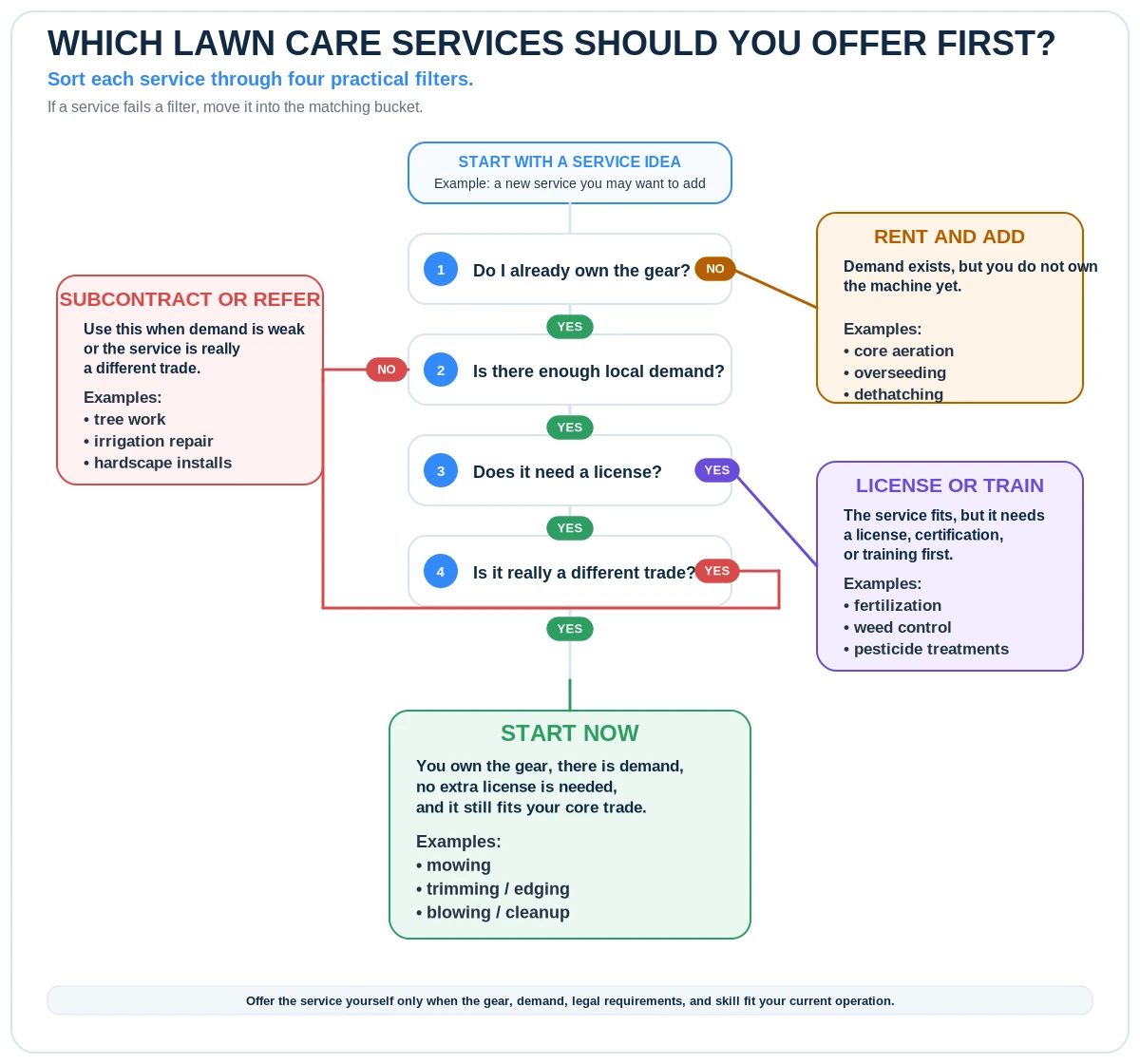
A solo operator can build the main mowing route and consider adding one rental-equipment service each season. Businesses with two or three crew members may have enough capacity to offer additional treatment programs, provided the people doing the work hold the necessary certifications. There is no need to advertise every service from the beginning.
How to create lawn care service packages
Customers should be able to understand what each package includes before requesting a quote. Three package options can cover regular mowing, seasonal maintenance, and more extensive turf care.
| Package | Included services | Schedule | Exclusions |
|---|---|---|---|
| Basic Mow | Mowing, string trimming, hard edging, blowing hard surfaces | Weekly or biweekly during growing season | Clipping haul-off, bed weeding, shrub work, treatments |
| Seasonal Care | Basic Mow, plus separately quoted spring and fall cleanups | Weekly mowing in season, with scheduled cleanup visits | Chemical treatments, irrigation, licensed specialist work |
| Turf Health | Seasonal Care, aeration, overseeding, and a scheduled treatment program | Recurring maintenance with seasonal turf services | Chemical treatments only where appropriately licensed; other work requires separate agreement |
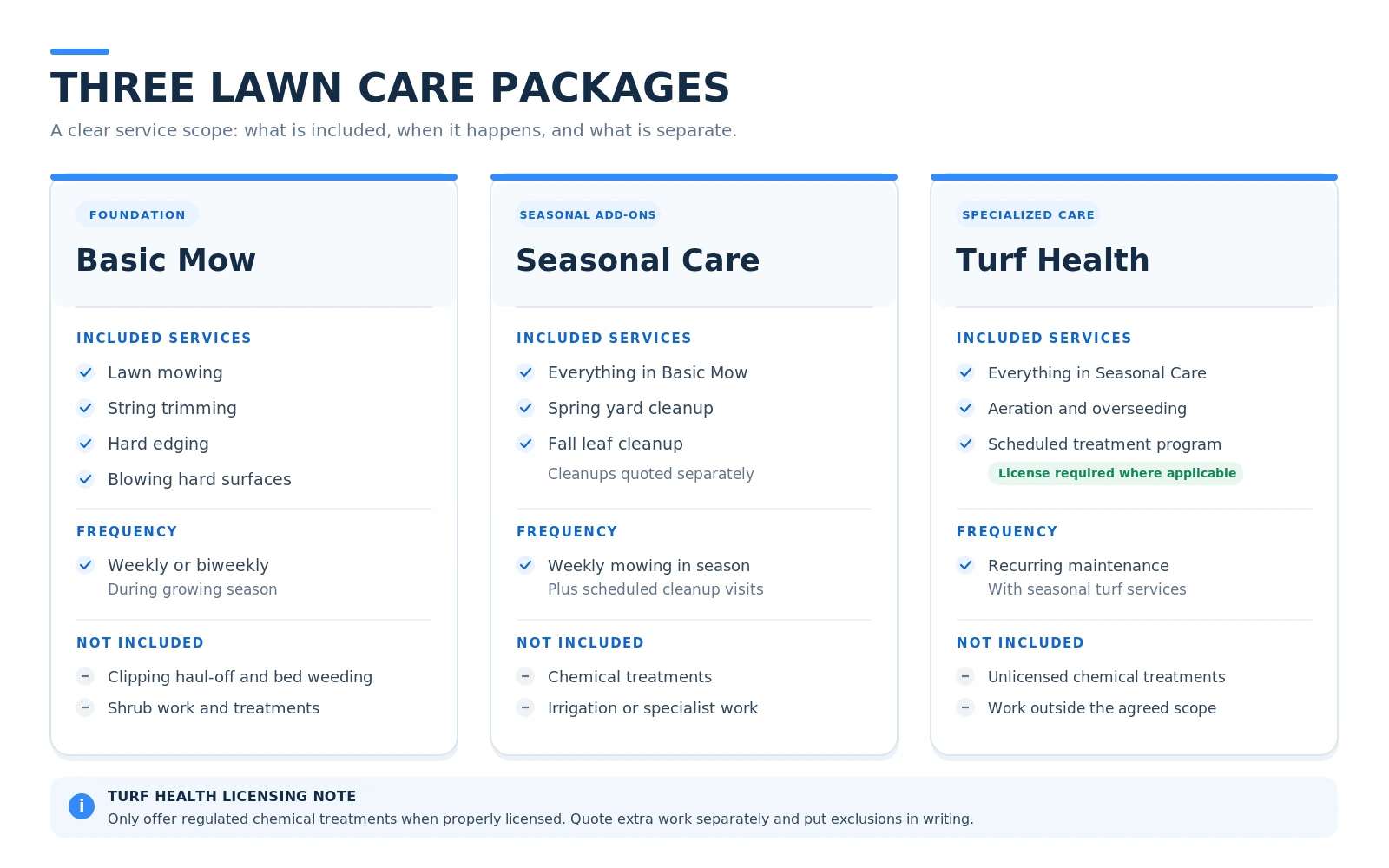
The Turf Health package should only include regulated treatments when your business is licensed to provide them. Without the required certification, offer Basic Mow and Seasonal Care until your business qualifies.
Put the service scope in writing
Each package should state what is included and excluded. Clipping disposal is a common source of confusion. Tell the customer whether clippings will be mulched in place, bagged, or hauled away. The agreement should also explain how additional work is approved. For example, if a customer asks for flower bed cleanup during a mowing visit, provide the extra price and get written approval before starting.
A short change order is usually enough for straightforward additions. Record the work requested and the agreed price. Your estimate or service-menu template should have space for the selected package, service frequency, exclusions, clipping policy, and any additional approved work. Prices should be entered according to the property and your business costs.
How to price lawn care services
Lawn care pricing should account for the time needed to complete the work, the cost of reaching the property, and the expenses involved. For context, the US average for lawn mowing is approximately $123 per visit, although actual rates vary considerably by property size and region. Landscaping labor is commonly billed in the $25–$60 per hour range.
Those figures can be used as market references. Your quote should be calculated from your own costs.
Choose the right pricing method
| Pricing method | Suitable services | Example |
|---|---|---|
| Per visit | Mowing, regular yard maintenance, cleanups | One charge for each scheduled visit |
| Per unit | Aeration, chemical treatments, mulch installation | Per 1,000 sq. ft. or per cubic yard |
| Per project | Sod installation, lawn renovations, large bed work | One agreed price for the project |
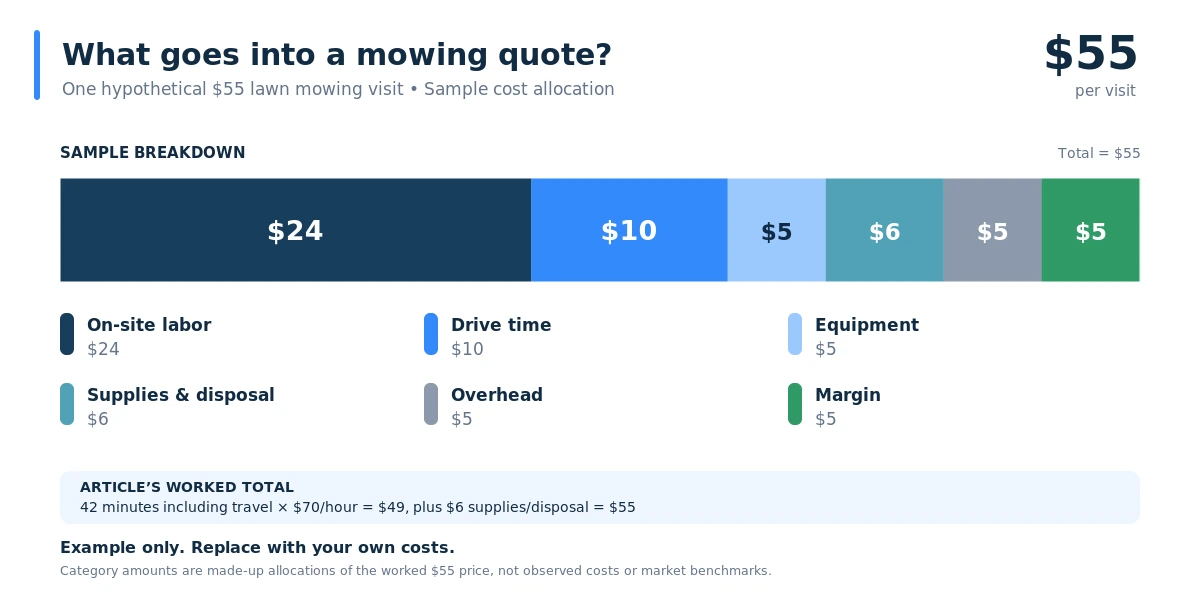
Each quote should account for:
- Labor time on the property and travel time.
- Equipment ownership costs or rental fees.
- Materials, supplies, and disposal charges.
- Business overhead, including insurance.
- The profit margin your business needs.
Example: calculating a mowing price
Suppose a mowing visit takes 42 minutes, including travel time. For this example, assume a crew billing target of $70 per hour and another $6 for supplies and disposal. The calculation would be:
42 ÷ 60 × $70 + $6 = $55
The estimated charge is $55 before any applicable local tax or contingency allowance. These are illustrative numbers, not recommended market rates. Replace the assumptions with your actual labor costs, overhead, travel time, and target margin. For aeration or treatments, measure the lawn and calculate the price per 1,000 square feet. A single flat price for every property can undercharge customers with large lawns or overcharge those with smaller ones.
Accurate measurements also help when preparing an initial quote from a property's address.
Remember insurance and other overhead
Insurance belongs in your operating costs. General liability insurance for lawn care operators has a reported median cost of about $46 per month. The amount for an individual business can differ. Other insurance expenses may include commercial auto coverage, workers' compensation, a business owner's policy, and tools or equipment coverage. Businesses offering chemical treatments or higher-risk work may need additional coverage.
Account for these costs when setting your rates rather than paying for them out of whatever remains after each job.
How to get customers to find your lawn care services online
Customers searching for lawn mowing, aeration, or yard cleanup need to find those services on your Google Business Profile and website. A clear service menu helps explain what you offer. You also need to make sure your business appears in searches across the areas you actually serve.
Add your services to Google Business Profile
Your Google Business Profile should accurately describe your lawn care business.
| Profile setting | What to include |
|---|---|
| Primary category | Lawn Care Service, when it best describes your business |
| Additional categories | Relevant categories for services you actually provide |
| Services | Individual services with short, accurate descriptions |
| Service area | Cities and areas where you accept jobs |
| Photos | Actual photos of your completed work, including before-and-after images |
| Reviews | Reviews from customers, with responses from your business |
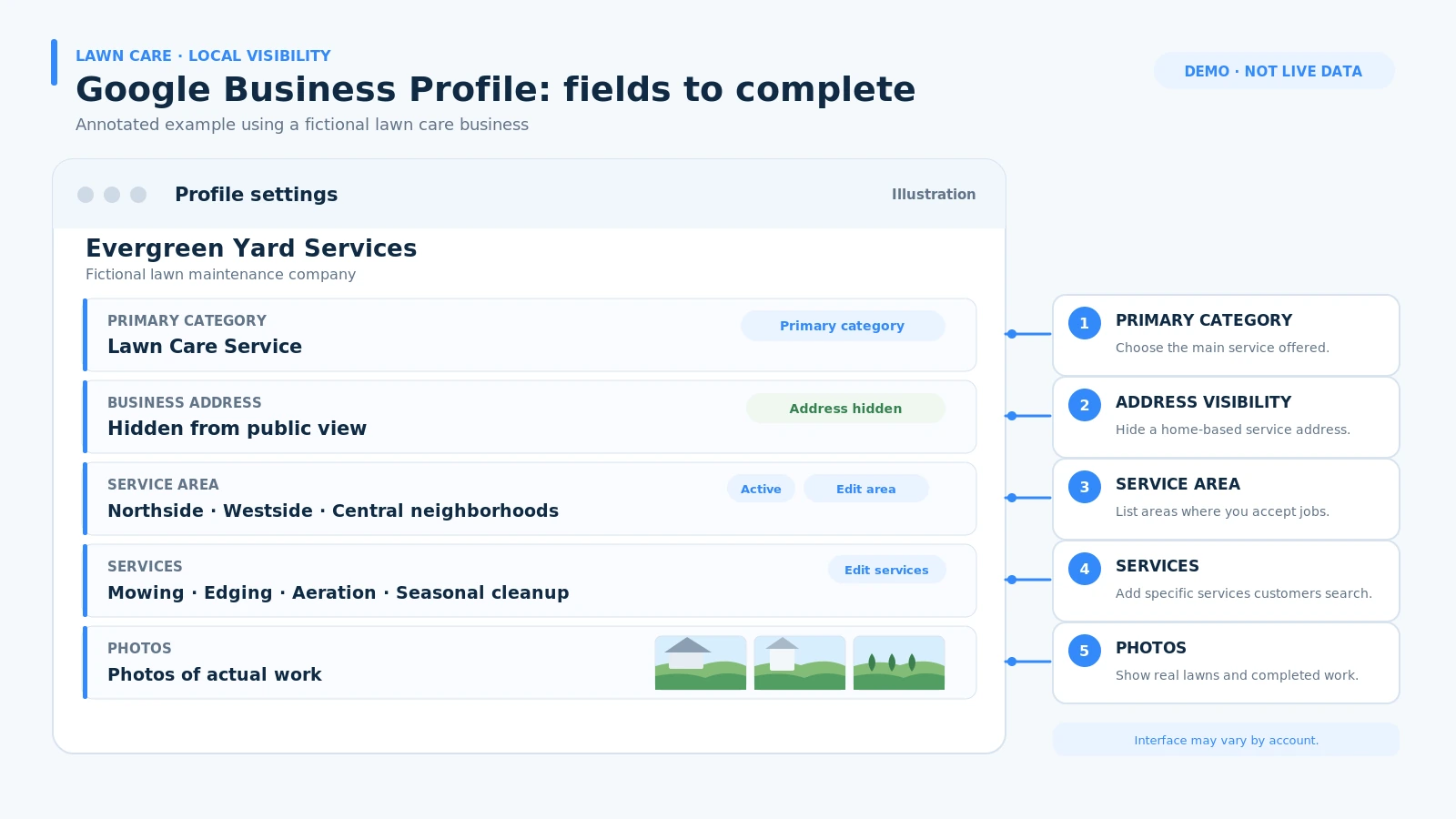
Use the same service names that customers commonly search for. For instance, "lawn aeration and overseeding" is easier for a typical customer to recognize than "cultural turf management." If you operate from home and do not serve customers at that address, set up the profile as a service-area business and hide the address. Define your service area according to where you actually work. Google's service-area guidance generally uses about a two-hour driving radius as a limit.
PO boxes and virtual offices do not qualify as legitimate business locations under Google's Business Profile rules. Keep your service area accurate so the listing represents where your business operates.
Create clear service descriptions on your website
Organize services into categories such as mowing and maintenance, seasonal cleanups, lawn health, and treatments. Each service should explain the work customers will receive and any important exclusions. For example, a lawn aeration page can describe what core aeration does, when it is normally performed in your region, and whether overseeding is available with it.
Include relevant local information where it is useful. Avoid creating dozens of nearly identical city pages that only change the city name. Service-area pages should provide meaningful information about the work and the locations covered. RankBeaver's guide to service area pages that rank covers how to structure these pages without relying on duplicated content. For help with profile setup, see the Google Business Profile guide for lawn care and pest control businesses.
Check where your business appears in local searches
A business can rank differently across neighborhoods, even within the same city. Checking your search position from your office does not tell you exactly what customers see in other parts of your service area. RankBeaver provides several tools for checking local visibility. Local Rank Grid displays local search rankings at different points on a map. You can use it to see how visibility changes across the areas you serve.
Local Search Result Checker helps check whether your business appears in local search results.
Benchmark lets you compare your business with competing providers in your market.
These checks can help you identify locations where your business has limited search visibility, even when you already serve customers nearby. For additional guidance on attracting local customers, read RankBeaver's lawn care marketing guide.
Frequently asked questions
Q.1 What services are included in basic lawn care?
Basic lawn care typically includes mowing, string trimming, edging, and blowing grass clippings off hard surfaces. Visits are generally scheduled weekly or biweekly during the growing season. Clipping removal, flower bed weeding, shrub trimming, and chemical treatments are usually separate services unless the agreement specifically includes them.
Q.2 What is the difference between lawn care and landscaping?
Lawn care generally covers the ongoing maintenance of an existing lawn. Common services include mowing, edging, cleanups, aeration, and turf treatments. Landscaping includes planting, outdoor construction, irrigation installation, and grading. Landscaping projects may need additional equipment, contractor licenses, and specialized skills.
Some businesses offer both. Others begin with recurring lawn maintenance and gradually add landscaping projects.
Q.3 Which lawn care services require a license?
Commercial herbicide, insecticide, and fungicide applications commonly require pesticide applicator certification or licensing. Fertilizer-only applications may be regulated separately, depending on the state and the products involved. Irrigation, grading, and tree services may also have additional licensing requirements. Mowing and basic maintenance usually do not require specialized trade licenses, although business registration and local licensing rules may still apply.
Check with your state's regulatory agency before advertising any service that may require certification.
Q.4 Can you offer lawn aeration without buying an aerator?
Yes. You can rent a core aerator and charge customers for the service. Renting during the first season or two allows you to measure actual demand before purchasing equipment. If you consistently book enough aeration jobs to cover the cost of ownership, buying may become more economical. Compare rental fees with the purchase price, storage, maintenance, and how often the machine will be used.
Q.5 What lawn care services are best for a one-person business?
Mowing, string trimming, edging, blowing, and basic seasonal cleanups are practical options. They can usually be completed with a mower, trimmer, blower, and basic hand tools. Start by scheduling customers close together to reduce travel time between appointments. Once the regular route is established, consider a rentable service such as aeration. Chemical treatments should wait until the business has a properly certified applicator and the required insurance.
Checklist before publishing your lawn service list
Before adding a service to your website, estimates, or Google Business Profile, confirm the following:
Only publish services your business is prepared and qualified to deliver. Add new services as demand grows and you have the equipment, staff, and approvals to handle them.