
You have probably thought about this while mowing your own lawn. The guy who does the yard across the street was in and out in twenty minutes, and somewhere around the second pass you started doing the math on what he charges and how many houses are on your block.
The math works. That is the honest answer, and it is why lawn care attracts so many people. A lawn care business, or a lawn service business if that is the term you use, is one of the few things you can start with a few hundred dollars of used equipment and have paying customers within a month, with no degree, no loan, and no storefront.
What is harder to see from the sidewalk is which part is actually difficult. It is not the mowing, and it is not choosing the equipment, even though that is where most of your research will want to pull you. It is the twenty minutes between jobs.
Route density, not horsepower, decides whether your first season clears $40,000 or $4,000. The lawn care businesses that fold in year one are rarely the ones that bought the wrong mower. They are the ones nobody in their own neighborhood could find.
So this guide walks the lawn care setup in order, with numbers you can check yourself. It gives the most room to Step 8, because that is the step that decides how well every other step pays off.
How to start a lawn care business: the 9 steps
- Choose the lawn care services you'll offer
- Name and register your lawn care business
- Write a lawn care business plan you'll actually use
- Get lawn care insurance before your first job
- Buy only the lawn care equipment your tier needs
- Price your lawn care services so you don't resent August
- Set up the lawn care business side before you're busy
- Get your lawn care business found before you print flyers
- Land your first 20 lawn care customers
Costs, earnings, and a week-by-week first 90 days follow the steps.
What it actually costs to start a lawn care business
If you have searched this before, you have seen numbers ranging from a few hundred dollars to fifty thousand. That spread is confusing, but it is not a contradiction. Those figures describe genuinely different businesses, and once you see the tiers the range makes sense.
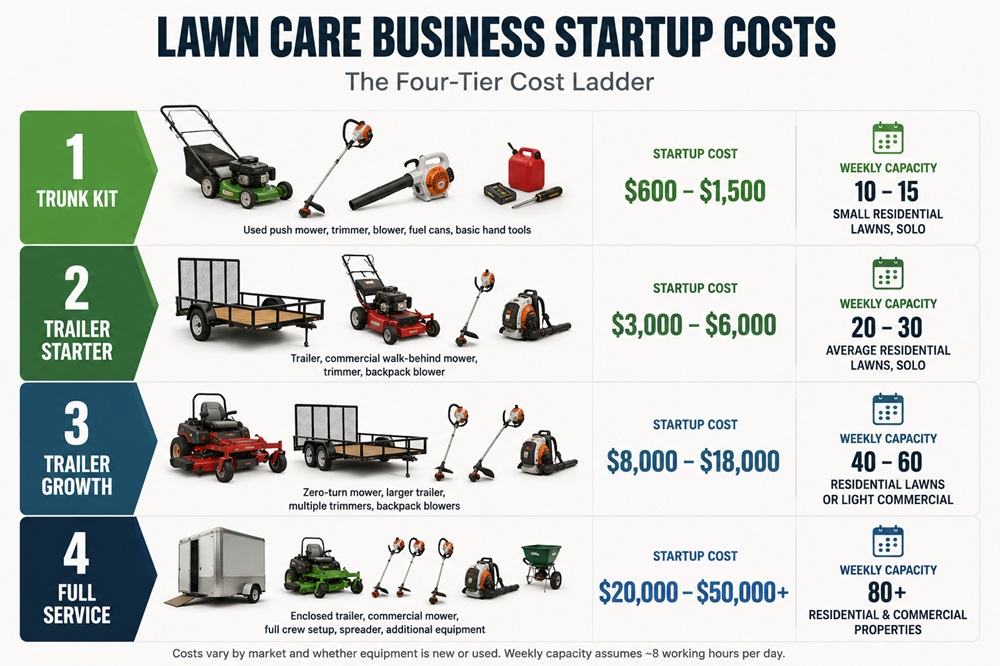
Lawn care business startup cost depends almost entirely on how you plan to move equipment and how many lawns you intend to service in a week. Here it is, by operating tier.
The table below is our own model, built from current retail and used-equipment pricing, not a figure taken from a survey. Weekly capacity assumes standard suburban lots, a solo operator, and roughly eight working hours a day. Treat it as a planning framework and check the equipment prices in your own market before committing.
| Tier | What you buy | Startup cost | Realistic weekly capacity |
|---|---|---|---|
| 1. Trunk kit | Used 21-inch push mower, string trimmer, handheld blower, fuel cans, basic hand tools | $600 to $1,500 | 10 to 15 small residential lawns, solo |
| 2. Trailer starter | Used 5x8 trailer, commercial 21-inch or 30-inch walk-behind, commercial trimmer and backpack blower | $3,000 to $6,000 on top of a vehicle you already own | 20 to 30 lawns, solo |
| 3. Truck and trailer | Used pickup, 6x12 trailer, 36-inch to 48-inch walk-behind or stand-on, full handheld set, spare trimmer | $12,000 to $30,000 | 30 to 40 lawns, room for one helper |
| 4. Full service | Zero-turn, second crew setup, spray equipment, pesticide licensing | $35,000 to $60,000+ | Multiple crews, fertilization and treatment revenue |
On top of the equipment, every tier carries the same fixed setup costs:
- Business registration: $50 to $500 depending on your state and structure
- Local business license: $50 to $400 per year, and some cities charge nothing
- General liability insurance: a median of $46 per month, or $550 per year, according to Insureon's lawn care rate data, last updated January 2025
- Website and Google Business Profile: the profile is free, the website is $0 to $2,000
Why the published numbers vary so much
Every startup estimate carries an unstated assumption about the vehicle. A figure that includes a work truck lands near $30,000. A figure for someone loading a mower into a hatchback after work lands near $800. Both are accurate for the business they describe.
So read the tier, not the total. Then pick the tier that matches the number of lawns you can realistically sell in your first 60 days, not the one that matches your ambition. Tier 3 equipment sitting idle because you have eleven customers is the most expensive mistake in this business.
What you can skip in your first year in lawn care
- A new mower. Commercial-grade used equipment at two or three years old costs a third of new and does the same work. Buy from a retiring operator, not a big-box clearance rack.
- A wrap on your truck. A $40 magnetic sign does most of the work of a $3,000 wrap when you have no route yet.
- Field-service software with a per-tech monthly fee. A spreadsheet and a calendar handle 25 customers fine. Move when scheduling starts costing you evenings.
- A logo designed by an agency. You need a name and something legible on a sign.
How much can a lawn care business make?
Two numbers decide what a lawn care business earns: what a single lawn is worth, and how many you can fit in a day.
The national average for a single mowing visit is $123, with a typical range of $49 to $203, according to Angi's 2026 lawn mowing cost data. Standard suburban quarter-acre residential lots sit at the low end of that, generally $40 to $65 per cut. Landscaping labor bills at $25 to $60 per hour.
Here is what that compounds into. The worked example below is our own model, not survey data, and every assumption in it is stated so you can swap in your own numbers.
A solo operator, 25 weekly customers, $55 average cut, 30-week season:
| Line | Amount | Assumption |
|---|---|---|
| Gross revenue | $41,250 | 25 lawns x $55 x 30 weeks |
| Fuel | -$1,800 | $60 per working week |
| Equipment maintenance | -$1,500 | Blades, line, oil, repairs, one mid-season service |
| Insurance | -$3,285 | General liability, tools and equipment, commercial auto, at Insureon medians |
| Vehicle upkeep | -$1,500 | Maintenance and wear on a used truck, excluding fuel |
| Net before tax | $33,165 | |
| Self-employment tax | -$4,686 | 15.3% on 92.35% of net |
| After self-employment tax | $28,479 | Before federal and state income tax, which depend on your total household situation |
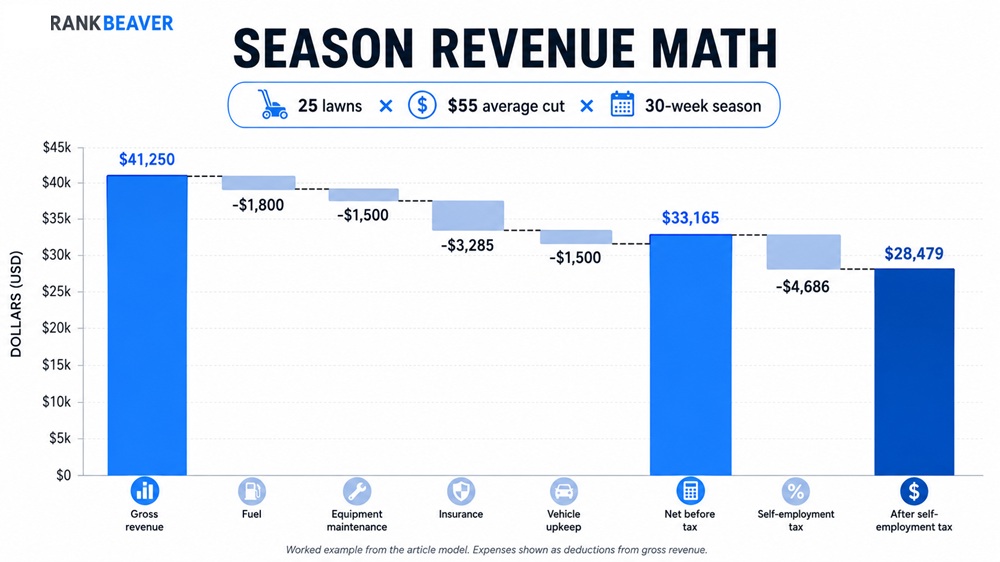
Change any assumption and the number moves a lot. Drop to 18 customers and you are near $20,000. Add a fall cleanup season and you add several thousand without buying anything. The point of the model is not the total, it is seeing which line you can actually move.
For context on the ceiling: the wider industry is not a shrinking one. US landscaping services reached $188.8 billion in 2025, growing 5.8% that year, with a 6.5% compound annual growth rate from 2020 to 2025, per IBISWorld. The Bureau of Labor Statistics projects grounds maintenance employment to grow 4% from 2024 to 2034, with median pay of $38,470 in 2024 for workers in the field (BLS Occupational Outlook Handbook).
Read that last figure carefully, because it is easy to misread. $38,470 is what an employee earns for doing the work. As an owner you are trading that wage for margin, and the margin only shows up once your route is tight enough that you spend your day cutting grass instead of driving between jobs.
Step 1: Choose the lawn care services you'll offer
Your lawn care services list determines your licensing, your equipment, and your ceiling. Start narrow.
Mowing, trimming, edging, and blowing is the entry package. It requires no special license in most states, the equipment is cheap, and it produces the thing this business runs on: a recurring weekly visit that a customer barely thinks about.
Add-ons that need no new license include spring and fall cleanups, mulch installation, hedge trimming, aeration, overseeding, and gutter clearing. These add-ons are where a solo lawn care business makes the difference between covering costs and having a good year, because they are high-ticket and they fill the shoulder seasons.
Services that trigger licensing are the fertilization and weed control category. The moment you apply a pesticide or herbicide commercially, you are in regulated territory in every state. That is not a reason to avoid it forever, since treatment revenue carries far better margins than mowing, but it is a reason to not start there.
Step 2: Name and register your lawn care business
Pick a lawn care business name you can still use at forty customers. Names that lock you to one town or one service ("Maple Street Mowing") become a problem the first time you expand a mile in the wrong direction or add mulch work. Check that the domain is free and that no business in your county already trades under something close to it.
Choose a structure. A sole proprietorship costs nothing and takes effect the moment you start working, but it puts your personal assets behind the business. An LLC costs $50 to $500 to file depending on the state and separates the two. If you are running equipment near cars, windows, and children, the LLC is worth the filing fee.
Get an EIN. It is free and takes ten minutes on the IRS website. You need it to open a business bank account, and you want a business bank account from your first customer rather than from your first tax problem.
Check local licensing. This varies more than any other part of the setup. Some cities require a general business license for anyone operating within limits. Some counties add a contractor registration. A few require nothing at all for mowing. Call your city clerk's office and ask directly. Ten minutes on the phone beats a citation.
Pro tip: Call your city clerk instead of searching. Ten minutes on the phone gets you one definitive answer, while an hour of searching gets you three contradictory ones from aggregator sites that outrank your city's actual ordinance page.
Handle pesticide licensing separately. If you plan to apply treatments, your state department of agriculture sets the exam, the fee, and the renewal cycle. Look it up before you buy spray equipment.
Step 3: Write a lawn care business plan you'll actually use
A lawn care business plan does not need to be forty pages. It needs to answer five questions honestly: which neighborhoods you are targeting, what you charge, how many customers cover your fixed costs, what you do in the off-season, and at what point you hire.
If you are financing equipment or applying for a grant, you will need a formal version with financial projections. If you are self-funding a trunk kit, a single page is enough, as long as you actually write down the break-even number.
Step 4: Get lawn care insurance before your first job
Not before your tenth job. Before your first. Lawn care insurance is the one cost you cannot defer. A thrown rock from a mower deck travels fast enough to go through a window or a windshield, and that claim arrives whether or not you have a policy.
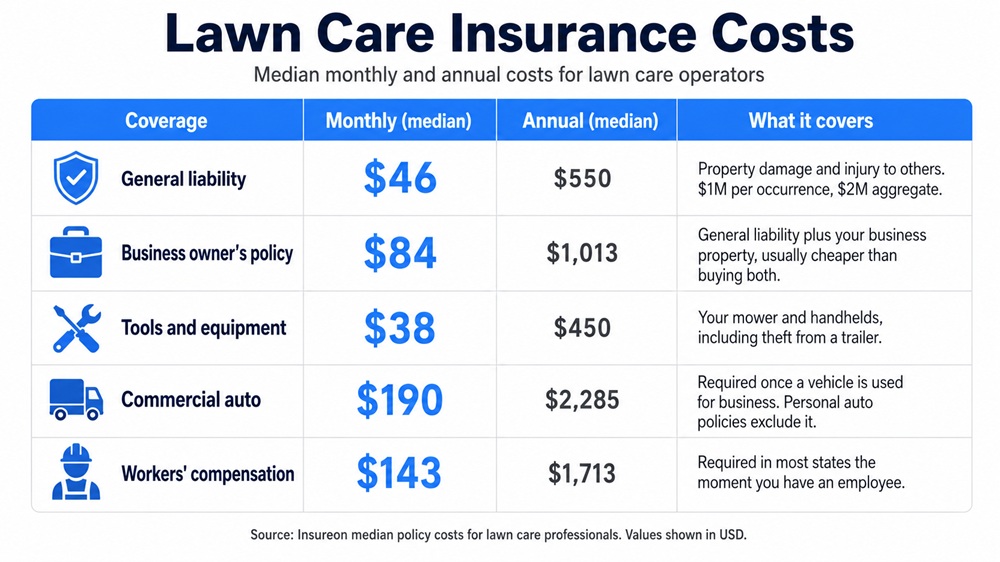
Median costs for lawn care operators, per Insureon:
| Coverage | Monthly (median) | Annual (median) | What it covers |
|---|---|---|---|
| General liability | $46 | $550 | Property damage and injury to others. $1M per occurrence, $2M aggregate |
| Business owner's policy | $84 | $1,013 | General liability plus your business property, usually cheaper than buying both |
| Tools and equipment | $38 | $450 | Your mower and handhelds, including theft from a trailer |
| Commercial auto | $190 | $2,285 | Required once a vehicle is used for business. Personal auto policies exclude it |
| Workers' compensation | $143 | $1,713 | Required in most states the moment you have an employee |
Pro tip: Ask your insurer for the certificate of insurance PDF the day your policy binds. HOAs and commercial prospects want to see it before they will accept a bid, and requesting it later costs you the job you were bidding on.
Two things new operators get wrong here. First, your personal auto insurance almost certainly excludes commercial use, so an accident on the way to a job can be denied. Second, many commercial clients and HOAs will ask for a certificate of insurance before they will even accept a bid, which means the policy is a sales tool as much as a protection.
Step 5: Buy only the lawn care equipment your tier needs
Buy your lawn care equipment in this order, because this is the order in which a missing item stops you from working:
- Mower. The single decision that sets your capacity. A 21-inch push mower handles gated backyards and small lots. A 30-inch to 36-inch walk-behind roughly doubles your lawns per day on open suburban lots and still fits most gates. A zero-turn only pays for itself on large properties.
- String trimmer. Buy commercial grade. This is the tool that fails first and gets used on every job.
- Blower. Handheld is fine at tier 1. Backpack once you are doing more than fifteen lawns a week, purely for your shoulders.
- Edger. Optional at first, since a trimmer turned sideways edges adequately. It stops being optional when a customer compares your line to the neighbor's.
- Trailer and ramps, if you are past a trunk kit.
- Consumables: trimmer line, spare blades, two-cycle oil, fuel cans, gloves, eye and ear protection.
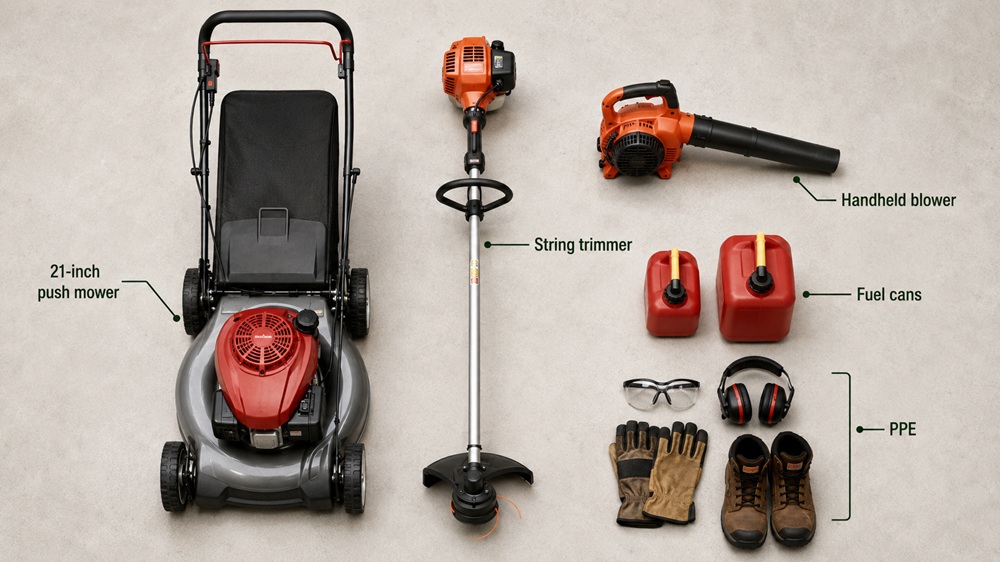
Pro tip: Buy used from operators upgrading in early spring, not from big-box clearance in fall. Spring is when commercial-grade equipment hits the resale market, and it lands at roughly a third of new.
Two lawn care equipment habits worth building early: keep a second trimmer in the trailer so a failure does not end your day, and sharpen or swap mower blades weekly. A dull blade tears grass and leaves a brown cast across the lawn two days later, which is the kind of thing a customer notices without knowing why.
Step 6: Price your lawn care services so you don't resent August
Most new lawn care businesses price by guessing what sounds competitive, then discover in midsummer that their busiest week is also their least profitable. Price from your effective hourly rate instead.
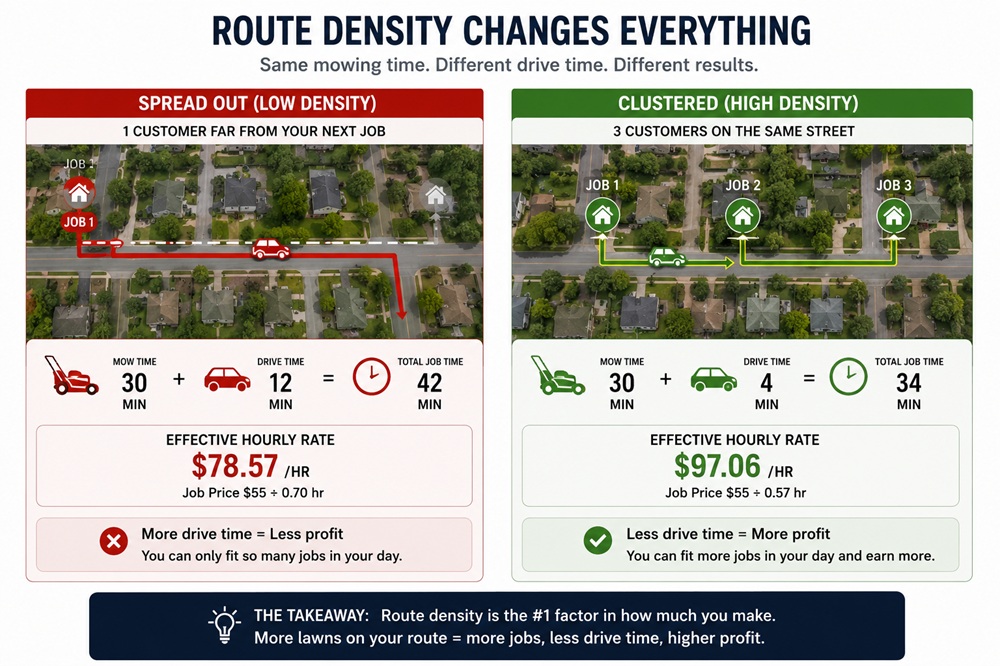
Work out your target rate. If you want $60 per hour of on-site time, and a quarter-acre lot takes 30 minutes to mow, trim, edge, and blow, that lawn is $30. Except it is not, because you spent 12 minutes driving there. Real time on that job is 42 minutes, so the price is $42. Round to $45.
That arithmetic is the whole reason route density matters. The same lawn on a street where you already service three other homes has maybe three minutes of drive time attached, which makes it a $35 job that pays better than the $45 one across town.
Three pricing models:
- Per visit is standard for residential mowing. Simple, and the customer understands it.
- Per hour works for cleanups and one-off jobs where scope is unpredictable. Never quote hourly for routine mowing, because your customer will start watching the clock.
- Monthly or seasonal contract bills a flat amount across the season regardless of cut frequency. This is the model that smooths cash flow and is worth moving toward once you have a stable route.
Set a lawn care minimum. Below roughly $35 to $40 per stop, a residential lawn does not carry its share of your drive time, fuel, and equipment wear no matter how small it is. Have a number and hold it.
Pro tip: Print your minimum on the estimate form itself. The number is easy to hold when it is already written down and hard to hold when a customer is standing in front of you asking for a favor.
Raise prices annually. A 5% increase communicated in writing in February costs you almost no customers. Four years of no increases costs you the business.
Step 7: Set up the lawn care business side before you're busy
Ninety minutes of admin setup now saves your lawn care business a bad January.
- Open a business checking account. Every dollar in, every dollar out, one account. This is the difference between an hour of bookkeeping and a weekend of it.
- Track mileage from day one. It is one of the largest deductions available to a service business and it is impossible to reconstruct in April.
- Set aside 25% to 30% of profit for taxes, and expect to file quarterly estimated payments as a self-employed operator.
- Decide how you invoice. Paper invoices work at ten customers. They do not work at forty. Pick something that lets a customer pay by card, because chasing checks is unpaid labor.
- Pick a scheduling method. A shared calendar is fine early.
Step 8: Get your lawn care business found before you print flyers
This is the step that decides your first season, so it gets the most room.
When a homeowner decides they are done mowing, they usually do not ask a neighbor for a lawn care recommendation first. They open Google Maps, type "lawn service near me," and call one of the top three results. If you are not in that map pack, you are invisible to most of the demand on your own street, no matter how good your work is.
The good news is that local search is the one channel where a brand-new lawn care business can outrank an established company, because proximity and reviews count for more than age or budget.
Create your Google Business Profile, correctly, this week
Your Google Business Profile is free and it is the single highest-value asset you will create this month. Create it before your website.
Because you travel to customers rather than having them come to you, Google classifies you as a service-area business, and that changes three rules that catch nearly every new operator:
- Hide your address if you run the business from your house. Google's guidelines for representing your business state directly that service-area businesses should hide their address, and a visible residential address is a suspension risk. Reinstatement is far more painful than getting it right the first time.
- No PO boxes, remote mailboxes, or virtual offices. Renting a mailing address at a place you do not operate from will not pass.
- Keep your service area tight. Google caps it at roughly two hours of driving time, but that is the outer limit, not a target. Listing every town within an hour dilutes your relevance everywhere and generates leads you cannot profitably drive to. Start with the three or four zip codes closest to you.
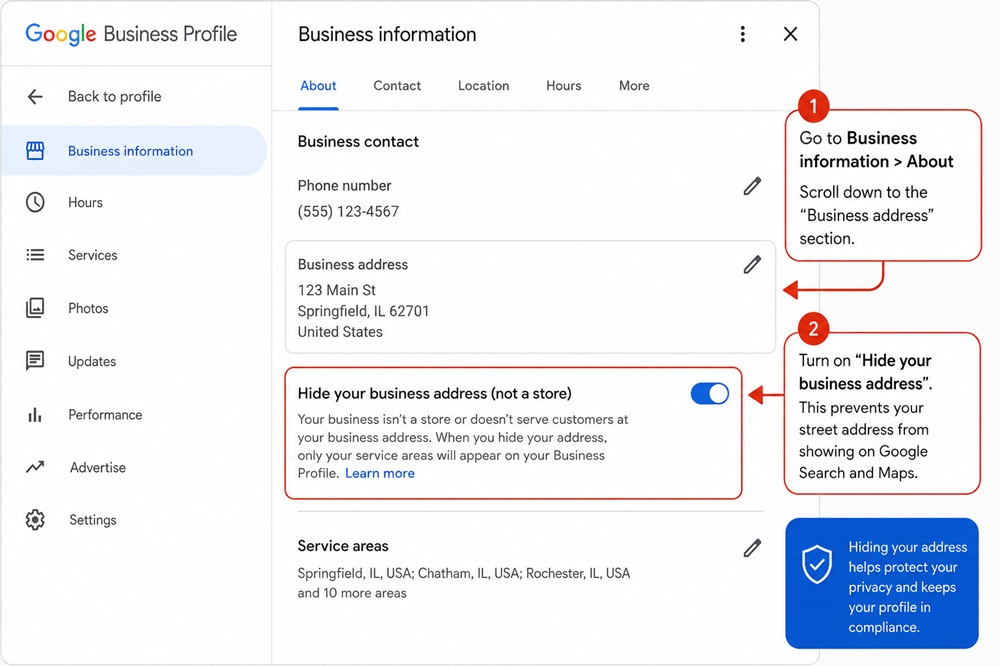
Then fill it out completely: Lawn Care Service as your primary category, your services, hours, phone number, and real photographs of lawns you actually cut. Before-and-after shots from your phone outperform anything you could buy.
Pro tip: Shoot your before-and-after photos on the same phone at roughly the same time of day. Consistency reads as a working business; a mix of stock images and random phone shots reads as a listing someone set up and abandoned.
Once it is live, check where you actually stand. Ranking is intensely geographic, and your position varies block by block, which is why one rank check from your kitchen table tells you almost nothing.
- Run our free Local Search Result Checker to see where you appear for "lawn service near me" right now.
- Run the free Local Rank Grid to see your position mapped across your whole service area.
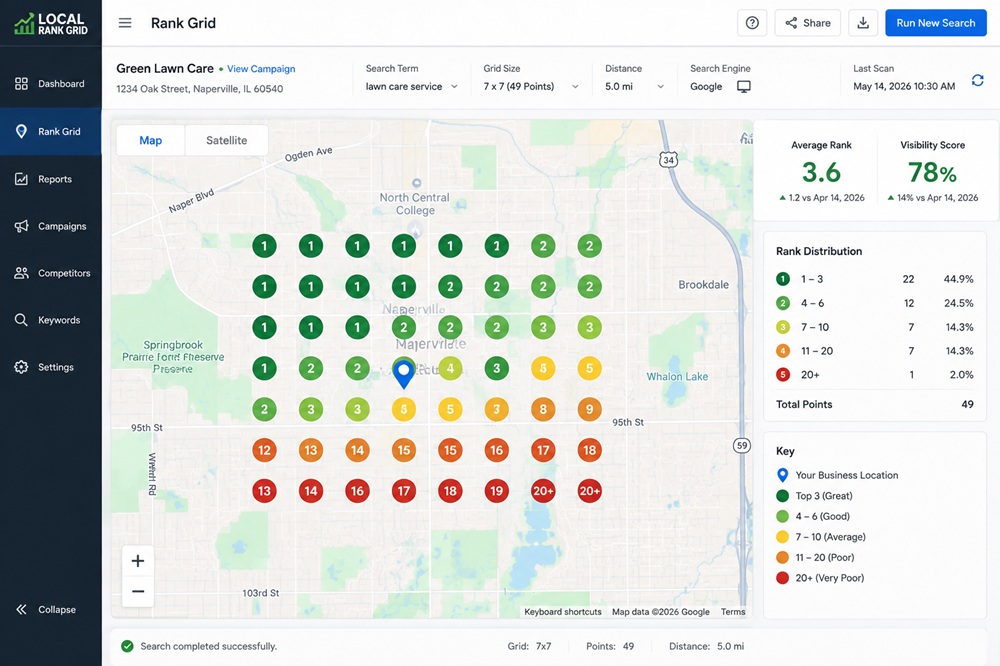
The grid matters most in your first season, because it tells you which streets to canvas. A flyer works far better in an area where the homeowner can also find you online afterward.
Get your first 10 lawn care reviews in 30 days
Reviews are the strongest lever a new lawn care profile has, and the first ten move you further than the next fifty will.
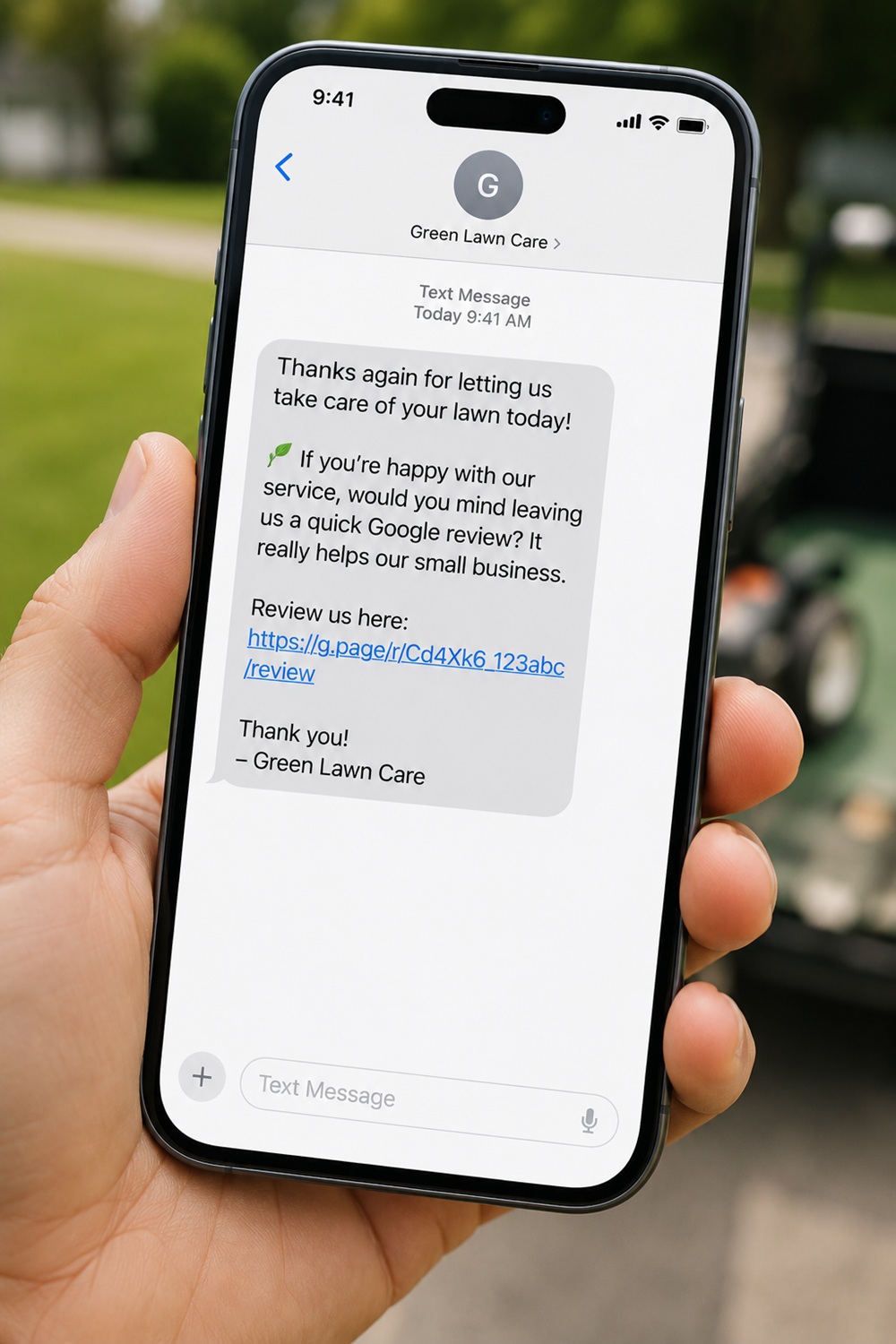
Ask in person, at the job, the moment the customer says the lawn looks good. That is the highest-conversion moment you will ever get and it never repeats. Follow it with a text containing the direct review link, because nobody navigates to a review form on their own. Never offer a discount in exchange for a review; it violates Google's policies and puts your profile at risk.
Then hand the rest off
Everything above is a launch setup, and it is enough to start taking calls. The ongoing work is a different job: choosing channels, running ads, building a site that converts, and generating leads at a predictable cost. Those have their own guides.
- Door hangers and flyers still work, but as a second touch. The highest-return version is hanging them on the twenty houses around a lawn you are already cutting, on the day you cut it.
- Your website comes after the profile and needs less than you think: service area, services, phone number, reviews.
- For the full channel mix once you are past launch, start here.
Step 9: Land your first 20 lawn care customers
Your first twenty lawn care customers come from four places, roughly in order of speed:
- People who already know you. Not a discount, a straight ask: you have started a lawn service, here is your rate, here is when you can start.
- The street you already work on. One customer on a block is a reason to knock on that block. You are visible, the work is in front of them, and you are already driving there.
- Your map pack listing. Calls from Google Maps start arriving within weeks of a complete profile with a handful of reviews.
- Neighborhood groups. Local Facebook groups and Nextdoor generate real leads, but only if you participate rather than post ads. Answer a lawn question well and you will get calls from it.
Pro tip: When two leads look equally good, take the one nearest an existing customer. Every time, without exception. That single habit compounds into most of your margin by year two.
Chase route density, not customer volume. Twenty customers spread across five neighborhoods is a worse business than fifteen in one. Fewer customers, more profit, shorter days. When you are choosing which leads to pursue, choose the one nearest your existing route almost every time.
Your first 90 days in lawn care, week by week
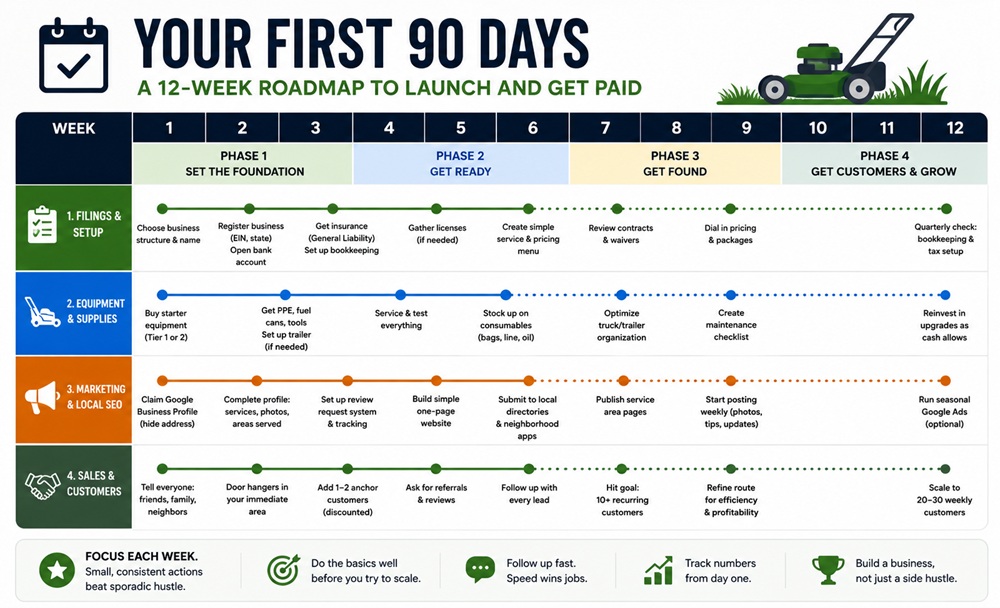
Steps in a list look sequential, but several of these run in parallel, and filings take time you can use for other things. Here is the sequence that keeps everything moving at once.
| Weeks | Do this |
|---|---|
| 1 to 2 | Pick your tier and your service list. Choose a name and check the domain. File your LLC. Apply for your EIN. Call the city clerk about local licensing. |
| 3 to 4 | Get insurance quotes and bind a policy. Open the business bank account. Create your Google Business Profile and hide your address. Buy equipment while the filings process. |
| 5 to 6 | Set your prices and your minimum. Run a rank check to see your starting position. Ask everyone you know. Take before-and-after photos of your first jobs. |
| 7 to 8 | First paying customers. Ask each one for a review at the job. Door-hang the twenty houses around every lawn you cut. |
| 9 to 12 | Tighten the route. Drop or reprice the customers who are costing you drive time. Add one shoulder-season service. Review the rank grid to find the neighborhoods to work next. |
Surviving the lawn care off-season
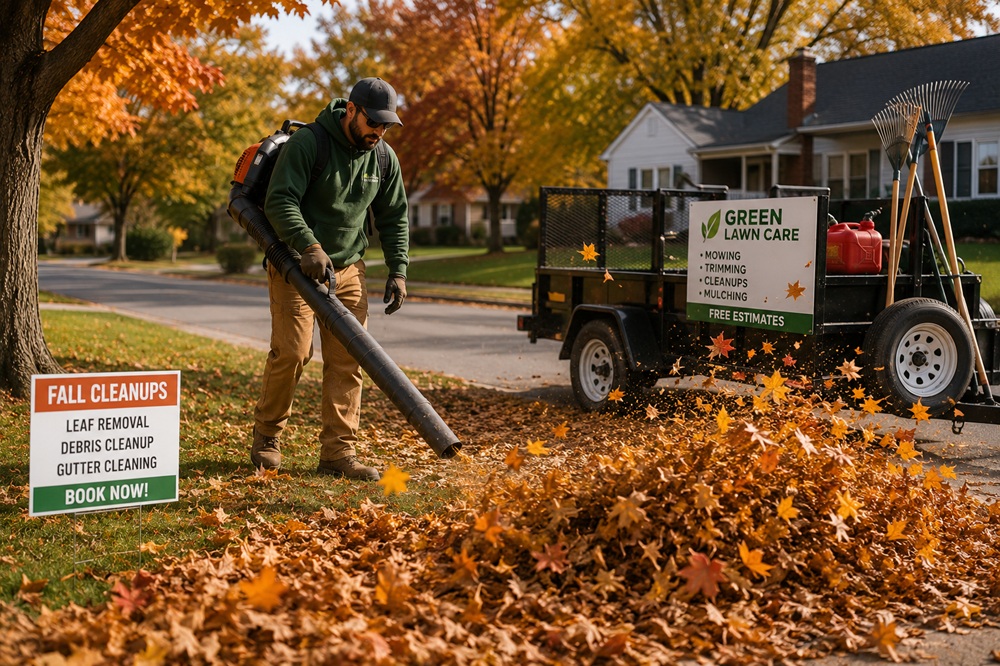
The winter revenue gap is the most common reason first-year lawn care businesses do not become second-year lawn care businesses. Mowing revenue stops in most markets somewhere between late October and April, while insurance, loan payments, and your own living costs do not.
Plan your lawn care off-season before it arrives:
- Fall cleanups and leaf removal are the highest-value work of the year in most markets, and they use equipment you already own.
- Gutter clearing pairs naturally with leaf season and needs only a ladder.
- Aeration and overseeding in early fall are high-margin and easy to sell to existing customers.
- Snow removal or holiday lighting where the climate supports it, using the same route and the same customers.
- Prepaid seasonal contracts billed monthly across twelve months rather than seven, which converts your seasonal revenue into steady cash flow.
Budget as though your season is 30 weeks, not 52, and set money aside during the busy months. The operators who make it to a second season are the ones who treated July's cash as covering January.
When to hire your first lawn care employee
Hire your first lawn care employee when you are turning down profitable work in your existing service area, not when you are tired. Those feel identical in August and they are not the same problem.
The signals worth acting on: you are consistently declining jobs on streets you already service, your route is dense enough that a second person cuts drive time rather than adding it, and you have banked enough to cover roughly three months of that person's wages before the revenue they generate arrives.
Note that workers' compensation becomes a legal requirement in most states the moment you have an employee, at a median of $143 per month for lawn care operators. Factor that in before you make the offer, along with payroll taxes, which add roughly 8% to 10% on top of the wage.
Frequently asked questions
Q.1 How much does it cost to start a lawn care business?
Starting a lawn care business costs between $600 and $1,500 for a trunk kit with used equipment, or $3,000 to $6,000 for a trailer setup with commercial gear. Add roughly $700 to $1,400 in fixed costs for business registration, local licensing, and a year of general liability insurance. Estimates above $15,000 typically include the purchase of a work truck.
Q.2 Do you need a license to start a lawn care business?
For basic mowing, trimming, and edging, most US states require no specialty license, though many cities require a general business license to operate within their limits. The moment you apply fertilizer, herbicide, or pesticide commercially, you need a pesticide applicator license from your state department of agriculture. Requirements vary by city, so call your local clerk's office rather than relying on a national answer.
Q.3 How much can you make in your first year?
A solo lawn service operator with 25 weekly customers at an average of $55 per cut grosses about $41,250 across a 30-week season. After fuel, equipment maintenance, insurance, and vehicle upkeep, that leaves roughly $33,000 before tax, or about $28,500 once self-employment tax is paid and before income tax. First-year results vary enormously with how fast you build the route, which is why the customer acquisition steps matter more than the equipment ones.
Q.4 Do I need an LLC for a lawn care business?
An LLC is not legally required for a lawn care business. You can operate as a sole proprietor from your first job. An LLC costs $50 to $500 to file and separates your personal assets from business liability, which is meaningful in a trade where equipment throws debris near cars, windows, and people. Most operators who intend to stay in the business form one early.
Q.5 How do you start a lawn care business with no money?
You cannot start a lawn care business with literally nothing, but you can start for under $600 by buying a used push mower, trimmer, and blower from an operator who is upgrading, mowing lawns within walking or short driving distance to keep fuel costs near zero, and asking for payment on the day of service so you are never financing a customer. Register as a sole proprietor, which costs nothing, and add the LLC once revenue covers it. What you cannot skip is general liability insurance at roughly $46 per month, because one thrown rock costs more than a year of premiums.
Q.6 Is a lawn service business the same as a lawn care business?
In everyday use the two terms mean the same thing, so if you searched for how to start a lawn service business and landed here, this guide covers it and the steps are identical. Customers searching for either expect the same work: mowing, trimming, edging, and blowing on a recurring schedule. Some operators use "lawn care" to signal that they also do treatment work such as fertilization and weed control, which requires a state pesticide applicator license, while "lawn service" or "lawn maintenance" implies mowing only. The distinction matters for licensing, not for how you name the business.
Q.7 How do I get my first lawn care customers?
Start with people who already know you, then work the streets where you already have a job. In parallel, create a complete Google Business Profile with your address hidden, because "lawn service near me" is how most homeowners begin the search. Ask for a review at the job, in person, the moment the customer compliments the work, and follow up with a text containing the direct link.
Conclusion
Before you buy anything, find out whether anyone can find you. Run the free Local Rank Grid on "lawn care near me" in your area. It takes a minute and it tells you which streets are worth your first flyers.
The equipment decision you are agonizing over matters less to your lawn care business than you think. Pick the tier that matches the customers you can sell in 60 days, get your profile live with your address hidden this week, and put every hour you were going to spend comparing mowers into making your route tighter. Density is the whole business.