

Getting more leads sounds like a good sign for your landscaping business, but how many of those inquiries actually turn into paying customers?
Suppose you spend $1,200 on marketing in a month and receive 40 inquiries. Of those, only 24 come from potential customers in your service area who need the services you offer. You send out 18 estimates and manage to book six jobs, each worth an average of $1,500. That gives you $9,000 in booked revenue from your $1,200 marketing spend.
Now look at the numbers. Your cost per lead was $30, but you actually spent $200 to acquire each paying customer. These are hypothetical figures, but they explain why tracking inquiries alone can give you the wrong impression of how well your marketing is performing.
A good landscaping marketing strategy should help you attract customers who need your services, live within your service area, and have projects that make financial sense for your business. The approach will also differ depending on whether you provide residential lawn maintenance, landscape design and installation, or commercial landscaping services.
In this guide, we'll cover 15 practical landscaping marketing strategies for 2026, including local SEO, Google Business Profile optimization, paid advertising, and customer referrals. We'll also explain how to choose the right marketing channels for your landscaping business, manage your budget, and measure how many inquiries turn into booked jobs.
What this guide covers
- What landscaping marketing has to do
- Why it works differently in 2026
- Pick your business model before you pick a channel
- 15 landscaping marketing strategies that generate leads
- Best channels by business type
- How much should landscaping marketing cost?
- How to measure ROI and cost per booked job
- A region-sensitive seasonal calendar
- Common mistakes
- Your first 90 days
- FAQ
What landscaping marketing has to do
Landscaping marketing is everything that moves a stranger from noticing your work to signing an estimate, and then keeps them. It is not brand awareness for its own sake. The job is a path: someone discovers you, decides you are credible, asks for a price, and books. Every tactic below earns its place by moving someone along that path, and you measure it by where people fall off.
The path is short and local. Most landscaping work is bought by someone within a few miles of a job they saw or a search they ran, and the decision turns on proof and responsiveness more than on clever copy. That is good news for a small operator, because the things that win here are things you can do yourself.
Consumers say "landscaper" for anyone with a mower. In the install trade the word is landscape contractor, and the distinction runs through everything, including how you market. A guide that lumps a weekly mowing route together with a $40,000 paver job will be wrong for both. The next sections keep them apart.
Why landscaping marketing works differently in 2026
Landscaping marketing is capacity-constrained in a way most marketing advice ignores. You are not only trying to fill a calendar; you are trying to fill it without buying work you cannot staff. Two facts set the backdrop.
First, labor is tight and seasonal. Landscaping and groundskeeping was the single largest H-2B occupation in FY2025 at 89,013 certified positions, 38.3 percent of all certified positions that year, against a statutory annual cap of 66,000 for the whole program. Demand for seasonal crews runs well past what the visa cap allows, which is why retaining customers and crews beats chasing volume.
Second, the binding limit on an install company is usually crew leaders, not laborers. Across the landscaping services industry there are roughly 85,000 first-line supervisors to 557,000 groundskeeping workers, about one leader for every six and a half workers. You can hire hands faster than you can grow someone who runs a job unsupervised, so marketing that outruns your crew-leader count books jobs you will deliver badly.
The practical consequence: your marketing has an off switch, and using it is a skill. When the crew is full, the right move is to stop spending and let the pipeline breathe, not to keep buying leads you will quote slowly and lose. Capacity is a marketing input, not a separate problem.
Pro tip: Put a one-line capacity rule in writing before the season starts, for example "pause paid channels when booked work passes four weeks out." It turns a judgment call you will get wrong when the phone is ringing into a decision you already made.
Pick your business model before you pick a channel
The fastest way to waste a marketing budget is to run tactics built for a different business than yours. Decide which of these you are, or which mix, and let that pick your channels. If you run two, run two plans, not an average of them.
| Business model | Who buys | The main job | Lead channels that pay | Proof they need | Primary number to watch |
|---|---|---|---|---|---|
| Residential maintenance / lawn route | Homeowner near your route | Recurring mow, cleanup, seasonal care | Google Business Profile, referrals, neighbor marketing, past-customer reactivation | Nearby work, reliability, reviews | Booked stops per drive hour |
| Residential design/build (install) | Homeowner planning a project | One-off patio, planting, irrigation, lighting | Project photos, service pages, Google Search Ads, photo-led social | Before/after galleries, a real portfolio | Profit per won project |
| Commercial maintenance / contracts | Property or facilities manager, HOA board | Contracted grounds care, renewals | Commercial service pages, partnerships, direct outreach, bidding | Insurance, references, availability | Qualified proposals and annual contract value |
Maintenance is a density game. The economics live in how many stops sit close together, so the marketing that pays is anything that adds customers near customers you already have. Deep tactics specific to recurring lawn work are covered in lawn care marketing; this guide keeps maintenance in view but does not duplicate it.
Design/build is a proof game. Fewer, larger decisions, a longer consideration period, and a buyer who needs to see work like theirs before they call. Photos and service pages do most of the selling.
Commercial is a relationship and paperwork game. The buyer is a manager comparing vendors on reliability and documentation, the sales cycle is long, and the win is a contract that renews. Marketing here looks more like business development than advertising. The full commercial playbook sits in commercial landscaping marketing.
15 landscaping marketing strategies that generate leads
These are grouped so you can start at the top of the group that fits your model. Within each, the aim is something you could act on Monday, not a description of a channel.
Foundation: get found and get hired for free
01. Finish your Google Business Profile, then keep it accurate. For a local service, a complete and correct profile is the highest-leverage free thing you can do, because Google ranks local results on relevance, distance, and prominence, and the profile feeds all three. Fill every field, not most of them.
| Profile field | What to put |
|---|---|
| Primary category | The one that matches your main money service (for example "Landscaper," "Lawn care service," or "Landscape designer"), not a catch-all |
| Additional categories | Each distinct service you actually sell |
| Service area | The towns and ZIPs you will drive to, honestly |
| Services | Each service named the way customers search it |
| Photos | Real, recent project photos, refreshed monthly |
| Hours and phone | Exact, with a number that reaches a person |
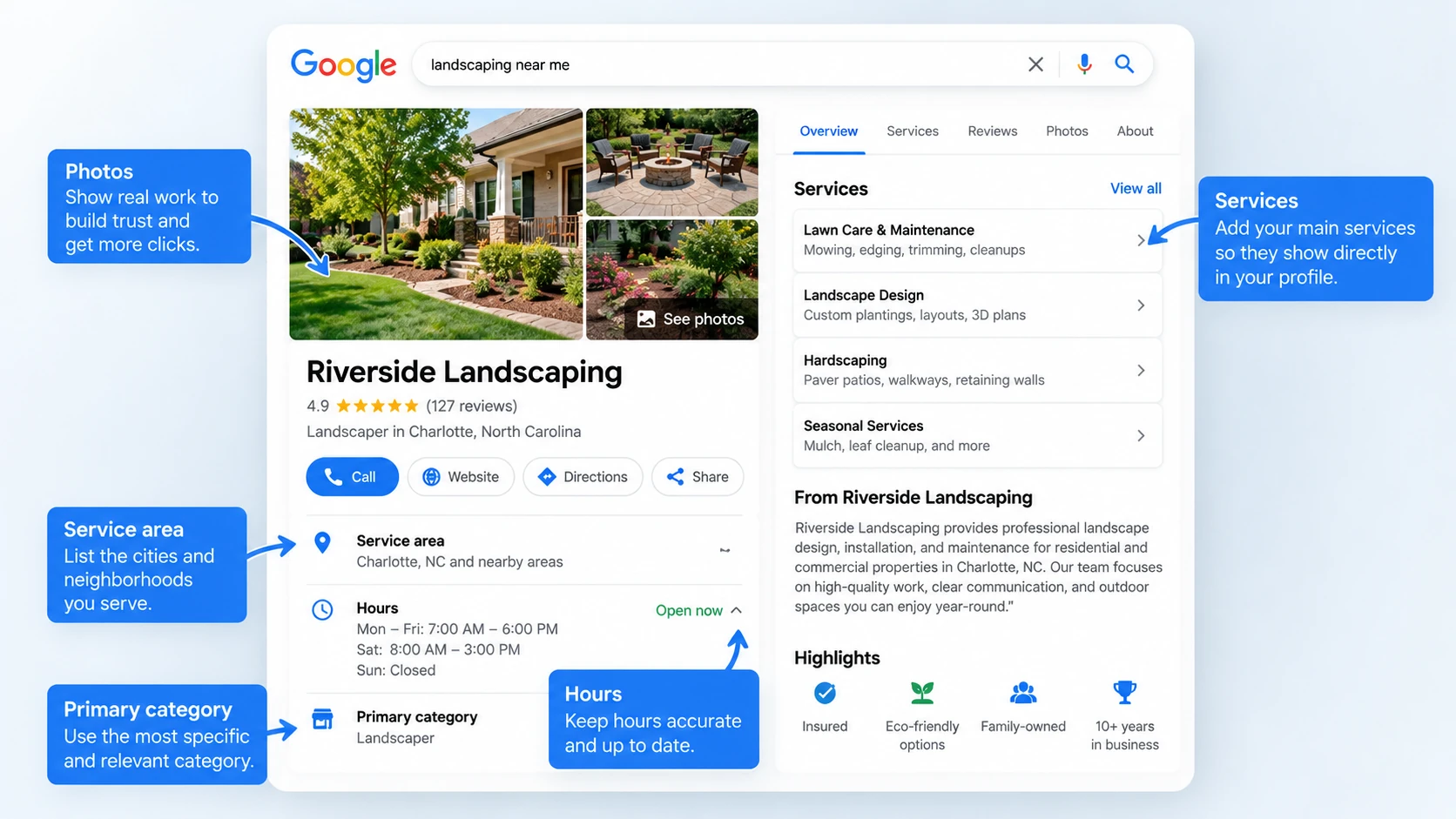
Cadence: 15 minutes a week to add a few photos and answer every question and review. Do not treat posting frequency as a confirmed ranking factor; it is customer communication, and that is reason enough. A full walkthrough is in the RankBeaver’s Google Business Profile guide.
If you are not sure you even show up in local results yet, run your own business name and main service from outside your office network and see what appears. The Local Search Result Checker does the same check without the guesswork.
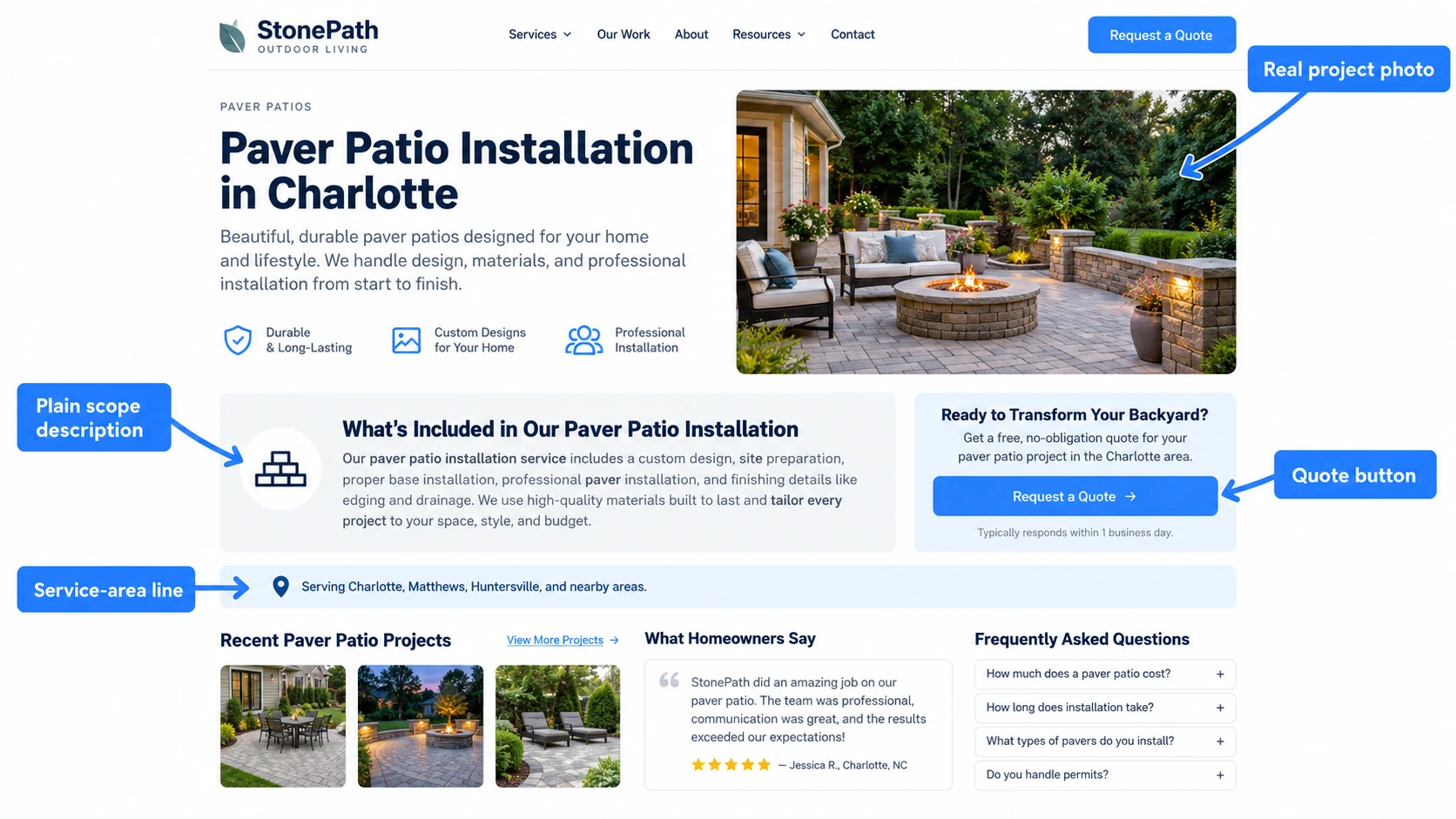
02. Build one real page per service, not one page that lists services. A page titled "Paver patio installation in Charlotte" can rank and convert for that exact search; a single "Services" page cannot. Give each core service its own page with your own photos, a plain description of what the job includes, and a quote button. Build location pages only where you have genuine local content for that area, not thin copies with the town name swapped. The mechanics of this are covered in service-area page SEO.
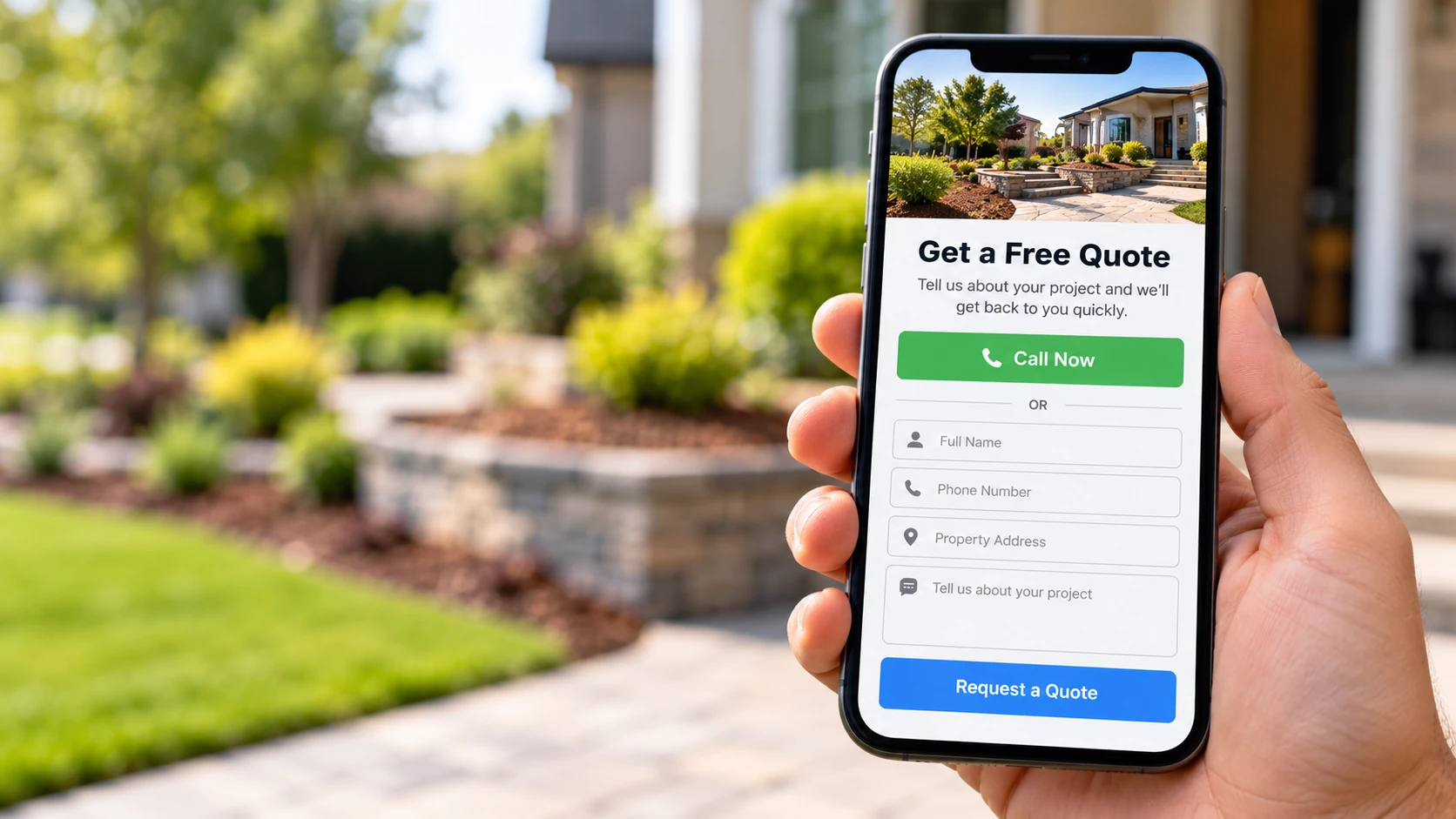
03. Make the quote request take ten seconds on a phone. Most landscaping searches happen on a phone, and most quote forms ask for too much. Put a tap-to-call button and a short form (name, phone, address, one line on the job) above the fold on every page. Measure completed forms and call clicks, not visits. Design patterns that convert are shown in landscaping website examples.
04. Shoot every job three times and keep the files. Before, install-day, and grown-in photos from the same angle are the single most reusable asset in this trade, and the one most operators skip. One job shot this way feeds a service page, a profile update, a social post, and a line in a proposal.
- Shoot from a fixed spot so before and after line up.
- Note the location, the service, and that you have permission to show it.
- Come back in a few weeks for the grown-in shot; that frame is the one competitors never have.
Pro tip: Keep a shared phone album per crew named by job address. The barrier to photo marketing is never the camera, it is finding the photo six weeks later, and an address-named album solves that for free.
05. Ask for honest reviews on a schedule, and never pay for them. Reviews feed both your ranking prominence and the homeowner's decision. Ask every satisfied customer, in person or by text, right after the job or after the first month of a maintenance plan. Google prohibits incentivized reviews and the FTC prohibits buying reviews outright, so the ask is for an honest review, with nothing attached.
A script that works, sent the day after the job: "Thanks again for having us out. If you were happy with the patio, a quick Google review helps a lot of neighbors find us. Here is the link." Respond to every review, good or bad, in a sentence.
Paid: buy high-intent attention when the free base is working
06. Run Google Search Ads on the services worth the most to you. Search ads put you in front of someone typing "paver patio installer near me" right now, which is why they suit design/build better than low-ticket maintenance. Keep it tight: one ad group per high-value service, each pointing at that service's page, with your service area set honestly.
- Match types: start with phrase match on terms like "paver patio installation," not broad match, which spends on irrelevant searches.
- Negatives: add "jobs," "salary," "DIY," "wholesale," "equipment," and the names of services you do not sell.
- Judge it on cost per booked job, not cost per click. Campaign structure is detailed in Google Ads for landscaping companies.
07. Check whether Local Services Ads are live in your market before you count on them. Google lists landscaping and lawn care among its Local Services categories, but availability and the screening you must pass vary by location, so confirm it for your own account and area rather than assuming. These are pay-per-lead and sit above search ads. Note the badge is now "Google Verified" in Google's current documentation; older articles still say "Google Guaranteed" or "Google Screened," so do not copy those claims. Compare real lead quality and disputed contacts against spend, not lead count.
08. Advertise finished projects on Facebook and Instagram, not your logo. Paid social works for landscaping when the creative is a genuine transformation shot and the targeting is your service geography. Test a before/after image against a seasonal offer, send the click to the matching service page, and measure contacts and closed jobs, not likes.
Local and relationship: the channels that compound
09. Build a referral ask into the end of every job. Referrals are the cheapest qualified leads in this business and they go uncollected because no one asks. Make it a step in closing out a job, and make it trackable with a simple "how did you hear about us" note or a referral card.
Script, said to a happy customer at walkthrough: "Most of our work comes from neighbors telling neighbors. If you know anyone thinking about their yard, I would appreciate you passing my name along." Keep referral thank-yous separate from reviews; a thank-you gift for a referral is fine, a reward for a Google review is not.
10. Market the streets your crews are already on. Route density is money for maintenance, so the highest-return offline marketing is aimed at the houses nearest a job you just did. The mechanic is physical and small:
- Hang door hangers on the eight to ten nearest homes after each job, while the truck is still there.
- Put a small, permitted yard sign on the job itself where allowed.
- Carry 25 hangers in the truck so it is never a separate trip.
11. Set up a handful of local partnerships. Builders, realtors, nurseries, pool and hardscape contractors, and property managers all meet your customers before you do. A standing referral relationship with three or four of them beats most advertising. Track which partner sent which quote so you know which relationships to keep.
12. Reactivate past customers before each season. Your customer list is a channel. A consent-based email or text before local demand peaks ("spring cleanup slots are opening, reply to hold yours") books work from people who already trust you, at near-zero cost. Segment by the service they bought last, and measure booked renewals and opt-outs, not opens. Tracking this from source to signed job is covered in how to track landscaping leads.
Conversion and revenue: win more of what you already attract
13. Turn installs into maintenance plans at handoff. The cheapest recurring customer is one whose install you just finished. Offer a care plan when you hand over the job, with clear tiers, scope, and price, so the yard you built stays yours to maintain. Track attachment rate: contracts signed divided by eligible completed installs.
14. Pursue commercial contracts on purpose, not opportunistically. Commercial work runs on a different motion: facilities managers and HOA boards comparing vendors on reliability, insurance, references, and availability, over a longer cycle. Build commercial-specific pages and a simple proposal packet with proof and documents ready, and expect to follow up for weeks. The full approach is in commercial landscaping marketing.
15. Follow up on every estimate until you get a yes or a no. The job you already quoted is more winnable than a new lead, and most are lost to silence rather than price. Assign each inquiry an owner, respond fast, and follow up on a schedule until the customer books or declines.
- Respond to new inquiries same day; speed is the strongest conversion lever you control.
- Follow up a quoted estimate twice, spaced a few days apart, then stop.
- Record why you lost each one; "too high," "went with neighbor's guy," and "never replied" point at different fixes.
Pro tip: If your state licenses irrigation work, the license number often has to appear on your ads, signs, and truck lettering. Texas, for one, requires the irrigator's license number on business cards, ads, signs, and vehicle lettering, so a wrap that omits it is both a compliance problem and a wasted trust signal. Check your own state before you print anything.
Best channels by business type
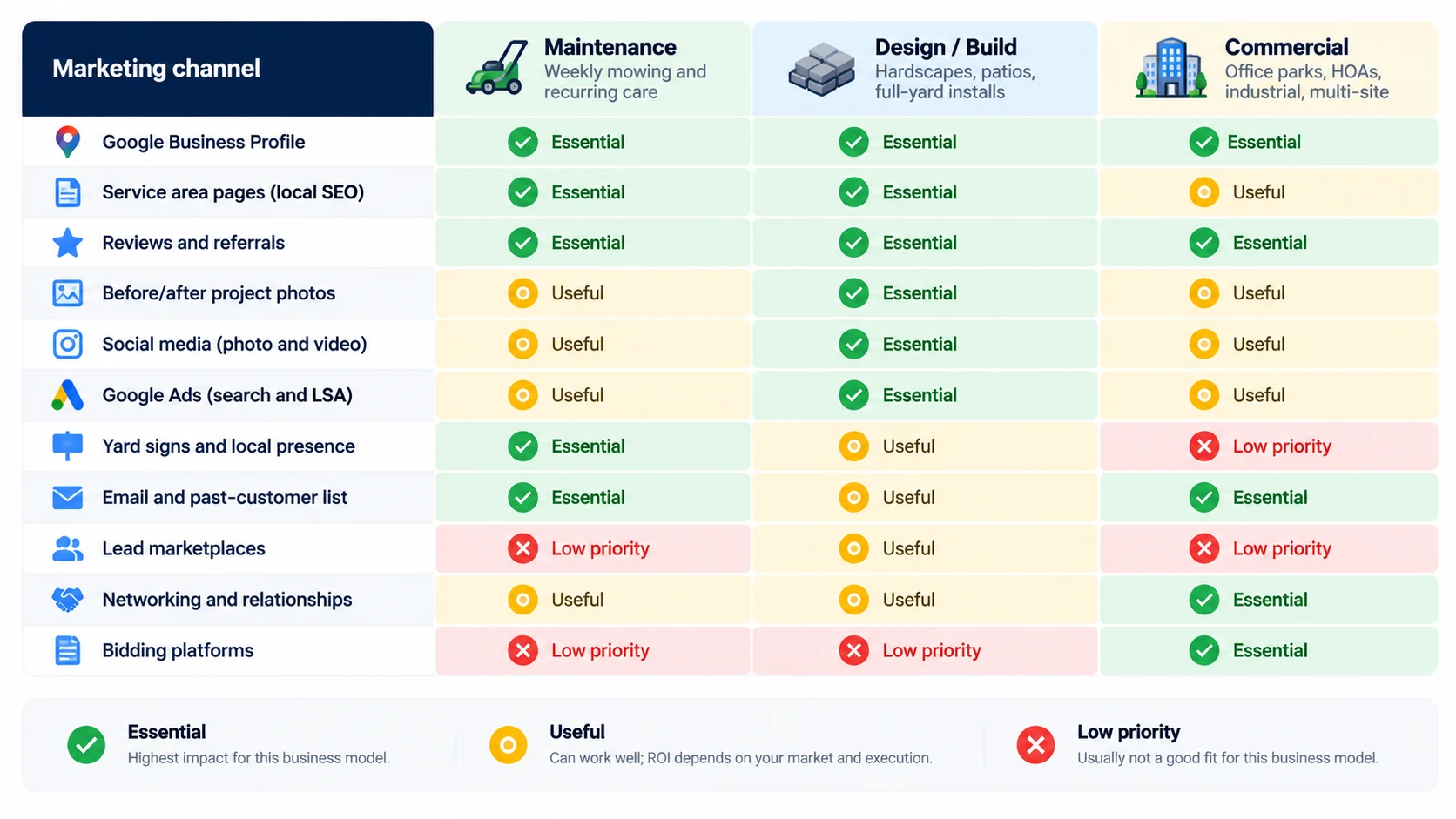
If you only act on one table in this guide, use this one. Match the effort to the model; running all channels at once is how small operators burn a budget.
| Channel | Maintenance / route | Design/build | Commercial |
|---|---|---|---|
| Google Business Profile | Essential | Essential | Useful |
| Service and location pages | Useful | Essential | Essential |
| Reviews | Essential | Essential | Useful |
| Project photo library | Useful | Essential | Useful |
| Google Search Ads | Low priority | Essential in season | Situational |
| Local Services Ads | Useful where eligible | Useful where eligible | Low priority |
| Paid social | Low priority | Useful | Low priority |
| Referrals | Essential | Essential | Useful |
| Route-density / neighbor marketing | Essential | Useful | Not applicable |
| Local partnerships | Useful | Useful | Essential |
| Email / SMS reactivation | Essential | Useful | Useful |
| Direct outreach and bidding | Not applicable | Low priority | Essential |
How much should landscaping marketing cost?
There is no honest universal percentage of revenue, so be suspicious of anyone who gives you one. Published guidance ranges from roughly 5 to 12 percent of revenue, but those are vendor proposals, not a measured rule, and the right number depends on your margin, your crew capacity, and whether you are holding steady or growing. Spend framed as a scenario is more useful than a percentage.
| Stage | Where the money goes | What to spend on first |
|---|---|---|
| Holding steady | Keep the owned base strong | Profile upkeep, reviews, past-customer reminders, referral asks. Mostly time, not cash. |
| Filling gaps in season | Add demand where crews have room | One paid channel tied to your top service, with a stop rule when the crew fills |
| Growing deliberately | Build pipeline ahead of added crew | Paid search plus service-page expansion, funded only as crew-leader capacity grows |
Two rules hold across stages. Protect operations first and never buy work you cannot quote and staff responsibly. And build the free base before you expand paid reach, because ads sent to a weak profile and a slow quote path lose money faster. A worked budget you can adapt is in the landscaping marketing budget template.
How to measure ROI and cost per booked job
Measure the whole path from inquiry to signed job, because the leaks between the steps are where the money is. Cost per click and cost per lead flatter a channel; cost per booked job tells the truth. Here is the full funnel with illustrative figures, labeled so no one mistakes them for benchmarks.
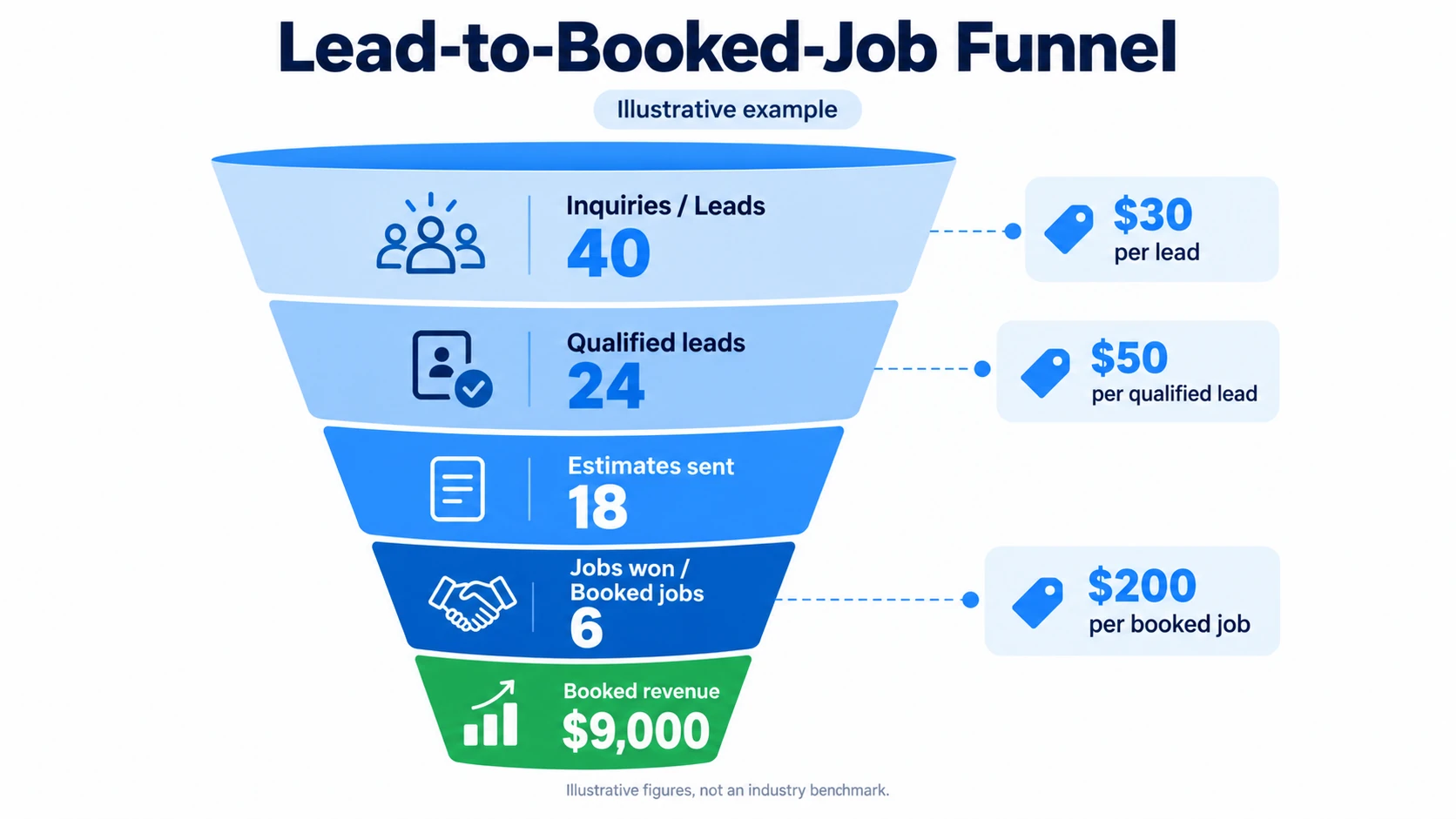
| Metric | How to get it | Illustrative example |
|---|---|---|
| Leads | Count unique inquiries | 40 per month |
| Qualified leads | Meet your service, area, and job-size rules | 24 of 40 (60%) |
| Estimate rate | Estimates sent ÷ qualified leads | 18 of 24 (75%) |
| Win rate | Jobs won ÷ estimates sent | 6 of 18 (33%) |
| Cost per lead | Spend ÷ leads | $1,200 ÷ 40 = $30 |
| Cost per qualified lead | Spend ÷ qualified leads | $1,200 ÷ 24 = $50 |
| Cost per booked job | Spend ÷ jobs won | $1,200 ÷ 6 = $200 |
| Revenue from booked work | Jobs won × average job | 6 × $1,500 = $9,000 |
| Revenue ÷ spend | Booked revenue ÷ spend | $9,000 ÷ $1,200 = 7.5× |
That last line is a revenue multiple, not profit. Real profit comes out only after labor, materials, equipment, and overhead, so treat 7.5× as a signal that the channel is worth examining, not as money in your pocket. The point of tracking it is comparison: the channel with the lowest cost per booked job and the best job quality gets more next month; the one with cheap clicks and no signed work gets cut, however good its cost per lead looked.
Pro tip: You do not need software to start. A single spreadsheet with one row per inquiry, columns for source, qualified yes/no, estimate sent, and won/lost, answers "did this channel pay?" within one season.
A region-sensitive seasonal calendar
Marketing has to launch before the work, and when that is depends on your climate, so do not copy a national calendar. The same month that means spring cleanup in Minnesota means peak irrigation in Arizona. Tie campaigns to local growing seasons and the services you actually offer, and start outreach before demand spikes, not during.
| Period | Cool and temperate markets | Warm and mild markets | Marketing lead time |
|---|---|---|---|
| Jan–Feb | Prebook spring cleanup; design and hardscape consults | Maintenance renewals, irrigation planning, early spring push | Start outreach before the local spike |
| Mar–May | Cleanups, mulch, planting, lawn repair, irrigation | Spring planting, maintenance, irrigation | Launch ads before crews fill |
| Jun–Aug | Mowing, maintenance, irrigation fixes, hardscape | Heat-appropriate maintenance, drainage, irrigation | Upsell existing accounts; watch capacity |
| Sep–Nov | Leaf removal, aeration, overseeding, fall planting | Seasonal planting, drainage, cleanup | Send reactivation reminders ahead of work |
| Dec | Holiday lighting or snow where genuinely offered; next-year design | Maintenance and projects where weather allows | Renewals, planning, portfolio refresh |
Seasonal offers and the renewal timing behind them are expanded in seasonal landscaping promotions.
Common landscaping marketing mistakes
- Running too many channels at once. Two channels done consistently beat eight done occasionally. Pick by your model and add only when the first ones are working.
- Chasing leads outside your route or below your minimum. Volume is not the goal; profitable, staffable, nearby work is. An unqualified lead costs you a drive and a quote and still loses.
- Letting estimates go cold. Most lost jobs are lost to silence, not price. A follow-up schedule recovers more revenue than a new campaign.
- Spending ahead of capacity. Booking work you cannot staff well damages the reviews and referrals the rest of your marketing depends on.
- Treating all jobs as one business. Generic advice applied to maintenance, install, and commercial at once underperforms a plan built for each.
Your first 90 days
A sequence beats a list, so do this in order. Each stage ends with something you can measure before the next begins.
| Days | Do this | You should have |
|---|---|---|
| 1–30 | Audit how you show up locally; define your services and minimum job; finish the Google Business Profile; fix the phone and quote form; gather existing project photos; start a one-row-per-inquiry source log | A baseline lead log and a working quote path |
| 31–60 | Publish your priority service pages with real photos; start honest review requests; reactivate past customers; test one tightly focused paid or neighbor channel if the crew has room | A first read on channel quality and conversion |
| 61–90 | Review quotes, booked jobs, cost per booked job, and job fit by channel; adjust geography and offers; set up a seasonal email schedule; write down your follow-up steps | A decision to scale, change, or stop each channel on evidence |
Frequently Asked Questions
Q.1 What is the best marketing strategy for a landscaping business?
A complete Google Business Profile backed by honest reviews and your own project photos, because it wins local visibility and converts the high-intent searches you want at no media cost. It is the base other channels build on. Which paid channel to add next depends on whether you run maintenance, design/build, or commercial work.
Q.2 How can I market a landscaping business with no budget?
Finish your Google Business Profile, ask every happy customer for an honest review, photograph every job three ways and post the results, hang door hangers on the nearest homes after each job, and text past customers before each season. These cost time, not money, and they convert better than paid traffic sent to a weak site.
Q.3 How do I get more qualified landscaping leads, not just more leads?
Qualify before you chase. Publish service and location pages for the exact work you want so the wrong inquiries self-select out, state your service area and minimum job honestly, and track each lead by source to a booked job. The goal is more of the right leads near your route and at your job size, not a bigger inbox.
Q.4 Is Google Ads worth it for landscaping companies?
For high-value services like patios, planting, and irrigation, yes, because search ads reach buyers at the moment of intent. For low-ticket recurring mowing the economics are usually worse than referrals and route-density marketing. Judge it on cost per booked job, keep ad groups tight and negatives thorough, and pause when the crew is full.
Q.5 How can I get commercial landscaping clients?
Treat it as business development, not advertising. Build commercial-specific pages, get your insurance, references, and a proposal packet ready, and reach facilities managers and HOA boards directly, then follow up over a long cycle. Relationships and documentation win contracts here; photos and search ads matter less than they do for residential work.
Q.6 What is the difference between lawn care marketing and landscaping marketing?
Lawn care is recurring maintenance revenue, so its marketing grows on route density, reviews, and keeping customers. Landscaping install is project revenue re-sold every time, so its marketing grows on visual proof and high-intent search. The channels overlap but the economics do not, which is why the plans differ. Recurring-revenue tactics are covered in lawn care marketing.
Conclusion
Pick the single service that makes you the most money and the area you most want to work, and run the foundation strategies against just that for one season. Finish the profile, publish the page, collect the photos and reviews, track every inquiry to a booked job, and add a paid channel only once that base converts. One service done well gives you the proof and the numbers to repeat it everywhere else.
If you want to see where you currently rank across your service area before you start, the Local Rank Grid shows how your visibility changes block by block, which is usually the first thing worth fixing.