You have probably already cleaned a house or an office this week for someone else's company. You know how long a two-bathroom home actually takes, which products work, and what a good job looks like when you walk out.
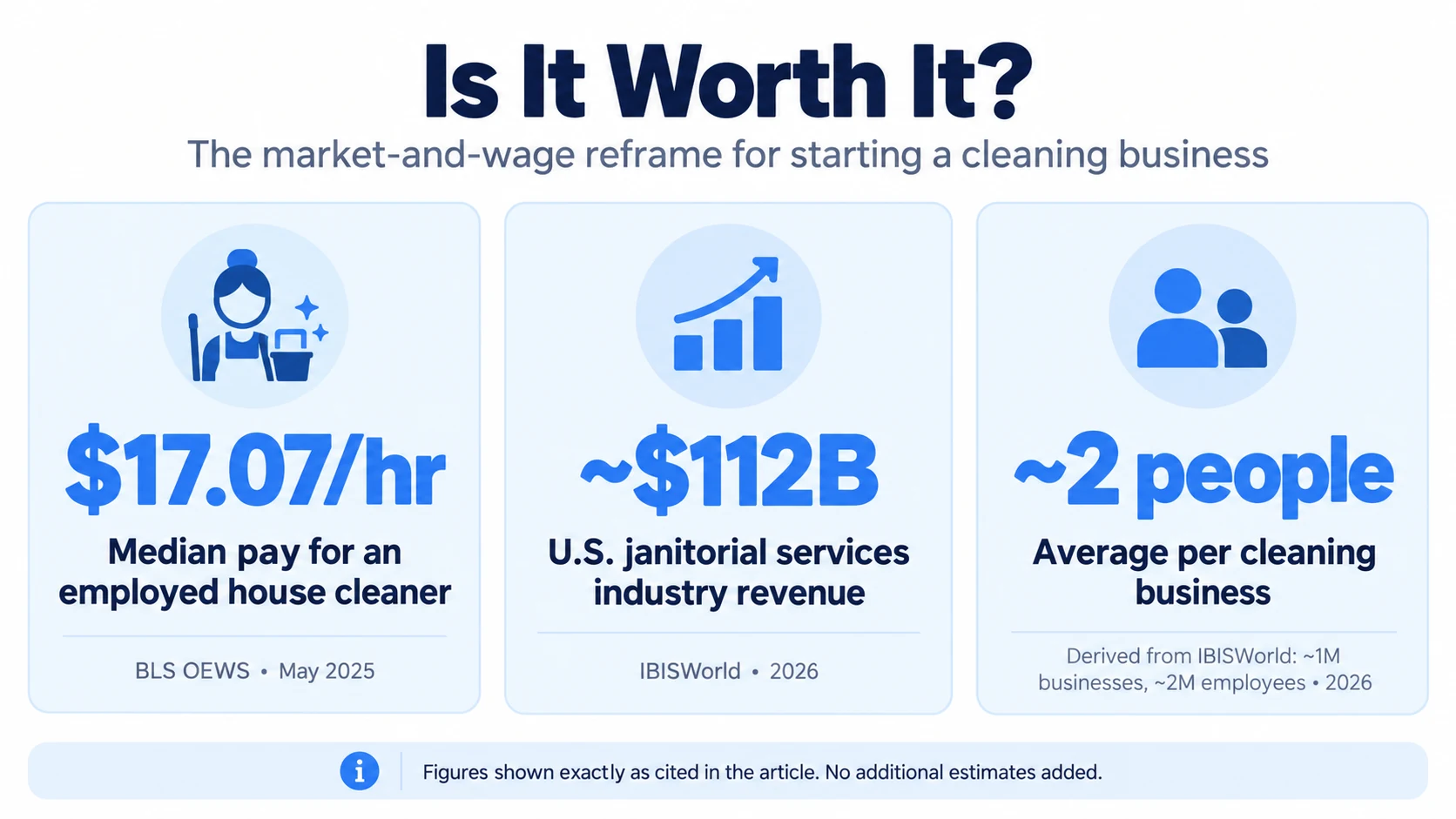
Here is the part nobody who hired you wanted you to notice. The median house cleaner in the US earns $17.07 an hour, and the median janitor $17.71, according to the Bureau of Labor Statistics for May 2025. Those are wages for doing the work. The company that owns the account is not billing an hour. It is billing the visit, and keeping whatever is left after your wage and a few dollars of supplies. The business you are thinking about starting is that gap.
That gap is the whole reason to do this, and it is also why most of the hard parts are not about cleaning. They are about keeping the accounts, charging enough, and staying on the right side of rules that change depending on whether you clean homes or buildings and which state you are in. This guide leads with the residential, solo-to-small-team path because that is where most people start. If you are headed into commercial janitorial, the differences are large enough that section 11 is written for you.
Steps at a glance
- Decide whether a cleaning business is worth it for you in 2026
- Choose residential or commercial, because they are not the same business
- Work out what it actually costs to start
- Register the business and handle the legal setup
- Get the right insurance and bonding
- Buy the supplies and equipment you need, and no more
- Price your work from your costs
- Land your first clients
- Market the business where buyers are looking
- Hire without walking into the classification trap
- Understand the commercial janitorial path
- Know what the business actually earns
- Avoid the mistakes that sink new cleaners
- Follow a 90-day launch plan
Is starting a cleaning business worth it in 2026?
Yes, if you want a business you can start cheaply and grow on recurring revenue, and you go in knowing the work is physical and the margin lives in route density and retention rather than in any single job.
Start with the size of the field. IBISWorld put the US janitorial services industry at about $112 billion in revenue across roughly a million businesses employing about two million people in 2026. Divide it out and you get an average of about two people per business. That number tells you more than the headline does: this is an industry of small operators, not a few large firms you have to beat. A solo cleaner or a two-person team is the normal unit, not the underdog.
Demand is steady rather than spectacular. BLS projects employment of janitors and building cleaners to grow about 2 percent from 2024 to 2034, roughly in line with the overall economy. Nobody is going to automate a bathroom clean this decade, and occupied homes and operating buildings need the work done on a schedule. That schedule is the point. A good cleaning business is a stack of recurring visits, not a series of one-off sales.
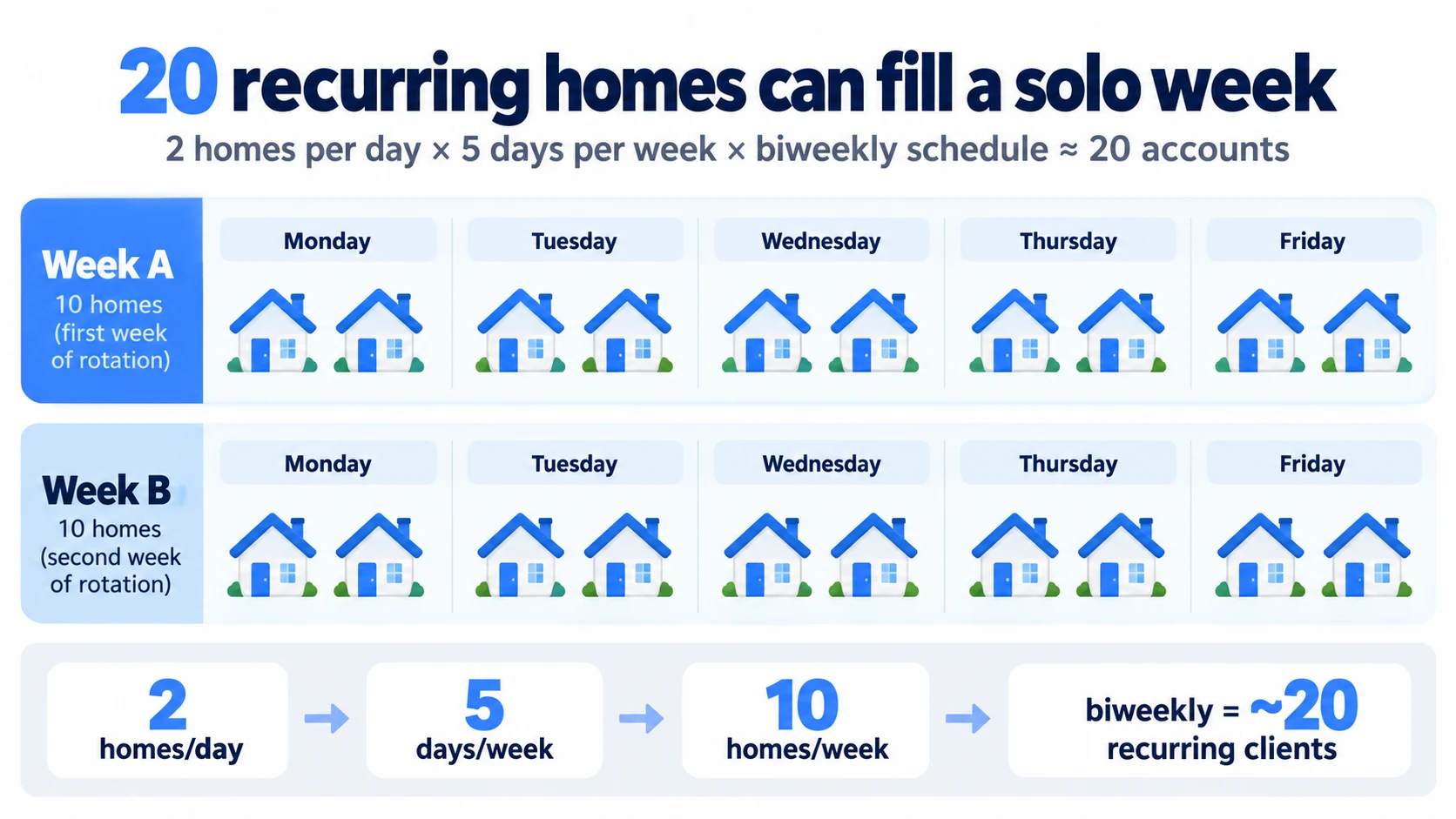
Here is the reframe that makes the goal concrete. Picture yourself cleaning solo, two homes a day, five days a week. That is ten cleans a week. If every client is on a biweekly schedule, you only need about 20 recurring homes to fill your entire working week. Twenty. Not a hundred, not a marketing funnel, twenty households who like your work enough to keep you. That is the real target for year one, and it is small enough to name every one of them.
Who it suits. People who are reliable, physically able to do several hours of focused work a day, and comfortable charging money to someone's face. People who like steady over glamorous.
The honest tradeoffs. You are the product at the start, which means every day you are sick is a day with no revenue and a client wondering where you are. Growth means hiring, and hiring is where the margin and the legal exposure both change. And the silent killer is drive time: an hour spent driving between two jobs is an hour you cannot bill, so where your clients are matters as much as how many you have.
Pro tip: Before you commit, do four paid cleans for friends or neighbors at your intended price. You will learn your real hourly speed, which is the single number every later decision depends on, and you will find out whether you actually enjoy the work when the clock is running.
Residential or commercial: pick one, because they are not the same business
Choose one lane before you do anything else. The two look similar from outside and run on opposite mechanics, and a guide, or a founder, who blurs them produces a business that is bad at both.
| Residential | Commercial janitorial | |
|---|---|---|
| Who buys | A household, deciding emotionally, in days | A facility or property manager, on a bid cycle, in weeks |
| How you sell | Lead, quote, first clean | Cold outreach, walkthrough, written bid, scope of work, signed contract |
| How you price | Flat rate per visit, built off estimated hours | Dollars per cleanable square foot per month, backed out from a production rate |
| When you work | Daytime, in occupied homes | Nights and weekends, in empty buildings |
| How you get paid | Card on file at the time of service | Invoice, net 30 to 60 |
| Contract | None; the client can stop any week | Signed, usually with a 30-day cancellation clause |
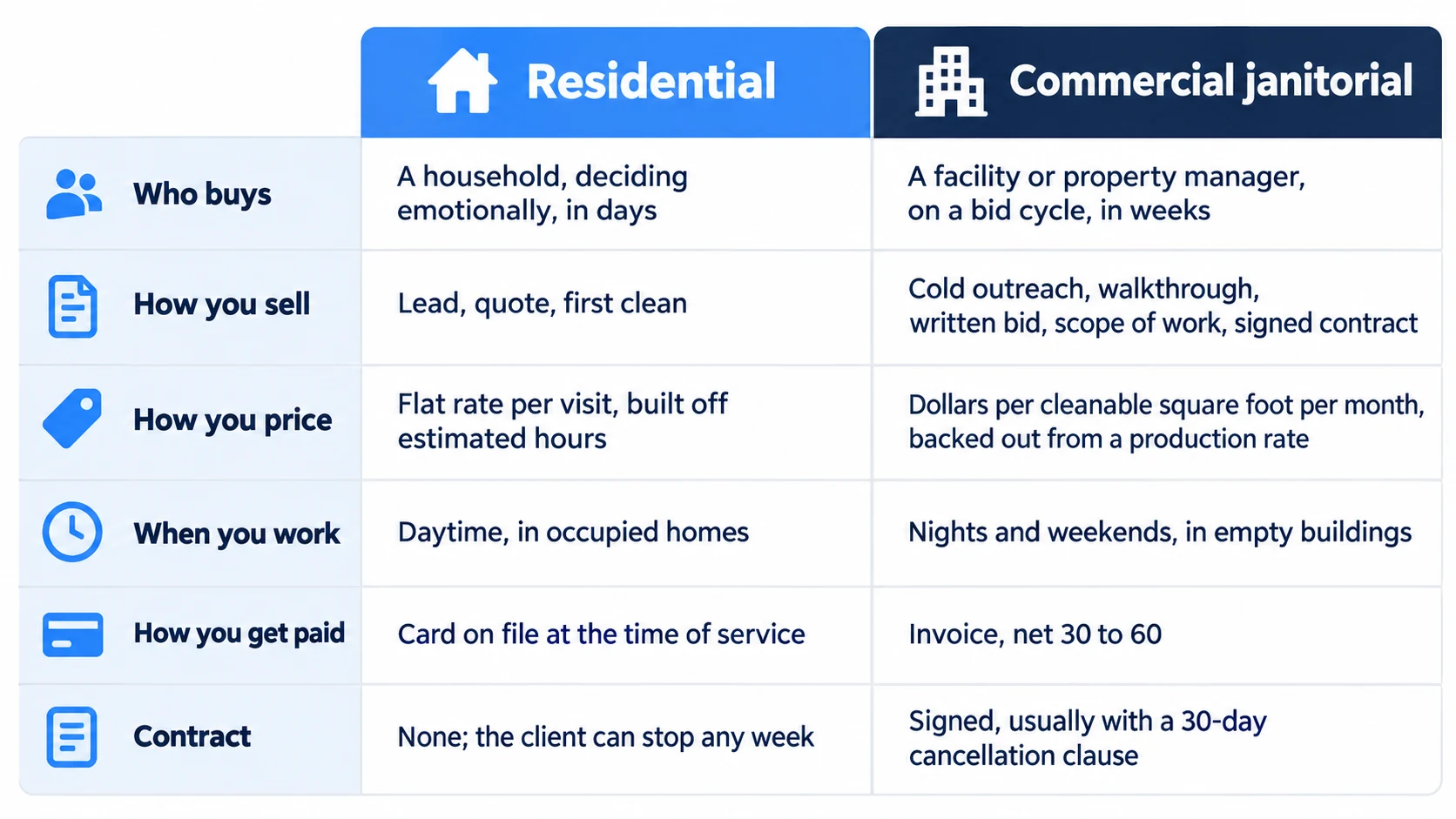
The payment column is the one that bankrupts people. In residential, money hits your account the day you clean. In commercial, you run payroll every week or two while waiting 30 to 60 days for the customer to pay, so winning a big contract can drain your cash faster than losing one would. More on that in section 11.
Within residential, the common niches are recurring house cleaning (your bread and butter), deep cleans and initial cleans (higher ticket, one-off), move-in and move-out cleans (turnovers, often from realtors and landlords), and short-term rental turnovers (Airbnb, high frequency, tight windows). Pick a primary one and let the others be add-ons. A business known for reliable biweekly house cleaning will get referred; a business that does "everything" gets remembered for nothing.
Commercial splits into offices, medical, retail, and specialty floor care (strip and wax, buffing, extraction), which is its own profit center. Commercial rewards operators who can supervise work they are asleep for and who can survive the cash gap. It is not a beginner-friendly first business for most people, which is exactly why it pays better.
How much does it cost to start a cleaning business?
Less than almost any other business you could name, which is both the appeal and the trap. You can start residential for a few hundred dollars in supplies and a few hundred more in registration and insurance. The published "average startup cost" figures that float around (the "$2,000 to $10,000" and "$3,500 average" numbers) trace back to content sites and vendors, not to any neutral survey, so treat them as marketing, not benchmarks.
Instead, build your own number from the line items. Here is an illustrative solo residential startup, with every figure labeled as an example you should replace with your own local quotes:
| Item | Example cost | Notes |
|---|---|---|
| Business registration (LLC or sole prop) | $50 to $500 | Varies widely by state; a sole proprietorship can be near-free |
| General liability insurance | $400 to $800 / year | Your first real quote; get three |
| Janitorial service bond | $100 to $300 / year | A client expectation, not a legal must; see section 5 |
| Starter supplies and equipment | $300 to $600 | Vacuum, mop system, caddy, chemicals, cloths |
| Phone, basic website, scheduling app | $0 to $50 / month | Much of this is free to start |
| Marketing (business cards, door hangers, GBP) | $100 to $300 | Google Business Profile is free |
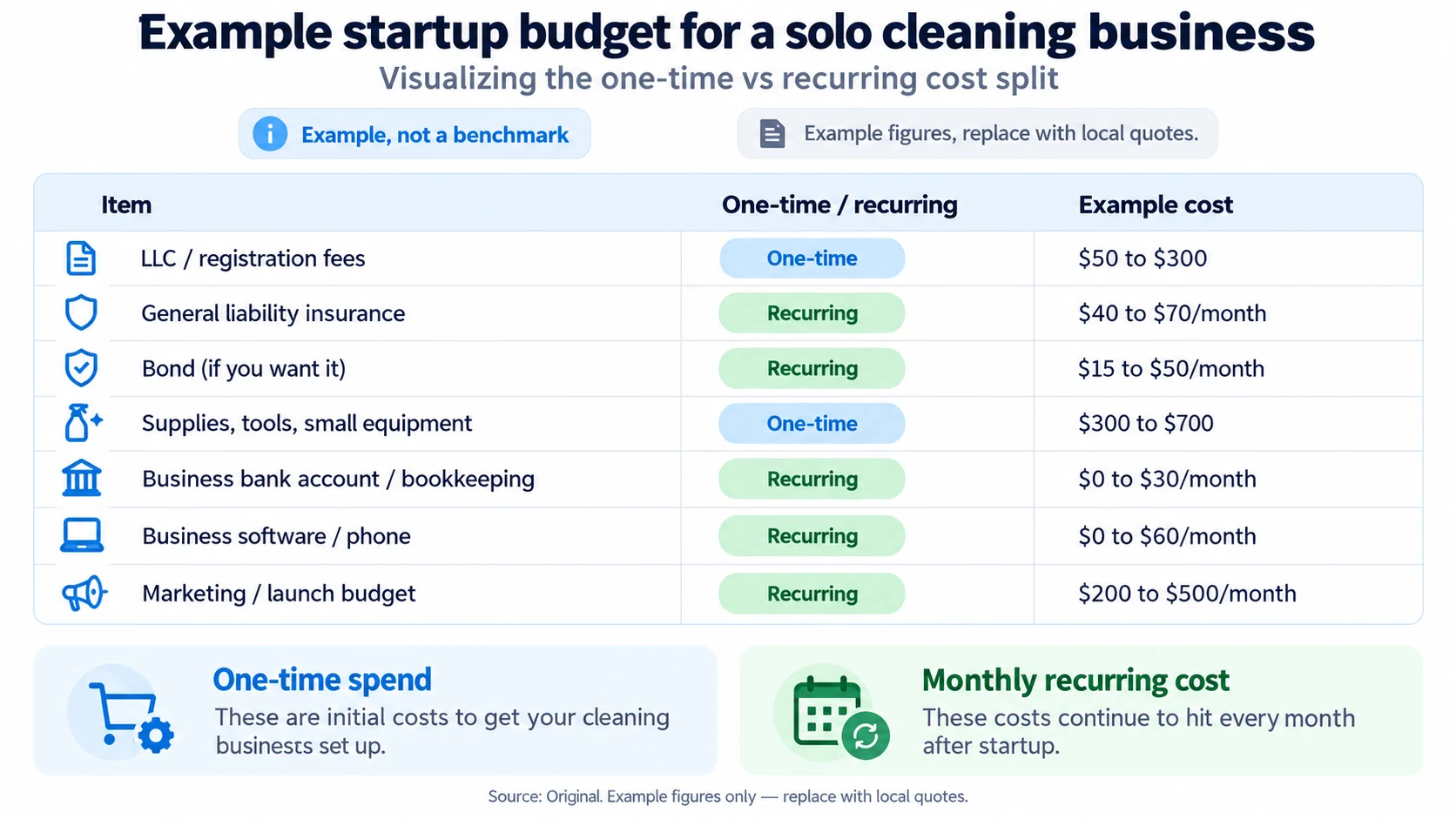
The one-time spend here lands in the low four figures. What matters more than the total is the split between one-time and recurring. The vacuum is a one-time cost; the insurance, software, fuel, and restocking are monthly costs that come whether or not you booked a job that week. New owners fixate on the startup number and get surprised by the monthly one.
For commercial, add working capital as its own line, and make it the biggest one. If you will pay cleaners weekly and invoice the client net 45, you need enough cash to cover six to eight weeks of payroll before the first invoice clears. That is not startup cost in the usual sense. It is the money that keeps you alive during the gap, and underfunding it is the single most common way a growing commercial cleaner fails.
Pro tip: Open the business bank account before you spend a dollar on supplies, and run every expense through it from day one. It makes your taxes trivial, it is required to keep an LLC's liability protection intact, and it turns "did this job make money" into a question you can actually answer.
Register your cleaning business and handle the legal setup
Do this before your first paid job, because the point of registering is to separate your personal savings from a claim, and that protection does not apply retroactively to work you already did.
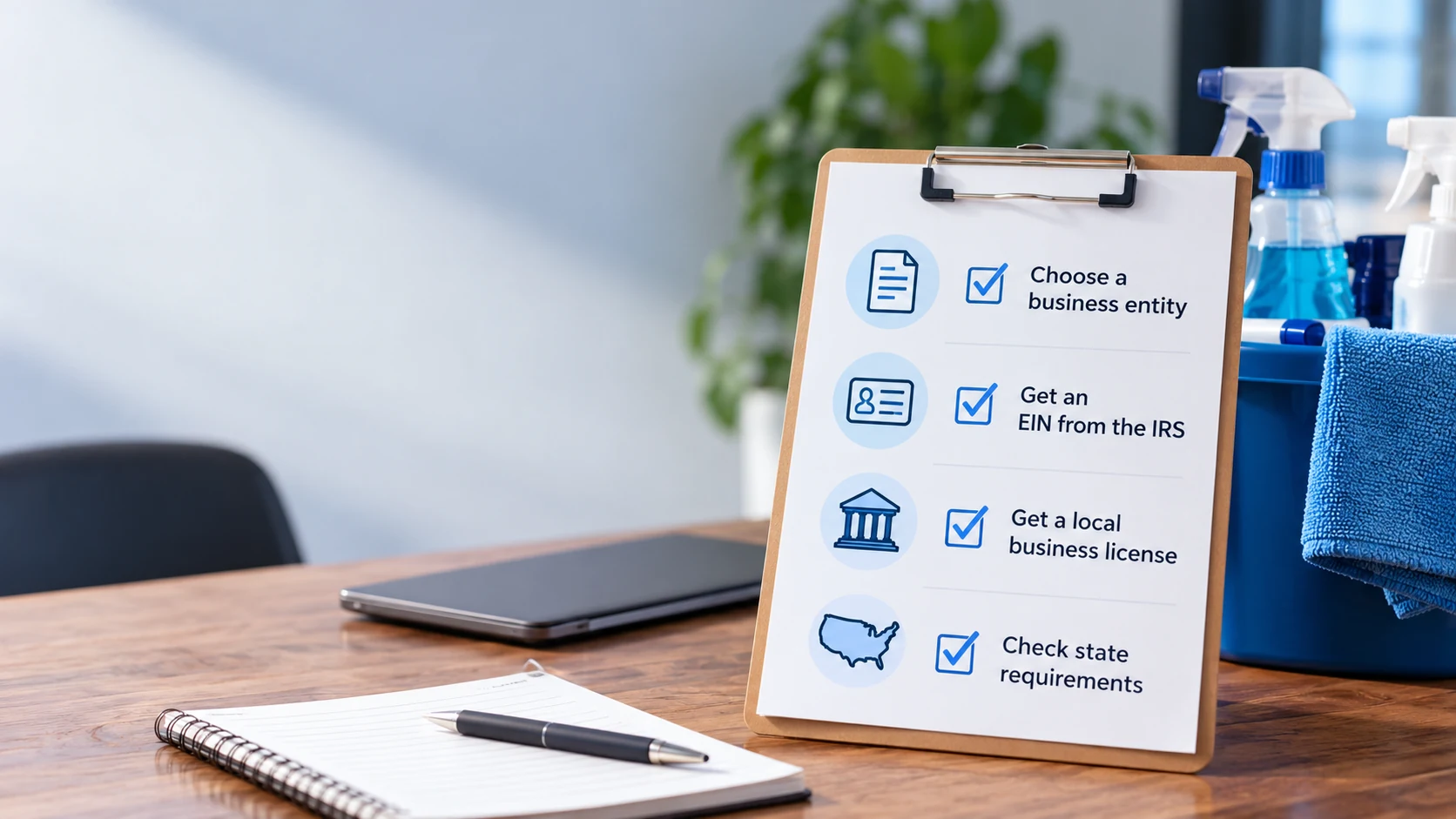
Pick a structure. Most new cleaners choose between a sole proprietorship (simplest, cheapest, no liability separation) and an LLC (a few hundred dollars, separates personal and business assets). No law requires an LLC to clean houses. But the whole risk in this work is a claim arising from damage or injury in someone's home or building, which is exactly what the liability separation is for, so most owners who plan to keep going form one. Get an EIN from the IRS once you register; it is free and takes minutes, and you will need it for a business bank account and for payroll later.
Get your general business license. This is the piece that catches people who read "you don't need a license to clean." You almost certainly need a general business license or tax registration from your city or county, even though cleaning itself is not a licensed trade in most of the US. The trade-versus-business distinction is the one to hold onto: no state was found issuing an occupational license to house cleaners as such, but operating any business locally usually requires registration.
Two states add rules the others do not. This is where most competing guides go quiet, and it is worth getting right if you are in or near either state.
- California requires janitorial employers to register annually with the Labor Commissioner under the Property Service Workers Protection Act. The application and the annual renewal are $500 each, you must carry workers' compensation coverage, and owners must complete biennial harassment-prevention training. The law's definition of a covered employer deliberately includes contractors and franchise arrangements, so you cannot structure around it by relabeling the relationship.
- Washington applies its isolated-worker protections to janitorial employers of any size. If your workers clean alone, you owe them a written harassment policy, documented training, panic buttons, and an annual report to the Department of Labor and Industries by January 31, with penalties running to $1,000 per violation and higher for repeats.
The safe way to think about this everywhere else: California and Washington impose industry-specific obligations, and your own state may too, so check it rather than assuming it is clear.
Sales tax is the most commonly missed item. Some states tax cleaning services. Texas, for example, taxes janitorial and custodial work as a taxable real property service and does not distinguish residential from commercial. Whether your cleans are taxable depends entirely on your state, so confirm it with your state's tax agency before you set prices, because the tax comes out of your margin if you forget to add it.
Pro tip: Type your city name plus "business license" into Google, then do it again with your state name plus "sales tax on cleaning services." Ten minutes answers the two local questions that no national guide, including this one, can answer for you.
A full, state-by-state breakdown of registration and licensing is more than fits here; a dedicated guide to cleaning business licenses by state covers the local requirements in detail.
What insurance and bonding does a cleaning business need?
General liability insurance is the one piece you should treat as non-negotiable, because it covers the exact risk this business carries: damage to a client's property or an injury on their premises. Most residential clients will ask whether you have it, and most commercial contracts will not let you bid without it.
Here is what the coverage actually does, and what the common confusion costs:
- General liability pays for property damage and third-party injury. This is the core policy. Expect to show a certificate of insurance before some jobs.
- A janitorial service bond is a fidelity bond. It reimburses a client if one of your people steals from them. It is not liability insurance and it is not legally required in any state that could be confirmed; it is a client expectation, a thing that wins trust and bids. Buy it because customers want it, not because a law demands it.
- Workers' compensation becomes mandatory once you hire employees in almost every state. Texas is the notable outlier, where private employers may choose not to carry it, with notification and reporting duties instead. California requires it specifically as part of janitorial registration.
- Commercial auto matters once you are driving to jobs for business; your personal policy may not cover an accident on the way to a clean.
The distinction between a bond and liability insurance trips up more new owners than any other insurance question. A bond protects your client from your employee. Liability insurance protects you from a claim. You generally want both, and they are not substitutes.
Essential cleaning supplies and equipment
Buy the minimum that lets you do excellent work, and resist everything else until a paying job requires it. The fastest way to waste your startup budget is to buy for the business you imagine instead of the one you have.
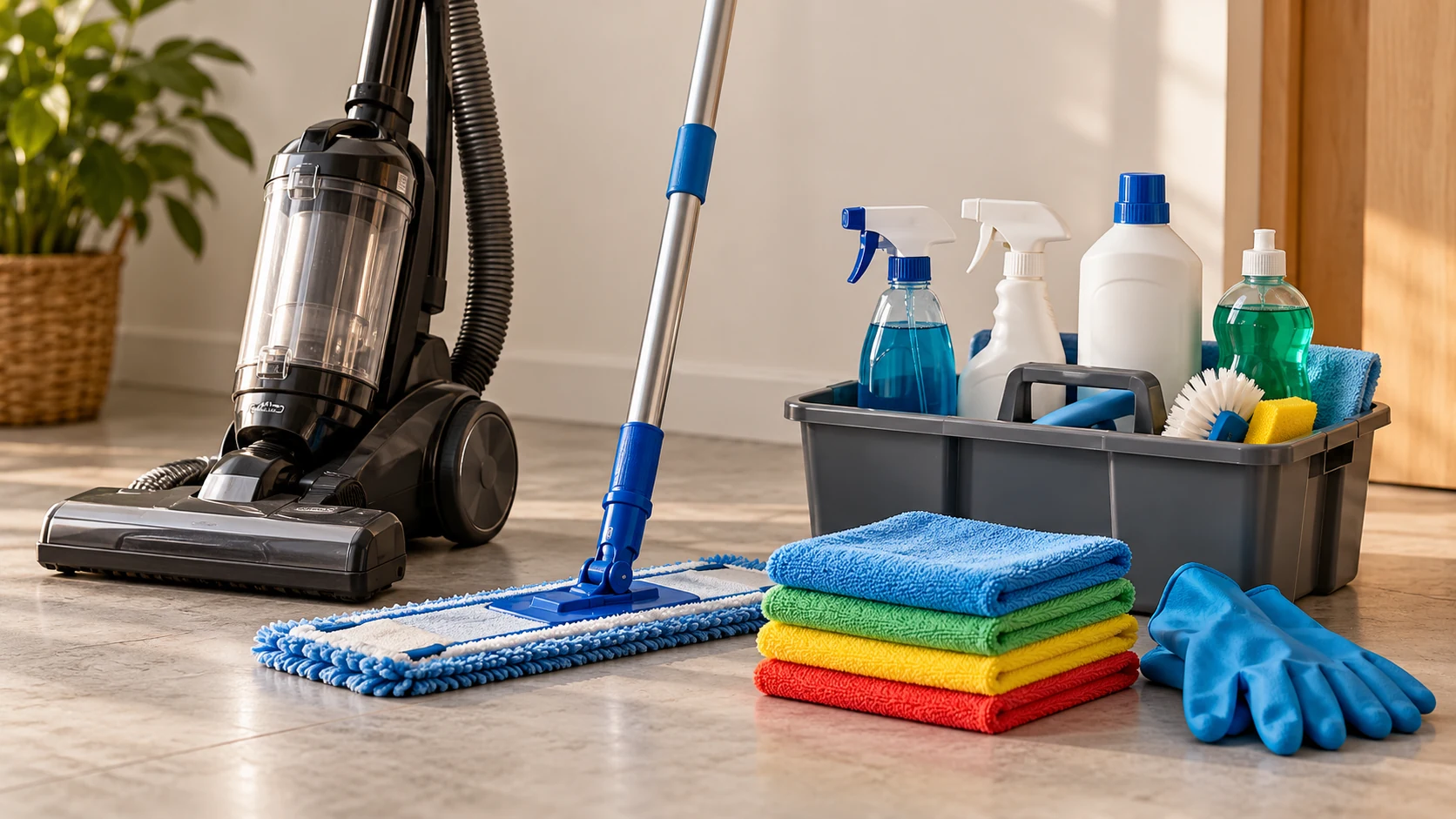
A working solo residential kit is short:
- A reliable vacuum, ideally with a HEPA filter
- A microfiber mop system and a bucket, or a flat-mop setup
- Microfiber cloths in enough quantity to use fresh ones per home (color-coded to avoid cross-contamination)
- A caddy of core chemicals: all-purpose, glass, bathroom, disinfectant
- Scrub pads, a grout brush, an extendable duster
- Personal protective equipment: gloves, and eye protection for the stronger products
Specialty work needs specialty gear, and that is the point of buying it later: a carpet extractor, a floor machine, or a pressure washer each unlocks a service line, so buy each one when a booked job pays for it, not before.
The chemical rule most guides skip, and the 2026 deadline behind it. Because you use hazardous chemicals every day, OSHA's hazard communication standard applies to you as an employer. That means safety data sheets, a written program, labels, and training for anyone you employ. There is a live date attached: OSHA aligned the standard to a newer global labeling system, and the employer compliance date for substances is November 20, 2026, with mixtures following in 2028. The practical version you can act on today: any spray bottle you fill from a concentrate is a secondary container and must be labeled with its contents. Most competing content will not mention this at all.
One more distinction that is widely botched. The OSHA exemption for people who privately employ household help belongs to the homeowner, not to you. A cleaning company that sends employees into homes is an ordinary employer with ordinary OSHA obligations. Do not assume that working in houses makes the rules go away.
How much should you charge for cleaning services?
Charge enough to pay yourself a real wage, cover every cost, and still have margin left over, which means you build the price from your costs rather than copying a number off a competitor's site. The "$25 to $45 an hour" and "$0.05 to $0.20 per square foot" figures you will find everywhere come from lead-generation marketplaces and software vendors reporting their own users, not from any neutral source. Use them to sanity-check, never to set your price.
Here is the formula, and then a worked example. For any job, add up:
- Your labor, at the hourly rate you actually want to earn, times the hours the job takes
- Drive time, valued the same way, because unbilled driving is still your time
- Supplies and consumables used on that job
- Overhead, your monthly fixed costs (insurance, software, phone, marketing) divided across your billable hours
- Margin, a profit percentage on top of all of the above, because your wage and your profit are two different things
A worked example, with assumptions you should swap for your own:
| Line | Example | How it is figured |
|---|---|---|
| On-site labor | $100 | 2.5 hours at a $40/hour target wage |
| Drive time | $20 | 30 minutes round trip at the same rate |
| Supplies | $7 | Chemicals and cloths for one home |
| Overhead | $12 | Monthly fixed costs spread across the month's jobs |
| Subtotal | $139 | |
| Margin at 15% | $21 | Profit above your own wage |
| Quote | $160 | Per visit |
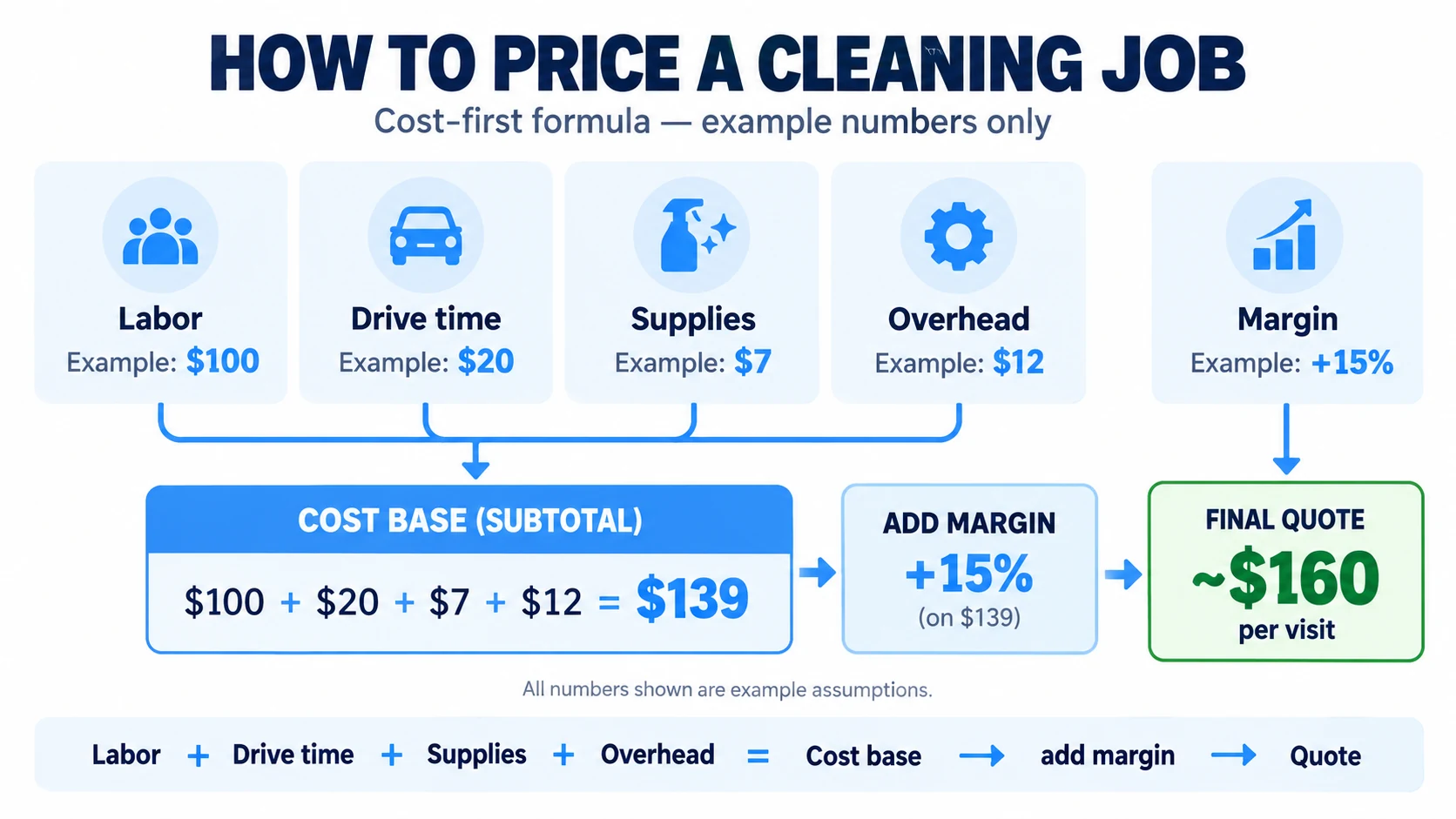
Notice that your wage is a cost in this model, not your profit. If you skip that line, you will set a price that feels fine until you realize you bought yourself a job that pays less than the one you left. Notice too that drive time is in the price. Two homes on the same street carry almost no drive cost; two homes across town carry a lot, which is why where your clients are determines your real hourly earnings as much as what you charge.
For recurring work, you can discount slightly off the one-time rate, because a biweekly client is worth far more than a single deep clean and costs you nothing to re-sell. For commercial, the whole basis changes to dollars per cleanable square foot per month, backed out from how fast your crew can clean a given space (the production rate). Bidding below a rate your crew can actually hit means eating the loss every night for the length of the contract, so commercial pricing is a discipline, not a guess.
The deeper mechanics of quoting, including a per-square-foot model and a printable price book, are covered in the guide to pricing cleaning services.
How to get your first cleaning clients
Your first ten clients come from people who already trust you, not from advertising, so start where trust already exists and spend nothing until you have to. The goal for the first month is proof: a handful of paying clients who will rebook and refer.
In order of how fast they convert:
- Your personal network. Tell everyone you know, specifically, that you are taking cleaning clients and what you charge. Not a vague announcement, a direct ask: "I clean homes now, I have two slots open on Tuesdays, do you know anyone who wants a reliable cleaner?"
- Neighbors and your immediate area. Density is margin, so your ideal first clients live near each other. Door hangers on the eight to ten nearest homes after each job take ten minutes and put you in front of exactly the people whose addresses cut your drive time.
- Property managers and realtors, if you want move-out and turnover work. One property manager can be a steady stream of turnovers. Introduce yourself in person, leave a card, and make clear you can turn a unit around fast.
- Local online groups. Neighborhood Facebook groups and Nextdoor are where "can anyone recommend a cleaner" gets posted every week. Answer those, do not spam them.
Then make every first job produce the next one. Ask for the rebook before you leave ("would you like me to put you on the same time in two weeks?"), and ask for a review the day after, with a direct link, while the clean home is still fresh. Referrals and reviews are the entire growth engine of a residential cleaning business, and both of them happen only if you ask, out loud, every time.
A fuller playbook of acquisition channels, with scripts for each, lives in the guide to getting cleaning clients.
How to market your cleaning business
Once referrals are flowing, marketing is mostly about being the business that shows up when someone in your area searches for a cleaner. For a local service business, that means your Google Business Profile and your local search presence do more than any other channel, and both are free to set up.
Set up the Google Business Profile properly, because a half-filled profile loses to a complete one every time:
| Field | What to put | Why it matters |
|---|---|---|
| Primary category | "House cleaning service" (or "Commercial cleaning service") | This is the single biggest ranking factor; pick the one that matches your core service |
| Service area | The specific zip codes or towns you actually serve | Tells Google where to show you, and keeps you out of searches you cannot profitably serve |
| Services | List each service with a short description and price range | Fills the profile and answers the buyer's first question |
| Photos | Before-and-afters, your team, your branded supplies | Profiles with photos get more clicks; add a few a month |
| Reviews | Respond to every one, good or bad | Response rate is a signal, and a calm reply to a one-star review reassures the next reader |
Treat it as a fifteen-minute-a-week job: one update or post, a few new photos, and a reply to everything. That cadence beats any amount of one-time setup.
The question underneath all of this is whether you show up at all when someone nearby searches. You can check it directly: search for "house cleaning near me" from your phone, then have a friend across town search the same thing, and compare what comes up. Rankings vary by the searcher's location, which is why a single check from your own kitchen tells you almost nothing. RankBeaver's Local Search Result Checker shows whether your profile is surfacing for the searches that matter, and the Local Rank Grid maps how your ranking changes across your service area, which is the version of the question that actually affects your bookings.
Beyond local search, a simple website with your services, area, and a way to book gives referrals somewhere to land and gives Google something to index. Offline still works in this business too: a vehicle decal turns every drive to a job into an impression, and door hangers remain the cheapest way to reach the homes nearest the one you just cleaned. Whatever you run, ask every new client how they found you and write it down, because the one question "how did you hear about us" tells you which channel to keep feeding and which to drop.
Local search is deep enough to deserve its own treatment; the guide to local SEO for cleaning businesses covers ranking in the map pack in detail.
How to hire and train cleaners without the classification trap
Hire your first cleaner when you are turning away work you could profitably do, and not before, because a hire you cannot keep busy is a cost with no revenue attached. The trigger is a waitlist, not a wish.
When you do hire, the biggest decision is not who, it is how you classify them, and getting it wrong is the single largest legal exposure in this business.
The trap: paying cleaners as 1099 contractors to avoid payroll taxes. It is the most common shortcut and, for most cleaning businesses, the most dangerous. Calling someone a contractor does not make them one. The test is how the work actually operates, and cleaners who use your name, your schedule, your methods, and your clients usually fail it.
- In California, the ABC test governs, and cleaning companies fail its second prong almost automatically, because that prong requires the worker to do work outside your usual business, and cleaning is the usual business of a cleaning company. California also specifically excludes janitorial work from the business-to-business exemption, so the popular workaround of making each cleaner form an LLC does not save you. The franchise structure has been litigated on the same theory and is not a reliable loophole either.
- At the federal level, the rules were unsettled through 2026. The Department of Labor stopped applying its 2024 contractor rule and proposed a replacement in February 2026, with the comment period closing that April; whether a final rule has issued could not be confirmed as of this writing. Regardless of the regulation, courts apply their own economic-reality test, so the safe assumption is that a worker who looks like an employee is one.
The plain-language version: paying someone as a 1099, or calling them a franchisee, does not by itself make them one. If you control the work, you probably have an employee, which means payroll, workers' comp, and tax withholding. Build that into your pricing before you hire, not after an audit.
The owner-operator trap, for your own time. At the start, you are the best and cheapest cleaner in the company. Every step toward growth replaces your work with an employee's, which costs more and, at first, cleans worse. That is normal and unavoidable, and the way through it is a written checklist for every clean and a quick quality inspection on new hires' work, so the standard lives in the system instead of only in your hands.
The full hiring sequence, including background checks and a training checklist, is covered in the guide to hiring cleaners.
Starting a commercial janitorial business
If you are headed into commercial rather than residential, you are starting a genuinely different company, and the research you did on house cleaning only half applies. This section is the one written for you.
The sale is slow and structured. You do not get a lead and quote it. You find buildings, reach the facility or property manager, do a walkthrough to measure and scope the work, write a bid priced per cleanable square foot per month, and negotiate a scope of work and a contract. Weeks, not days. The contract usually carries a 30-day cancellation clause, which makes even a signed account functionally at-will.
Cash, not sales, is the constraint that kills new commercial cleaners. You pay cleaners weekly or biweekly and invoice the customer net 30 to 60. That gap means a large new account can drain your bank account before its first invoice clears, so the account that feels like your big break is also your biggest cash risk. Fund the gap deliberately, as covered in section 3, and grow at the speed your working capital allows rather than the speed your pipeline offers.
Two more structural risks to price in from the start:
- Account concentration. One account at 40 percent of your revenue, paired with a 30-day cancellation clause, is a countdown you cannot see. Spread your revenue across several accounts as fast as you can.
- Bid discipline. Win a contract at a production rate your crew cannot actually hit, and you eat the overrun every night for the length of the deal. Measure your real cleaning speed before you price, not after you have signed.
Commercial also carries the compliance weight most heavily, from the OSHA logs that apply above a small-employer threshold to the state janitorial rules in section 4. It pays better than residential for a reason: the barriers that make it hard to start are the same ones that keep competitors out once you are in.
The bidding process, from building a lead list to writing the proposal, is covered in the guide to getting commercial cleaning contracts.
How much profit can a cleaning business make?
Enough to replace a full-time wage as a solo operator and more as you build a team, but only if you keep three numbers separate: revenue, your own wage, and profit. Most of the income claims you will read online ("the average owner makes $50,000 to $100,000," "six figures in year one") trace to no real source, so ignore the numbers and learn the math instead.
Work it from the unit you control, a single recurring client:
- A biweekly client at an example $150 a visit is $300 a month and about $3,900 a year in revenue.
- Twenty such clients fill a solo week and bring in roughly $78,000 a year in revenue.
- From that, subtract supplies, fuel, insurance, software, and your tax reserve. What is left is your pay plus profit, and as a solo operator those are the same pile of money.
The number that decides whether this is a good business or a hard job is route density. The same twenty clients clustered in two neighborhoods earn far more per working hour than twenty clients scattered across a metro, because the scattered version spends your day in the car. Unbilled drive time is the silent margin killer, and it is a geography problem, not a pricing one.
When you hire, the math changes shape. Your profit becomes the margin between what you bill for an employee's work and what that employee plus burden costs you, which is why the classification and pricing decisions in sections 7 and 10 are where your profit is actually made or lost. A deeper model, with overhead, taxes, and break-even worked out, is covered in the guide to cleaning business profit.
Common cleaning business mistakes to avoid
Most new cleaners fail for a handful of reasons that have nothing to do with how well they clean. The short list, each of which the sections above address:
- Underpricing by forgetting to pay themselves. Leaving your own wage out of the price feels like winning the job and ends in burnout.
- Buying equipment before a job pays for it. The specialty machine you bought "to be ready" is dead capital until a booked job needs it.
- Skipping liability insurance. One claim in one home can end a business that saved $600 a year by going uninsured.
- Scattering clients across a metro. Chasing any client anywhere turns a profitable route into a day of driving.
- Misclassifying employees as contractors. The tax saving is real until the back-taxes-and-penalties bill arrives, and it is usually larger than the business.
- Never asking for the rebook or the review. The growth engine only runs if you turn it, every job, out loud.
Your first 90 days: a cleaning business launch plan
A launch is a sequence, not a to-do list, so here is the order that gets you to paying clients fastest while keeping the legal setup ahead of the work.
Week 1: Choose residential or commercial and your primary niche. Pick a name and check it is available. Do four practice cleans at your intended price to learn your real hourly speed.
Weeks 2 to 4: Register the business and get your EIN. Apply for your local business license. Get three general liability quotes and buy a policy and a bond. Open the business bank account. Buy the minimum supply kit. Set up the Google Business Profile.
Days 31 to 60: Land your first five to ten clients from your personal network and immediate area. Ask for the rebook on every job and a review the day after. Start tracking how each client found you.
Days 61 to 90: Convert first-time clients to recurring schedules. Tighten your route so new clients cluster near existing ones. Check whether you are showing up in local search, and fix the profile if you are not. Only now consider whether the waitlist justifies a first hire.
Working through those milestones in order is the difference between being busy and being booked. A printable version of this schedule is available as a downloadable 90-day launch checklist.
Frequently asked questions
Q.1 Do you need a license to start a cleaning business?
In most of the US you do not need an occupational license to clean, because cleaning is not a licensed trade, but you almost certainly need a general business license or tax registration from your city or county. California and Washington add janitorial-specific requirements, and some states tax cleaning services, so confirm the rules for your own state rather than relying on a national answer.
Q.2 How much does it cost to start a cleaning business?
A solo residential cleaning business can start in the low four figures, covering registration, general liability insurance, a basic supply kit, and simple marketing. The published "average" startup figures come from content sites, not neutral surveys, so build your own number from local quotes. Commercial costs far more because you must fund six to eight weeks of payroll before your first invoice is paid.
Q.3 Can you start a cleaning business with no money?
Almost, but not quite. You can start residential very cheaply by using supplies you own, registering as a sole proprietor, and relying on free channels like your personal network and a Google Business Profile. The one cost worth not skipping is general liability insurance, because a single claim in a client's home can cost more than years of premiums.
Q.4 Do you need an LLC to start a cleaning business?
No law requires an LLC to clean. Many owners form one anyway because the work's main risk is a damage or injury claim in a client's property, and an LLC separates your personal assets from that claim. A sole proprietorship is cheaper and simpler to start, but it offers no such separation.
Q.5 Is a cleaning business profitable?
It can be, if you price to include your own wage, keep your clients geographically close, and build recurring revenue. The profit in cleaning comes from owning accounts and running an efficient route, not from any single job. Scattered clients and prices that forget to pay the owner are the two most common reasons a cleaning business stays busy but not profitable.
Q.6 How long does it take to start a cleaning business?
You can be legally set up and cleaning paying clients within 30 days: a few days to choose your niche and name, a couple of weeks to register, insure, and equip, and the rest to land your first clients. Reaching a full recurring schedule of around 20 biweekly clients typically takes the first several months of asking for rebooks and referrals.
Conclusion
Pick your lane first, residential or commercial, because every later decision follows from it. Then do the four practice cleans, because the single number they give you, your real hourly speed, is what your pricing, your schedule, and your income all depend on. The legal setup and the first clients can run in parallel in your first month.
When you are ready to find out whether customers can actually see you, check how your business shows up across your service area with RankBeaver's free Local Rank Grid. Showing up when someone nearby searches for a cleaner is the difference between a business that grows on referrals alone and one that grows on both.