You can start a residential carpet cleaning business with a used portable extractor and a vehicle you already own. In the example budget below, that setup costs about $2,600, including a small cash reserve. Buying a new portable extractor raises the example to $6,900. A used van and truck-mounted system bring it to $31,500. These are planning estimates, not national averages or supplier quotes.
Before taking paid jobs, learn to identify carpet materials, check local registration and tax requirements, and buy insurance that addresses damage to the carpet you are cleaning. Then set your prices using the full time required for each appointment, including driving and setup.
Steps at a glance
- Choose your customers and service area
- Check local demand and prices
- Calculate your startup budget
- Learn carpet cleaning before accepting paid work
- Register the business and arrange insurance
- Set a minimum charge and calculate the price of each job
- Find your first customers
- Follow the same process on every cleaning job
- Track your costs and schedule before expanding
- Decide when to hire or take commercial contracts
1. Choose your customers and service area
Residential carpet cleaning is the simplest place to begin if you plan to work alone. Homeowners typically book cleaning for bedrooms, living rooms, stairs, or carpets affected by pets and everyday soil. Appointments can often be completed with a portable extractor, although the size and condition of each job change the time required. You usually collect payment when the service is finished, subject to the terms agreed with the customer.
Rental properties offer another source of work. Landlords and property managers need cleaning when tenants move out, sometimes with little notice. They may ask for a fixed rate for standard units, written invoices, proof of insurance, and quick availability. A property manager with many units can refer repeat work, but the number of jobs depends on actual tenant turnover and how many units have carpet.
Commercial cleaning requires different planning. An office may need cleaning after business hours, a written scope, and a larger crew or different equipment. Commercial clients may also pay on invoice rather than immediately. Leave water-damage restoration and contaminated-material work out of your starting service list unless you have the training and equipment required for those jobs.
Limit your initial service area to neighborhoods you can reach without spending much of the day in traffic. A customer 40 minutes away can turn a two-hour cleaning job into a four-hour calendar commitment once travel, unloading, inspection, and packing are included. Look at the distances between likely jobs before promising coverage across an entire metro area.
2. Check local demand and prices
Search Google Maps for carpet cleaning [your city], carpet cleaning near me, and upholstery cleaning [your city]. Visit the websites of businesses appearing in the results. Record their minimum charges, service areas, room-pricing rules, add-on fees, opening hours, and the way customers request quotes. Read recent reviews to identify common complaints such as missed appointments, unexpected fees, slow drying, or stains that remained after cleaning.
Call several businesses as a prospective customer only if you intend to make a genuine inquiry. Ask what a standard cleaning includes, how stairs are priced, and whether the quote changes for heavily soiled carpet. Published offers often exclude oversized rooms or extra treatments; your comparison needs to account for those conditions.
Use the research to set an opening service area and a price range. It cannot tell you how many customers you will book. Test demand with a small number of actual appointments before assuming that search interest will produce a full schedule.
3. Calculate your startup budget
The main cost is the machine. Transportation, tools, insurance, business registration, and cash for slow weeks also belong in the budget. A low equipment price will not help if you cannot pay for repairs or cover personal expenses while finding customers.
| Expense | Used portable, existing vehicle | New portable, existing vehicle | Used van and truck mount |
|---|---|---|---|
| Cleaning machine | $1,100 | $3,400 | $12,500 |
| Vehicle | $0 | $0 | $12,000 |
| Installation and fittings | $0 | $0 | $1,500 |
| Wand, hoses, solutions, and other tools | $500 | $1,200 | $1,400 |
| Registration and license allowance | $200 | $250 | $250 |
| Initial insurance allowance | $100 | $150 | $350 |
| Basic website and initial promotion | $100 | $400 | $500 |
| Working cash reserve | $600 | $1,500 | $3,000 |
| Illustrative total | $2,600 | $6,900 | $31,500 |
Existing vehicle · $600 cash reserve
Existing vehicle · $1,500 cash reserve
Used van · $3,000 cash reserve
These examples assume you already own a suitable vehicle in the first two scenarios. They exclude your living costs during startup, training fees, finance charges, and any additional vehicle insurance or modifications. Registration charges and insurance premiums vary by location and coverage. Get written quotes before making a purchase.
Equipment to buy first
For hot-water extraction, start with a portable extractor suited to the type and size of work you plan to accept. You will need a cleaning wand, suitable hoses, a vacuum for dry soil removal, pre-spray equipment, and a small set of spotting products. Add protective equipment, furniture tabs or blocks where appropriate, and tools for basic inspection. Air movers and agitation equipment may be useful depending on the cleaning method.
Inspect used equipment while it is running. Check the vacuum motors, solution pump, hoses, seals, fittings, and recovery tank. Look for leaks and confirm that replacement parts are available. Ask whether the seller has service records. A machine that loses suction midway through a job will affect cleaning and drying, even if its purchase price looks attractive.
Do not buy specialist chemicals for every imaginable stain. Learn the products required for your initial services and follow their labels. Some carpets and stains need methods you should not attempt without additional training.
Portable extractor or truck mount?
A portable extractor can clean residential carpet when the machine, cleaning method, and operator are suited to the job. It is useful in apartments and buildings where bringing equipment inside is easier than running long hoses from a vehicle. A truck-mounted system can deliver greater heat and continuous power, and may reduce work time on some jobs. It also costs more to purchase, operate, and maintain.
Calculate an upgrade from completed work. Suppose a truck mount would save 30 minutes per appointment. That saving has financial value if it reduces paid labor costs or allows you to fit another paying job into the schedule. If you only have a few appointments a week, the additional capacity may go unused. Buy based on actual booking volume and operating costs, not a rule that you must upgrade after a particular number of months.
Useful for residential jobs and buildings where carrying equipment inside is easier than running hoses from a vehicle.
Can provide greater heat and continuous power, and may reduce job time. Costs more to buy, run and maintain.
4. Learn carpet cleaning before accepting paid work
Carpet fibers, dyes, backing materials, and construction affect the cleaning process. An unsuitable chemical or too much moisture can leave discoloration, damage backing, or create a drying problem. A worn traffic lane may remain visible after soil has been removed. You need to recognize those conditions during inspection and explain them before work begins.
The IICRC Carpet Cleaning Technician (CCT) certification teaches carpet identification, pre-inspection, cleaning chemistry, soil removal methods, and related procedures. It is a voluntary professional certification, not a government business license. The course has no prior-experience requirement according to the research supplied for this article; confirm course formats, fees, and examination details with an approved provider.
Practice the complete process before charging customers. Identify the carpet, vacuum dry soil, inspect stains and wear, test an inconspicuous area, apply a compatible cleaning solution, and extract without leaving unnecessary moisture. Check the result once the carpet has dried. If you cannot identify the material or the risks, do not guess on a customer's property.
5. Register the business and arrange insurance
Business requirements depend on your state and local government. Check the US Small Business Administration's startup guidance and contact your city or county licensing office for rules that apply to carpet cleaning at your address.
Choose a business name and decide how to register. A sole proprietorship may be simpler to establish, while an LLC can provide separation between certain business and personal liabilities. An LLC does not prevent every claim against the owner, particularly claims involving the owner's own actions. Check whether you must register a trade name, obtain a general business license, or comply with local rules for operating a business from home.
Find out whether you need an Employer Identification Number. The IRS explains when an EIN is required, and applying directly through the IRS is free. Open a separate account for business receipts and expenses so you can track jobs and taxes without mixing them with personal spending.
Check whether carpet cleaning is taxable
Sales tax treatment varies by state. The Texas Comptroller, for example, identifies carpet cleaning among taxable cleaning services. Other states may treat cleaning services differently. Check your own state revenue department before collecting payments or publishing tax-inclusive prices. If tax is due and you fail to collect it, the business may still owe the amount.
Ask specifically about damage to customers' carpets
A general liability policy may not cover damage to property while it is in your care, custody, or control. Policy terms and endorsements differ, so describe your work in detail when requesting insurance quotes. Ask the broker or insurer: “If my cleaning solution damages the carpet I am cleaning, would this policy pay for the damage?” Get the answer and any coverage restrictions in writing.
Also discuss equipment coverage, use of your vehicle for business, and workers' compensation if you employ people. Commercial customers may require specified liability limits and a certificate of insurance. Review exclusions and deductibles before choosing a policy based on its monthly premium.
6. Set a minimum charge and calculate the price of each job
Carpet cleaning businesses use per-room prices, square-foot pricing, and minimum visit charges. Your final estimate needs to account for the number and size of areas, stairs, carpet condition, treatment requirements, travel distance, and any extra services. A room rate without a size limit can leave you cleaning a very large room for the price of a small bedroom.
The supplied competitor research uses reference ranges of $40–$50 per room, $0.30–$0.45 per square foot, and a $125–$150 minimum visit charge. Treat these as rough comparison figures; they are not verified local market averages. Set your own rates using nearby competitors' terms and the costs you record from completed jobs.
A minimum charge covers the trip and setup on small appointments. If your minimum is $140, explain that price when someone asks about cleaning one room. The customer should know the total before you arrive.
Example: a $180 cleaning appointment
Assume a customer books three rooms plus a hallway and staircase for $180. The following costs are hypothetical.
| Item | Amount |
|---|---|
| Customer invoice | $180.00 |
| Cleaning solution and water | −$6.00 |
| Fuel allocated to the job | −$9.00 |
| Card processing (assumed 3%) | −$5.40 |
| Left before overhead, labor, and taxes | $159.60 |
Now count the time: two hours cleaning, 20 minutes loading and packing, and one hour of driving. The appointment uses three hours and 20 minutes. Dividing $159.60 by that time gives $47.88 per hour before overhead, equipment wear, and owner pay. The figure is a way to compare appointments, not the business owner's hourly wage or profit.
If another booking is ten minutes away, you may be able to finish both on the same route. Two distant appointments can occupy the entire day even if the cleaning itself takes only four hours. Record the amount invoiced and the total time for every job. Use those records to adjust your minimum charge and service area.
List extra services separately. Stain treatment, odor treatment, stain protection, upholstery, and rug cleaning may require different materials or more time. The written quote should identify what is included, what costs extra, and whether certain stains may remain.
7. Find your first customers
Begin with a clear service offer: the neighborhoods you cover, the types of carpet cleaning you perform, your minimum charge or quoting method, and a phone number customers can reach. Build a basic website page showing these details and how to request an estimate. Use photographs of your actual work with the customer's permission; avoid stock before-and-after images that imply results you have not produced.
Tell people you know that you are taking bookings. Post in local Facebook or neighborhood groups where business posts are allowed. Answer quote requests with the information customers need: availability, what is included, whether furniture moving costs extra, and expected drying conditions. A prompt and complete response gives a prospective customer a reason to choose a new company with few reviews.
After a few jobs, approach rental property managers with a short service sheet and a way to book move-out cleaning. Quote a unit by its carpeted area or an agreed scope, rather than assuming all two-bedroom apartments are the same size. Ask about payment terms and vendor requirements before offering discounted volume rates.
Set up Google Business Profile as a service-area business
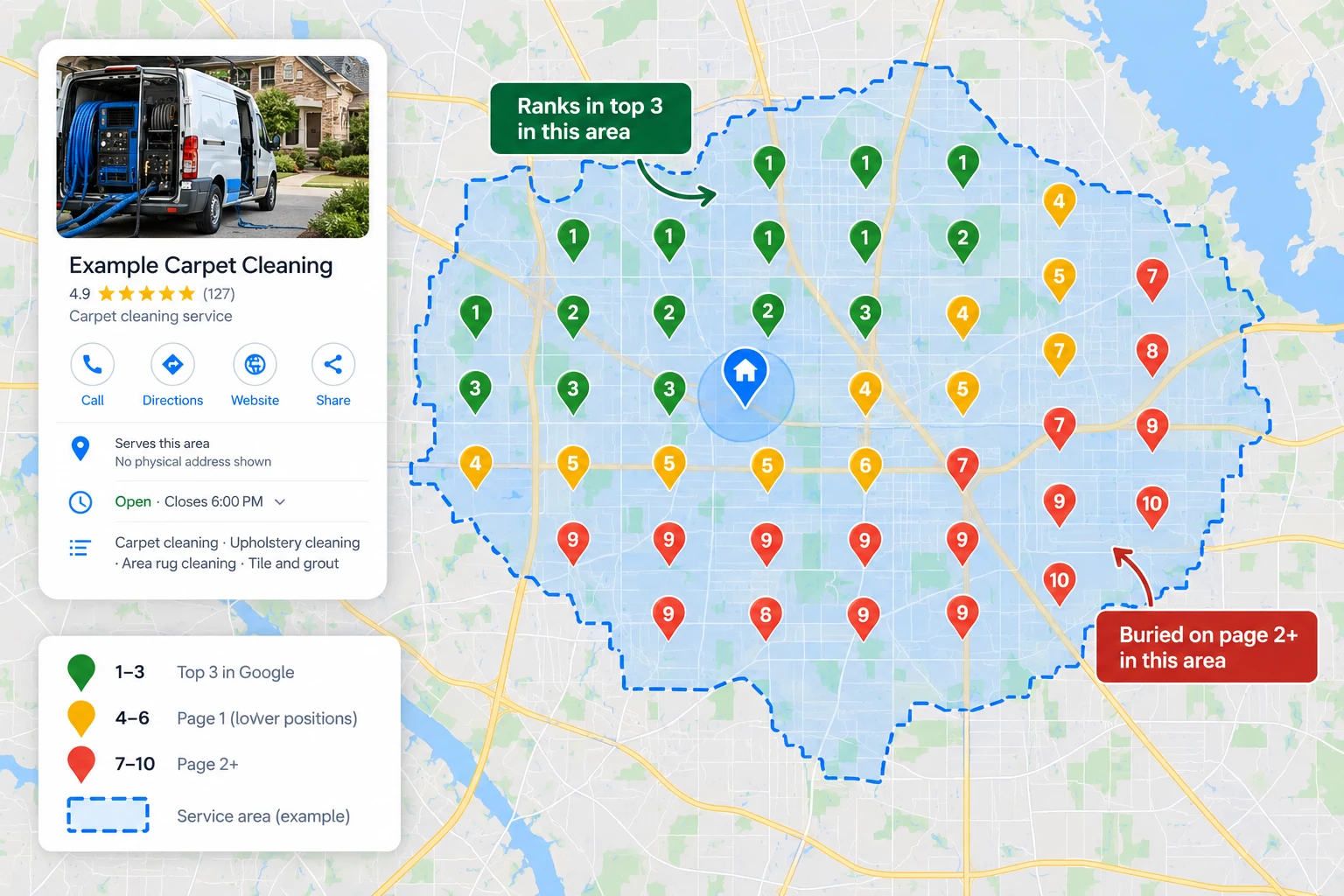
If you travel to customers and do not serve visitors at your address, set up your Google Business Profile as a service-area business and hide your address. Add the cities or postal codes you actually serve. Google's guidance generally limits a service area to about two hours of driving from the business base, but your profitable radius may be considerably smaller.
Use an accurate business category, keep contact information and hours current, and list the services customers can book. Add your own job photographs with permission. Do not claim a storefront at a location that is not staffed and able to receive customers.
Google results can change from one neighborhood to another. When you have a working profile, use RankBeaver's Local Rank Grid to check how your business appears from different points across the service area. Compare those results with the neighborhoods generating inquiries; a service area setting alone does not make your business visible throughout that area.
Request genuine reviews
Send an honest review request after the customer has seen the finished work. For example: “Thanks for booking the cleaning today. If you'd like to leave feedback, here's our Google review link.” Ask customers regardless of whether you expect positive or negative feedback. Respond to complaints directly and keep records of any follow-up work.
Do not offer a discount, gift, or free service in exchange for posting a Google review. Google prohibits incentivized reviews. You can run an introductory offer for new customers, but it must not depend on leaving a review.
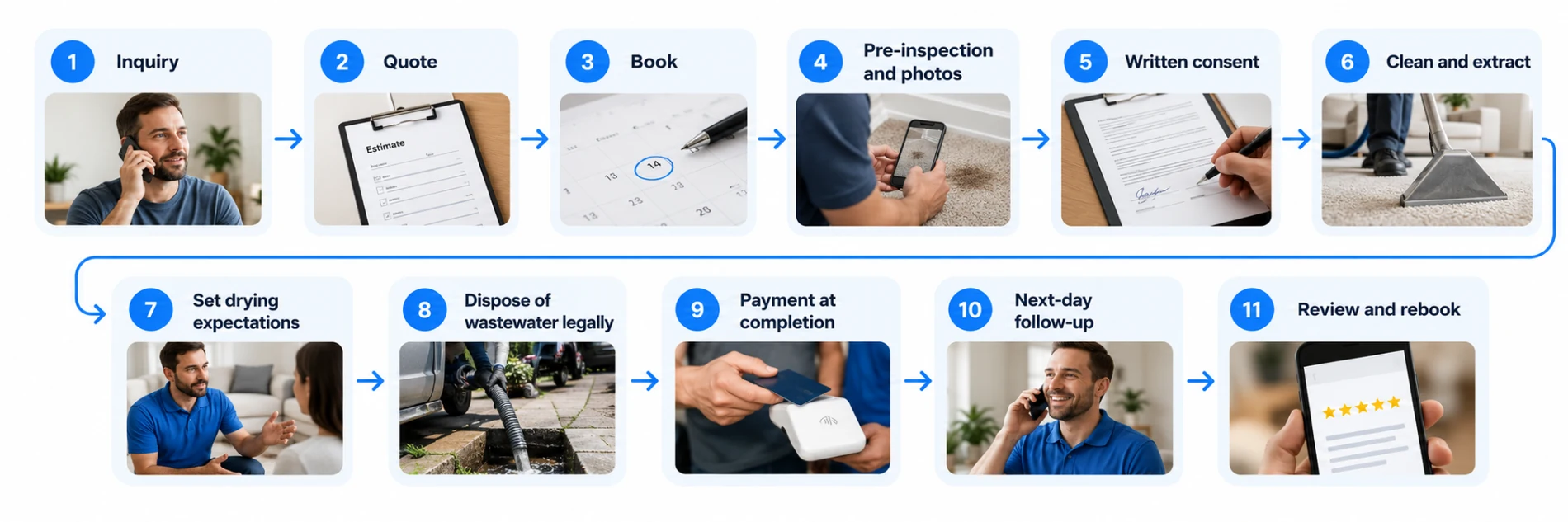
8. Follow the same process on every cleaning job
Inspect the rooms before unloading all your equipment. Walk the areas with the customer and look for existing stains, frayed seams, loose carpet, discoloration, and worn patches. Ask about earlier stain treatments and identify furniture or fragile items that must stay in place. Photograph relevant conditions with permission. A pre-job inspection also gives you the chance to change or decline the work before causing damage.
Confirm the scope and price. Record the rooms being cleaned and whether the quote includes stairs, moving furniture, and spot treatment. Explain any areas where cleaning is unlikely to remove a mark or where damage may become more visible afterward. Get written authorization for the agreed work, particularly when there are existing carpet defects or unusual materials.
Test products and control moisture. Inspect the carpet material and test an inconspicuous area when appropriate. Follow the product label and use the correct dilution. Avoid leaving carpet unnecessarily wet. Drying time varies with carpet construction, humidity, airflow, temperature, and the cleaning method; give advice based on the actual conditions rather than guaranteeing the same drying time for every job.
Handle chemicals and wastewater properly. Keep products in labeled containers and have safety information available. If you employ workers who handle hazardous cleaning chemicals, review applicable OSHA hazard communication requirements. Do not discharge extraction wastewater into a street or storm drain without authorization. Confirm permitted disposal methods with the local wastewater authority.
Finish with a walkthrough and an invoice. Show the customer the areas cleaned and identify any remaining stains. Record the total charged, payment received, and any agreed follow-up. Send a short message after the carpet has dried so the customer can report problems while the job details are still recent.
9. Track your costs and schedule before expanding
For every job, save the customer name, address, type of work, quoted price, invoice total, direct costs, travel time, and time spent on site. A spreadsheet is enough for this when bookings are light. Review the records weekly to see which jobs paid well and which types of work regularly exceeded the estimate. Include missed appointments and unpaid quotes in your assessment of how efficiently the business is operating.
Here is one illustrative month for a solo cleaner charging an average of $180:
| Activity | Assumption |
|---|---|
| Jobs per day | 3 |
| Days per week | 4 |
| Weeks counted | 4 |
| Jobs completed | 48 |
| Monthly revenue | $8,640 |
That revenue is before supplies, advertising, vehicle costs, insurance, equipment depreciation, taxes, and compensation for your work. It also assumes you can book and complete 48 jobs. A new business may begin with far fewer appointments. Use your actual booking numbers to decide how much cash the business can safely spend.
When appointments become difficult to manage, use a shared calendar or booking software and a consistent quoting process. Confirm access instructions and parking before the appointment. Leave enough space between jobs for driving and unexpected cleaning problems; a schedule filled with overlapping arrival windows leads to missed appointments.
10. Decide when to hire or take commercial contracts
Hiring someone adds payroll costs and responsibility for training and supervision. Check applicable state and federal worker-classification rules before paying someone as an independent contractor. Calling a cleaner a contractor on an invoice does not automatically determine their legal classification.
For a commercial contract, get the scope and payment terms in writing. If the client pays in 30 or 60 days, calculate how much you must spend on labor, fuel, and supplies before receiving payment. A large office account can create a cash shortage if you pay staff weekly but invoice the customer monthly. Confirm access arrangements, service frequency, insurance requirements, and cancellation terms before accepting the work.
Upgrade equipment when your records show that the time saved or additional jobs completed will justify the cost. If you are still working to fill your existing calendar, new equipment may add expense without increasing revenue.
Frequently asked questions
How do I start a carpet cleaning business without experience?
Take a carpet cleaning training course, practice on suitable materials, and learn basic inspection and cleaning methods. The IICRC CCT course is an option for beginners. Register your business and obtain appropriate insurance before accepting paid appointments. Start with routine residential cleaning and decline work you are not trained or equipped to handle.
How much does it cost to start a carpet cleaning business?
The illustrative budgets in this article are $2,600 for a used portable extractor with an existing vehicle, $6,900 for a new portable setup, and $31,500 for a van with a truck-mounted system. Equipment prices, registration fees, and insurance vary by location. Add training and living expenses to your personal budget before deciding how much cash you need.
Do I need a license to clean carpets?
You may need a general business license, registration, or local permit depending on your city and state. Carpet cleaning certification from the IICRC is a professional credential and does not substitute for those legal requirements. Check the local licensing office and your state revenue department before providing services.
Can a portable extractor clean carpets professionally?
Yes, provided the machine and cleaning method suit the carpet and the operator understands how to use them. Check the vacuum recovery and overall condition when buying used equipment. You can consider a truck mount later if your job volume and cleaning requirements justify it.
How do I price a carpet cleaning job?
Base the estimate on the rooms or measured area, carpet condition, access, travel, and any separate treatments. Set a minimum charge to cover small appointments. Give the customer a written estimate and explain what would trigger an additional charge before starting work.
How many jobs do I need to break even?
Divide monthly fixed costs by the amount each job brings in after its direct costs. If your fixed costs are $500 and each job contributes $125 toward those costs, four jobs cover the $500. Your own pay, taxes, future machine replacement, and any debt payments require more income. Calculate the number using your actual business expenses.
Is residential or commercial carpet cleaning better for a beginner?
Routine residential work usually has smaller scopes and often allows payment at completion. Commercial customers may require bids, scheduled after-hours work, higher insurance limits, and invoice payment terms. Begin with work you can complete reliably using your current equipment and budget.
Official references
- IICRC — Carpet Cleaning Technician
- US Small Business Administration — 10 steps to start your business
- IRS — Employer Identification Numbers
- Texas Comptroller — Carpet cleaning services
- Google — Guidelines for representing your business
- Google — Get more reviews
- OSHA — Hazard Communication
Budget and revenue figures are illustrative examples assembled from the supplied competitor research, not verified national averages. Obtain local supplier and insurance quotes before using them in a business plan.