

Whether you are a beginner looking to start a window cleaning business or a professional aiming to complete jobs more efficiently, you need high-quality window cleaning tools. With the right equipment, you can clean windows more effectively while protecting expensive glass surfaces from scratches and other damage.
There are many window-cleaning tools available, including squeegees, strip washers or scrubbers, T-bars, extension poles and microfiber cloths. If you want to upgrade your window-cleaning kit, this blog will help you choose the right tools and build a professional setup.
What Tools Do You Need to Clean Windows?
The window-cleaning tools you need depend on the type of glass and the conditions you are working with. For ground-level windows, traditional hand tools are usually sufficient. However, specialist equipment may be required for high windows, delicate coatings, post-construction debris, large commercial façades or frequent exterior cleaning.
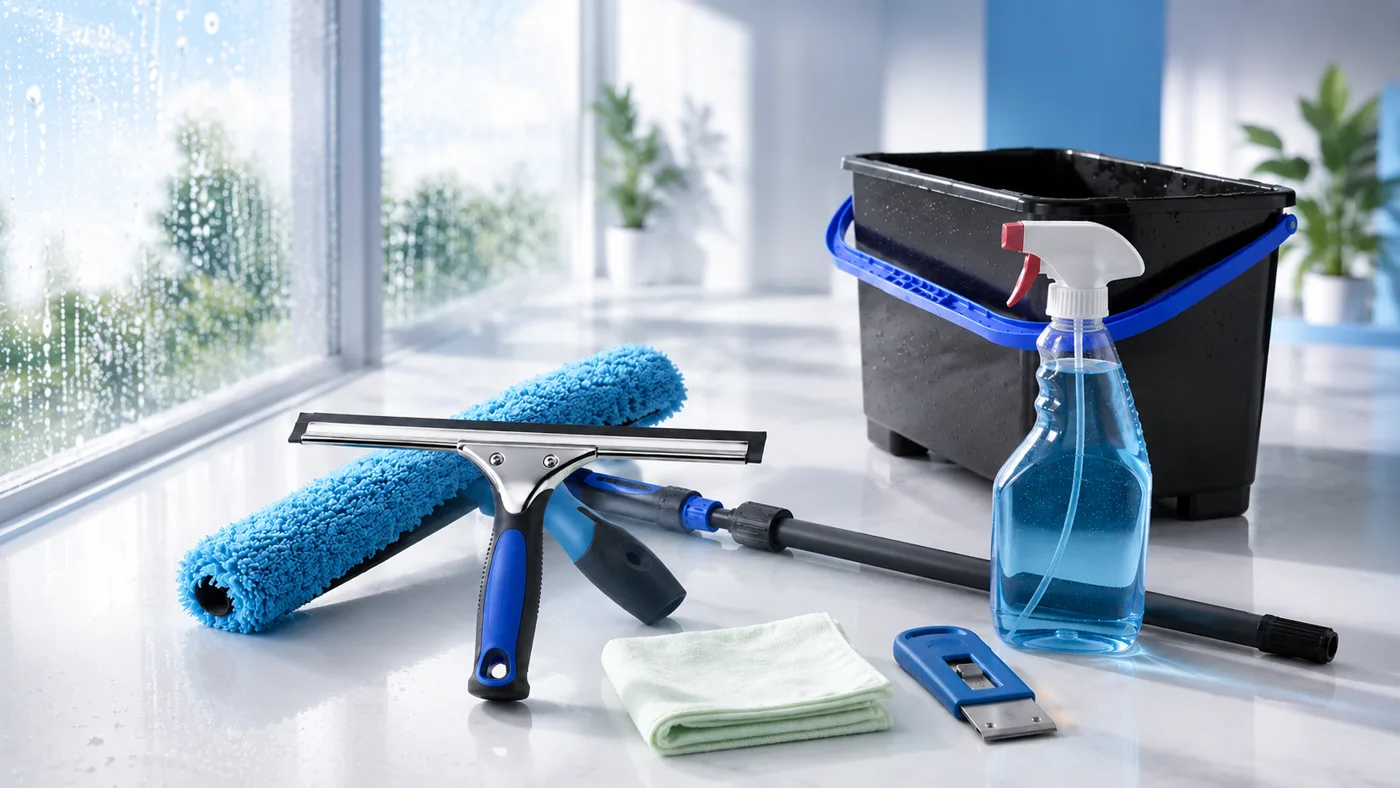
Confused about which tools to choose? The table below explains the most common window-cleaning tools, what they are used for, their typical prices and other important details.
| Tool | What it does | Typical price | Priority | Best suited to |
|---|---|---|---|---|
| Squeegee | Removes water and solution from glass | $15 to $50 | Essential | Everyone |
| Strip washer or scrubber | Applies solution and agitates dirt | $20 to $30 | Essential | Everyone |
| T-bar | Holds the removable scrubber sleeve | $5 to $15 | Essential if not included | Pros and repeat users |
| Extension pole | Extends traditional tools from the ground | $15 to $150+ | Useful | Homes and storefronts |
| Carbon-fiber trad pole | Reduces weight during longer pole work | $150+ | Specialist | Working professionals |
| Microfiber cloths | Details edges, frames and remaining moisture | $1 to $8 each | Essential | Everyone |
| Pocket scraper | Removes small labels and stuck residue | $4 to $10 | Useful | Homes and light commercial |
| Heavy-duty scraper | Handles wider areas and construction residue | $25 to $40 | Specialist | Professionals |
| Rectangular bucket | Holds water and fits wider tools | $25 to $40 | Essential | Everyone |
| Bucket on a belt or BOAB | Keeps wet tools accessible while moving | $45 to $55 | Professional | Route and storefront work |
| Tool belt and holster | Organizes scrapers, cloths and hand tools | $25 to $100+ | Professional | All-day use |
| Glass cleaner or soap | Provides cleaning action and blade glide | $6 to $20 | Essential | Everyone |
| Abrasive pads | Loosen selected stubborn deposits | Varies | Specialist | Tested compatible glass only |
| Screen brush | Removes dust from window screens | Varies | Useful | Residential work |
| Track and crevice tool | Reaches corners, tracks and narrow gaps | Varies | Useful | Residential interiors |
| Water-fed pole | Scrubs and rinses exterior glass from the ground | Often sold in a system | Specialist | Exterior route work |
| DI purification unit | Removes dissolved minerals from suitable source water | About $524 to $1,748 | Specialist | Low-TDS areas |
| RO/DI system | Processes harder source water before final DI polishing | About $1,600 to $2,900 | Specialist | Frequent exterior work |
| Ladder | Provides physical access to elevated work | Varies by rating and height | Job-specific | Trained users |
| Ladder levelers | Stabilize compatible ladders on uneven surfaces | About $109 | Job-specific | Exterior work |
| Rope-access package | Supports trained high-rise descent work | About $600 to $3,600+ | Highly specialized | Qualified high-rise crews |
| Eye protection | Protects against particles, splash and debris | Varies | Safety essential | Scraping and chemical work |
| Magnetic cleaner | Cleans both sides of compatible inaccessible glass | About $75 to $87 | Specialist | Selected double-sided windows |
| Window vacuum | Collects liquid from interior glass and smooth surfaces | About $80 | Optional | Homeowners and interior work |
These bands are rounded from representative current listings rather than formal category averages. Examples include a $16.87 Ettore brass squeegee, a $46.53 Unger Ninja squeegee, $25 to $35 six-gallon buckets, a $151.20 XERO carbon-fiber trad pole, a $108.94 pair of Xtenda-Leg levelers and a $79.99 Kärcher WV 1 Plus window vacuum.
Which Tools Do You Need for Each Type of Job?
Post-construction cleanup deserves separate planning. Scrapers and abrasives may be necessary, but the cleaner must first identify coatings, fabrication debris risks and the glass manufacturer's limitations. The following table lists the tools needed for each type of job.
| Job type | Core tools | Additional equipment | Main safety consideration |
|---|---|---|---|
| Interior residential | Squeegee, washer, cloths, bucket, mild solution | Track tools, screen brush, window vacuum | Protect floors and furnishings |
| Ground-floor exterior | Traditional kit, pole | Scraper after glass assessment | Slips, pedestrians and hose placement |
| Two-to-three-story residential | Traditional kit | Controlled pole system or water-fed pole | Avoid improvised access |
| Storefront route | Squeegees, washer, BOAB, cloths | Short pole, scraper, tool belt | Public traffic and wet surfaces |
| Low-rise commercial | Traditional and water-fed tools | DI or RO/DI, hose management | Edges, access areas and falling objects |
| High-rise | Site-specific cleaning tools | Qualified rope-access or platform equipment | Formal work plan, anchors, rescue and fall protection |
| Post-construction cleanup | Washer, scraper, cloths | Multiple blade types, tested abrasives | Identify glass before scraping |
| Solar panels | Pure water, compatible brush and pole | TDS meter and hose system | Electrical, roof and manufacturer requirements |
The Essential Window Cleaning Tools to Buy
As a beginner, you will need the following window-cleaning tools before starting your window-cleaning business:
1. Squeegee
A squeegee uses a straight rubber edge to pull water and loosened soil from the glass. Blade quality matters more than decorative features because even a small nick can leave a consistent line on every pass.
Choose the channel width according to the panes you clean most often. A narrower channel is easier to control on divided residential windows, while a wider channel reduces passes on storefront glass. Brass handles are durable but heavier. Aluminum reduces fatigue, while stainless steel sits between the two in weight and corrosion resistance.
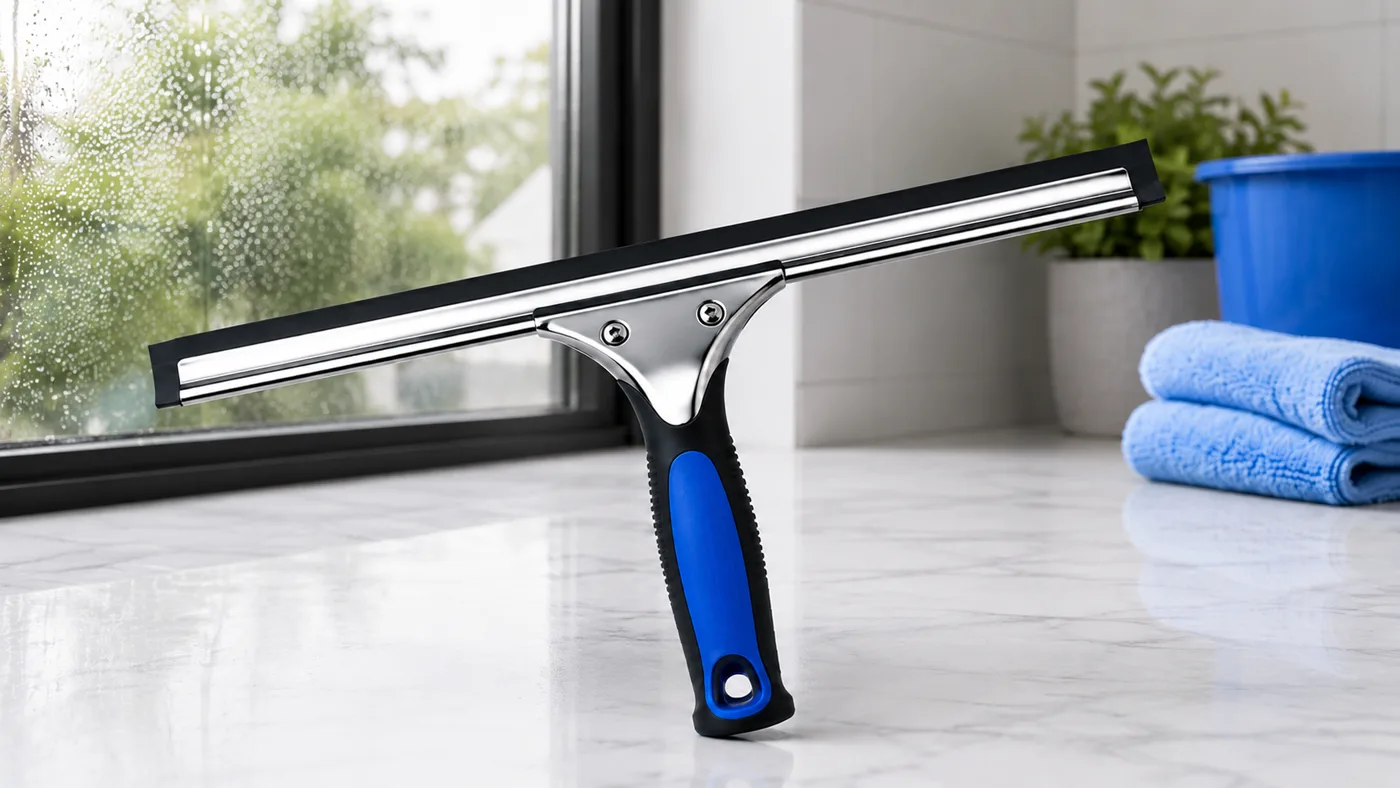
Current examples include the Ettore Complete Master Brass Squeegee at $16.87 and the Unger ErgoTec Ninja 30-degree complete squeegee at $46.53. The Ninja is the more adjustable professional option, while the Ettore is a sensible traditional starting point.
Soft rubber generally fits well for cooler glass and lighter residential work. Harder compounds can hold their edge better in warm conditions and on larger commercial panes. Keep spare rubber in the vehicle rather than waiting for visible failure.
2. Strip Washer or Scrubber
A strip washer wets the glass, carries cleaning solution and agitates dirt before the squeegee passes. It consists of a T-bar and a removable fabric sleeve.
Look for water retention, strong stitching, secure fastening and a scrub edge that matches the surfaces you clean. Microfiber sleeves hold water and handle normal soil well. More aggressive fibers can help with heavier grime, but they require greater caution around tint, film and coated glass.
The Moerman Complete Microfiber Stripwasher is listed at $28.61, while the Ettore Pro+ Microfiber Window Washer is about $26.80. Both use microfiber sleeves with reinforced construction and a focused scrubbing edge.
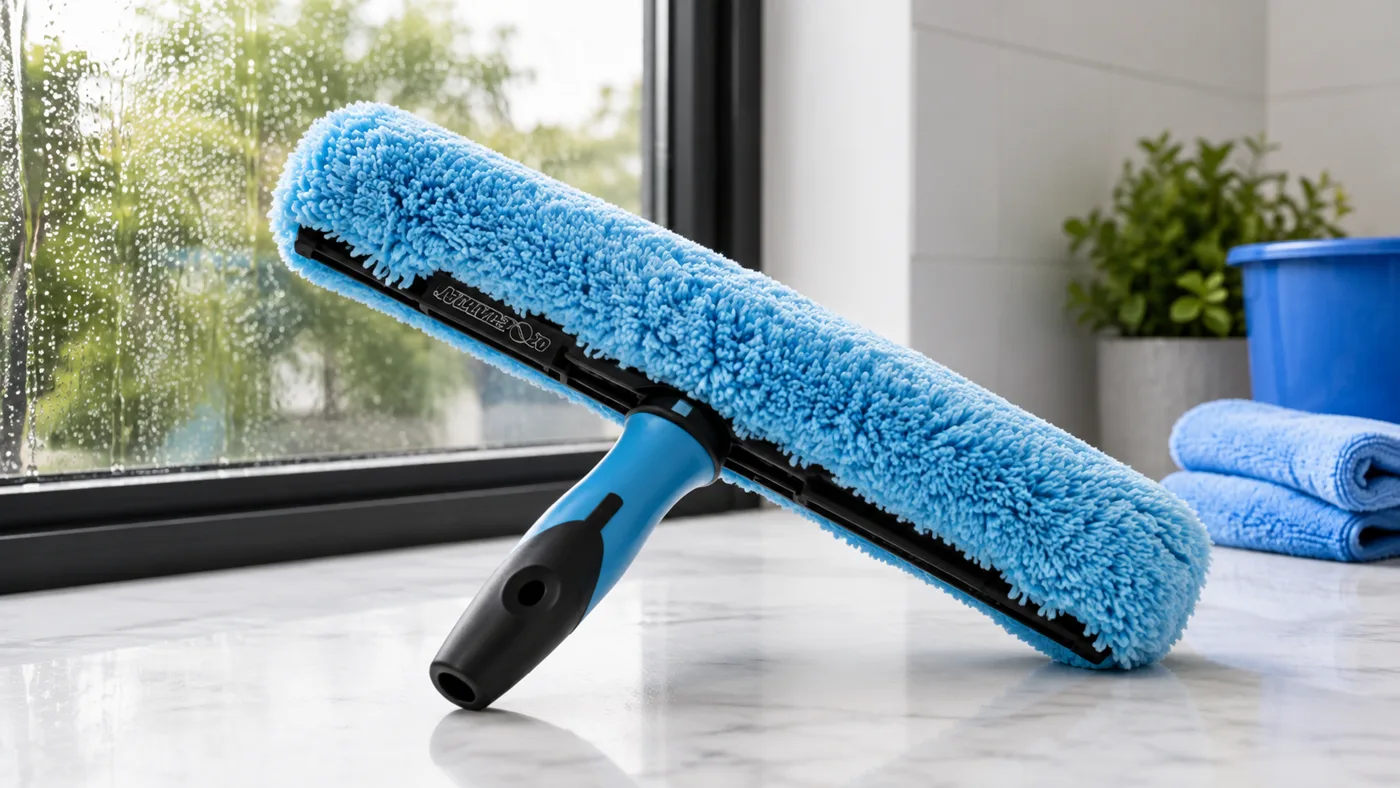
Buy a second sleeve before you buy a second complete washer. A fresh sleeve prevents one heavily contaminated applicator from being used across every surface on the job.
3. T-bar
The T-bar is the frame underneath a strip-washer sleeve. It controls pressure, reach and wrist movement. A fixed T-bar is inexpensive and predictable. A swivel model is easier to use on a pole, around deep frames and at changing angles. Check sleeve compatibility before mixing brands because length may match while fastening position or handle shape does not.
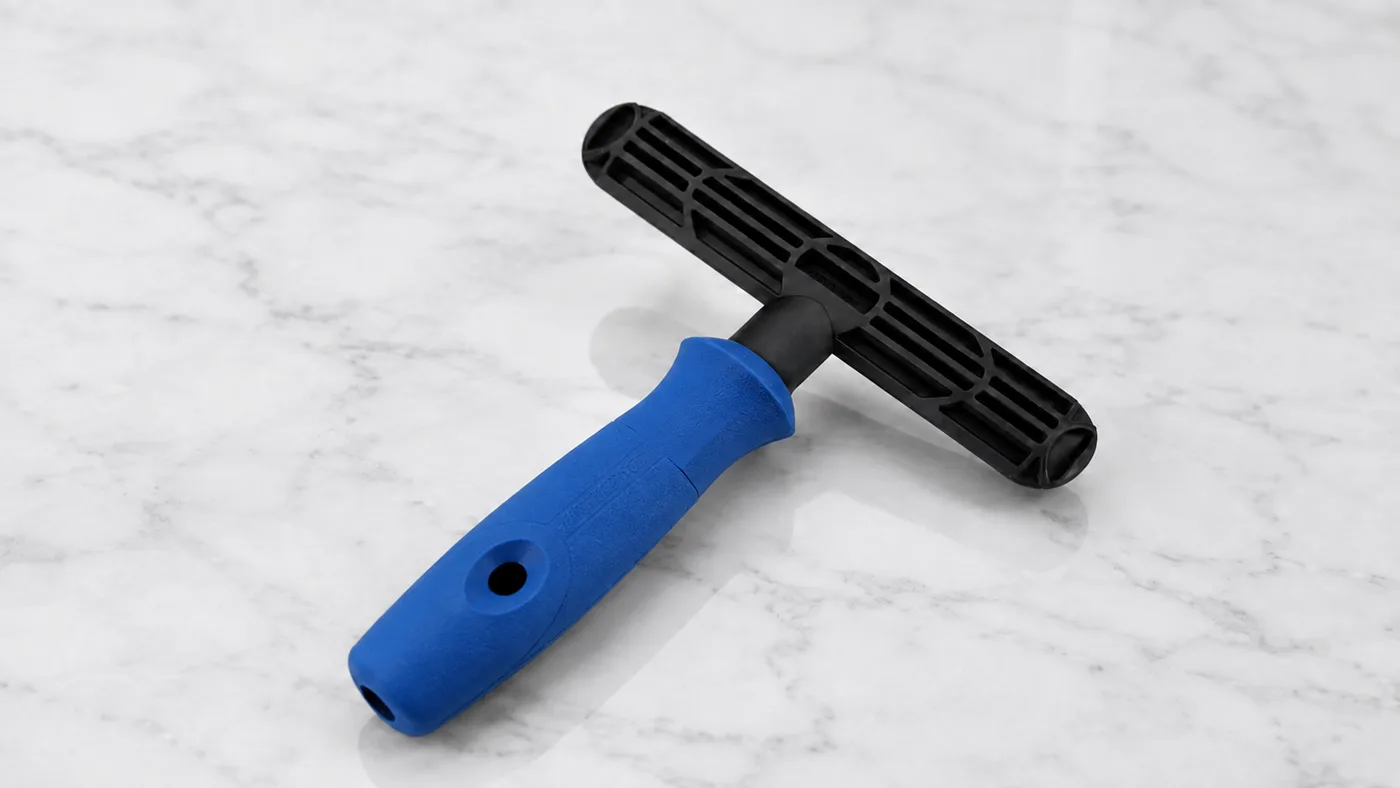
The lightweight Moerman Mono Ergonomic T-Bar starts around $5.07. The Sörbo Swivel T-Bar is about $14.45 and is designed to accept sleeves from multiple brands.
A swivel joint is valuable only when it stays where you set it. Excessive play makes accurate edge work harder, so inspect the locking mechanism rather than choosing entirely by price.
4. Extension Pole
An extension pole lets you use a washer, squeegee or selected accessory above normal reach while remaining on the ground.
The locking mechanism should hold securely without requiring excessive force. Also check collapsed length, attachment compatibility and flex at full extension. Aluminum poles are affordable and durable but become tiring at length. Carbon fiber costs more but is lighter and more rigid, which matters when a professional works with a pole for hours.
The aluminum Ettore REA-C-H line starts around $14.36 for its shortest configuration, while Unger OptiLoc poles begin around $42 depending on length. The XERO Carbon Fiber Trad Pole 2.0 was listed at $151.20 for its base configuration.
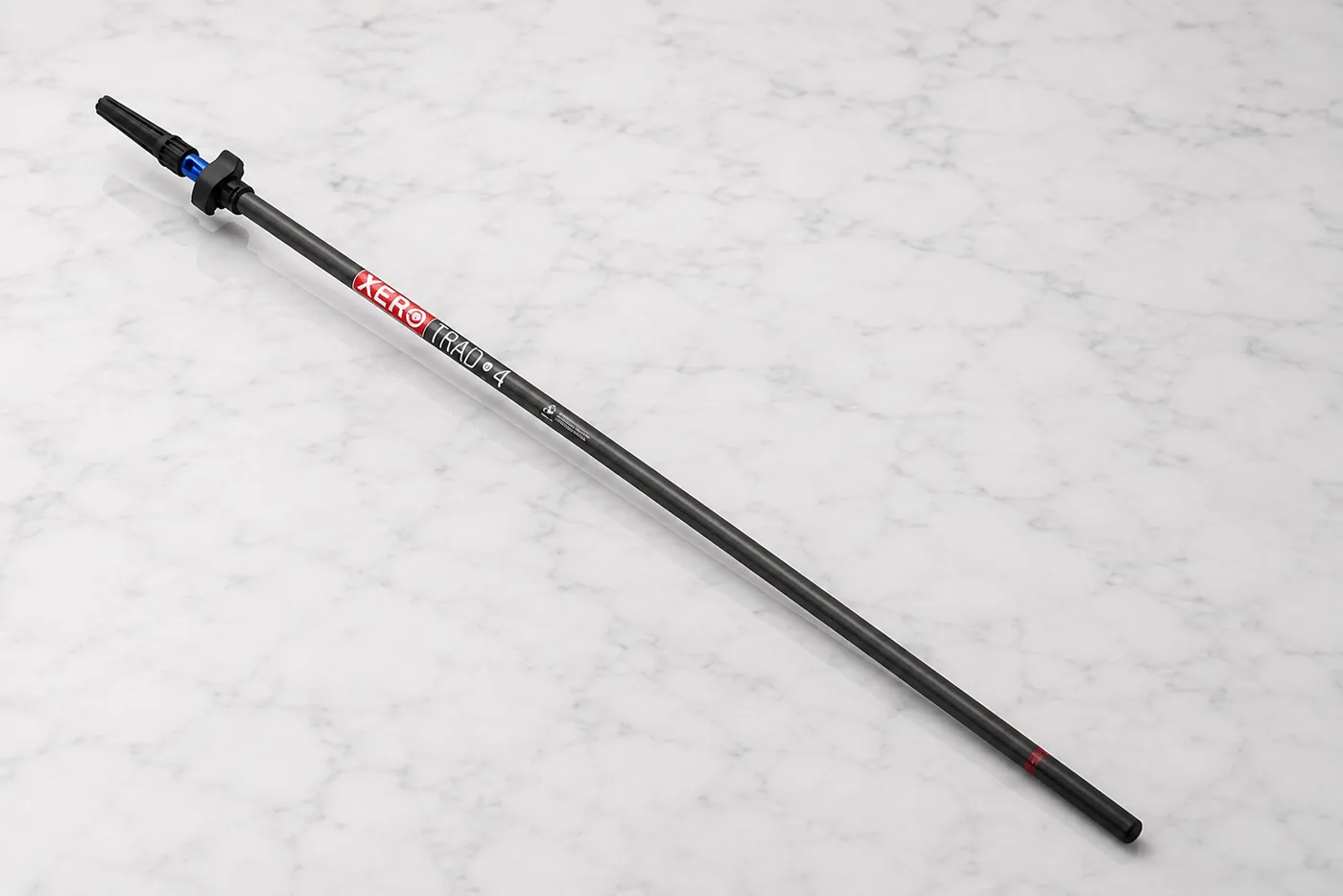
Do not buy more reach than you can control. Using a long pole that flexes heavily can take longer than repositioning a shorter, more rigid pole.
5. Microfiber Cloths
Microfiber cloths are used to detail edges, wipe frames and remove small amounts of moisture the squeegee leaves behind. Choose lint-free cloths for glass detailing and keep them separate from the cloths used on dirty tracks or frames. A higher-quality waffle or tightly woven cloth usually performs better for edge detailing, while inexpensive general microfiber is useful for frames and rougher surfaces.
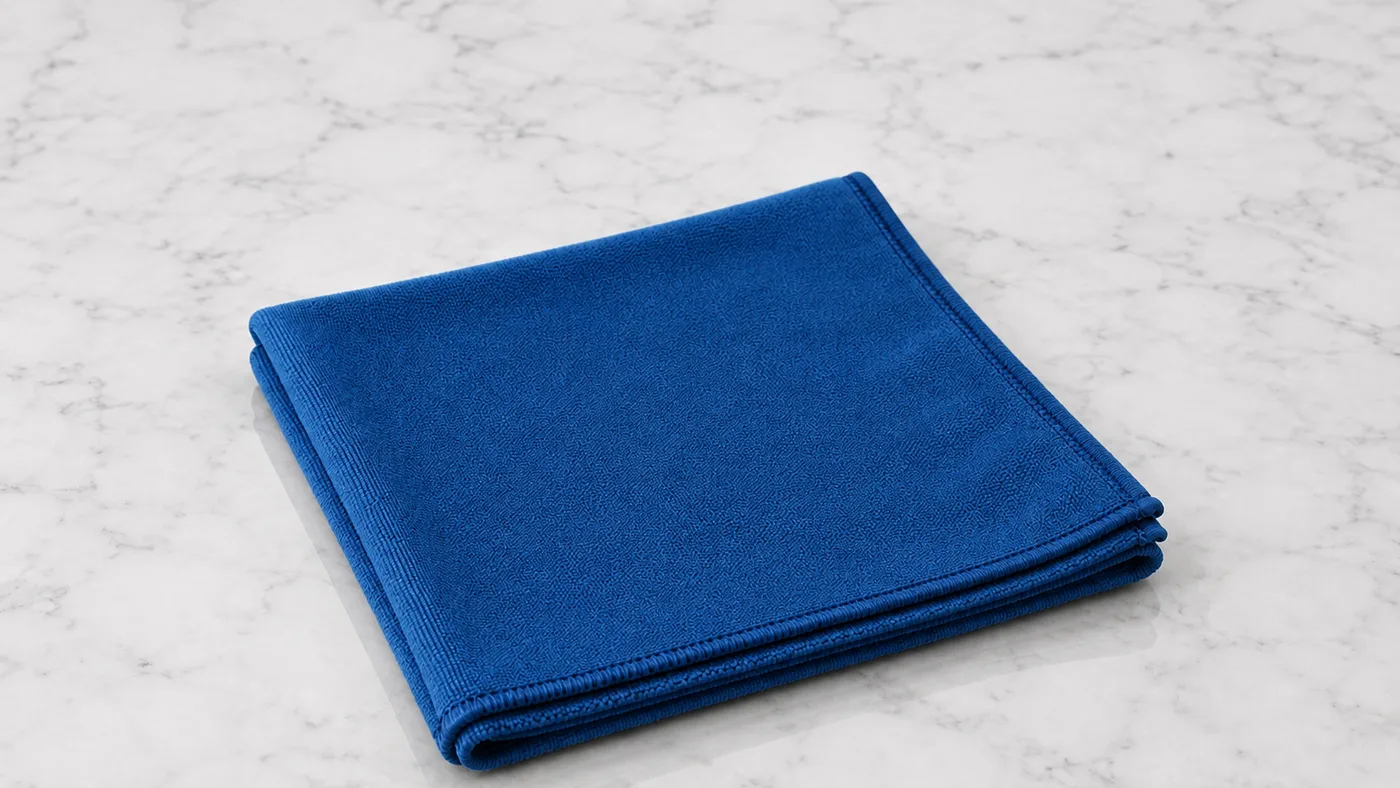
Current examples range from a $0.99 NICE microfiber towel to the $7.64 Unger MicroWipe. The latter is a 16-by-16-inch cloth designed to hold several times its own weight in liquid. Wash microfiber without fabric softener because residues can reduce absorbency and contribute to smearing. Retire contaminated or linting cloths from glass work and reuse them for frames or equipment.
6. Scraper
A scraper lifts paint specks, adhesive, labels and other deposits that normal washing may not remove. It is also one of the easiest tools to misuse. Stainless blades resist corrosion. Carbon-steel blades can be very sharp but require dry storage and regular replacement. Choose a lockable or retractable design and carry replacement blades in a protected dispenser.
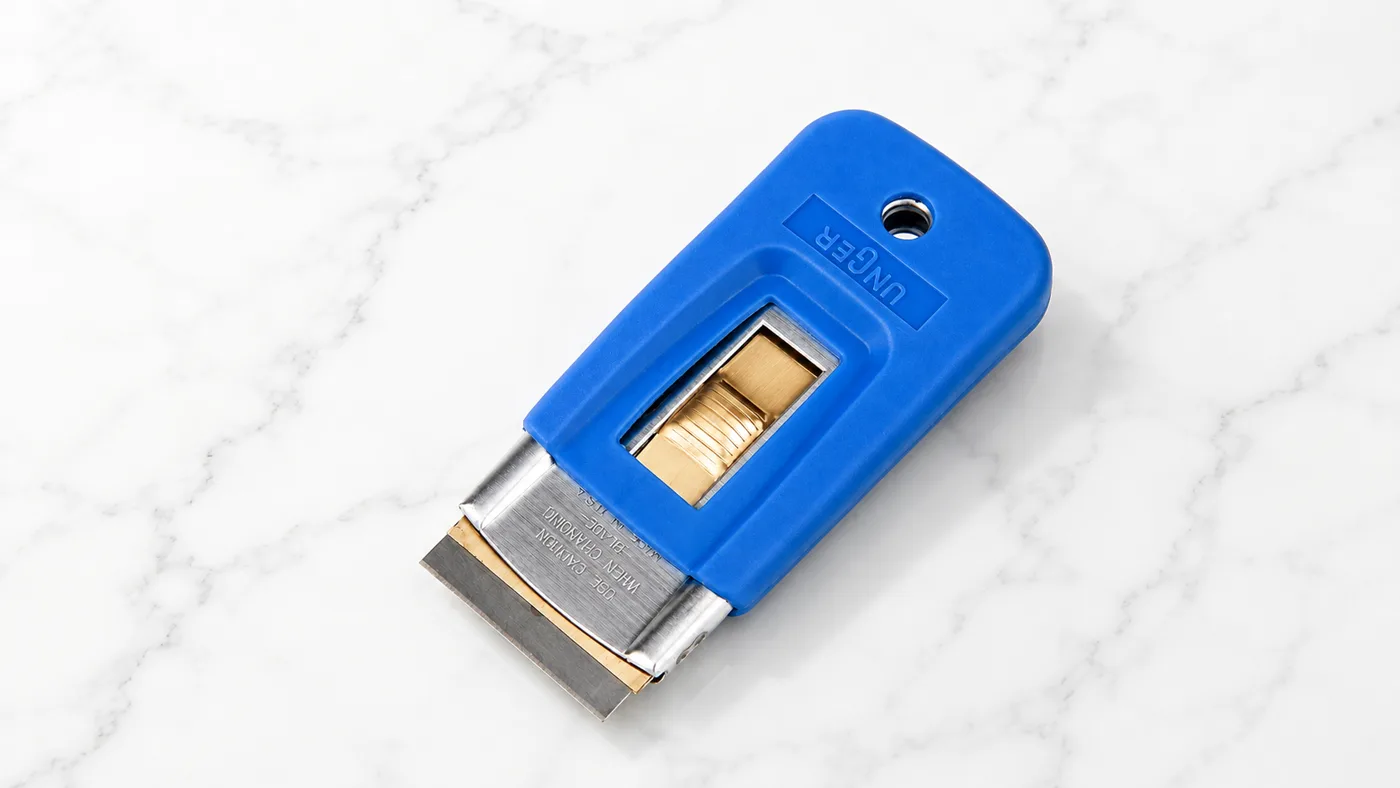
The compact Unger Safety Scraper is listed at $3.98, while the wider Ettore Heavy Duty Super Scraper costs about $29.51. Before scraping, identify the glass, review the glass manufacturer's instructions and test an inconspicuous area. Unger's guidance recommends checking suitability first, lubricating the glass thoroughly, applying even pressure and scraping in one direction. Coated, treated or certain tempered surfaces require particular caution.
7. Bucket
A window-cleaning bucket should be long enough to submerge the strip washer and wide squeegee channels without forcing them diagonally. Rectangular buckets waste less space around long tools than ordinary round household buckets. Useful features include a lid, carrying handle, sieve or tool rest. A lid becomes important when transporting cleaning solutions in a vehicle.
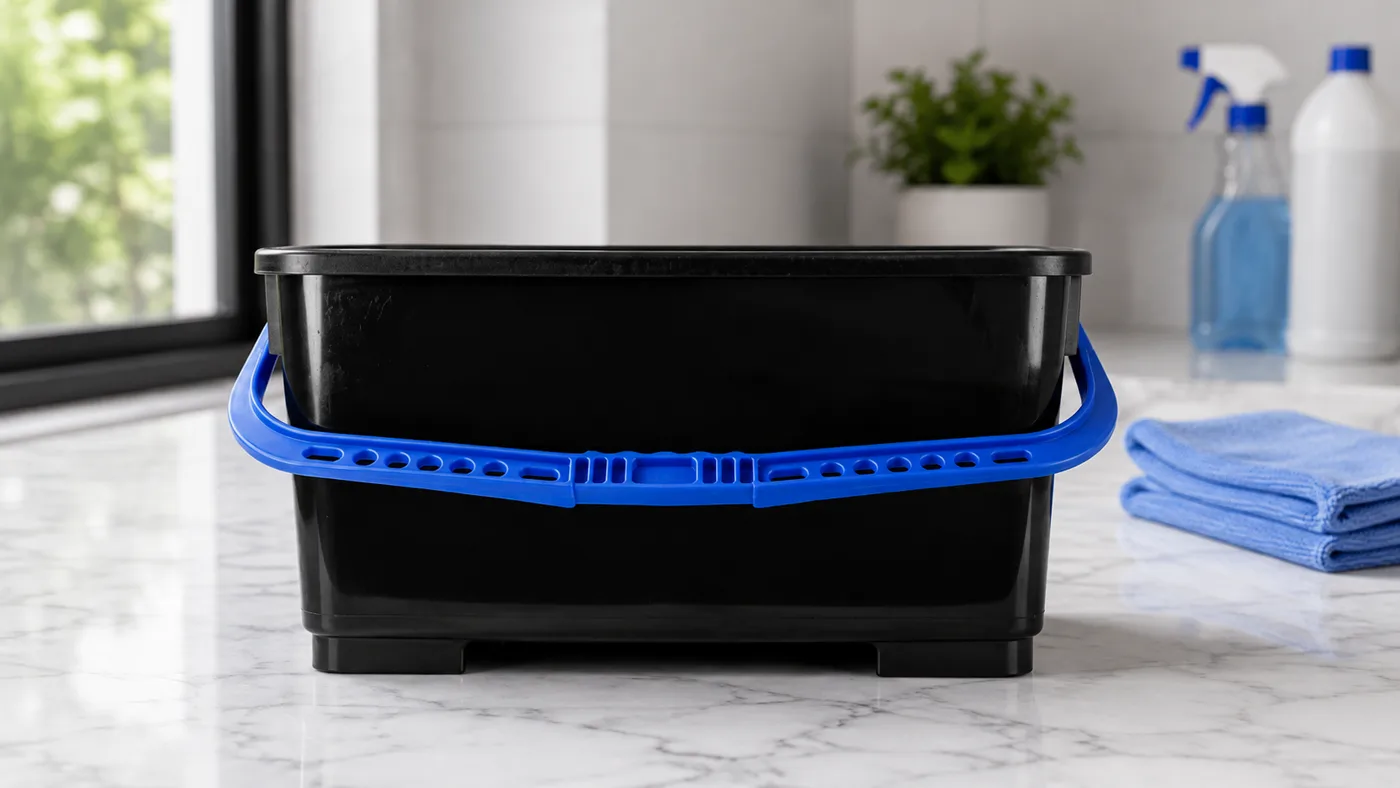
A Pulex six-gallon bucket is listed around $25.41, while an Unger six-gallon bucket is about $34.99. A Pulex bucket set with a lid was listed around $39.85. For home use, a smaller bucket may be easier to carry. For professional work, choose one that accommodates the longest washer used on a normal route.
8. Cleaning Solution
Cleaning solution loosens oily residue, suspends dirt and provides glide for the squeegee blade. A professional concentrate offers consistent dilution and predictable performance. A small amount of dish soap is also widely used because it provides glide, although excessive soap increases detailing and can leave residue. For tinted or filmed glass, follow the film manufacturer's approved-cleaner instructions and avoid assuming that every glass cleaner is compatible.
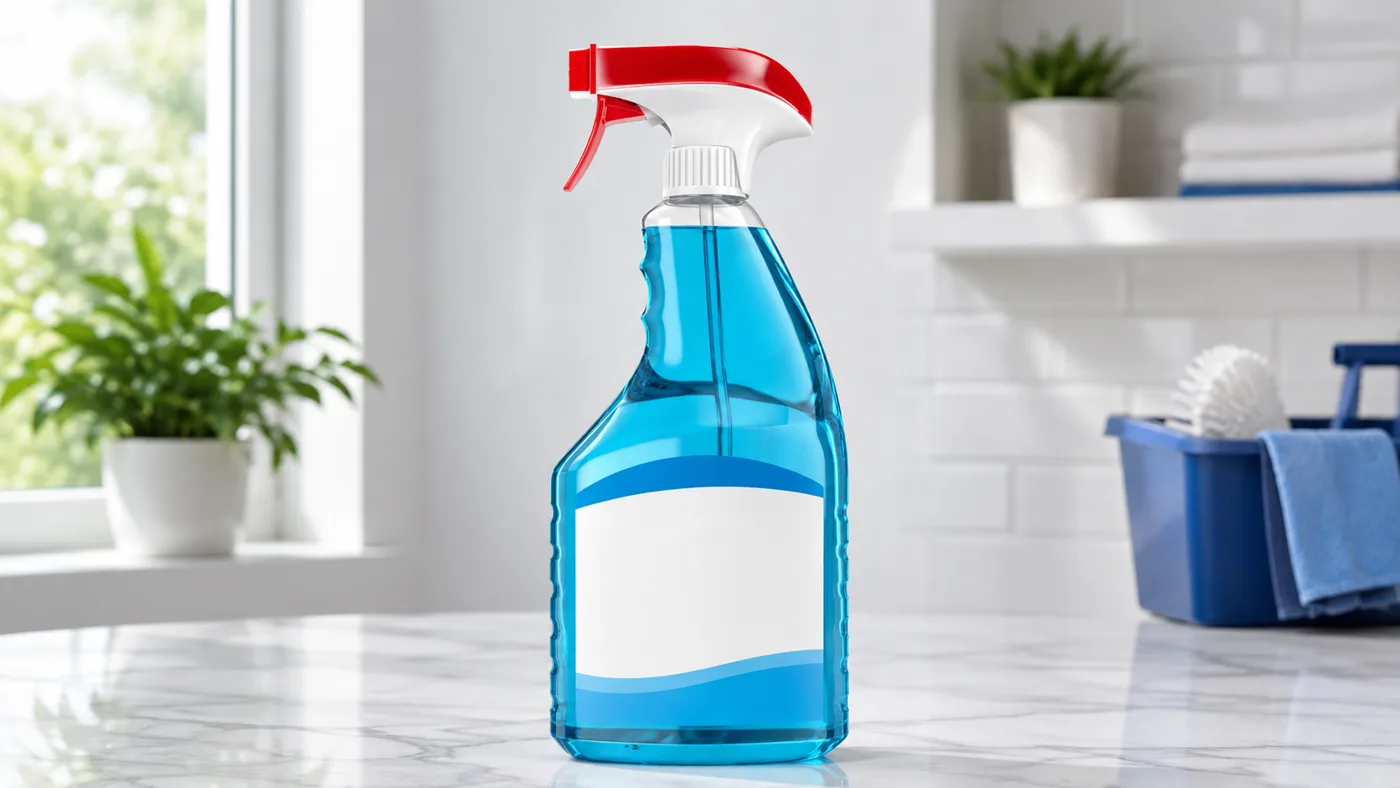
Current retail examples include Windex Commercial Line at $5.98 for 32 ounces and Dawn Professional dish soap at $17.98 per gallon. Using more cleaning solutions does not automatically produce better results. Start with the product's labeled dilution, then adjust only when the surface and local water conditions justify it.
Professional Window Cleaning Tools (for working crews)
Professional window-cleaning tools become especially valuable for business owners and cleaners who work on glass for several hours every day. These tools are designed to improve speed, organization, ergonomics and durability across repeated jobs. They may not necessarily change what you can clean, but they can reduce unnecessary movement, keep frequently used tools within easy reach and make long working days more manageable.
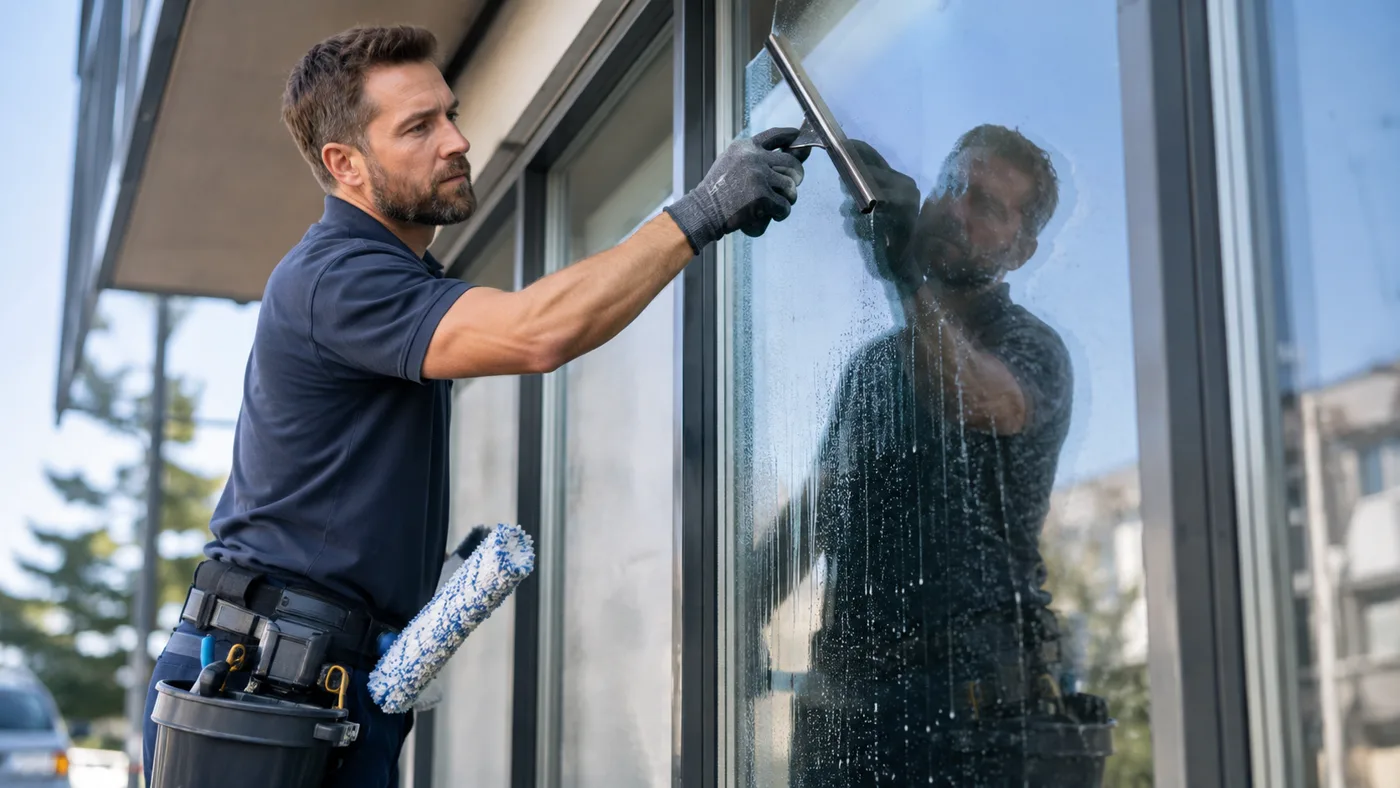
If you run a window-cleaning business, the following tools can help you upgrade your current kit and work more efficiently.
1. Bucket on a Belt (BOAB)
A bucket on a belt, also known as BOAB, holds a wet washer and one or more squeegees at the cleaner's side. This reduces repeated trips to the main bucket during storefront and route work. The Unger Classic BOAB is listed around $49.44.
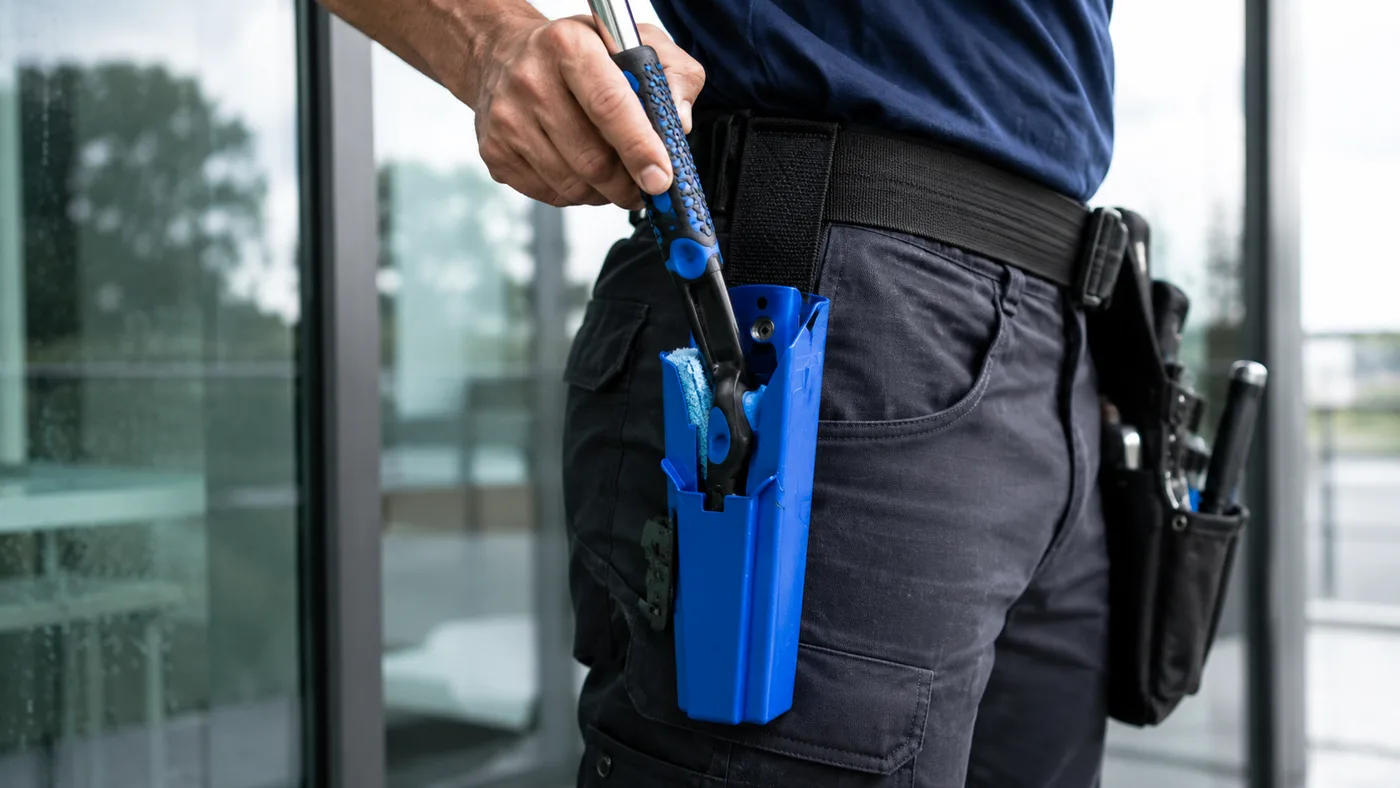
Professional BOABs may provide separate compartments for multiple squeegees and washers, drainage areas and adjustable attachment points. Products such as the Ettore SideKick and Moerman Drywalker Flex are examples designed around this type of mobile workflow. For storefront routes, commercial interiors and larger residential jobs, a BOAB can noticeably reduce bending and walking between panes.
2. Holsters and Tool Belts
A professional tool belt or holster keeps scrapers, detailing cloths, small brushes and other frequently used equipment accessible while leaving both hands free. This becomes especially useful when moving between multiple rooms, climbing approved access equipment or working across long storefront routes.
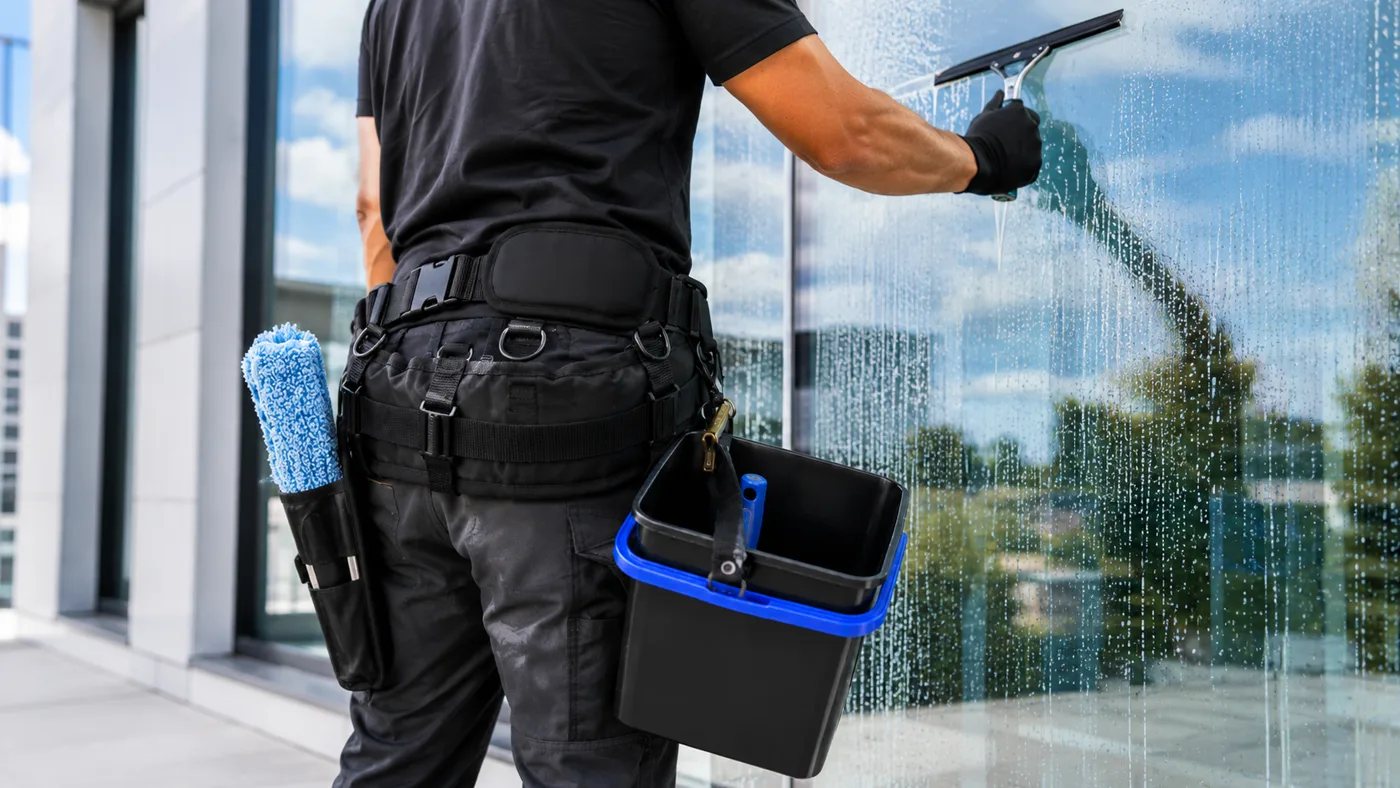
Look for a belt that distributes weight comfortably and lets you position pouches and holsters according to your dominant hand and workflow. An Unger ErgoTec belt allows cleaners to organize several tools around the waist instead of carrying them individually or repeatedly returning to a tool bag.
3. Heavy-Duty Scrapers, Abrasive Pads and Polish Pads
Heavy-duty scrapers are designed for stubborn contamination such as adhesive, paint spots and selected construction residue that a standard washer cannot remove efficiently. Wider blades can cover more surface area, while secure blade holders provide better control during repeated professional use.
Abrasive and polishing pads provide another level of agitation for difficult deposits. Different pads have different levels of abrasiveness, so they should always be matched to the glass or surface being cleaned. 3M polish pads, for example, are among the specialist products professionals may carry for jobs requiring more than routine washing.
4. Screen Cleaning Tools and Accessory Adapters
Dedicated screen brushes and cleaning tools help remove dust, pollen and debris without contaminating the tools used for final glass detailing. They become particularly valuable on residential jobs where screens are included as part of the service.
Finally, tool adapters make a professional kit more flexible. An Unger accessory adapter, for example, can help connect compatible cleaning accessories to a pole system. Cross-brand compatibility matters because professional cleaners often build their kit from several manufacturers rather than replacing an entire setup simply because one attachment uses a different connection system.
Water-Fed Poles and Pure-Water Systems
A water-fed pole sends purified water through a hose to a brush at the top of the pole. The brush loosens soil and the purified water rinses it away. When the glass is properly cleaned and the final rinse water contains very few dissolved minerals, the glass can dry without the mineral spots associated with ordinary tap water.
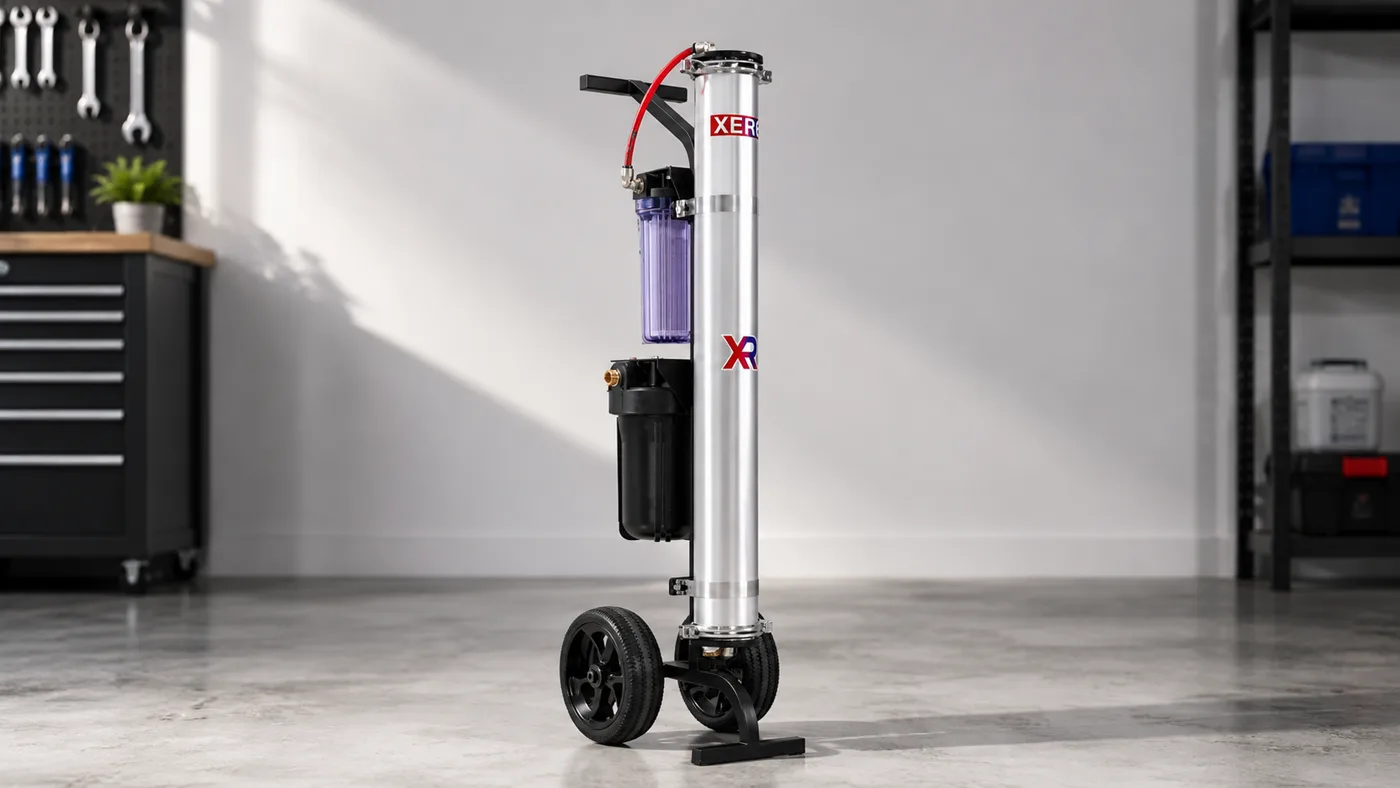
The purification system should be selected according to the incoming total dissolved solids, or TDS. Window Cleaning Resource's general selection guidance says that source water under roughly 100 TDS may make a DI-only setup economical. Higher-TDS water usually makes reverse osmosis followed by deionization more practical because RO removes much of the mineral load before the DI stage.
A XERO Pure three-stage RO/DI system was listed around $1,899, with another promotional listing around $1,614. A single-stage Unger HydroPower Ultra DI unit was listed at approximately $524, while a larger three-stage version was around $1,748.
Check output water with a TDS meter rather than judging resin life by time alone. XERO recommends replacing or refilling its DI media when output rises above 10 parts per million for the referenced system. Actual resin consumption depends heavily on source-water TDS and the amount of water used.
Traditional Tools vs Water-Fed Equipment
Neither system replaces the other completely. Traditional tools offer close control and low startup cost. Water-fed systems improve ground-based exterior productivity when the job mix supports them.
| Factor | Traditional tools | Water-fed pure-water system |
|---|---|---|
| Upfront cost | About $85 for a home kit or $400 to $550 for a strong solo-pro setup | About $524 for an entry DI unit to $2,400+ for an RO/DI package with a pole |
| Ongoing costs | Rubber, sleeves, cloths, blades and solution | Resin, prefilters, membranes, brushes and hose parts |
| Reach | Hand work and moderate pole work, with ladders where appropriate | Product-dependent, with some packages designed for work around 40 feet |
| Speed | Efficient on interiors, small panes and detailed work | Strong on repeat exterior panes and larger routes |
| Edge detailing | Direct and precise | Usually no manual detailing when glass and rinse conditions are suitable |
| Ladder dependence | May still require ladders for some exteriors | Can reduce ladder use for compatible exterior work |
| Learning curve | Technique-focused but inexpensive to practise | Requires brush technique, hose management and water-quality monitoring |
| Best for | Interiors, first-floor work, divided panes and low-frequency cleaning | Repeated exterior work, larger properties and dense routes |
Decision rule: Start with traditional tools unless exterior height or repeated route work is already limiting productivity. Add pure-water equipment when you have enough suitable work to keep the system in use and when its reduced setup time can repay the larger purchase.
Tools for Hard-to-Reach and High Windows
The safest tool is not simply the one with the longest advertised reach. It is the tool that allows controlled work within its design limitations.
For moderate height, an extension or telescopic pole may be enough. Check the pole's actual extended length, collapsed storage length and rigidity. A magnetic cleaner can clean both sides of some inaccessible panes, but the magnetic strength must match the glass thickness. Tyroler lists different Glider configurations for different thickness ranges, with examples priced around $75 to $87.
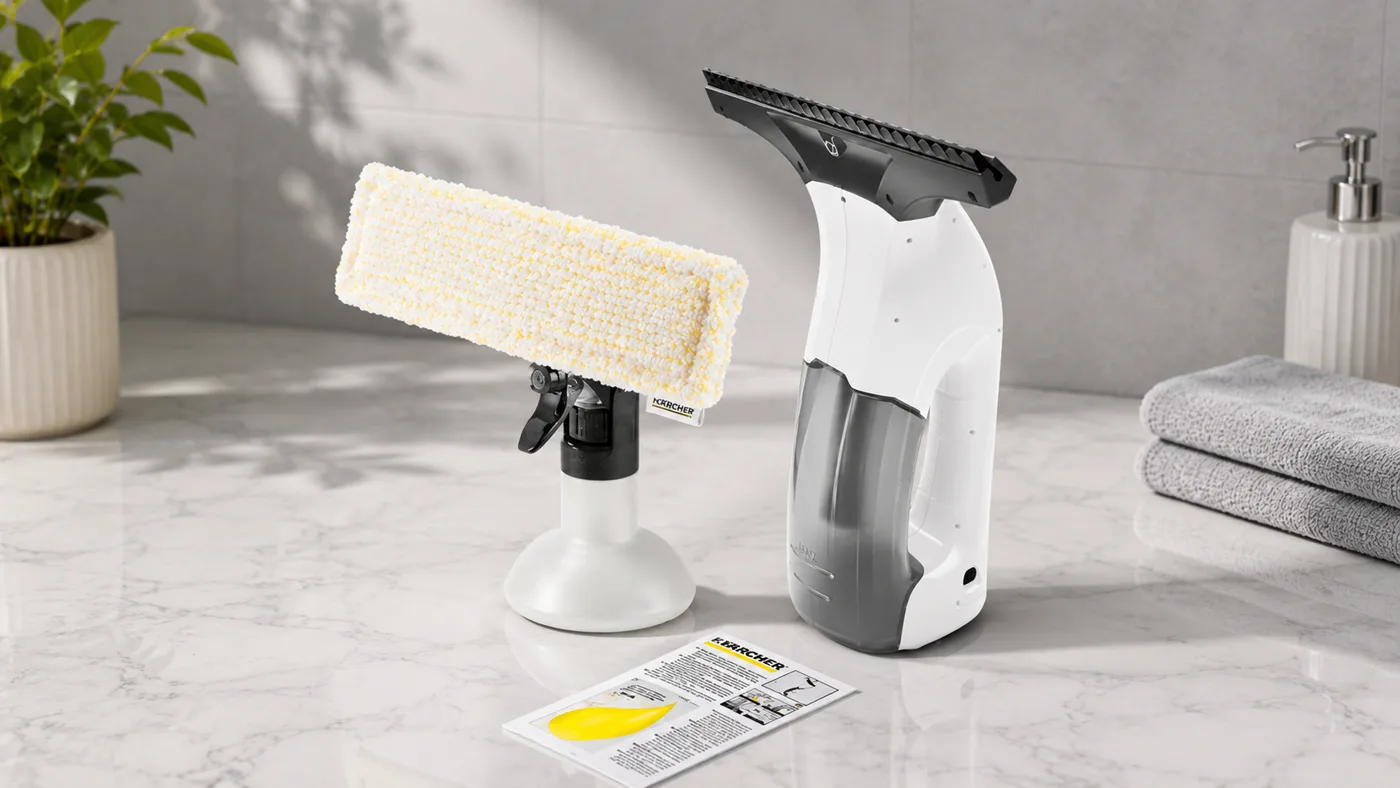
A window vacuum is useful for interior glass, mirrors and areas where drips are undesirable. The Kärcher WV 1 Plus is currently listed at $79.99 and uses a roughly 10-inch suction nozzle. It collects water but does not eliminate the need to loosen attached dirt first.
Ladders, suspended access and rope descent are not ordinary tool upgrades. They introduce separate inspection, training, rigging and rescue responsibilities.
Window-Cleaning Safety and OSHA Requirements
Safety equipment must match the access method and the hazards present. Gloves and eye protection may be appropriate for scraping, chemicals and construction debris. Ladders should be selected by duty rating and working height, then inspected before use.
OSHA standard 1910.23 requires employers to inspect ladders before their initial use during each work shift, remove defective ladders from service, ensure workers face the ladder while climbing and require at least one hand to grasp it. Portable ladders must also be used on stable, level surfaces unless secured or stabilized to prevent displacement.
Under OSHA 1910.28, general-industry employees exposed to an unprotected side or edge four feet or more above a lower level generally require an approved fall-protection system. The exact rule depends on the working surface and operation.
Rope descent systems have additional requirements under 1910.27. Among them:
- Each anchorage must be capable of supporting at least 5,000 pounds in any direction for each attached employee.
- The anchorage information must be based on annual inspection and certification at least every 10 years.
- Equipment must be inspected at the start of the work shift.
- Each employee must use a separate, independent personal fall-arrest system.
- Tools and buckets must be secured against falling.
- Employers must provide for prompt rescue.
- Hazardous weather can prohibit use.
The broader occupational category of janitors and cleaners is not identical to professional window cleaning, but its injury data reinforces why access and surface conditions matter. BLS recorded 4,720 same-level fall cases and 4,910 cases involving floors, walkways or ground surfaces in its 2016 to 2020 occupational snapshot. In 2023, 20.2 percent of janitors and cleaners were exposed to heights as part of their work.
Requirements vary by jurisdiction, building and access method. Employers should verify the applicable rules with their regulator, insurer and qualified safety professional rather than treating a tool guide as a work plan.
Tools for Tracks, Sills and Screens
Customers often notice dirty tracks, frames and screens even when the glass itself is clean. Start by vacuuming loose material from tracks. Use a narrow crevice attachment, groove brush or plastic putty knife to reach corners. Plastic is safer than an unprotected metal tool around painted frames and soft finishes.
Screens can usually be cleaned with a soft brush, microfiber washer or dedicated screen-cleaning system. Support removable screens while washing them to avoid bending the frame. Keep screen tools separate from glass tools because trapped sand and grit can transfer back to the pane.
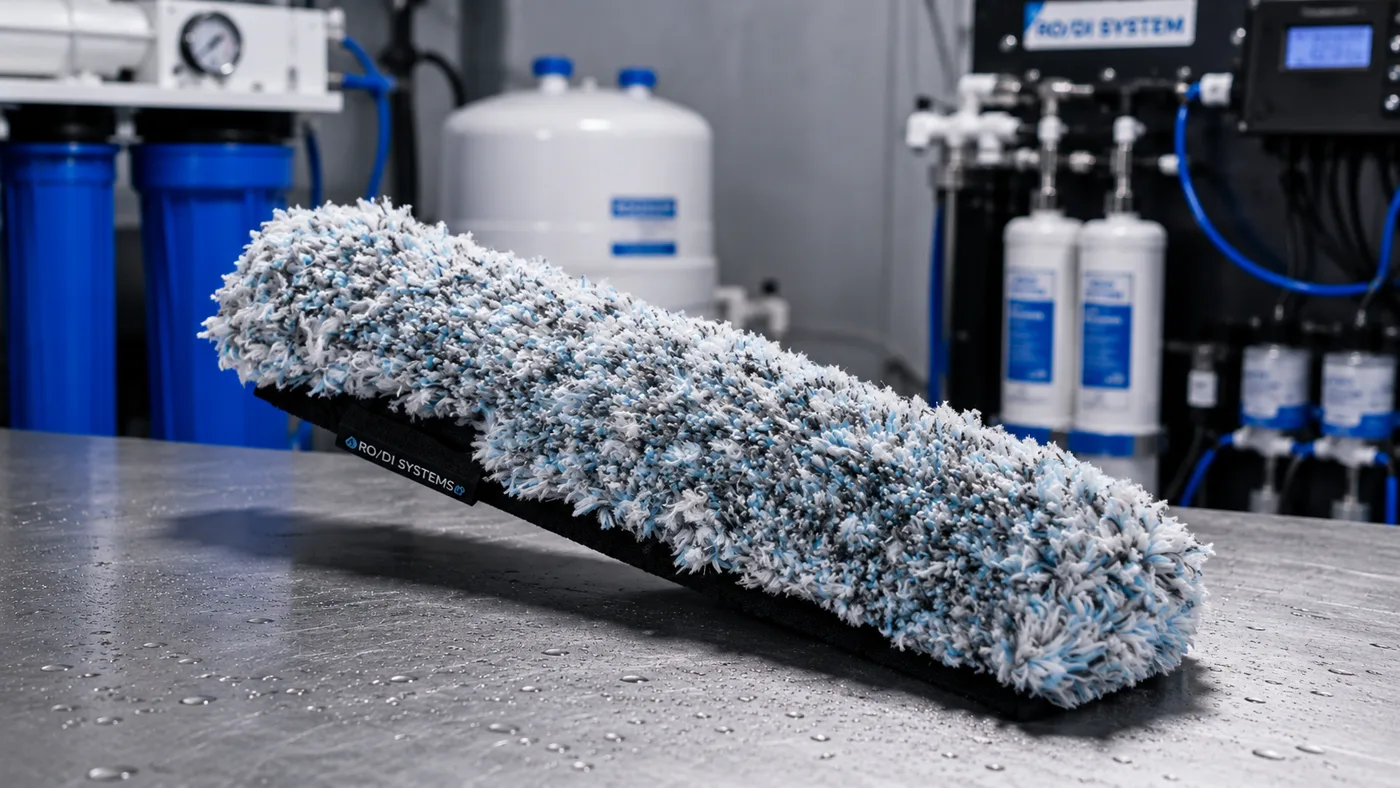
Avoid aggressive pads until you have checked the surface. Products designed for uncoated glass may not be appropriate for tint, self-cleaning glass, film, painted frames or other treated surfaces. For example, the Moerman FUGU sleeve is specifically identified as unsuitable for tinted windows.
How Much Does a Full Window Cleaning Kit Cost?
The following build-outs use current component listings and rounded calculations. They are examples, not mandatory shopping lists.
| Item | Homeowner kit | Solo-pro traditional kit | Crew or high-rise configuration |
|---|---|---|---|
| Core squeegee | $16.87 | $16.87 | Included in trad kit |
| Second professional squeegee | Not included | $46.53 | Included or purchased separately |
| Complete strip washer | $28.61 | $28.61 | Included in trad kit |
| Secondary T-bar | Not included | $14.45 | Included or purchased separately |
| Extension pole | Optional $42.07 | About $72.89 | Job-specific |
| Microfiber cloths | About $3.96 | About $25.16 | Included plus replacements |
| Scraper | $3.98 | $29.51 | Included plus specialist blades |
| Bucket or bucket set | $25.41 | $39.85 | Included |
| BOAB | Not included | $49.44 | Included or purchased separately |
| Holster | Not included | $28.00 | Included or purchased separately |
| Cleaning solution | $5.98 | $17.98 | Included plus stock |
| Spare squeegee rubber | Not included | $50.64 | Bulk stock |
| Replacement scraper blades | Not included | $13.99 | Bulk stock |
| Pure-water system | Not included | Not included | About $1,899 |
| Rope-access package | Not included | Not included | About $3,595 |
| Illustrative subtotal | $84.81 | $433.92 | About $6,058 |
The high-rise example combines a currently listed $3,595.13 rope-access package, a $1,899 RO/DI system and a $563.80 traditional kit. It excludes the vehicle, ladders, site-specific anchorage work, inspections, insurance, training and rescue planning.
Do not economize on squeegee rubber, safe access equipment or a pole's locking mechanism. Items that can usually wait include a second specialty handle, premium tool belt and water-fed system for a business that does not yet have enough suitable exterior work.
Consumables and Replacement Schedule
The annual estimates below assume a solo operator works approximately five days per week for 48 weeks. Actual use varies substantially by route, pane count, source water, debris and maintenance habits.
| Consumable | Replace when | Current replacement example | Estimated annual budget |
|---|---|---|---|
| Squeegee rubber | Nicked, rounded, dragging or leaving repeatable lines | $50.64 for a 12-pack | $200 to $350 |
| Scrubber sleeve | Fibres flatten, fastening weakens or contamination remains | $67.57 for four sleeves | $68 to $135 |
| Microfiber cloths | Linting, contaminated or no longer absorbent | $0.99 to $7.64 each | $50 to $150 |
| Scraper blades | Dull, rusted, damaged or contaminated | $13.99 to $22.58 per 100 | $14 to $45 |
| DI resin | Output TDS exceeds the system target | $99.58 per Unger bag | $100 to $1,200+ |
| Cleaning solution | Based on dilution and job volume | $17.98 per gallon for Dawn Professional | $50 to $220 |
| Pole clamps and small parts | Slipping, cracking or excessive play | Model-specific | Maintain a repair reserve |
There is no universal calendar for rubber replacement. Ettore notes that working cleaners may change or rotate rubber every few days, while household users replace it much less frequently. The practical trigger is performance: a persistent line, damaged corner or uneven glide.
Pre-Built Kits vs Buying Tools Individually
A pre-built kit is useful when you need compatible essentials quickly and do not yet have strong preferences about handles, channels and sleeves. Buying individually is better when you already know the widths, rubber compound and pole system that suit your work. Current starter-kit examples show how widely prices vary:
- Ettore Welcome Cleaning Set: about $205
- Residential Supreme Kit: about $225.94
- Jersey traditional kit: about $563.80
- LTWC Premium Starter Kit: about $800.10
Check whether the kit includes a pole, bucket, spare rubber and replacement sleeves. These are commonly required purchases even when the product page describes the package as complete.
Where Should You Buy Window Cleaning Tools?
The following table will help you find the right place to buy window-cleaning tools.
| Supplier type | Examples | Best for | Pricing consideration |
|---|---|---|---|
| Specialist window-cleaning supplier | Window Cleaning Resource, Detroit Sponge, abc Window Cleaning Supply | Broad brand choice, parts, kits and trade-specific support | Compare bundle, shipping and replacement-part availability |
| Manufacturer-direct | Ettore, Unger, Moerman, Sorbo, Pulex | Specifications and product-family compatibility | Selection may focus on one brand |
| Home-improvement retailer | Home Depot, Lowe's | Local pickup, basic tools, soap and buckets | Fewer specialist configurations |
| Large marketplace | Amazon | Availability and broad consumer selection | Verify seller, model and included components |
| Local janitorial supplier | Regional commercial dealers | Consumables and account purchasing | Tool selection varies by location |
Professional account programs can change the final price. Home Depot's Pro Xtra program includes features such as personalized or volume pricing, while Lowe's current Pro program provides rewards, business tools and access to bulk or customized quotes in eligible situations.
For specialist equipment, parts availability is more important than saving a few dollars on the first purchase. A pole, handle or pure-water unit is more valuable when replacement clamps, adapters, resin and seals remain easy to source.
How to Use Window-Cleaning Tools for Better Results
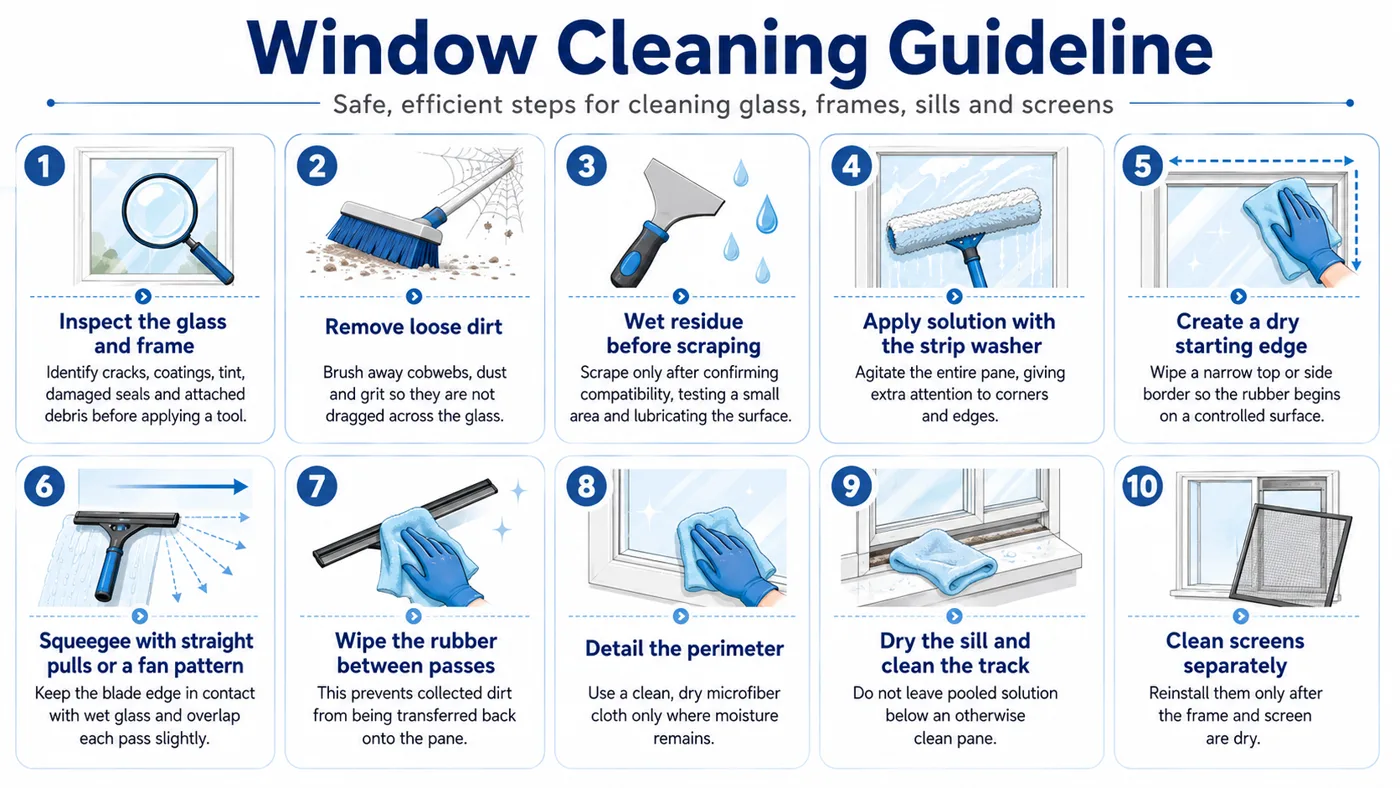
If you are a beginner and want to clean windows properly, here are the guidelines you can follow for the best possible results:
- Inspect the glass and frame. Identify cracks, coatings, tint, damaged seals and attached debris before applying a tool.
- Remove loose dirt. Brush away cobwebs, dust and grit so they are not dragged across the glass.
- Wet residue before scraping. Scrape only after confirming compatibility, testing a small area and lubricating the surface.
- Apply solution with the strip washer. Agitate the entire pane, giving extra attention to corners and edges.
- Create a dry starting edge. Wipe a narrow top or side border so the rubber begins on a controlled surface.
- Squeegee with straight pulls or a fan pattern. Keep the blade edge in contact with wet glass and overlap each pass slightly.
- Wipe the rubber between passes. This prevents collected dirt from being transferred back onto the pane.
- Detail the perimeter. Use a clean, dry microfiber cloth only where moisture remains.
- Dry the sill and clean the track. Do not leave a pool of cleaning solution below an otherwise clean pane.
- Clean screens separately. Reinstall them only after the frame and screen are dry.
Avoid cleaning very hot glass in direct sun when possible. The solution can dry before the squeegee reaches it, increasing drag and streaking.
Common Window Cleaning Mistakes
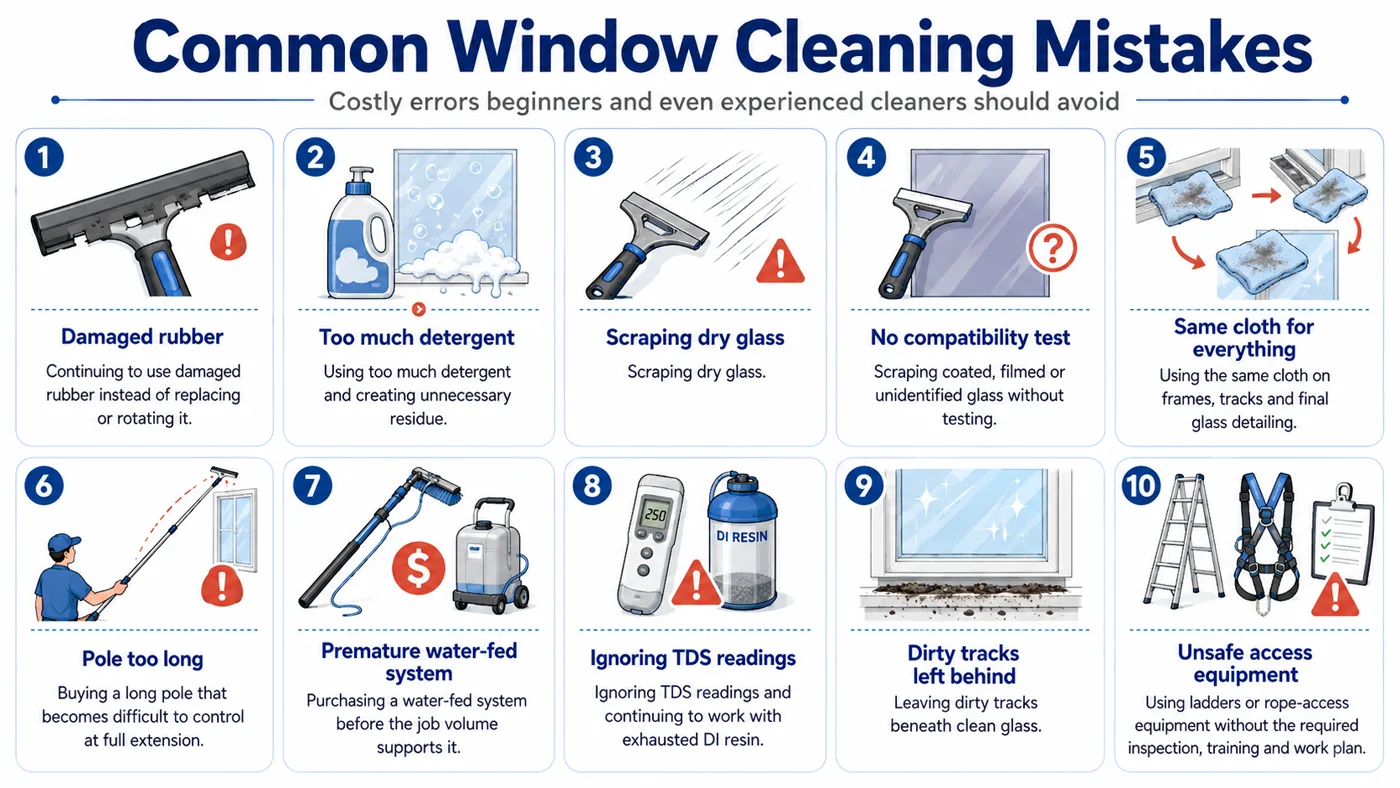
Common mistakes made by beginners and even experienced window cleaners include:
- Continuing to use damaged rubber instead of replacing or rotating it
- Using too much detergent and creating unnecessary residue
- Scraping dry glass
- Scraping coated, filmed or unidentified glass without testing
- Using the same cloth on frames, tracks and final glass detailing
- Buying a long pole that becomes difficult to control at full extension
- Purchasing a water-fed system before the job volume supports it
- Ignoring TDS readings and continuing to work with exhausted DI resin
- Leaving dirty tracks beneath clean glass
- Using ladders or rope-access equipment without the required inspection, training and work plan
Frequently Asked Questions
Q.1 What do professional window cleaners use?
Professional window cleaners commonly use squeegees, strip washers, T-bars, microfiber cloths, scrapers, rectangular buckets, BOABs and extension poles. Exterior crews may also use water-fed poles with DI or RO/DI purification. Access equipment depends on the building and must be selected through a separate safety assessment.
Q.2 What is the best tool for cleaning hard-to-reach windows?
A rigid extension pole is usually the first choice for moderately elevated windows. For repeated exterior work, a water-fed pole may provide more reach while keeping the operator on the ground. The correct choice depends on height, obstructions, glass condition and whether the pane requires close manual detailing.
Q.3 What is the best tool for cleaning outside windows you cannot reach?
For compatible exterior glass, a water-fed pole is often the most practical professional option. A magnetic cleaner may work on selected windows when its magnet rating matches the glass thickness. Inaccessible glass that requires ladder, lift or rope access should be handled by trained personnel following an appropriate access plan.
Q.4 Do professional window cleaners use Windex?
Some professionals use ready-to-use glass cleaner for interior touch-ups, mirrors and small areas. Traditional exterior work more commonly uses a diluted professional concentrate or a controlled amount of dish soap because it provides the volume and blade glide needed for washer-and-squeegee cleaning.
Q.5 What soap do window cleaners use?
Window cleaners use commercial concentrates such as Ettore Squeegee-Off or Unger Easy Glide, while many also use a small amount of professional dish soap. The right dilution depends on water, temperature and glass condition. Product and film-manufacturer instructions take priority on tinted or treated windows.
Q.6 How often should you replace squeegee rubber?
Replace squeegee rubber when it develops a nick, rounded edge, drag or repeatable streak. Full-time professionals may rotate rubber every few days or sooner on dirty routes. Home users may keep the same blade considerably longer because they clean fewer panes and expose it to less debris.
Q.7 Is a water-fed pole worth it?
A water-fed pole is worth considering when a business regularly cleans exterior glass above normal reach or serves enough nearby properties to keep the equipment productive. It may not be economical for occasional ground-floor work because the purification system, replacement media, hose management and pole add significant cost.
Q.8 Can you clean windows without a squeegee?
Yes, small interior windows can be cleaned with microfiber pads, spray cleaner or a window vacuum. A squeegee remains one of the fastest ways to remove a large volume of solution without leaving lint, particularly on larger panes and professional jobs.
Q.9 What tools do you need to start a window cleaning business?
Start with two squeegee widths, a complete strip washer, extension pole, bucket, BOAB, microfiber cloths, scraper, spare rubber, replacement blades, solution, eye protection and basic track and screen tools. Add ladders or water-fed equipment only after defining the jobs, training and safety procedures they require.
Q.10 How much does a window cleaning kit cost?
A basic homeowner kit costs roughly $85 to $130. The solo-pro traditional setup calculated in this guide costs about $435. Pre-built professional kits currently range from roughly $225 to $800, while pure-water and high-rise equipment can raise the total into several thousand dollars.
Build the Kit Around the Work
Buy the eight traditional essentials first and learn to produce consistent results with them. Add specialist tools only when a recurring job presents a clear need. A water-fed pole should solve an exterior productivity problem. A premium tool belt should reduce fatigue during long routes. High-rise equipment should exist inside a formal safety system, not merely inside a shopping cart.
The best window cleaning kit is not the one containing the most tools. It is the smallest kit that can complete the intended work efficiently, protect the glass and allow the operator to follow a controlled process.