If customers, tenants, employees, or visitors see your property before they ever speak to you, the landscape is already shaping their impression. Overgrown shrubs, patchy turf, poorly maintained entrances, and neglected planting beds can make even a well-run business look unprofessional and poorly maintained.
Commercial landscaping helps office parks, retail centers, hotels, medical facilities, industrial properties, and multifamily communities keep their outdoor spaces clean, safe, functional, and appropriate for the people using them. It is not simply about making a property look prettier. It is about creating an exterior that supports the business, protects the property’s presentation, and gives people confidence before they even walk through the door.
Key Takeaways
- Commercial landscaping goes far beyond mowing. It can include turf care, planting, trees, irrigation, hardscaping, lighting, and seasonal work across the entire property.
- Costs can vary significantly from one property to another, so a site-specific quote is far more useful than relying on a single national average.
- Good landscaping can support property value and rental appeal. One New York office study found higher transaction and rent premiums associated with greater street-level greenery, although there is no reliable rule that every property will gain 15% or 20%.
- The maintenance budget depends heavily on factors such as tree inventory, irrigation complexity, site access, service frequency, seasonal planting, and the level of presentation the property requires.
- The landscape should fit the property. A hotel, office park, medical facility, and industrial site all have different priorities, so they should not be designed or maintained the same way.
What Is Commercial Landscaping?
Commercial landscaping is about more than keeping grass cut and shrubs trimmed. It covers the design, installation, and ongoing care of the entire outdoor space around a commercial property, from lawns, trees, and planting beds to walkways, patios, retaining walls, edging, and seating areas. What makes commercial landscaping different is the scale and the level of coordination involved. A crew may be maintaining several acres, multiple buildings, or even several properties at once, often while working around employees, customers, deliveries, tenants, and business hours. The work may also require larger mowing equipment, complex irrigation systems, material-handling equipment, and specialized tree-care tools.
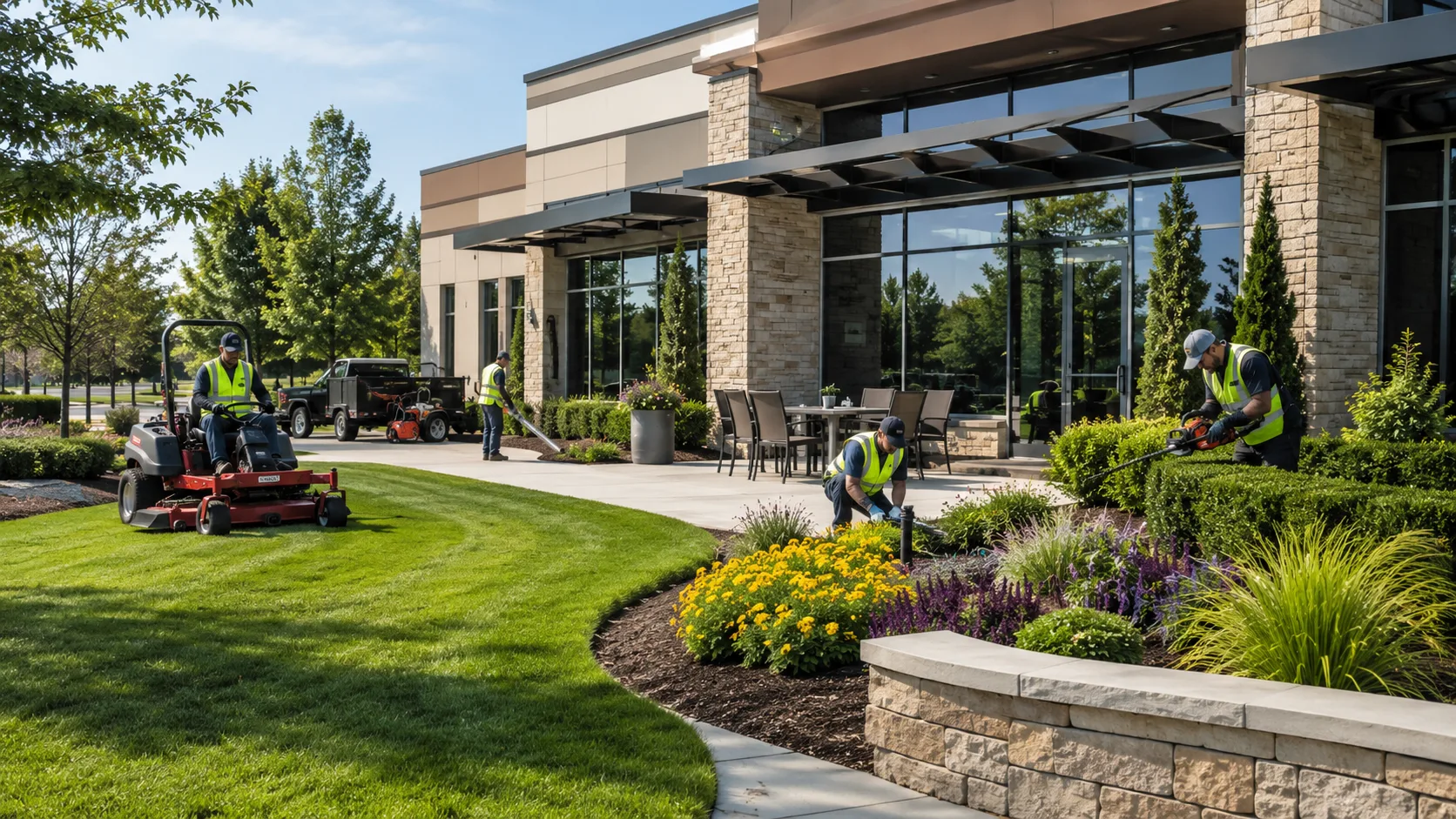
There is also more structure behind the service. Commercial landscaping is usually managed through a defined scope of work, scheduled visits, insurance requirements, and agreed maintenance standards. And unlike basic lawn care, which focuses mainly on turf, commercial landscaping looks after the property as a whole, including the areas that shape how customers, tenants, and visitors experience the business.
What Services Are Included in Commercial Landscaping?
Commercial landscaping can be as simple as routine grounds maintenance or as involved as a complete redesign and installation. What matters is not whether a contractor describes the service as “full service,” but what is actually included in the agreement. One contract may cover little more than mowing and edging, while another includes planting beds, pruning, irrigation checks, seasonal work, and ongoing property care. The label can sound the same, but the scope and price can be very different.
| Service | What it covers | Typical planning frequency | Usually in contract or billed extra |
|---|---|---|---|
| Landscape design | Site planning, planting layouts, materials and visual direction | During installation or renovation | Usually extra |
| Installation | Site preparation, turf, plants and landscape construction | One-time project | Extra |
| Mowing and turf care | Mowing, edging, trimming and general turf upkeep | Weekly or biweekly during growing season | Commonly included |
| Bed maintenance and mulching | Weeding, edging, bed cleanup and mulch | Routine plus seasonal | Bed care often included; mulch varies |
| Pruning and shrub care | Clearance, shaping and plant-health pruning | Seasonal or as needed | Often included within limits |
| Tree care | Inspections, pruning, treatment and removals | Annual or as needed | Usually extra |
| Irrigation installation and management | System design, scheduling, monitoring and adjustments | Monthly or seasonal checks | Monitoring may be included; installation and repairs usually extra |
| Fertilization and pest management | Turf and plant nutrients, weeds, insects and disease management | Several applications annually | Included or add-on |
| Seasonal color rotation | Annual flowers and seasonal display planting | Two to four rotations in some climates | Usually extra |
| Hardscaping | Paths, patios, walls, curbs and structural landscape elements | Project-based | Extra |
| Lighting | Landscape lighting installation, aiming and maintenance | Seasonal or quarterly checks | Usually extra |
| Leaf removal | Seasonal leaf and debris removal | Seasonal | Included with limits or extra |
| Snow and ice management | Plowing, shoveling and surface treatment | Weather-dependent | Usually separate |
| Storm cleanup | Fallen branches and storm debris | Event-based | Usually extra |
The right maintenance schedule depends on the climate, growing season, plant types, and the standard the property is expected to maintain. A commercial site in Houston, for example, may need weekly service during the March-to-October growing season, while a property in a cooler market may follow a very different schedule.
What Does Commercial Landscaping Cost?
There is no single commercial landscaping price that works for every property. Costs change significantly based on location, property size, service level, and the amount of work involved. A February 2026 HomeGuide cost study puts full-service commercial lawn care at roughly $800 to $1,600 per acre per month. Mowing alone is considerably cheaper, at around $50 to $150 per acre per visit for properties under five acres and $25 to $60 per acre for sites of five acres or more.
This full-service range works out to approximately 1.8 to 3.7 cents per maintained square foot each month. Regional pricing shows just how much these numbers can move. One Houston commercial landscaping guide lists full-service maintenance at around $800 to $1,600 per acre per month, with examples of $1,200 to $1,800 for office parks, $900 to $1,400 for retail centers, and $500 to $900 for industrial properties.
A 2026 Florida guide, however, reports much lower annual benchmarks of roughly $3,500 to $8,000 per acre for standard commercial maintenance. Higher-detail properties such as Class A offices and healthcare facilities are estimated at around $6,000 to $12,000 per acre annually.
That gap is exactly why commercial landscaping costs should be treated as planning benchmarks rather than fixed rates. The final price depends on the market, the property, and exactly what the contractor is being asked to maintain.
| Property type | Published maintenance reference | Typical one-time install | Key cost drivers |
|---|---|---|---|
| Small storefront or office | A Dallas contractor reports roughly $400 to $900/month for a small retail pad under one acre | Site-specific quote | Minimum account charge, frontage, beds and seasonal color |
| Office park | Houston: about $1,200 to $1,800/acre/month; Dallas: about $1,200 to $3,500/month for a 1 to 5 acre office park | Site-specific quote | Multiple entrances, turf-to-bed ratio, trees, irrigation and presentation standard |
| Retail center | Houston: about $900 to $1,400/acre/month | Site-specific quote | Parking islands, litter, visibility, customer traffic and seasonal displays |
| Medical facility | Florida high-detail commercial benchmarks reach roughly $6,000 to $12,000/acre/year for healthcare and similar properties | Site-specific quote | Accessibility, entrances, scheduling, tree clearance and irrigation |
| Industrial site | Houston: about $500 to $900/acre/month | Site-specific quote | Large acreage, fence lines, weed control, screening and drainage |
| Multifamily or HOA | Houston examples range from $500 to $1,000/month for small shared HOA areas to $5,000 to $20,000+ for large multifamily properties | Site-specific quote | Amenities, entrances, paths, irrigation and resident expectations |
| Hotel and hospitality | No credible nationwide hotel-specific maintenance benchmark located | Site-specific quote | Arrival experience, lighting, daily presentation, seasonal color and outdoor areas |
The Houston and Dallas figures are best treated as regional pricing examples, not national averages. They are still useful because they show what contractors are charging for different types of commercial properties, but the same numbers should not be applied across every US market.
Installation pricing is even harder to generalize. There is no strong national dataset that gives reliable one-time installation costs for every commercial property type. One Houston contractor, for example, publishes a broad $5,000 to $50,000+ range for commercial landscape design and installation, but that figure reflects local projects and can change quickly once grading, irrigation, hardscaping, drainage, lighting, and plant selection are added. For that reason, a site-specific quote is usually the more useful way to budget for commercial landscape installation.
What Drives Commercial Landscaping Costs Up?
Several factors can push a commercial landscaping budget higher, even when two properties are similar in size.
- Irrigation complexity: Properties with multiple zones, older systems, damaged controllers, leaks, or frequent repairs take more time to inspect and maintain.
- Tree inventory: Mature trees often need more than a standard landscaping crew. Pruning, removals, or health assessments may require arborists, lifts, and specialist equipment.
- Seasonal color: Changing annual displays several times a year adds plant material, bed preparation, and labor.
- Site access: Tight gates, courtyards, slopes, busy customer areas, and restricted service hours can slow crews down and increase labor time.
- Service frequency: A property that needs weekly attention will usually cost more than one serviced every two weeks.
- Property standard: A hotel entrance or Class A office property is often maintained to a much higher visual standard than a low-traffic industrial perimeter.
- Regional climate: Longer growing seasons can mean more mowing, pruning, and cleanup visits. In colder regions, part of that budget may shift toward leaf removal, snow, and ice management.
The ROI of Commercial Landscaping
Commercial landscaping can create value in several ways, but not every ROI claim is backed by the same level of evidence. You will often see claims that landscaping automatically increases commercial property value by 15% or 20%. That is too broad to treat as a reliable rule. The actual impact depends on the property, location, market, design quality, and how well the landscape is maintained.
A better way to look at ROI is to separate the benefits that are supported by stronger research, such as property value, rental appeal, customer perception, and water efficiency, from benefits that are harder to measure directly, such as tenant retention or reduced reactive maintenance costs.
| Claimed benefit | What the research supports | Evidence quality |
|---|---|---|
| Property value uplift | New York offices associated with greater visible greenery had 8.9% to 10.5% transaction premiums | Moderate, observational and location-specific |
| Rental-rate premium | The same study found 5.6% to 7.8% rent premiums | Moderate, observational and location-specific |
| Tenant retention and lease renewal | Outdoor quality may influence experience, but evidence does not isolate a reliable landscaping-specific retention percentage | Weak |
| Customer perception | Retail surveys show stronger perceptions and intended patronage in landscaped environments | Moderate |
| Willingness to pay | One strip-mall survey found 8.8% higher stated willingness to pay | Moderate survey evidence, not transaction data |
| Employee wellbeing | Workplace nature interventions show promising mental-health and cognitive outcomes | Promising but limited |
| Energy savings | Trees can reduce cooling demand but effects depend on climate, location and building design | Site-specific |
| Reduced reactive maintenance | Early inspections can identify irrigation and landscape problems sooner | Operationally plausible, weak quantified evidence |
| Irrigation efficiency | EPA says microirrigation can use 20% to 50% less water than conventional sprinklers | Strong technology-specific evidence |
Property Value and Rental Premiums
Apeer-reviewed study of New York commercial office propertiesmeasured street-level greenery using a Green View Index derived from Google Street View imagery. The researchers found that offices with more visible greenery were associated with 8.9% to 10.5% higher transaction prices and 5.6% to 7.8% higher rents than properties with very little greenery. The study also accounted for factors such as nearby parks, subway access, sidewalk width, and other characteristics that can influence office values.
That does not mean adding landscaping will automatically increase a property’s value by 10%. The study shows a clear association between visible greenery and stronger commercial property values, but it does not prove that landscaping alone caused the increase.
Tenant Retention and Lease Renewal
Landscaping can also influence how tenants experience a property, especially when outdoor areas provide shade, seating, walkways, or shared spaces they can actually use. The evidence is much less clear when it comes to tenant retention. There is currently no strong independent research showing that better landscaping will increase lease renewals by a specific percentage or keep tenants for a certain number of additional years.
That is because tenants consider far more than the landscape when deciding whether to stay. Rent, location, building quality, amenities, management, and lease terms all play a much larger role in the decision.
Customer Perception and Foot Traffic
The evidence becomes stronger when we look at how customers perceive a property, although it is still harder to prove that landscaping directly increases sales or foot traffic.
AUS Forest Service study of strip mallssurveyed residents in three Pacific Northwest cities and found that participants preferred landscaped roadside environments. Respondents also reported willingness to pay 8.8% more for goods and services in well-landscaped malls.
That 8.8% number measures stated willingness to pay in a survey. It is not evidence that installing landscaping will raise actual retail sales by 8.8%.
Employee Productivity and Wellbeing
Access to nature at work may support mental health and cognitive performance, but the research is still developing. Asystematic review of workplace nature-based interventionsfound generally positive results for mental-health measures and cognitive ability. Results for recovery, restoration, work satisfaction and physiological outcomes were mixed.
Only 10 interventions qualified for the review, and the researchers reported substantial heterogeneity and high risk of bias across the studies. The useful conclusion is that outdoor greenery may improve workplace experience and wellbeing. It is not evidence for a guaranteed productivity percentage.
Energy Savings From Strategic Shade
Trees can influence building energy demand through shade, evapotranspiration and changes to wind and surrounding temperature. AUS Forest Service Sacramento County case studymodeled these effects across residential and commercial buildings. The study found substantial regional cooling effects from the existing urban forest, but the result depended on local tree cover, building characteristics and climate. More recent US Forest Service reviews also find that urban-tree cooling effectiveness varies with tree traits, configuration and climate. This is why strategic placement matters more than simply adding trees.
Reduced Reactive Maintenance
Good landscaping maintenance is not only about keeping the property looking presentable. It can also help catch small problems before they turn into expensive repairs. TheUS Access Board’s ADA guidancegenerally requires accessible walking surfaces to maintain at least 36 inches of clear width, with only limited exceptions. Circulation areas may also need to maintain 80 inches of vertical clearance so people can move through the space safely.
It means branches, planters and overgrown shrubs are not just appearance issues. If they reduce the usable width of a path or hang too low over a circulation area, they can interfere with accessibility as well.
Commercial Landscape Design Ideas That Work for Business Properties
Good commercial landscape design starts with how the property is actually used, not with choosing plants first. The goal is to create an outdoor space that looks intentional, supports movement, fits the business and stays manageable over time.
Create a Clear Entrance Focal Point
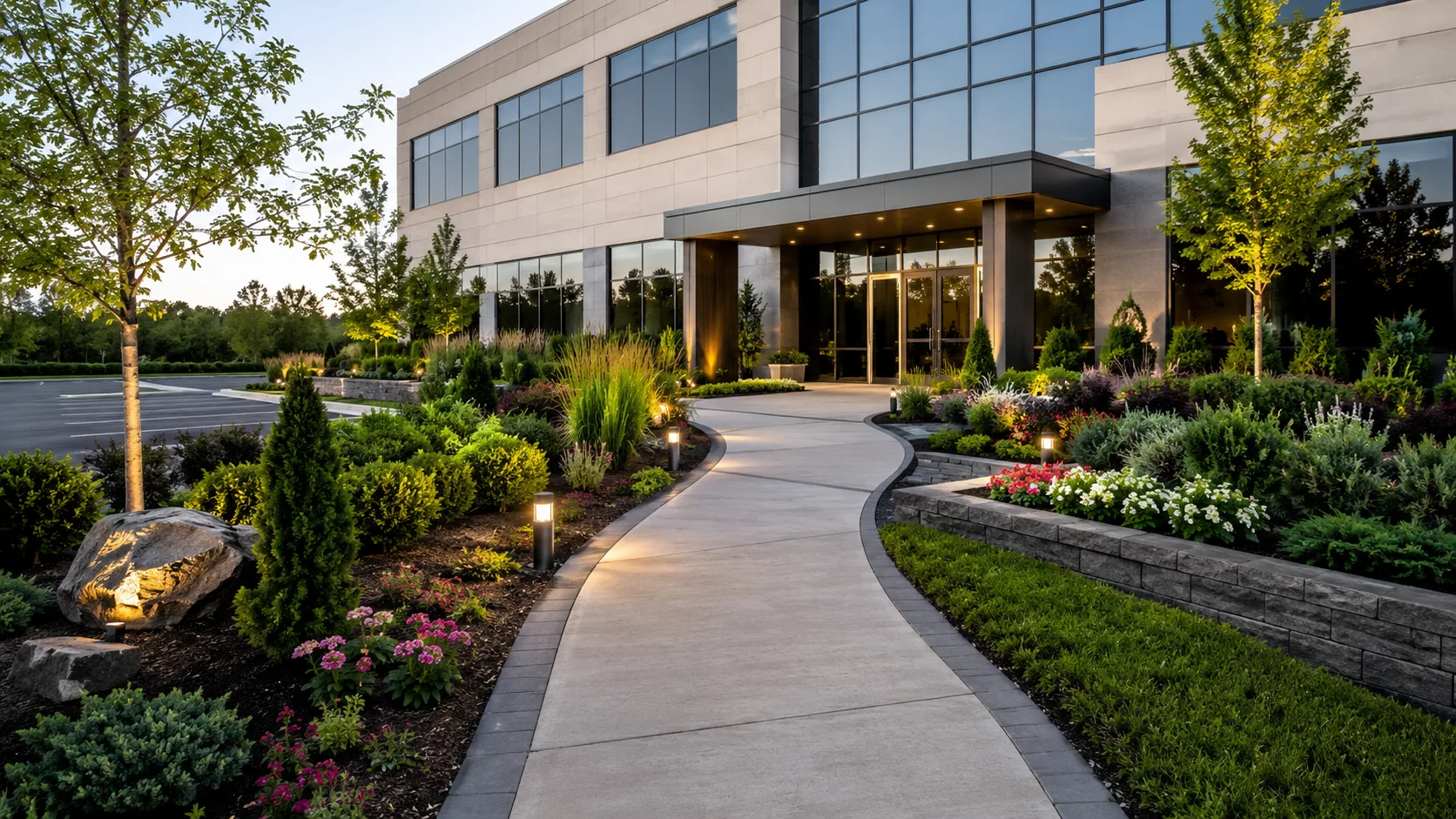
The main entrance is usually the best place to invest in visual impact. Trees, planting, lighting and hardscape can be used together to make the arrival area feel more polished and easier to identify. In most cases, concentrating detail around a few highly visible areas creates more impact than spreading the same budget thinly across the entire property.
Design Around Traffic Flow
Landscaping should work with the way people naturally move through the site. Direct paths make sense between parking areas, entrances and frequently used spaces where people want to get from one point to another quickly. Curved paths are better suited to courtyards, gardens and hospitality spaces where a slower experience is part of the design. A path may look attractive on a plan, but if people constantly cut across the grass to avoid it, the design is working against the property.
Build Year-Round Structure
A commercial landscape should still look organized when seasonal flowers disappear or deciduous plants lose their leaves. Evergreen planting, trees, edging, walls and hardscape provide structure throughout the year. They also reduce the need to rely entirely on seasonal planting to make the property look finished.
Use Native and Climate-Appropriate Plants
Choose plants that are suited to the local climate instead of forcing high-maintenance species into conditions where they struggle. Native and climate-appropriate plants can reduce unnecessary irrigation, replacement and treatment needs once they are established. They are not maintenance-free, but they usually make it easier to build a landscape that stays healthy without constant intervention.
EPA WaterSense landscaping guidancerecommends choosing plants that are suited to the local climate and do not demand more water than the site can reasonably provide. It does not mean every commercial property needs to become an entirely native landscape. The goal is simply to avoid filling the property with plants that need constant watering, treatment, or replacement just to stay healthy.
Use Lighting Deliberately
Landscape lighting should have a clear purpose. Use it where it improves entrances, walkways, signs, patios, and other outdoor areas people actually use after dark. The right lighting can make a property feel safer and more welcoming, but adding fixtures everywhere can create glare, increase maintenance, and add another system the property team has to manage.
Concentrate Seasonal Color
Seasonal flowers usually have the most impact around entrances, signs, patios, and other customer-facing areas. There is rarely a good reason to rotate annual flowers across an entire commercial campus. Concentrating seasonal color in a few highly visible areas can create the same visual impact with less labor, water, and replacement cost.
Match the Design to the Business
The landscape should feel like it belongs to the business. A high-end restaurant may benefit from detailed planting, warm lighting, and carefully designed outdoor areas. A medical facility may place more emphasis on shade, calm planting, and easy-to-follow paths. An industrial property may need little more than clean sightlines, controlled vegetation, and a well-kept entrance. The best commercial landscape is not necessarily the most elaborate one. It is the one that feels appropriate for the property and the people using it.
Industrial Properties
Industrial landscaping works best when it stays practical. The main priorities are usually clear sightlines, reliable drainage, controlled vegetation, accessible fence lines and a professional-looking entrance. Large operational areas do not need the same level of detail as customer-facing spaces.
More polished planting can be concentrated around office entrances, employee areas and road frontage, while the rest of the property uses durable, lower-maintenance landscaping that is easier to manage.
Multifamily and HOA Properties
Multifamily and HOA landscapes have to handle constant everyday use. Entrances, lawns, paths, pools, pet areas and shared spaces all create different maintenance needs. Some areas may need frequent attention, while others can be kept much simpler.
The contract should also be clear about who is responsible for plant replacements, irrigation repairs, resident damage and improvement requests. These details can become expensive points of disagreement if they are left vague.
Sustainability and Water Use
Sustainable commercial landscaping is not about making a property look sparse or neglected. It is about reducing unnecessary water, chemicals, replacement, and maintenance while still keeping the grounds healthy and presentable.
Xeriscaping and Climate-Appropriate Planting
Xeriscaping designs the landscape around the amount of water naturally available in the local climate rather than trying to support thirsty plants everywhere. That may mean reducing unnecessary turf, grouping plants with similar water needs, and choosing species that are better suited to local conditions. Done properly, the result can reduce irrigation demand and lower the amount of plant material that needs to be replaced because it struggles in the climate.
Native Planting
Native plants are already adapted to the environmental conditions of the region where they naturally occur. It does not make them maintenance-free. They still need appropriate placement, establishment, pruning, and care. But well-chosen native and adapted plants can reduce the amount of irrigation, treatment, and intervention required to keep a commercial property healthy.
Smart Irrigation
Traditional irrigation timers run according to a schedule whether the landscape needs water or not. Weather-based and soil-moisture-based controllers can adjust watering according to actual conditions. That can prevent unnecessary irrigation after rainfall, during cooler weather, or when the soil already contains enough moisture. For large commercial properties with several irrigation zones, those adjustments can become especially valuable.
Microirrigation
EPA WaterSensestates that microirrigation systems can use 20% to 50% less water than conventional sprinkler systems. Instead of spraying large areas, microirrigation delivers water slowly near plant root zones. That makes it particularly useful for planting beds, shrubs, trees, and other areas where broad overhead watering is unnecessary. For commercial properties trying to reduce irrigation use, this is one of the better-supported efficiency measures available.
Rainwater Capture
Roof runoff does not always need to disappear immediately into the stormwater system. Rain barrels, cisterns, and larger capture systems can store rainfall for later permitted uses such as landscape irrigation. The value of these systems depends on rainfall, roof area, storage capacity, and local regulations. Property owners should check local plumbing, water-quality, and reuse rules before relying on captured rainwater.
Reduced Chemical Inputs
A healthy commercial landscape should not require constant fertilizer, herbicide, and pesticide applications simply to stay presentable. Better plant selection, healthier soil, proper irrigation, and targeted pest management can reduce unnecessary treatments.
The goal is not to eliminate every chemical input. It is to use them where they are actually needed instead of treating the entire property by default. Businesses that track sustainability performance can also monitor water consumption, irrigation efficiency, stormwater management, and chemical use over time.
How Commercial Landscaping Maintenance Contracts Work
A commercial landscaping contract should make three things clear: what the contractor will maintain, how often the work will be done, and what will cost extra. This sounds simple, but vague contracts are one of the main reasons two landscaping quotes can look similar on paper while covering completely different levels of service.
A good agreement separates turf care, planting beds, trees, irrigation, seasonal work, and larger improvement projects so there is less room for confusion later. Before anything further, please check the following in the contract:
- Exact service areas and measured acreage
- Mowing and edging frequency
- Bed-maintenance schedule
- Pruning frequency
- Seasonal service calendar
- Materials included in the price
- Mulch quantities
- Irrigation inspections versus repair costs
- Responsibility for replacing plants
- Limits on tree work
- Snow and storm exclusions
- Response times
- Visit reports or photographs
- A named account manager
- Insurance requirements
- Subcontracting policies
- Annual price increases
- Renewal and termination terms
Be careful with phrases such as full service. If a contractor uses the term, ask exactly what it includes. One company’s full-service package may cover irrigation checks and mulch, while another may charge separately for both.
How to Choose a Commercial Landscaping Company
The cheapest commercial landscaping company is not always the least expensive choice over the life of the contract. A contractor also needs enough people, equipment, insurance, and management capacity to maintain the property consistently. Experience with similar commercial properties matters because maintaining a hotel, office park, or industrial site can require very different crews and workflows. Before signing a contract, ask:
- Do you currently maintain properties of this type and size?
- Which services are handled by your own crews?
- What work do you subcontract?
- What licenses or certifications are required locally?
- Can you provide current liability and workers’ compensation certificates?
- What are your coverage limits?
- How large will the crew assigned to this property be?
- Do you own the equipment required for the work?
- Who will manage our account?
- How are completed visits documented?
- Can you provide references from similar properties?
- How do you handle safety incidents and property damage?
Every contractor should also inspect the property before quoting the work. Ask each company to price the same written scope so you are comparing equivalent services rather than three completely different proposals. A 2026 Houston commercial landscaping guide makes similar recommendations, including defining the scope before bidding, checking insurance and licensing, comparing equivalent proposals, and confirming whether services such as irrigation repair are included. Because this guidance comes from a contractor, it is best treated as practical industry advice rather than an independent standard.
Is Commercial Landscaping Tax Deductible?
Routine commercial landscaping maintenance may qualify as a current business expense, while larger improvements may need to be capitalized. The distinction is not as simple as saying maintenance is deductible and new landscaping is depreciated.
IRS Publication 946explains that land itself generally cannot be depreciated. Costs connected with clearing, grading, planting, and landscaping may become part of the property’s land basis. Certain land-preparation costs can receive different treatment when they are closely connected to depreciable property and have a determinable useful life.
In other words, landscaping that has been capitalized is not automatically depreciable. Routine work such as mowing and pruning may be treated differently from projects such as:
- New landscape installation
- Major grading
- Drainage improvements
- New irrigation infrastructure
- Retaining walls
- Hardscape construction
The correct treatment depends on the work performed, the property, and the entity paying for it. This section provides general information rather than tax advice. A qualified tax professional should review the project scope and invoices before any tax treatment is determined.
Common Commercial Landscaping Mistakes
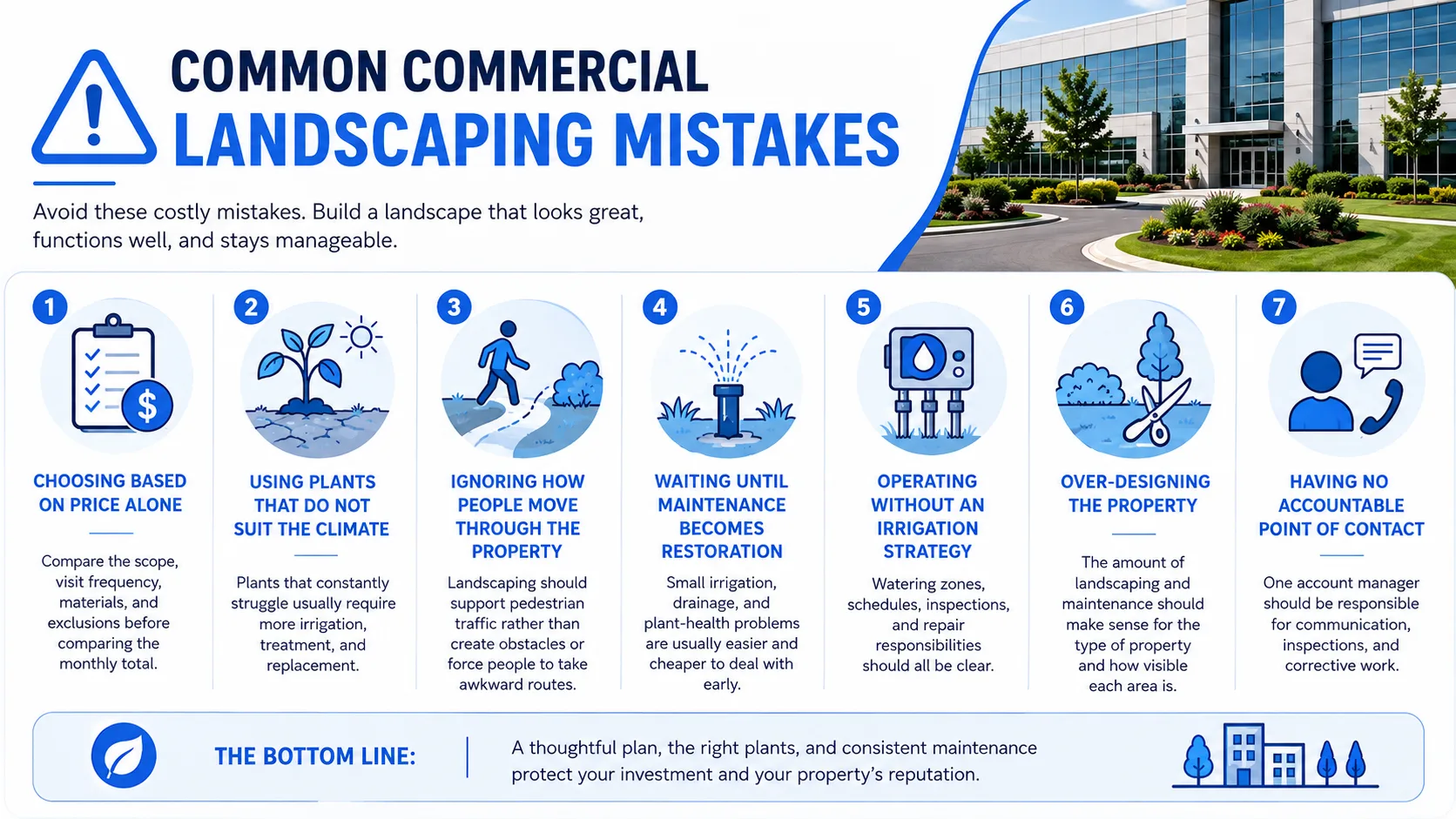
Here are a few commercial landscaping mistakes that many beginners do such as:
- Choosing based on price alone: Compare the scope, visit frequency, materials, and exclusions before comparing the monthly total.
- Using plants that do not suit the climate: Plants that constantly struggle usually require more irrigation, treatment, and replacement.
- Ignoring how people move through the property: Landscaping should support pedestrian traffic rather than create obstacles or force people to take awkward routes.
- Waiting until maintenance becomes restoration: Small irrigation, drainage, and plant-health problems are usually easier and cheaper to deal with early.
- Operating without an irrigation strategy: Watering zones, schedules, inspections, and repair responsibilities should all be clear.
- Over-designing the property: The amount of landscaping and maintenance should make sense for the type of property and how visible each area is.
- Having no accountable point of contact: One account manager should be responsible for communication, inspections, and corrective work.
Frequently Asked Questions (FAQs)
Q.1 What Is Commercial Landscaping?
Commercial landscaping is the design, installation, and ongoing maintenance of outdoor spaces around businesses and income-producing properties. It can include turf, trees, shrubs, planting beds, irrigation, hardscape, lighting, seasonal planting, storm cleanup, and snow management.
Q.2 How Much Does Commercial Landscaping Cost per Month?
There is no single national monthly rate for commercial landscaping. Pricing changes considerably according to location, property size, service frequency, and the amount of work included. Published 2026 benchmarks place full-service commercial lawn care at roughly $800 to $1,600 per acre per month, while regional commercial landscaping providers in markets such as Houston and Florida publish different ranges. These figures are best used for early budgeting before getting a site-specific quote.
Q.3 What’s the Difference Between Commercial Landscaping and Lawn Care?
Lawn care focuses mainly on turf, including mowing, edging, fertilization, weed control, and other grass-related services. Commercial landscaping covers the wider property. It may include trees, shrubs, planting beds, irrigation, hardscape, lighting, seasonal work, drainage considerations, and larger landscape improvements in addition to lawn maintenance.
Q.4 How Often Should a Commercial Property Be Landscaped?
Many commercial properties receive weekly or biweekly service during the active growing season, but there is no schedule that works everywhere. Climate, growth rate, plant material, property type, and the level of presentation expected from the site all influence how frequently maintenance is needed. Seasonal services such as pruning, mulching, fertilization, irrigation adjustments, leaf removal, and snow management follow their own schedules.
Q.5 Does Landscaping Increase Commercial Property Value?
Commercial greenery has been associated with stronger property values, but there is no reliable rule that landscaping will increase every property’s value by a fixed percentage. A New York office study found greater street-level greenery associated with 8.9% to 10.5% transaction premiums and 5.6% to 7.8% rent premiums. The study was observational and specific to that market, so the figures should not be treated as guaranteed returns from installing landscaping.
Q.6 Who Is Responsible for Landscaping in a Commercial Lease?
The lease determines who is responsible for landscaping costs and maintenance. Under some net leases, tenants may pay part or all of the property’s operating and common-area maintenance expenses in addition to base rent. Under a gross lease, the landlord generally covers those operating costs within the rent structure.Cornell Legal Information Instituteexplains the general distinction between these lease structures, but the actual lease agreement should always be checked.
Q.7 Is Commercial Landscaping Tax Deductible?
Routine landscaping maintenance may qualify as a current business expense, while larger installations and improvements may need to be capitalized. Capitalized landscaping is not automatically depreciable because some costs may become part of the non-depreciable land basis. The correct treatment depends on the work, property, and entity involved, so a qualified tax professional should review the specific project.
Q.8 What Should Be in a Commercial Landscaping Contract?
A commercial landscaping contract should clearly define the service areas, visit frequency, seasonal schedule, included materials, irrigation responsibilities, plant replacement, reporting requirements, response times, exclusions, insurance, subcontracting, pricing, renewal terms, and termination conditions. The more specific the scope is, the easier it becomes to compare contractors and hold the selected company accountable.
Build the Landscape Around the Property
The best commercial landscape is not the one with the most plants or the biggest maintenance budget. It is the one that fits the way the property is actually used. Start with the areas customers, employees, tenants, and visitors see and use most. Keep entrances, accessible routes, and sightlines clear. Choose plants that fit the climate. Spend more where presentation matters and keep secondary areas simpler where possible. After that, ask qualified contractors to price the same written scope. That gives you a landscaping plan built around the property instead of forcing the property into a generic maintenance package.
Do You Run a Landscaping or Lawn Care Business?
Maintaining commercial properties is one part of running a landscaping or lawn care company. Consistently bringing in the right local customers is another. RankBeaver has practical guides onbuilding service area pages that rank, deciding when to useLocal SEO vs Google Ads for pest and lawn companies, and understandinghow long Local SEO takes for pest control and lawn care businesses. You can also exploreRankBeaverto learn more about building stronger local visibility and generating leads for a lawn care business.